
Neo-Nazi leader Robert Rundo to leave jail after sentencing for 2017 political rally riots
Rundo said in a four-page handwritten letter to U.S. District Judge Josephine Staton that he was wrong to blame left-wing activists to justify 'my own vulgar actions.'


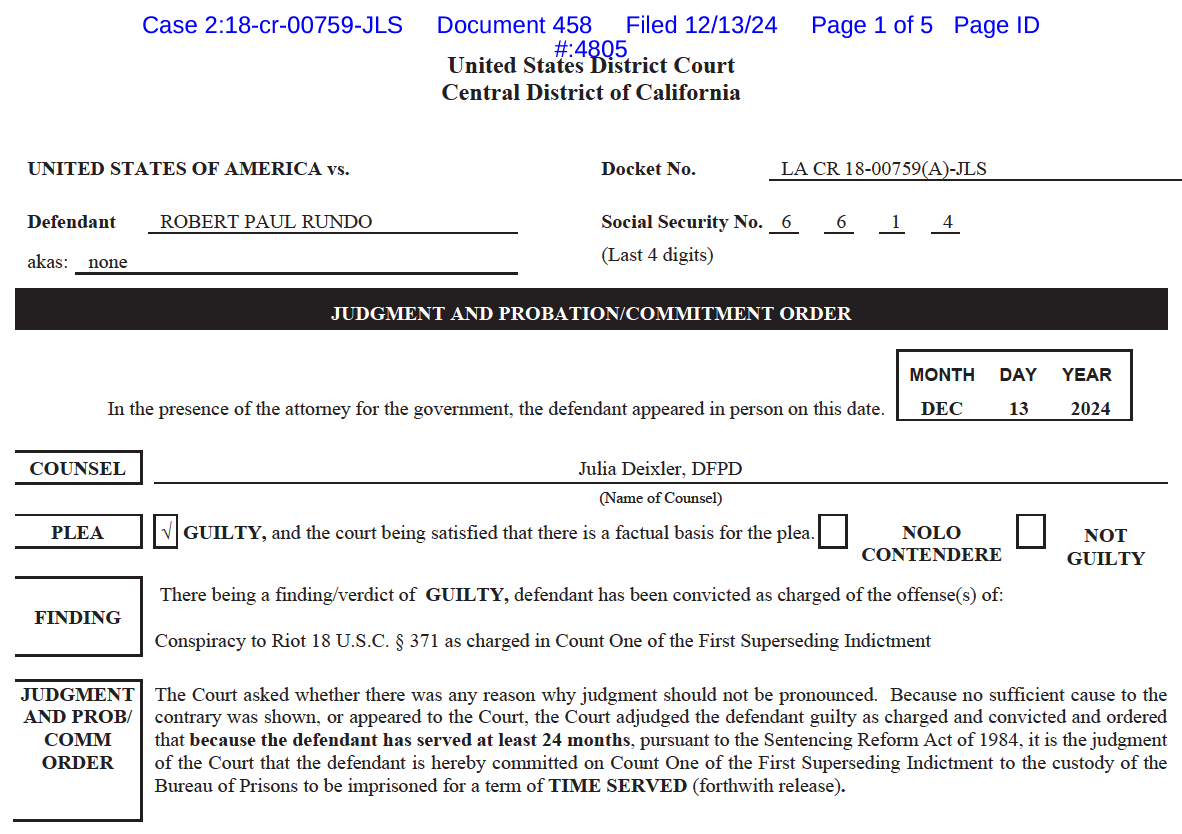
A neo-Nazi leader who assaulted people at political rallies in 2017 is expected to leave federal custody today after a judge sentenced him to two years in prison with credit for time served.
Robert Paul Rundo, 34, will be on probation for two years, and his probation officer must have the passwords to all his email and social media accounts to monitor his Internet activity. He also can’t contact members of the Rise Above Movement, the violent white supremacist group he co-founded.
The sentence from U.S. District Judge Josephine L. Staton matches the recommendation from federal prosecutors, who said Rundo’s poor relationship with his parents and “the gang culture to which he was exposed at an early age” mitigate his crimes. He could have been sentenced to 30 months under U.S. Sentencing Commission Guidelines agreed upon by prosecutors and his attorneys; the maximum sentence under federal law was five years.
In a press release, Akil Davis, assistant director of the FBI's Los Angeles office, said Rundo “has now been held accountable for his criminal activity which was motivated by his extremist dogma.”
“Mr. Rundo’s movement did not ‘rise above’ whatever differences Americans may have, but was divisive, harmful to others and ultimately led him to prison,” Davis said.
Rundo told Judge Staton in court on Friday that he got “swept up” in the 2016 presidential election and “found community in the alt-right scene I had not found before.” He was in jail in Europe when “it became clear to me that I had engaged in the same behavior that I said I actually wanted to go against.”
“Engaging in those fist fights, I could have seriously hurt someone, hurt myself. It was very regrettable,” Rundo said.
Rundo also said he believes “my alleged political views played a large part in this case, so I’d just like to say that my views are more nuanced.”
“The views I held at 26 have now changed over time, because I’m now 34 and I keep an open mind towards the future. And despite all the challenges I have faced and will continue to face, I will stay the course of non violence,” Rundo said.
Rundo said in a four-page handwritten letter that he was wrong to blame left-wing activists to justify “my own vulgar actions.”
Rundo wrote that he’s “opening up to new cultures” in federal custody, including by “learning Spanish from classes by Hispanic inmates.” He said he realized “I was the villain in a movie.”
“I came to terms with it and over the last few years have aimed to correct it,” Rundo wrote.


Judge Staton said Rundo was not in court because of his political views, but he’s attributed his crimes to his political views so she “does have to consider whether his present claim that he in some respects rejects those views is genuine.”
“I do hope he’s sincere about that. And I think he should be given the benefit of the doubt, given that there hasn’t been violence in the past seven years,” Staton said.
Staton also said the case against Rundo “was neither unfair nor unusual in any untoward sense.”
“That was the view of the 9th Circuit, and that is my view,” Staton said. “To the extent that the path that this case traversed was unusual, it doesn’t arise from any inappropriate conduct by either side, the prosecution or the defense.”
Staton was referring to the U.S. 9th Circuit Court of Appeal’s ruling that overturned U.S. District Judge Cormac J. Carney’s dismissal of Rundo’s charges.
Rundo was briefly free in February after Carney granted a dismissal motion from his public defenders that argued Rundo was being selectively prosecuted by the U.S. Department of Justice because left-wing activists engaged in violence at political rallies and haven’t been prosecuted.
The 9th Circuit ordered Rundo back into custody, then in July reinstated his criminal indictment and said Carney “compared apples to oranges” when he compared Antifa and far-left groups to Rundo and his co-defendants. By then, Carney had moved to senior inactive status and was no longer hearing cases, and Rundo’s case was assigned to Staton.
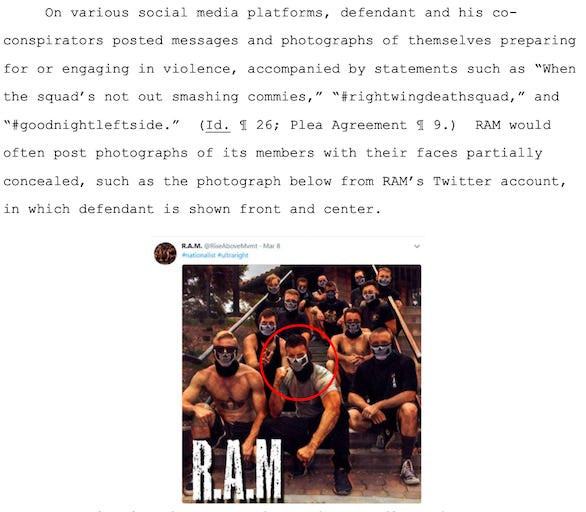
In a plea agreement reached in September, Rundo admitted to conspiring with members of his violent white supremacist group, the Rise Above Movement, to attend rallies “with the intent to provoke and engage in violent physical conflicts.” He and others shared photos on social media of training sessions “accompanied by statements such as ‘When the squad[‘]s not out smashing commies,’ ‘#rightwingdeathsquad,’ and ‘#goodnightleftside,’” according to the agreement.
The indictment related to violence at rallies in Huntington Beach, Berkeley and San Bernardino in 2017.
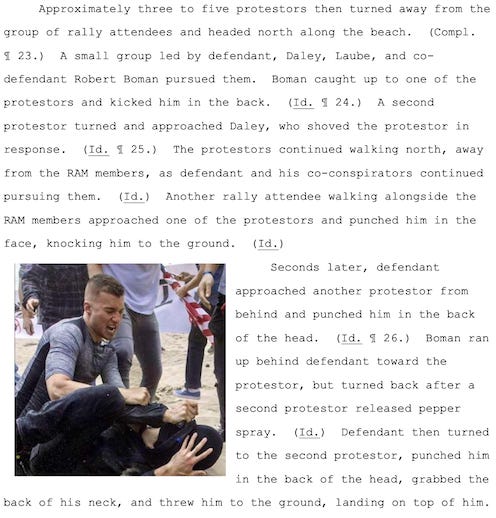
Rundo pleaded guilty in September to one count of conspiracy to violate the federal Anti-Riot Act for violence at political rallies. In the plea deal, he admitted that he other members pursued protestors and assaulted them. After the Berkeley rally, they “used the Internet to post photographs and videos of assaults one or more of them had committed,” according to the plea agreement. That includes a photo of a member punching a protestor with the caption, “Talk shit get hit!”
Judge Carney first dismissed the charges in 2020 on First Amendment grounds. The 9th Circuit reversed him in March 2021 and reinstated the charges, but Rundo wasn’t found until two years later when arrested in Romania in March 2023 and extradited to the United States in August 2023.
Rundo’s federal defender Julia Deixler said on Friday that Rundo’s move to Europe has been falsely characterized as “fleeing,” but at the time, he had no criminal charges pending and was free to travel internationally. She said Rundo wanted to start a new life away from Rise Above Movement members and embrace Christianity.
Prosecutors say Rundo continued to “promote militant extremism” while living in Romania with fake identification cards, but Deixler said Rundo was working as a journalist.

Videos cited by prosecutors “were his attempt at creating documentaries,” Deixler said. Prosecutors focus on “the ideology and the political beliefs that are quite distasteful and offensive to many,” Deixler said, but “he is not engaging in violence. He is not advocating for violence.”
Staton, however, said Rundo’s “own statements and his conduct reflect that he was not leaving the country because he found Christianity, but because he was attempting to avoid the criminal justice system.”
The judge said she was considering sentences imposed in the Western District of Virginia for Rise Above Movement members involved in the deadly Unite the Right rally in Charlottesville, Virginia, in August 2017, including 37 months in prison for group co-founder Ben Daley.
Daley’s sentence was “likely at or near” the low end of his Guidelines range, Staton said, so giving Rundo the low end of his Guidelines range would avoid a disparity and account for the fact that Rundo “did not participate in the Unite the Right rally.”
Deixler and Federal Deputy Public Defender Erin Murphy detailed Rundo’s troubled childhood in their 20-page sentencing memorandum and said he called his mother crying after briefly tasting freedom when Judge Carney had his case.
“When the arrest warrant was issued, he called his mother through tears to explain why he had to go back into custody for a charge that was already dismissed. For months, he remained in jail, waiting for the government’s appeal to conclude. As soon as it did, Mr. Rundo took responsibility and pleaded guilty,” according to the memo.
Assistant U.S. Attorneys Kathrynne N. Seiden and Anna P. Boylan in their memo said the assault occurred after the victim ran from a store after Rundo and his friends accosted him with knives. The men “chased the victim until he tripped and fell to the ground,” and Rundo stabbed him repeatedly. He was sentenced to two years in prison, and “while incarcerated, defendant tattooed the numbers ‘88’ with one ‘88’ on each shoulder — a neo-Nazi symbol signifying ‘HH’ or ‘Heil Hitler.’”
“Around the same time, Mr. Rundo met a friend at a gym who was into the ‘alt right,’” according to the memo. “Mr. Rundo became more interested in politics, including spending more time on the internet and social media than he ever had before. Through all of this, he started to have a community with what felt like some kind of purpose.”
Rundo’s lawyers wanted him sentenced to 18 months and said a 24-month sentence could put him at risk of serving too much time because of pending credit for good time, which is 54 days a year.
Judge Staton agreed on Friday to include the term “forthwith release” in Rundo’s “time served” judgment and commitment, and she issued it later that day to ensure his timely release.
Rundo said in court Friday that he wants to move to Florida to live with his mother and “go back working for the labor unions, as I did in years prior.”
“This process has taken a decade out of my life. So it’s a strong reminder to think before I act,” he said.
He told Judge Staton his choices and the “resulting media fallout” ruined his life and “ruined everyone’s life that was close to me.” He and his fiancée broke up “after years together” and his mother and sister hid photos of him while some of his friends “lost their careers for being associated with me.”
“Their pain weighs heavily on my shoulders and will for some time,” Rundo said.
Rundo said in his letter that he “foolishly … did not want to accept responsibility” in 2017 and “brushed it off as a small fist fight between foes.”
“Regrettably I even thought antifa was solely to blame because of their use of weapons and they assaulted people before my arrival that somehow my own vulgar actions were justifiable,” Rundo wrote.
“Clearly it wasn’t, and I would have this realization through my own harsh experiences,” he continued.


Rundo’s father said his son earned his GED in jail and “learned a trade.”
He also “asked me to look into getting his tattoos removed, he wants to put his past mistakes behind him,” the father wrote in a letter to Judge Staton that redacts his name from public view.
“He doesn’t want to be associated with them. He would be so grateful to go back to college and pursue a different career path when he goes to work,” according to the letter.
Rundo’s father said he knows his son “was wrong.”
“He NEVER should have engaged in violence. That was a huge mistake that he has paid for ever since,” the father wrote. “But it breaks my heart to read some of the stories about Rob that reduce him to something he is not. Rob has had friends from every walk of life. He is so good natured, generous, protective and caring with the people in his life.”
Rundo’s father told Judge Staton he understands “the seriousness” of his son’s crime, “and I can assure you that with all of this time Rob has served, he express so much remorse and regret over his actions.”
“I am asking you to give us both a chance to start over,” his father wrote.


The 9th Circuit reinstated Rundo’s codefendant Robert Boman’s charges, too, and he has a trial scheduled to begin Feb. 18 before Judge Staton.
Boman previously reached a plea deal with prosecutors last year, but he never actually entered his guilty plea. Instead, Judge Carney said after hearing a prosecutor read the factual basis for Boman’s plea that he didn’t believe a guilty plea would be legally valid. Carney then reversed U.S. Magistrate Judge Alka Sagar’s order detaining Boman, and Boman was released on $5,000 bond. He remains out of custody.
Another defendant, Tyler Laube, pleaded guilty last October to interference with a federally protected right without bodily injury, as part of an agreement with prosecutors related to him punching a journalist at the March 25, 2017, Huntington Beach rally. He did not seek to withdraw his guilty plea after Carney dismissed Rundo’s and Boman’s charges and was instead sentenced in April to 35 days already served in jail, probation for one year and a $2,000 fine. He’s currently on federal probation in Arizona.
Court documents:
Nov. 26 prosecution sentencing memo
exhibit 2009 Queens County police report
Dec. 6 defense sentencing memo w/ letters
Dec. 10 prosecution response
Previous articles:
My Feb. 22 article has background on Judge Carney, his departure as chief judge in 2020, and his other notable cases.
My Feb. 23 article has details on Judge Carney refusing to accept Boman’s guilty plea.
My Feb. 29 article has details on a status conference in which Carney asked in front of Rundo, “How about some of the reporting I’ve seen on my decision? Can I get those people arrested? Just because I disagree with how they characterize what I say and do?”
March 14: 9th Circuit stays future release orders for neo-Nazi Robert Rundo amid dismissal appeal
May 1: 'It was Antifa': Judge Carney grants bail for neo-Nazi leader Robert Rundo
May 4: 9th Circuit stays Judge Carney's bail order for Robert Rundo four hours after request
July 19: 9th Circuit reinstates Robert Rundo's indictment, rejects Antifa comparison
Sept. 13: After appellate reversal, white supremacist leader pleads guilty in political rioting case
Thank you for supporting my independent legal affairs journalism. Your paid subscriptions make my work possible. If you’re not already a paid subscriber, please consider purchasing a subscription through Substack. You also can support me through Venmo (MeghannCuniff), CashApp ($MeghannCuniff) and Zelle (meghanncuniff@gmail.com). Thank you!