
9th Circuit stays future release orders for neo-Nazi Robert Rundo amid dismissal appeal
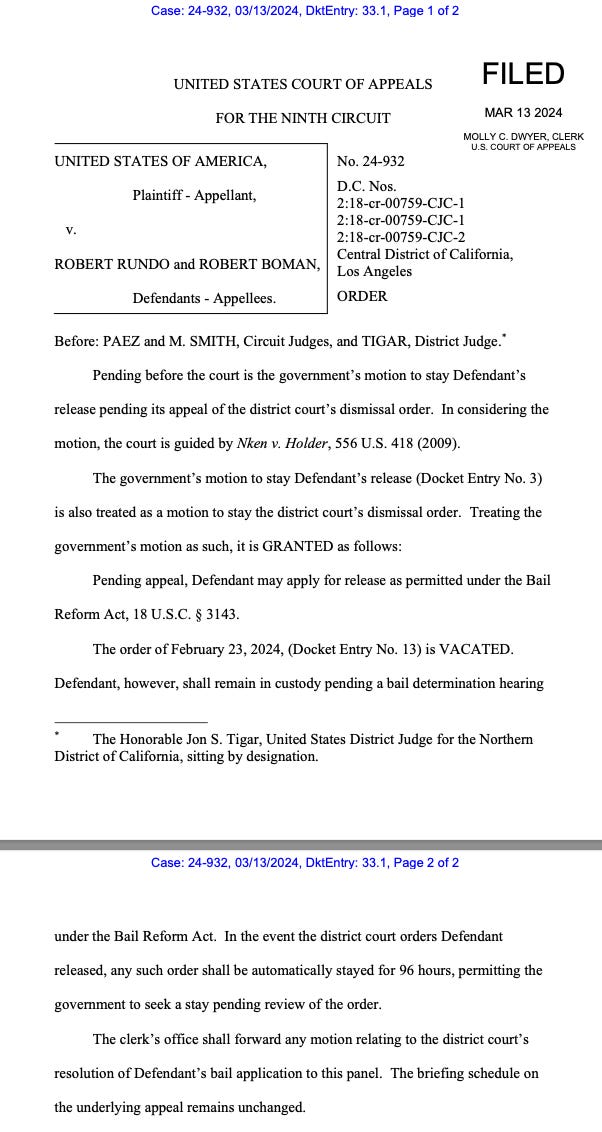
The panel also granted the U.S. Department of Justice's motion to stay Rundo's release pending appeal of Judge Cormac Carney's dismissal of his criminal charges.


A federal appellate panel on Wednesday said any future order granting bail for neo-Nazi leader Robert Rundo will be automatically stayed for 96 hours, an unusual move in a case already rife with anomalies.
The new order also stays Rundo’s original release from custody while the U.S. Department of Justice appeals U.S. District Judge Cormac J. Carney’s dismissal of his criminal indictment for allegedly inciting violence at political rallies in 2017.
The order specifies that Rundo can seek bail, which means he could be back in Carney’s courtroom soon.
Cory Webster, a partner at Dykema Gosset PLLC in Los Angeles, said the 9th’s order for an automatic stay is “unusual though not unprecedented.”
“I suspect that the court is concerned here about flight if the defendant were to be released,” Webster told Legal Affairs and Trials.
Rundo was extradited from Romania in August, nearly 2 1/2 years after the 9th Circuit reversed Judge Carney’s first dismissal order.
The judge already allowed Rundo’s co-defendant, Rise Above Movement associate Robert Boman, to leave jail for residential drug addiction treatment on a $5,000 bond last year, and the judge said at a Feb. 23 status conference he’s “not going to let Mr. Rundo wallow in custody unconstitutionally for eight or nine months until the Ninth Circuit gets to it.”
At the time, Rundo was still wearing street clothes after federal agents arrested him the night before about 50 miles north of San Diego, near San Clemente. He’d been free for about 24 hours because Judge Carney dismissed his rioting and conspiracy charges under a defense motion that argued the DOJ ignored violence from “‘far left wing’ counter-protestors” and selectively prosecuted Rundo and other white supremacists.
Carney said he believed Rundo had been unconstitutionally prosecuted and didn’t deserve to be in custody a minute longer, so he refused to stay the dismissal while prosecutors appealed.
The DOJ filed an emergency motion late that afternoon seeking to stay Rundo’s dismissal order, but by the time the 9th Circuit U.S. Court of Appeals granted it the next morning, Rundo had already been released. His lawyers contacted him to arrange for his surrender, but federal agents instead arrested him as he stepped out of a store shortly after the 9th Circuit issued its stay.
Deputy Federal Defenders Julia Deixler and Erin Murphy told Carney they didn’t believe Rundo could be lawfully arrested because his charges had been dismissed. But the 9th Circuit panel specified in its Feb. 22 stay order that no lower court can order Rundo’s release “absent further order of this Court,” and Murphy told Carney she couldn’t “as an officer of the court” ask him to violate the court’s mandate.
The judge did so anyway.
Despite the 9th’s order barring any release orders, Carney issued another release order for Rundo on Feb. 26 that said he can’t lawfully be jailed because no charges are pending. The judge stayed his order pending 9th Circuit review, but the court has not addressed it.
Instead, the 9th panel of Senior Judge Richard A. Paez, Judge Milan D. Smith Jr. and U.S. District Judge Jon S. Tigar, sitting by designation from the Northern District of California, rejected Rundo’s motion for immediate release in a one-sentence order on Feb. 28.
Then in Wednesday’s order, the judges disposed of a key argument from Rundo’s lawyers simply by stating that prosecutors’ motion to stay Rundo’s release “is also treated as a motion to stay the district court’s dismissal order.”
Rundo’s lawyers had taken issue with prosecutors not requesting a stay of the dismissal in their initial motion to stay Rundo’s release. They wrote in a March 7 brief that the failure to do so “led us down the chaotic path this case has taken to this point.”
The 9th’s apparent disregard for the argument is in line with what prosecutors argued in a March 6 brief: “Though the statute’s plain text permits detention pending appeal, if it is necessary to stay the district court's order of dismissal for the purpose of continuing defendant's detention, then this Court should do so.”
Prosecutors described Rundo as “a militant white supremacist charged with leading a combat-ready clan of extremists to political rallies at which they attacked demonstrators to silence their speech.”
Wednesday’s order staying the dismissal of Rundo’s charges cites the same case prosecutors cited: Nken v. Holder, a 2009 U.S. Supreme Court case that guides the authority for when an appellate court can stay an order.
“The government is likely to prevail on the merits because defendant came nowhere close to satisfying the ‘demanding’ and ‘rigorous’ standard to warrant dismissal of his indictment on selective prosecution grounds,” prosecutors wrote in their March 6 brief, quoting United States v. Armstrong, a 1996 U.S. Supreme Court decision that overturned a selective prosecution dismissal brought by Black defendants in a crack cocaine case.
Some of Rundo’s selective prosecution motion is redacted from public view, and many exhibits are sealed. It asked Carney to order the DOJ to produce discovery related to the selective prosecution claim if he didn’t feel dismissal was fully supported, but the judge instead heard about 90 minutes of argument on Feb. 21, then went to his chambers for about 15 minutes before returning with his 35-page dismissal order docketed.
The 9th Circuit reversed Carney’s first dismissal order, which was on First Amendment grounds, in March 2021. Rundo wasn’t found until two years later, arrested in Romania in March 2023 and extradited to the United States in August.
Prosecutors’ March 6 filing includes copies of identification cards under the names Pavic Roman and Marko Rodic that Romanian police found with Rundo, according to an FBI agent’s declaration, as well as a copy of a passport for Robert Lazar Pavic with a birthdate and passport number that don’t belong to Rundo.

Prosecutor also cited Rundo’s criminal conviction from 2010 “for a gang-related assault causing serious physical injury,” and the indictment says he and other members of the Rise Above Movement traveled to Germany, Ukraine and Italy in April 2018 “where they engaged in combat training with other white supremacists.”
“There is no evidence that defendant’s long-standing violent activities as part of a criminal organization will cease now,” according to the brief from Bram Alden, chief of the Los Angeles U.S. Attorney’s Office’s Criminal Appeals Section.
In the dismissal litigation, Rundo’s lawyers acknowledged he engaged in violence at the rallies
“To be sure, videos show Mr. Rundo fighting with some of these apparent ‘far left wing’ counter-protestors during rallies. The question here is not if any ‘side’ has a First Amendment right to engage in violence; nobody has that right. The issue is, unlike Mr. Rundo, none of these ‘far left wing’ counter-protestors were charged for violating the Antiriot Act,” according to the brief. “What people believe—no matter how repugnant or unpopular those beliefs may be—is not a proper basis to charge them, especially when another group with different political beliefs engaged in equally, or more culpable behavior.”
Rundo’s lawyers have never pushed for bail beyond his initial detention hearings. U.S. Magistrate Judge Karen L. Stevenson ordered him detained without bail on Oct. 24, 2018, and he stayed in custody until Judge Carney granted the first dismissal motion in June 2019.
After his extradition from Romania last year, U.S. Magistrate Judge Jean Rosenbluth ordered Rundo detained without bail, noting that he “was recently residing in a foreign country, and he previously left the United States several times, seemingly trying to evade arrest.” She also wrote that he has previous “failures to appear”, “no confirmed bail resources”, “unknown recent background information” and “prior conviction involving violence.”
Deixler and Murphy didn’t contest the order. Instead, they filed their motion to dismiss for selective prosecution on Jan. 15.
They had to know their motion was before a sympathetic judge. Carney has a long history of bold decisions, and Deixler and Murphy litigated the original dismissal motion in front of him in 2019. They also had access to the transcript of the Feb. 21, 2023, change of plea hearing for Boman in which Carney wouldn’t accept a guilty plea.
In the hearing, the judge told the avowed antisemite he didn’t appear to have committed crimes and was instead protecting people at the political rallies from left-wing activists.
“Your confrontation, your clash, your fighting, was that all with Antifa protestors?” Carney asked, according to a court reporter’s transcript.
“Yes,” Boman answered.
Carney suggested bail for Boman that day, then approved a plan to move him from jail to a Salvation Army residential treatment center a few weeks later. Boman being supervised by U.S. District Court’s pre-trial services on $5,000 bond, but Carney exonerated the bond when he dismissed the charges.
The DOJ’s appeal of Carney’s dismissal order for Rundo includes the dismissal for Boman.
The opening brief is due on May 15.
On April 4, Rundo’s and Boman’s co-defendant, Tyler Laube, is scheduled to be sentenced by Carney after pleading guilty to misdemeanor interference with a federally protected right without bodily injury, but he could move to withdraw his plea.
Carney, 64, plans to retire from the bench completely in May. He will not take senior status. His retirement is not listed on U.S. Senate’s website, but everyone in the courthouse has known about it for months, and his staff has been lining up new jobs.
Previous coverage:
My Feb. 21 article has background on him and his other notable cases.
My Feb. 23 article has details on Carney refusing to accept Boman’s guilty plea.
My Feb. 29 article has details on a status conference in which Carney asked in front of Rundo, “How about some of the reporting I’ve seen on my decision? Can I get those people arrested? Just because I disagree with how they characterize what I say and do?”
Court documents:
Jan. 15 selective prosecution motion
Feb. 21 9th Circuit emergency motion
Feb. 22 defense 9th status report
Feb. 23 transcript of Judge Kim hearing
Follow me on Threads if you’re on there.
Thank you for supporting my independent legal affairs journalism. Your paid subscriptions make my work possible. If you’re not already a paid subscriber, please consider purchasing a subscription through Substack. You also can support me through my merchandise store. Thank you!