
9th Circuit rejects Rundo's release request amid another discharge order from Judge Carney
An appellate panel ordered the racist leader to stay in jail last week, but Judge Cormac Carney and Judge Steve Kim took issue with how prosecutors secured his detainment.


One day after an appellate panel halted his order releasing a white supremacist from jail, U.S. District Judge Cormac Carney told the man and his lawyers what he wanted to do.
“I would like to be in a position to release him right now and let him walk out the door,” Carney said of Robert Rundo, accused of inciting violence at political rallies through the racist Rise Above Movement group he founded.
But Carney said he was stymied by his respect for “the rule of law” and would instead stay his release order while the 9th Circuit U.S. Court of Appeals reviews it. The judge made clear he was only doing so because the 9th had already intervened, and he questioned whether Rundo’s situation means he, too, can be arrested when he walks out of the courthouse.
“Am I going to leave and get arrested without any complaint or probable cause affidavit?” Carney asked during the hour-long status conference late Friday afternoon.
The veteran federal jurist also addressed journalists.
“How about some of the reporting I’ve seen on my decision? Can I get those people arrested? Just because I disagree with how they characterize what I say and do?” Carney asked.
The comments followed Carney’s decision to dismiss criminal charges against Rundo and his co-defendant Robert Boman for what he believes was an unconstitutionally selective decision by the U.S. Attorney’s Office to prosecute them for violence at political rallies and not “left-wing activists” whom he said “by many accounts … engaged in worse conduct and in fact instigated much of the violence that broke out.”
Issued Feb. 21, Carney’s order led prosecutors to seek emergency relief from the 9th Circuit that wasn’t granted until after Rundo had already left jail because Carney didn’t stay his release order pending appeal. It began a busy few days of filings and hearings that culminated with Carney again ordering Rundo’s release but staying it pending 9th Circuit review, despite the 9th’s Feb. 23 order that no lower court is to order Rundo’s release without first hearing from the higher court.
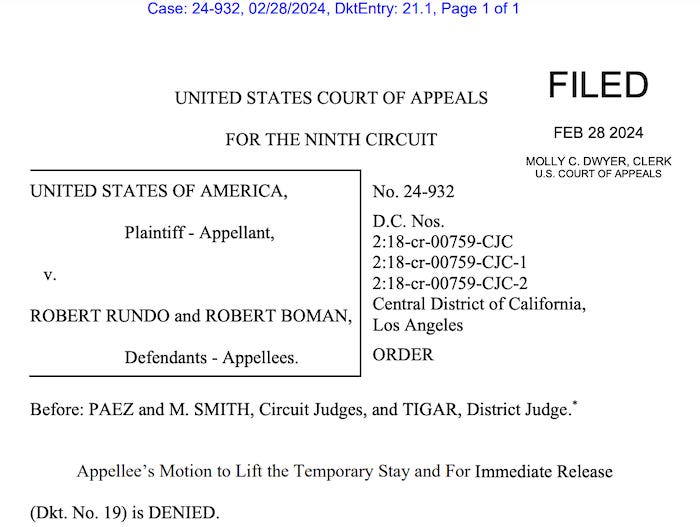
On Wednesday, Feb. 28, the same 9th Circuit panel that ordered Rundo to stay in jail denied an emergency motion from Rundo’s public defenders that sought his “immediate release.” The one-line order from Senior Judge Richard Paez, Judge Milan Smith and U.S. District Judge Jon Tigar, sitting by designation from the Northern District of California, did not explain the decision or acknowledge Carney’s new release order.
The U.S. Attorney’s Office, meanwhile, filed with the 9th an appeal notice on Wednesday for the 11-page order, in which the judge said Rundo was re-arrested on an unlawful warrant because the 9th Circuit didn’t stay his order dismissing Rundo’s charges — it only stayed his order releasing him from federal custody.
“The fact that the government appealed the Court’s dismissal order does not change the fact that there are no charges pending against Defendants at this time,” the judge wrote.
It’s the second time Carney has dismissed the rioting and conspiracy charges against Rundo and Boman. The 9th Circuit reversed his first dismissal over First Amendment claims in 2021, and Rundo was arrested in Romania and extradited to the United States in August 2023.
Accusations of condescending prosecutorial misconduct
Prosecutors obtained the arrest warrant last Thursday from U.S. Magistrate Judge Steve Kim, who told them after he issued it that they made conflicting representations about Rundo’s ability to seek bail that “are quite concerning and troubling” and include “a level of condescension and contempt for the court” and show “an abuse of power.”
In a 90-minute video hearing last Friday, Kim took issue with how prosecutors described his proceedings to the 9th Circuit when they filed a second motion asking the 9th for authorization to arrest Rundo because he’d already been released and Kim hadn’t yet issued a warrant.
Kim asked Assistant U.S. Attorney Bram Alden, chief of the Los Angeles office’s Criminal Appeals Section, how the motion “is not dripping with condescension if not contempt for this court” because it recounted how Kim hadn’t yet decided whether to issue a warrant and how his hearing had been delayed “due to Magistrate Court technical difficulties.”
The judge said he didn’t take the motion personally, but he defended his clerk by name and said “there was no one else that was running around more rapidly” to deal with his heavy workload than her.
“Do you not understand how this drips with such contempt?” Kim asked Alden, according to a court reporter’s transcript. “It says, ‘Rather than issue an arrest warrant,’ as if it should have been a routine pro forma arrest warrant that I signed off without a second look. That’s how you set the stage after our hearing yesterday.”
The judge called the line “a gratuitous side swipe” and said prosecutors were “just throwing legal spaghetti on the wall for anything that might stick.” He also asked if prosecutors would “withdraw some of these gratuitous statements,” but Alden said no.
Alden told Kim he thought Rundo would “be entitled to a detention hearing” but told the 9th Circuit “it was an open question” because his office believes he shouldn’t get one.
“What I told the 9th Circuit was that it should not allow a further detention hearing because our legal position is that he should not be entitled to that,” Alden said. He said that is not inconsistent with also acknowledging that a detention hearing is possible, and “my intention was never to mislead either court.”
But the problems didn’t end there. Kim also complained that the warrant application he’d approved the day before lacked “analysis and law and facts,” and Alden replied, “We were moving at a very rapid pace to prevent this Defendant from fleeing the country.”
Kim said “the entire posturing of all of this is everyone is not doing their job except you, Mr. Alden.”
Alden replied, “I certainly didn’t intend for it to be perceived that way.”
But Kim told Alden, “You speak out of both sides of your mouth in order to just get whatever end you want.”
“And that is a shocking approach. … I have to say it’s not the U.S. Attorney’s Office I know, and it’s certainly not the U.S. Attorney's Office I once belonged to,” said Kim, who was nominated to a U.S. District judgeship by Donald Trump in 2019 but was not confirmed.
Alden told Kim he “strongly” disagrees with his characterization.
“I can only accept your chastisement, as you’re the judge and I’m not, but I do believe that what I did here was actually appropriate and that we were trying to the best of our abilities to achieve what the Ninth Circuit wanted and what the Government thought was best for its prosecutive priorities when this Defendant risked fleeing to another country. I tried to do my best,” Alden said.
Alden added that, given Kim’s comments, if he could rewrite his filing “maybe I would try to do things in a way that did not come across as condescending, but that was not my intention, and I apologize if it came across that way.”
Kim said that instead of sanctions, he wanted Alden to take the hearings’ transcripts to his “front office” so they can be “discussed and see what lessons learned we can take from it.”
Later that day, Deputy Federal Public Defender Erin Murphy told Carney she doesn’t “throw the word misconduct around easily, Your Honor.”
“We had opportunities earlier in this case to do that. And we did it. But this is deeply disturbing,” Murphy said, adding that if she had “engaged in even a fraction of that kind of gamesmanship. I don't know that I’d have my license anymore.”
After reading a transcript of the hearing, Carney wrote in Rundo’s new release order, “If anything, the Deputy Federal Public Defender’s representation underrepresented Magistrate Judge Kim’s findings.”
“In the Court’s experience, it is rare for the Federal Public Defender’s Office to explicitly accuse the United States Attorney’s Office of engaging in prosecutorial misconduct. Such an accusation is particularly troubling when it relates directly to, as this Court found, selective prosecution,” the judge said. “But the Court is disappointed that the government’s zeal to detain Mr. Rundo and its apparent frustration with the Court’s ruling led it to proceed in a manner less than befitting of the United States Attorney’s Office.”
Carney learned that Rundo’s lawyers were alleging misrepresentations by prosecutors from a status report filed late Thursday after his arrest. He scheduled Friday’s status conference “because I understand you wanted to come and talk to me,” he told Murphy and Deputy Federal Public Defenders Julia Deixler and Margaret Ferrand.
“I must tell you: From the little things I’ve read, I’m quite concerned,” Carney said. “I feel Mr. Rundo is being unconstitutionally detained.”
Murphy told the judge, “I cannot ask Your Honor to defy the 9th Circuit order” and order Rundo’s release.
“As officers of the court, I don’t think that we can do that,” Murphy said. “But at a minimum, Mr. Rundo has been arrested, and he is entitled due process … even if that process feels like a farce at this point.” Murphy said she was arranging for Rundo’s surrender, but federal agents were apparently following him because they arrested him as he stepped out of a store about 50 miles north of San Diego shortly after the 9th Circuit issued its stay order
Carney issued the second release order for Rundo on his own accord because he said the situation left him no other legal options. The 9th Circuit hasn’t stayed his order dismissing Rundo’s charges — it only stayed his order releasing him from federal custody.
“If the government is ready to hand me a new indictment or a complaint, supporting probable cause, I would consider that,” Carney said. But, he said, “I’m not going to arraign him on the prior indictment.”
Carney waited for the court reporter’s transcript from Kim’s hearing before issuing a written order on Tuesday. It’s not as expansive as his courtroom comments on Friday, which included him saying he “can’t help but feel” that if “Mr. Rundo was a popular figure in today's society and he was wrongfully arrested, “there would be outrage.”
“It doesn’t matter whether Mr. Rundo’s a good man, bad man, whether he did something bad or not,” Carney said, adding that no one was following the Constitution. “Arresting someone without pending charges … that’s frightening to me. … I don’t understand this.”
Assistant U.S. Attorney Solomon Kim told Carney that prosecutors do not believe anyone can be arrested for no reason.
“That is simply not what the government believes and it is simply not what the government did in this case,” said Kim, who was joined by Assistant U.S. Attorneys Anna Boylan and Mark Takla.
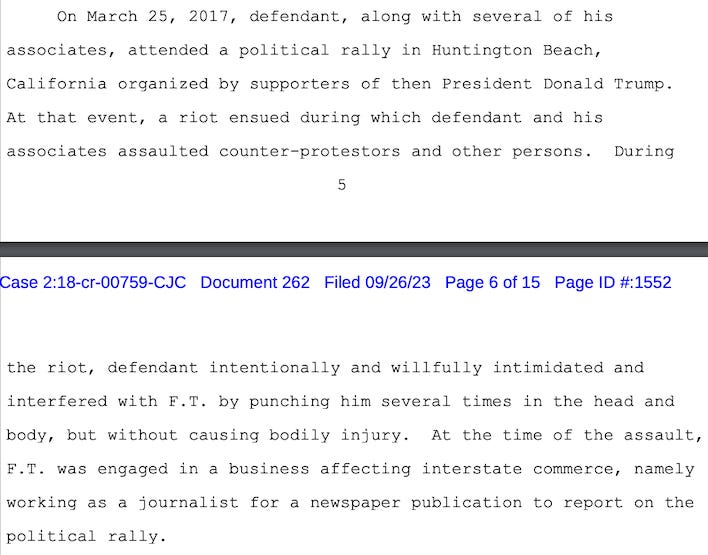
Judge Carney’s criticism of my reporting was made in front of an apparently receptive audience: Rundo’s co-defendant Tyler Laube admitted in a plea agreement that he “intentionally and willfully intimidated and interfered” with a newspaper journalist covering a rally in Huntington Beach “by punching him several times in the head and body, but without causing bodily injury.”
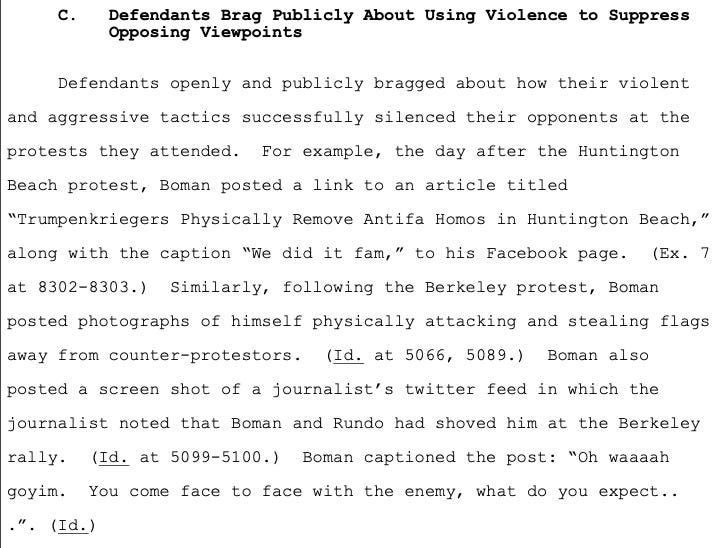
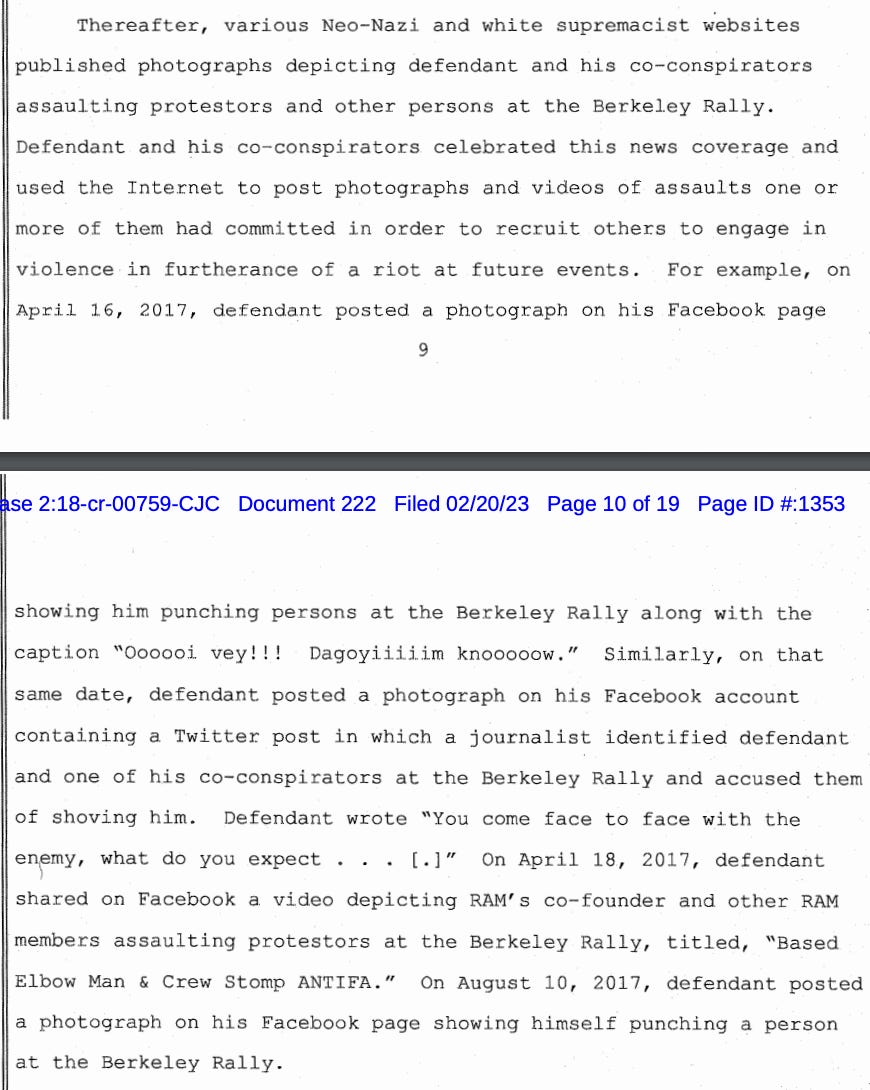
Prosecutors also said in their opposition to the most recent dismissal motion that co-defendant Boman shared a screenshot of a journalist saying on Twitter that Boman and Rundo shoved him at a 2017 rally in Berkeley and wrote, “Oh waaaah goyim. You come face to face with the enemy, what do you expect…”
Goyim is an antisemitic word described by the Anti-Defamation League as “intended to be understood as spoken by a panicked Jew responding to some occurrence that would ostensibly reveal Jewish manipulations or deceit to non-Jews.”
Boman’s plea agreement also described his actions.
Boman has been out of jail since March 2023, after Judge Carney refused to accept his guilty plea and told him he didn’t think he’d committed crimes and instead had only been defending demonstrators against left-wing activists. The judge did so after Boman took issue with several lines in the factual basis of his plea agreement. Boman said he was trying to protect a Black man from being attacked, which Carney repeated when explaining why he wouldn’t accept the plea.
“Now I’ve heard there is this young Black man who was about ready to get attacked by Antifa, and so Mr. Boman is going to his rescue,” the judge said.
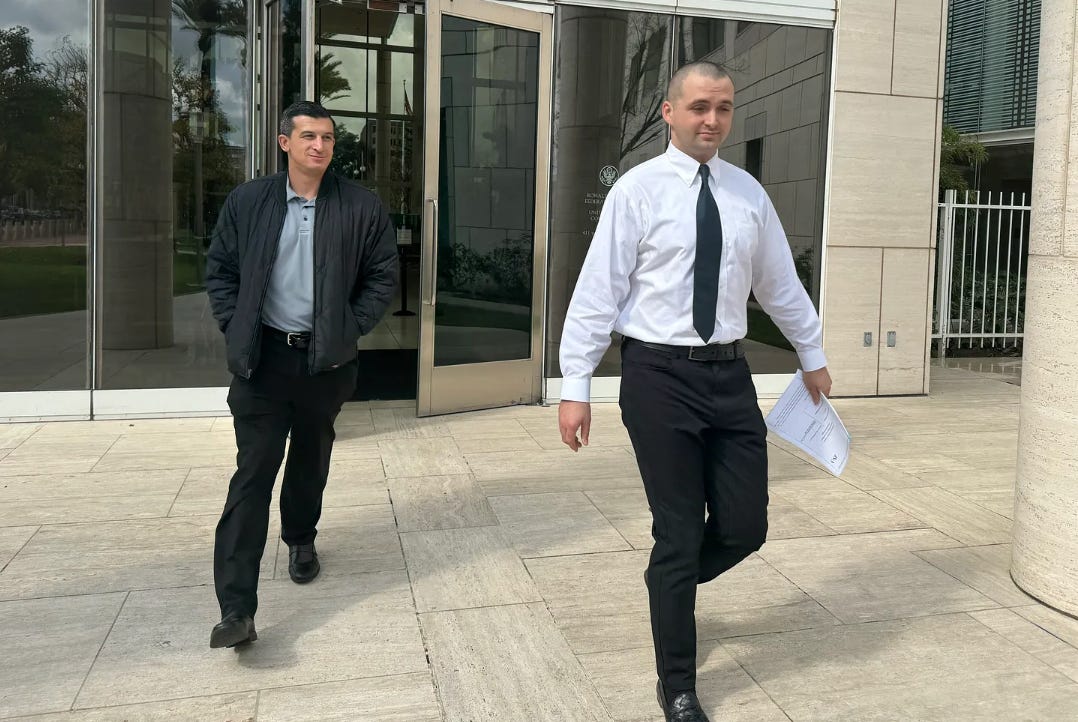
Laube, meanwhile, was to be sentenced on March 4, but prosecutors and his attorney, John agreed this week to reschedule it to April 4. He and his lawyer John McNicholas were seated in the courtroom gallery when Carney dismissed Rundo’s and Boman’s charges on Feb. 21.
I asked McNicholas in a phone interview yesterday if Laube would move to withdraw his guilty plea like he did after Judge Carney’s first dismissed the charges in 2020, and he told me, “Ultimately, it’s up to him.”
“One thing these guys don’t want is they don’t want attention to themselves because it’s tough situation to be in and this case has been going on since 2018,” McNicholas said, adding that Laube pleaded guilty to only a misdemeanor: interference with a federally protected right without bodily injury.
McNicholas told me the delay in sentencing “ has to do with what was recommended by probation.”
“It’s strategic. It’s all based on what I decided was appropriate for my client,” McNicholas said. “I’m working on what probation recommended, which I’m not going to share with you.”
There are two issues pending with the 9th Circuit: Prosecutors’ appeal of Carney’s second release order, and their appeal of his dismissal order, which includes seeking a permanent stay of Rundo’s discharge order. I will be following both proceedings.
Previous articles with court documents:
Robert Rundo is back in federal custody after the 9th Circuit stayed Judge Carney's release order

A white supremacist leader accused of training fellow assailants and inciting violence at political rallies is back in jail after the 9th Circuit U.S. Court of Appeals halted the judge's order that released him. Robert Paul Rundo, 33, was released after a hearing
White supremacist will leave jail 'imminently' under federal judge's order, DOJ tells 9th Circuit

UPDATE: A 9th Circuit panel early Thursday temporarily stayed Judge Carney’s order releasing Rundo, but Rundo already is out of custody. For the second time, a federal judge in Orange County has dismissed an indictment against white supremacists ac…
Thank you for supporting my independent legal affairs journalism. Your paid subscriptions make my work possible. If you’re not already a paid subscriber, please consider purchasing a subscription through Substack. You also can support me through Venmo (MeghannCuniff), CashApp ($MeghannCuniff) and Zelle (meghanncuniff@gmail.com). Thank you!
Wow. This is so bizarre. The judge basically says that "he's heard" that others have done worse but not been prosecuted without citing a single factual basis? "“by many accounts … engaged in worse conduct and in fact instigated much of the violence that broke out.”" Is this like Trump's "people say" or "people tell me"?