
White supremacist will leave jail 'imminently' under federal judge's order, DOJ tells 9th Circuit
Robert Paul Rundo is the founder of the Rise Above Movement, described by prosecutors as "a combat-ready white supremacist group."

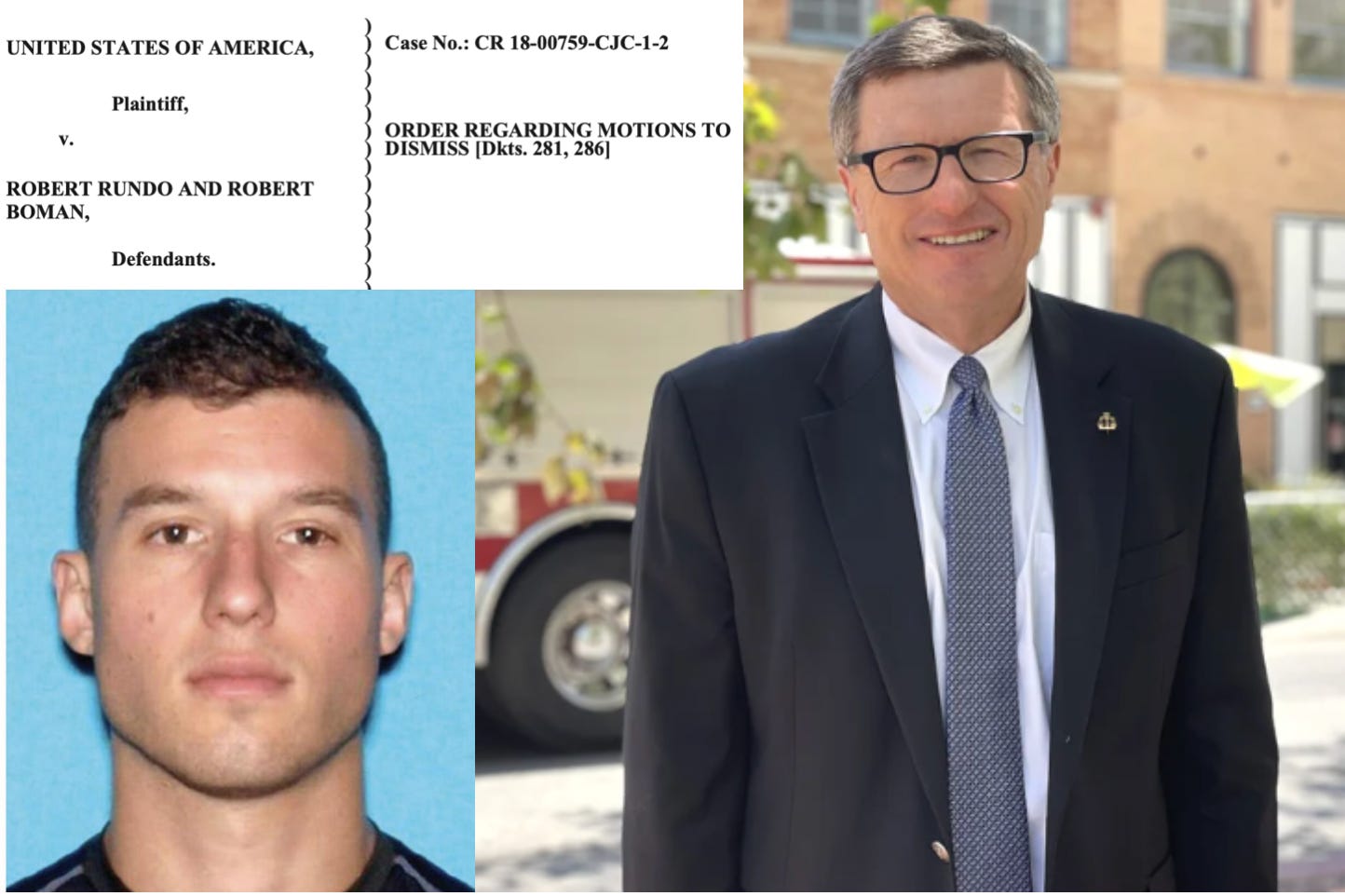
UPDATE: A 9th Circuit panel early Thursday temporarily stayed Judge Carney’s order releasing Rundo, but Rundo already is out of custody.
For the second time, a federal judge in Orange County has dismissed an indictment against white supremacists accused of inciting violence at political rallies in California.
U.S. District Judge Cormac J. Carney said Wednesday that the U.S. Department of Justice selectively prosecuted white supremacist leader Robert Paul Rundo and his Rise Above Movement associate Robert Boman because of their ideology while ignoring “far-left extremist groups, such as Antifa, that went to the same protests and rallies and engaged in the same violent acts as alleged against the Defendants in this case.”
Rundo has been in federal custody since he was extradited from Romania in August. Prosecutors on Wednesday asked Judge Carney to keep him in jail by staying his dismissal of his charges while they appeal to the 9th Circuit, but the judge declined.
“I don’t think it’s right that Mr. Rundo spends another minute in custody,” Carney said.
Prosecutors filed an emergency motion with the 9th Circuit U.S. Court of Appeals at 4:39 p.m. on Wednesday that said Rundo “presents a grave risk of flight, as well as a danger to the community.” It requests action by Thursday.
“Due to the district court’s order, Rundo will be released imminently (if the Bureau of Prisons has not already released him), at which point he will be under no bond conditions or travel restraints,” according to the motion by Assistant U.S. Attorney Bram Alden, who is chief of the Los Angeles office’s Criminal Appeals Section.
The 9th Circuit, which reversed a previous indictment dismissal by Carney in 2021, had not addressed the motion as of 10 p.m. Wednesday.
The order takes issue with the lack of prosecutions against “members of Antifa and related far-left groups” who Carney said “by many accounts … engaged in worse conduct and in fact instigated much of the violence that broke out at these otherwise constitutionally protected rallies to silence the protected speech of the supporters of President Trump.”
“That is constitutionally impermissible,” according to the order. “While Defendants openly promoted ideas the Court finds reprehensible, and likely committed violence for which they deserve to be prosecuted, this case is about something more important. It is about upholding the free speech and assembly rights guaranteed to all of us,” the judge continued.
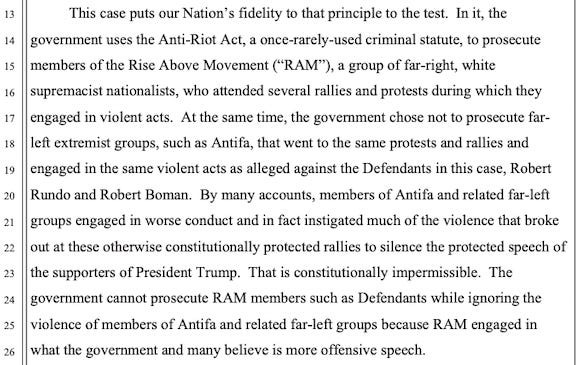
Carney’s order grants a dismissal motion filed by Rundo’s public defenders, Julia Deixler and Erin M. Murphy, that argued the U.S. Attorney’s Office charged only Rundo and other far-right activists because of their beliefs even though protestors of different ideologies could have been prosecuted under the federal Anti-Riot Act, too.
“None of this is to suggest that ‘one side’ is ‘worse’ or ‘better’ than the other. And the question is not whether Mr. Rundo or anyone can immunize violence within the cloak of the First Amendment. The issue here is simpler than that: the government, facing two groups with similar alleged misconduct, chose to charge only one group,” according to the motion.
In their opposition, prosecutors said the men were “downplaying their dangerous conduct and public proclamations of their violent objectives” while seeking to use their views “to immunize themselves from prosecution.” Rundo’s lawyers didn’t identify “a single individual” who could have been prosecuted, “let alone one materially similar to either defendant.”
But Judge Carney said he believes prosecutors targeted Rundo and Bamon for their beliefs, and his order references the U.S. Attorney’s Office press release that called the men engaged in “an orchestrated effort to squelch free speech” and “attack those who hold different views.”
“The problem in this case, though is that sentiment equally describes Antifa and other extremist, far-left groups. Neither RAM nor Antifa have ‘the right to violently assault their political opponents,’” the judge wrote, again quoting the 2018 press release.
The judge acknowledged that people “sometimes use their First Amendment rights to spread vitriolic and hateful ideas and beliefs” sand said protecting those rights ‘is not always easy.”
“The struggle of preserving the First Amendment in the face of speech many find outright dangerous is pronounced during times of uncertainty, division, polarization, and fear—challenges we unfortunately face today. But the answer cannot be for the government to single out and punish the speech that it and many in the country understandably find repugnant,” according to the order.
Carney heard about 90 minutes of argument on Wednesday from Deixler and Murphy as well as Assistant U.S. Attorneys Kathrynne Seiden, Solomon Kim and Anna Boylan, then recessed for 15 minutes. When he returned to the bench, his 35-page order had been docketed, and he directed his staff to print copies for the attorneys.
“The government disagrees with the decision, but the decision is what it is,” Carney said. “Now that I’ve dismissed the charges, Mr. Rundo, you are to be released forthwith. Mr. Boman, your bond is exonerated.”
The order comes nearly four years after Carney dismissed the indictment against Rundo, Boman and co-defendant Aaron Eason after deeming the Anti-Riot Act “unconstitutionally overbroad” because it “regulates a substantial amount of protected speech and assembly.”
Carney at the time also dismissed the charge against a fourth defendant, Tyler Laube, after allowing him to withdraw his guilty plea on a conspiracy charge.
All charges were reinstated after the 9th Circuit reversed Carney, and Laube pleaded guilty again in October, this time to interference with a federally protected right without bodily injury. His sentencing is scheduled for March 4, but it’s possible he could seek to withdraw his plea again now that Carney has dismissed his co-defendants’ charges.
Prosecutors moved to dismiss charges against Eason in January 2023 because he died.
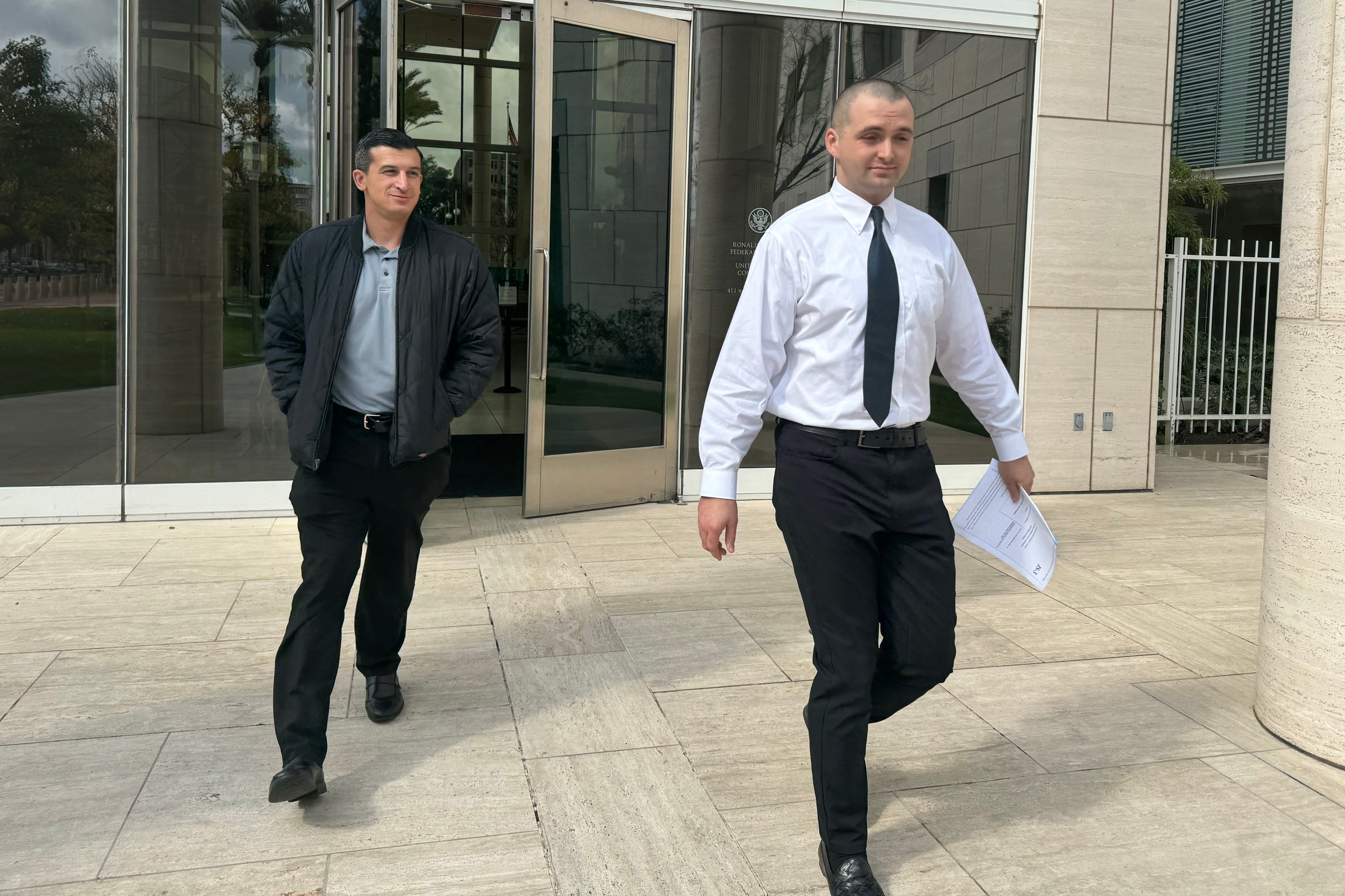
Boman was released from jail in March on $5,000 bond that Carney approved, nearly 10 months after he was arrested following the 9th Circuit reversal.
He was emotional in the courthouse hallway on Wednesday after Carney dismissed the indictment and told reporters through tears, “You know, it says in the scripture that God gave Jesus Christ all authority over all authority and all power.”
He left the courthouse with a friend as well as his court-appointed attorney, Peter Swarth, who joined in Deixler’s and Murphy’s motion.
Rundo and Boman were charged with two federal felonies: rioting and conspiracy to violate the Anti-Riot Act.
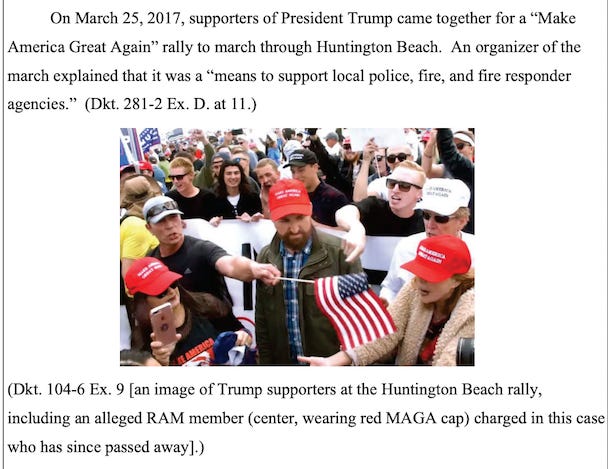
Prosecutors said they recruited members and coordinated “hand-to-hand and other combat training, traveling to political rallies to attack protesters and other persons, and publishing photographs and videos of violent acts to recruit other members for future events.” The indictment cited attacks at rallies in Huntington Beach on March 25, 2017; in Berkeley on April 15, 2017; and in San Bernardino on June 10, 2017.
The Rise Above Movement also was heavily involved in the deadly Unite the Right rally in Charlottesville, Virginia, in August 2017, though Rundo’s lawyers said neither he nor the other defendants attended the rally.


Judge Carney heard argument Wednesday on the dismissal motion for selective prosecution as well as a dismissal motion that argued the Anti-Riot Act is unconstitutionally vague. He rejected the latter because he said Rundo’s and Boman’s charges include clear allegations of use of interstate commerce, which is an element of the Anti-Riot Act.
But the judge also said he “respectfully disagrees” with the 9th Circuit’s rewriting of the act, and he chuckled about the 9th embracing the act when it was designed to target “the civil rights leaders.”
“It has really a racist origin,” Carney said. “That’s very troubling. And it’s ironic that the 9th Circuit of all circuits is using a racist statute to go after the defendants. But it is what it is.”
He also referenced his first dismissal order. “I made my decision. They said I was wrong,” Carney said.
Regarding the selection prosecution argument, the defense told Carney to consider “the big picture,” but prosecutors said the legal standard for selective prosecution motions requires the defense to show specific people who could have been charged but weren’t, and they hadn’t done that.
The public version of Deixler’s and Murphy’s 45-page motion is partly redacted, and many exhibits are sealed from public view.
In his 20 years as a federal judge, Carney has never shied from controversial decisions, and he isn’t afraid to criticize others in the judiciary if he thinks they got it wrong.
When I interviewed him for a Los Angeles Daily Journal profile in 2018, he explained how wrong he feels the 9th Circuit was to overturn his order in 2014 that declared California’s death penalty unconstitutional. He also told me, “I don’t really have an ideology, and I don’t profess to have divine wisdom. But if you had to say, ‘OK, what do you think you’re good at?’ I think I’m good at common sense,” Carney said.
In 2009, Carney shocked a national audience in the closely watched securities fraud criminal trial of Broadcom Corp. executives William Ruehle and Henry Nicholas when he dismissed all charges because of what he deemed prosecutorial misconduct involving witness intimidation. In 2011, he sanctioned the Federal Bureau of Investigation after finding an agent lied about the existence of documents in a civil case over alleged secret government surveillance of an Islamic group, then dismissed a related lawsuit at the FBI’s request to protect national security.
Carney again drew national attention in December when he temporarily halted California’s ban on guns in public, saying in his preliminary injunction order that the law violates the U.S. Constitution’s right to bear arms under the Second Amendment. The 9th Circuit has stayed the order as the California Attorney General’s Office appeals.
Carney was born in Detroit to Irish immigrants who later moved to Long Beach. His father played Gaelic football in Ireland, and Carney a star wide receiver at UCLA, then played briefly for the New York Giants and in the now-defunct United States Football League.
He chose Harvard Law School over a tryout with the San Francisco 49ers and worked four years at Latham & Watkins LLP, then 10 years at O’Melveny & Myers LLP before Gov. Gray Davis appointed him to the Orange County Superior Court in 2001. President George W. Bush appointed him to the federal bench in 2003. His clients at O’Melveny included Peanuts creator Charles Schulz.
U.S. District Judge David O. Carter, Carney’s colleague and friend at the Santa Ana courthouse, told me in 2018 that Carney is “very courageous” and “a brilliant scholar.”
“I think he balances that intellect with a tremendous amount of real world common sense,” said Carter, whose own high-profile decisions include a string of influential orders regarding Donald Trump’s and John Eastman’s criminal culpability in the 2020 election aftermath and attempted insurrection.
The 9th Circuit currently is considering a request from the U.S. Attorney’s Office to remove Carney as the judge on a criminal drug distribution case against a doctor. Carney has twice dismissed the case because of his disagreement with his colleagues’ ban on trials during the COVID-19 pandemic.
His last dismissal order in August 2022 “contravenes the spirit, if not the plain text, of this Court’s first directive to reinstate the indictment,” prosecutors said in their 9th Circuit brief, adding that Carney chose “to ignore this Court’s mandate.”
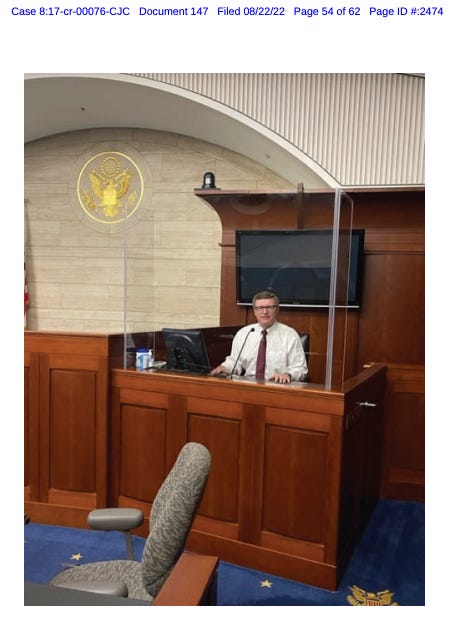
They said he’s “too personally invested” in the case and said he “has improperly engaged in his own investigation of the facts,” including by photographing and measuring grand jury rooms and the courtroom and including with his order “a photo of himself sitting in his courtroom’s witness box.”
In late 2018, Carney moved his chambers to Los Angeles to be chief judge of the Central District in California, but he resigned and returned to the Santa Ana courthouse in June 2020 after he made comments to the chief court clerk that many saw as racially biased. First he called the clerk, who is Black, “so street smart,” then, amid mounting criticism, he told her in a phone call, “it was not like I was the police officer standing on your neck.”
His resignation email as chief judge said he believed “street smart” was a compliment and his reaction to criticism “was an insensitive and graphic overreaction to the criticism that was leveled against me.” A criminal defendant later cited the comments when moving to recuse Carney as the judge in his case, but Senior U.S. District Judge James V. Selna rejected the motion, writing in his order, “one extrajudicial comment which exhibited racial insensitivity is not a basis for recusal.”
“The comment related to the George Floyd police killing in Minneapolis. It did not reflect in itself bias on a racial basis toward the court employee, Blacks, or people of color in general,” Selna wrote.
Carney’s return to Santa Ana came about the time the courts closed for the pandemic, which led him to twice dismiss the criminal indictment against the doctor in the case currently before the 9th Circuit. The same panel that reversed Carney in April 2021 has the latest appeal.
According to a July 21 order, “The previous panel has retained jurisdiction of this appeal. Oral argument, if any, will be set in due course.” Nothing has happened in the seven months since.
Carney, 64, plans to retire from the bench completely in May. He will not take senior status. His retirement is not listed on U.S. Senate’s website, but everyone in the courthouse has known about it for months, and his staff has been lining up new jobs.
Court documents:
Failure to state a claim motion
Emergency motion to 9th Circuit
Previous article:
DOJ asks 9th Circuit to remove judge from doctor’s criminal case, citing broken mandate

A federal judge upset over his colleagues’ decision to prohibit jury trials during the COVID-19 pandemic has twice dismissed a criminal drug distribut…
I am watching the 9th Circuit docket for action on the emergency stay motion. Stay tuned.
Thank you for supporting my independent legal affairs journalism. Your paid subscriptions make my work possible. If you’re not already a paid subscriber, please consider purchasing a subscription through Substack. You also can support me through Venmo (MeghannCuniff), CashApp ($MeghannCuniff) and Zelle (meghanncuniff@gmail.com). Thank you!