
Robert Rundo is back in federal custody after the 9th Circuit stayed Judge Carney's release order
The judge dismissed Rundo's charges on Wednesday. Last year, he declined a plea offer from a co-defendant and suggested possible bail after learning of his meth habit.


A white supremacist leader accused of training fellow assailants and inciting violence at political rallies is back in jail after the 9th Circuit U.S. Court of Appeals halted the judge's order that released him.
Robert Paul Rundo, 33, was released after a hearing on Wednesday, and he stayed out overnight before the appellate court granted an emergency motion from federal prosecutors at 7:38 a.m. on Thursday.
Thom Mrozek, spokesman for the U.S. Attorney’s Office in Los Angeles, confirmed Rundo was in custody about 6:30 p.m. on Thursday. Rundo’s public defenders said in a filing late Thursday that they arranged with prosecutors “for the self-surrender of Mr. Rundo.”
“The defense understands that soon after or during those communications, Mr. Rundo was arrested without incident, approximately 50 miles north of San Diego, and will be brought to the Metropolitan Detention Center in Los Angeles tomorrow,” according to a status report from Deputy Federal Public Defenders Julia Deixler and Erin M. Murphy.
Rundo’s brief freedom followed an order by U.S. District Judge Cormac J. Carney in Santa Ana that dismissed rioting and conspiracy charges against him and Robert Boman, a member of Rundo’s Rise Above Movement group who already was out on bail. The judge said the U.S. Department of Justice selectively prosecuted the men because “far-left extremist groups, such as Antifa” engaged in similar conduct but weren’t prosecuted.
Prosecutors said the legal standard for selective prosecution motions requires Rundo’s lawyers to show specific people who could have been charged but weren’t, and they hadn’t done that. They filed their notice of appeal to the 9th Circuit minutes after the hearing.
The 9th Circuit’s order on Thursday applies only to Rundo. It’s a temporary stay as the court considers permanently staying Rundo’s release pending the DOJ’s appeal of Carney’s dismissal order, which could take several months, at least. “The schedule for the motion to stay will be set by a separate order,” according to the order from Judges Richard Clifton, Consuelo Callahan and Holly A. Thomas.
Prosecutors said in Wednesday’s emergency motion that Rundo “presents a grave risk of flight, as well as a danger to the community.”
The indictment cited attacks at rallies in Huntington Beach on March 25, 2017; in Berkeley on April 15, 2017; and in San Bernardino on June 10, 2017. A U.S. Attorney’s Office press release said the men recruited members and coordinated “hand-to-hand and other combat training, traveling to political rallies to attack protesters and other persons, and publishing photographs and videos of violent acts to recruit other members for future events.”
Rundo was previously released in June 2019 after Carney granted a different motion to dismiss from the federal defender’s office that argued the federal Anti-Riot Act under which he was charged is overbroad under the First Amendment. Like he did on Wednesday, the judge declined to stay his order while prosecutors appealed.
A 9th Circuit panel reversed Carney’s first dismissal in March 2021, and the case returned to him in February 2022 after the U.S. Supreme Court declined a petition for a writ of certiorari.
Rundo was arrested on the reinstated charges and extradited to the United States in August 2023 from Romania, where DOJ officials say he lived under a false identity.
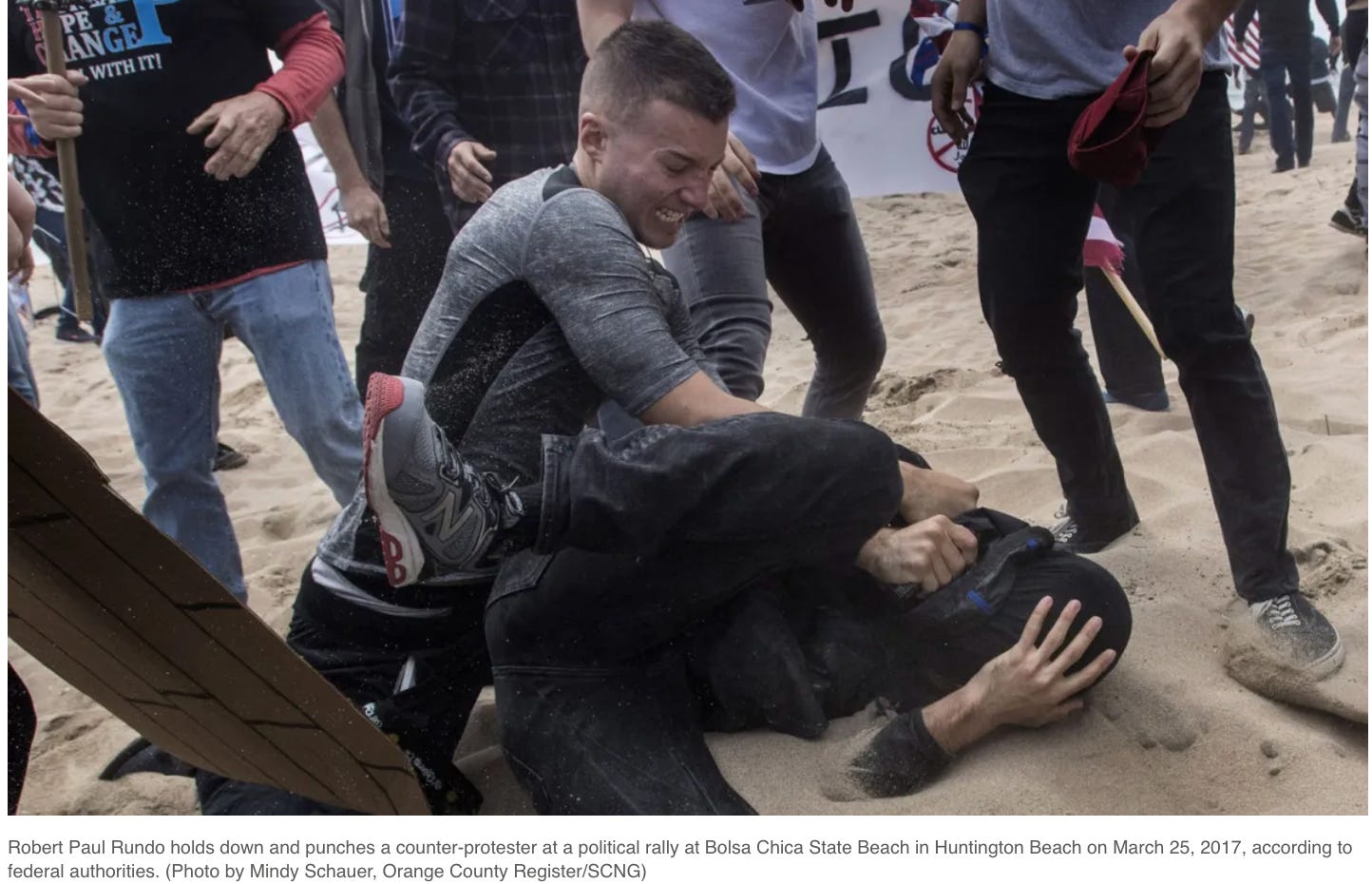
On Aug. 2, U.S. Magistrate Judge Jean Rosenbluth ordered Rundo detained without bail, noting that he “was recently residing in a foreign country, and he previously left the United States several times, seemingly trying to evade arrest.” She also wrote that he has previous “failures to appear”, “no confirmed bail resources”, “unknown recent background information” and “prior conviction involving violence.”
Deixler and Murphy filed their motion to dismiss for selective prosecution on Jan. 15.
Carney issued his 35-page order after hearing about 90 minutes of argument on Wednesday, then declined prosecutors’ request to stay his order.
“I don’t think it’s right that Mr. Rundo spends another minute in custody,” Carney said.
‘I don’t know if that’s a crime’
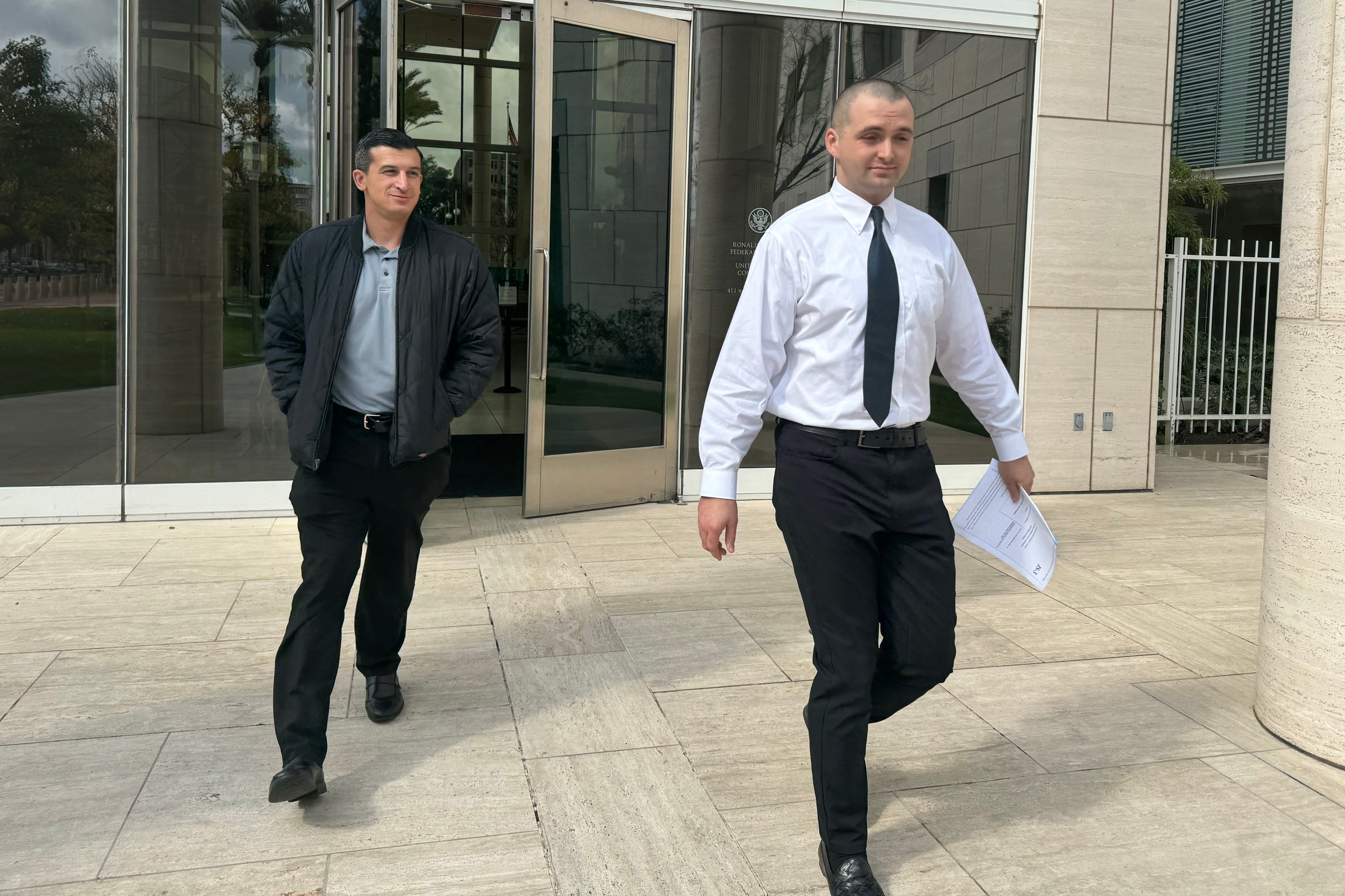
Last year, Boman struck a plea agreement with prosecutors, but he never pleaded guilty to the conspiracy charge as planned.
Instead, Carney said during a Feb. 21, 2023, hearing that he didn’t believe he could accept the plea because Boman may not have committed any crimes and was instead defending himself and others against far-left activists. The judge’s unusual approach followed Boman disputing some of the factual basis that Assistant U.S. Attorney Maria Jhai read aloud, including that he’d crossed police barriers during a rally in Berkeley.
Boman told Judge Carney he saw people jump “this Black kid” who “was about 18 years old” and wearing a “Defend America” hat.
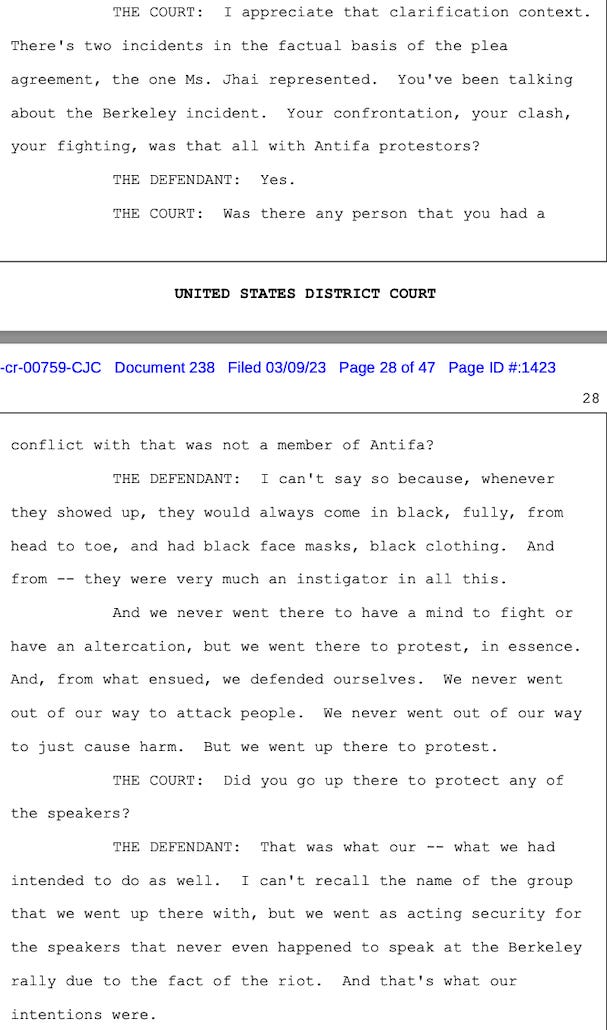
Carney asked Boman, “Your confrontation, your clash, your fighting, was that all with Antifa protestors?”
“Yes,” Boman answered, according to a court reporter’s transcript.
“Was there any person that you had a conflict with that was not a member of Antifa?” Carney asked. (FBI Director Chris Wray said at a congressional hearing in 2020 that “antifa” is “not a group or an organization. It’s a movement or an ideology.”)
“I can’t say so because whenever they showed up, they would always come in black, fully, from head to toe, and had black face masks, black clothing. … They were very much an instigator in all this,” Boman answered. “And we never went there to have a mind to fight or have an altercation, but we went there to protest, in essence. And, from what ensued, we defended ourselves. We never went out of our way to attack people. We never went out of our way to just cause harm. But we went up there to protest.”
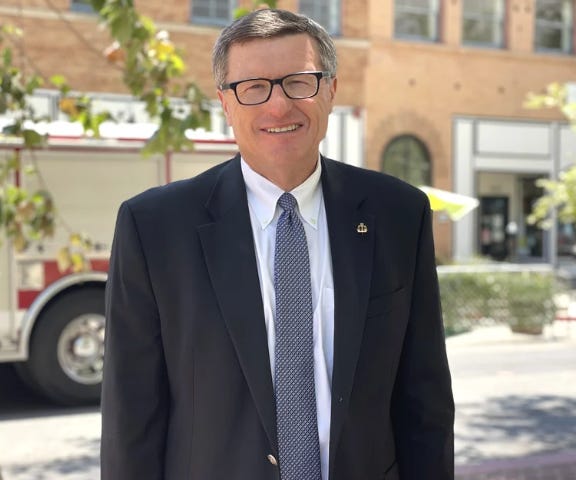
Jhai told the judge, “This is the first that the Government is hearing about specific disagreements with this factual basis.”
But Carney said he’d heard some of it before.
“I vividly recall in discussions at other hearings that this was really the confrontation with Antifa. And I recognized then, and I recognize again today, they’re not sympathetic victims. And I don’t know if some of these facts are in self-defense, and it’s not a crime,” Carney said.
Carney also questioned Boman about a rally in Huntington Beach that was mentioned in his plea deal.
“Was it only protestors belonging to Antifa?” Carney asked.
“I would say so, yes, to the best of my knowledge. And the statement where it says I had kicked a protestor in the back, he was pepper-spraying us as we’re walking with our signs. He let out a spray of pepper spray and then he tripped, and then I kicked him,” Boman said.
“Did you go up there to protect any of the speakers?” Carney asked.
“That was what our, what we had intended to do as well,” Boman answered.
Boman’s lawyer, Peter Swarth, told Carney they were “in a difficult place.”
“As I’m sure the court is aware, negotiating with U.S. government is a very difficult prospect at best. They are the most powerful force ever known, and they swing a very heavy weight,” Swarth said. “My client has been in custody for almost two years on this matter with a five-year max. So we got to a point where a plea was going to be more efficient for him than going to trial.”
Carney told Swarth, “You’re in a tough spot, and it’s a tough case.”
“And I’m not trying to aggravate or compound the situation, but I’ve never taken a guilty plea from someone who may be innocent,” the judge said.
Swarth told Carney the case “has to do with what you believe in terms of your politics, in terms of your ideology.”
Carney agreed and said he remembers “vividly seeing photographs of Antifa.”
“I vividly recall seeing — I don’t know whether it was the Huntington Beach or the Berkeley rally. And I recall a veteran in a wheelchair being — water or drinks or beverages were thrown at him. I remember an elderly woman being cut because Antifa was throwing stuff at her. I recall seeing certain speakers, because of their political views, were being shut down by Antifa,” the judge said.
He continued, “So that’s the basis for my statements that these aren’t some of the most sympathetic victims. And now I’m hearing — this is a new fact — that the person that Mr. Boman was kicking back, he was pepper-spraying people.”
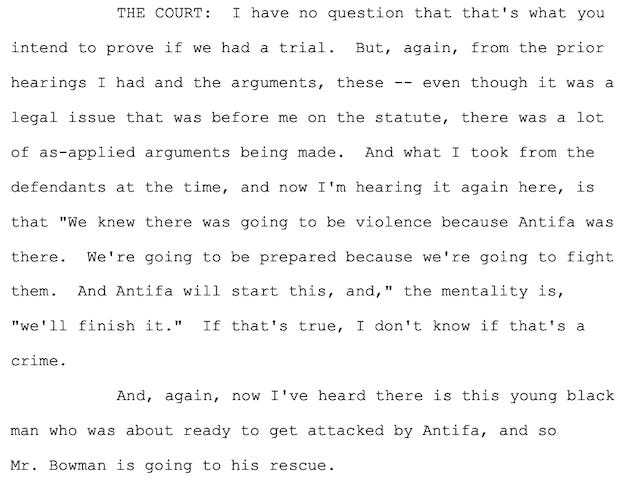
Carney also said Boman’s situation appears to have been, “We knew there was going to be violence because Antifa was there. We’re going to be prepared because we’re going to fight them. And Antifa will start this, and, the mentality is, we’ll finish it.”
“If that’s true, I don’t know if that’s a crime,” Carney said.
The judge also referenced Boman’s statements about a Black man being attacked and said Boman was “going to his rescue.”
Swarth said his client “has a meth habit” that got him in trouble before the 9th Circuit restated the case, but he wasn’t accused of theft of violent crime.
Carney then raised the issue of bail and asked where Boman would stay if he’s released. Swarth said Boman’s father “doens’t have a place for him,” but he could live with his mother in Kentucky. Swarth said he hadn’t been able to secure bail from the magistrate judge, referring to U.S. Magistrate Judge Alka Sagar who ordered Boman detained without bail.
Issued in May 2022, Judge Sagar’s order cited Boman’s “history of substance abuse,” “use of aliases and name variations” “history of outstanding warrants” and his “extensive criminal history” that includes violent crimes and “a lengthy juvenile record.” She also cited the violent acts alleged in the indictment “and that Defendant is a member of a violent White Supremacist organization.”
But during the February 2023 hearing, after Swarth mentioned Boman’s meth habit and his potential home with his mother in Kentucky, Carney said, “Based on that proffer, Mr. Swarth, that you made, I would consider giving Mr. Boman bail.”
The judge also suggested drug addiction treatment. “I know he’s been in custody, but the temptations are extreme,” Carney said.
Jhai told Carney that Sagar’s detention order was “grounded in Mr. Boman’s conduct. And so the government, at this time, still does continue to oppose bail.”
But Carney replied that he wasn’t “comfortable accepting a guilty plea based on what I heard before and then what Mr. Boman said today.”
“I’m not promising, Mr. Boman, that I would grant it, but I will seriously consider giving him bail,” Carney said.
One week later, Swarth, a sole practitioner in West Hills, filed an application for review of Sagar’s detention order. He included a letter from the intake coordinator at The Salvation Army Adult Rehabilitation Center in Santa Monica that said Boman “has been screened and approved for our residential Salvation Army Adult Rehabilitation Center program.”
“We will accept him directly from custody contingent upon court disposition and eligibility,” the letter said.
Carney authorized Boman’s release on a $5,000 bond on March 2, 2023. Swarth then joined in Rundo’s lawyers’ selective prosecution motion, which led to both his charges being dismissed on Wednesday alongside Rundo’s charges.
It wasn’t the first time Carney offered a Rundo co-defendant bail.
In January 2019, he vacated U.S. Magistrate Judge Rozella A. Oliver’s order denying bail for Aaron Eason and allowed him to be released on $175,000 bond. Eason’s charges were dismissed in January 2023 after he died.
Will Rundo appear in court?
The U.S. Attorney’s Office filed an emergency motion with the 9th Circuit at 1:56 p.m. on Thursday that requested an order authorizing Rundo’s arrest.
The motion said prosecutors asked Carney for an arrest warrant after the 9th’s order, and Carney referred the issue to U.S. Magistrate Judge Steve Kim, who hadn’t yet issued the warrant.
“Meanwhile, defendant is believed to have traveled to the Southern District of California, near the United States-Mexico border,” according to the motion from Assistant U.S. Attorney Bram Alden, chief of the Los Angeles office’s Criminal Appeals Section. “An emergency order from this Court is necessary to effectuate defendant’s arrest and prevent his flight.”
At 5:17 p.m., Alden filed a status report with a letter addressed to the clerk of court that said Judge Kim had ordered the issuance of an arrest warrant for Rundo. It says the warrant “leaves open the question of whether defendant must once again appear before a magistrate,” and it says Kim wrongfully stated that Rundo still can seek bail pending appeal.
“The district court already ordered defendant's release, and the government has already filed a notice of appeal and a request that this Court order defendant detained pending the government's appeal,” Alden wrote. “Moreover, if the district court were to once again order defendant's release, the government would be forced to file yet another emergency motion, repeating this cycle.”
In their status report filed at 11:46 p.m., Rundo’s lawyers said prosecutors told Judge Kim during an emergency hearing at noon that Rundo can contest his detention but now “says the exact opposite to this Court” by arguing an initial appearance isn’t necessary.
“What the government said just hours ago today (when it wanted the arrest warrant) is fundamentally different from what it says now (after it got the arrest warrant),” according to the report. “In their haste to effectuate an ultra vires arrest of Mr. Rundo, the government plays fast and loose with the United States District Court, and this Court.”
Deixler and Murphy said Judge Kim “presumably” issued his warrant based on the representation, and they as defense counsel relied on it when arranging Mr. Rundo’s “voluntary self-surrender.”
The 9th Circuit had not addressed the filings as of 1 a.m. on Friday.
Previous article:
White supremacist will leave jail 'imminently' under federal judge's order, DOJ tells 9th Circuit

UPDATE: A 9th Circuit panel early Thursday temporarily stayed Judge Carney’s order releasing Rundo, but Rundo already is out of custody. For the second time, a federal judge in Orange County has dismissed an indictment against white supremacists ac…
Thank you for supporting my independent legal affairs journalism. Your paid subscriptions make my work possible. If you’re not already a paid subscriber, please consider purchasing a subscription through Substack. You also can support me through Venmo (MeghannCuniff), CashApp ($MeghannCuniff) and Zelle (meghanncuniff@gmail.com). Thank you!
I don'tnormallycomment on news artuckes, but...
" “And I’m not trying to aggravate or compound the situation, but I’ve never taken a guilty plea from someone who may be innocent,” the judge said. " -- Says the judge who is clearly not aware of how the current judicial system works, particularly for those of various ethnicities, races, and socioeconomic classes.
(And also a judge who thinks antifa is a group, deserving a capital A. The term antifa is literally just a shortened way to say anti-fascism. So if you are against "Antifa" you are saying you are PRO-fascism. You are a fascist.)