
Ex-LA deputy mayor sentenced to 12 years in federal prison for RICO conspiracy
Raymond She Wah Chan, 69, had been working for the City of Los Angeles since 1984 when he began conspiring with a city councilman to collect bribes from developers.

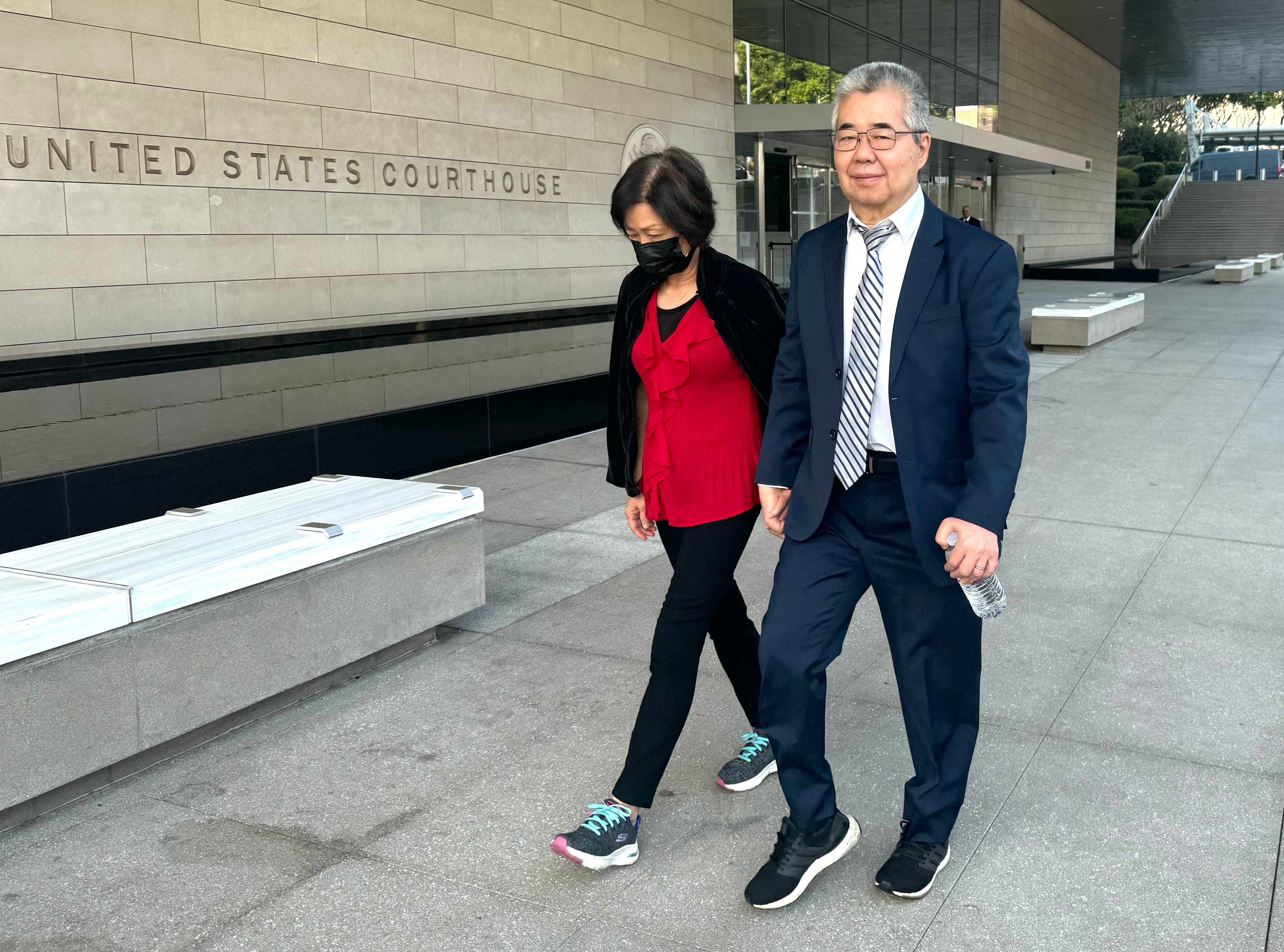
A federal judge on Friday handed a 12-year prison sentence to a career Los Angeles City Hall employee who helped developers repeatedly bribe a city councilman while he secretly collected his own bribes for his post-retirement consulting company.
Former Deputy Mayor Raymond She Wah Chan’s crimes “significantly undermined public confidence in our institutions” and showed “a calculated and deliberate violation of the trust placed” in him by the City of Los Angeles, said Senior U.S. District Judge John F. Walter.
“The defendant’s criminal conduct, viewed through the lens of our country’s traditional understanding of the profound evils of corruption, requires a substantial sentence,” Walter said at the end of a 2 1/2 hour hearing. “Any other sentence would erode our country’s utter rejection of any type of tolerance for corrupt governance.”
Chan, 69, told Walter earlier in the hearing that he takes “full responsibility” for his convictions, then lauded the work he did since he started with the City of Los Angeles in 1984. He said he believes he went the “extra mile to help hundreds of people.” But at the same time, his “desire … to help people” clouded his judgment “and I did something that I should not have done to help the wrong people.”
“I take responsibility for my wrong doings, and I regret my wrong doings. I just hope that, Your Honor, that my lifetime record of good deeds reflects that I am not the person that has been identified by my wrongdoings,” said Chan, who managed the the Los Angeles Department of Building and Safety before he became deputy mayor of economic development in 2016. He stopped working for the city in 2017.
Chan told the judge he hopes “that my lifetime record of good deeds … suggests that behind my wrongdoings, I really didn’t have the wrong intention.”
Judge Walter ordered Chan to report to prison on Jan. 6.
The judge also ordered him to serve three years probation when he’s released and to pay $752,457 in restitution to the City of Los Angeles. He’s to pay at least $185,000 immediately, then at least another $425,000 within six months. The remaining approximately $242,457 is to be paid while he’s in prison “at the rate of not less than $25 per quarter,” the judge said.
A jury in March deliberated about 90 minutes after a 12-day trial before convicting Chan of all 12 felony charges, including racketeering conspiracy, for a pay-for-play scheme with real estate developers and now-former Los Angeles City Councilman Jose Huizar. Huizar, who served on the City Council from 2005 to 2020, pleaded guilty to racketeering conspiracy and tax evasion in January 2023 and is to surrender to the Federal Bureau of Prisons by noon on Monday to begin his 13-year prison sentence.
Prosecutors said in their 50-page sentencing recommendation that Huizar remains “the face of corruption in Los Angeles,” but Chan “was the brains that devised some of the most sophisticated aspects” of the conspiracy, including the secret funneling of $600,000 from Wei Huang, a Chinese billionaire who owns the L.A. Grand Hotel Downtown, to settle a sexual harassment lawsuit against Huizar filed by a former employee with whom he was having an extramarital affair. At the same time, Chan used his position at City Hall to get money for a consulting company he’d secretly started with a real estate developer and planned to work for after retiring from the city.
Huang, who was trying to develop his hotel into a 77-story skyscraper, paid for Huizar and his assistant George Esparza to travel to Las Vegas 20 times between 2013 and 2017, gave them thousands of dollars in gambling chips and paid for their visits with prostitutes. He is charged with two crimes in Los Angeles federal court and has been a fugitive since he was charged in 2020.
Chan never went to Vegas with Huizar, but he helped facilitate Huizar’s relationship with Huang and sometimes checked in with the councilman about how things were going.
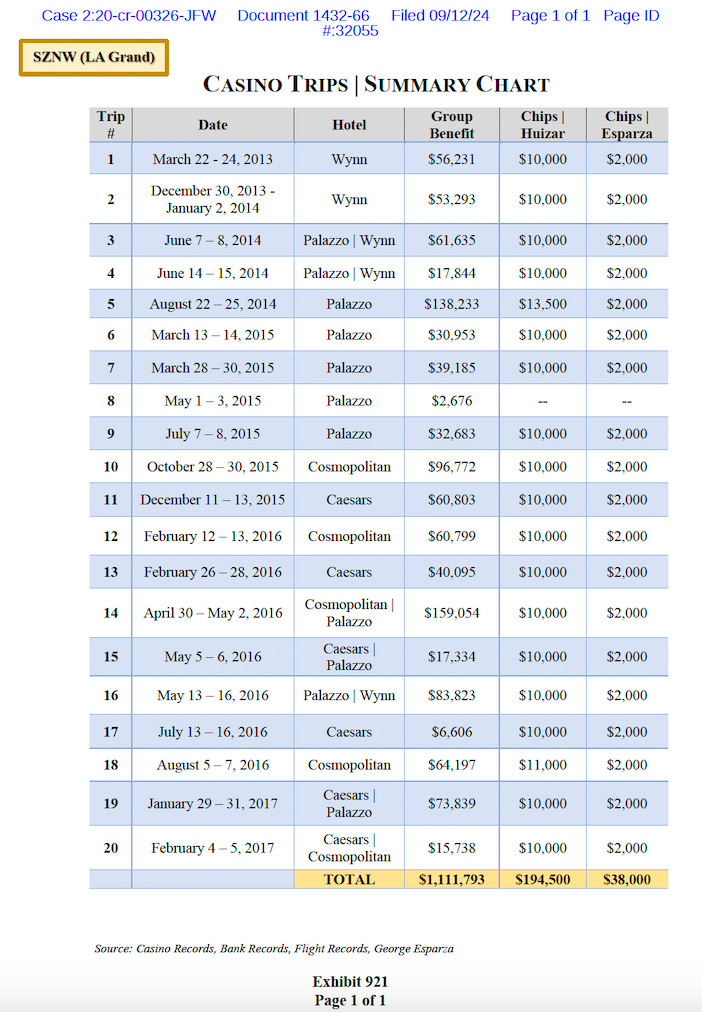
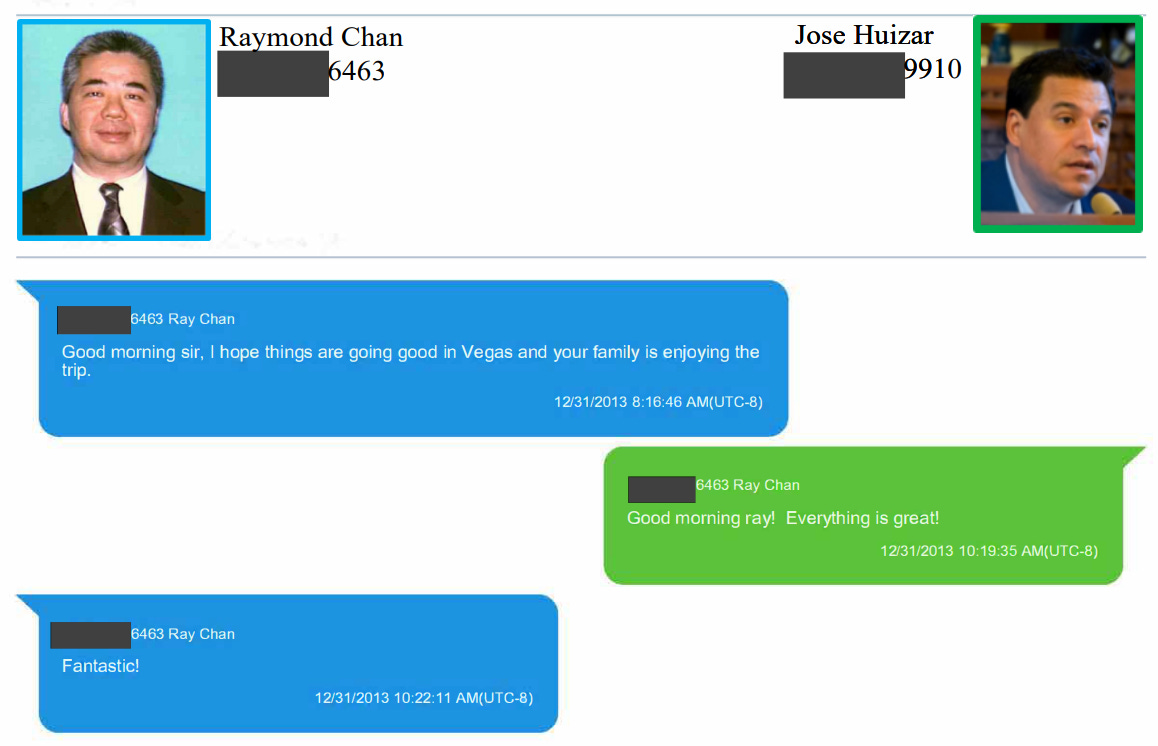
The jurors who convicted Chan in March saw text messages from Dec. 31, 2013, in which Chan wrote Huizar, “Good morning sir, I hope things are going good in Vegas and your family is enjoying the trip.” They also heard a covertly recorded phone call from 2017 between Chan and friend-turned-prosecution witness Andy Wang in which Chan discussed the federal investigation into Huizar and said “they’ve already connected it with Vegas” and “Vegas is a very big problem.”


Assistant U.S. Attorneys Cassie Palmer, Susan Har and Brian Faerstein called Chan’s crimes a “shameless and unapologetic betrayal of the public trust” in their sentencing memo and recommended Walter sentence him to 17 1/2 years in prison.
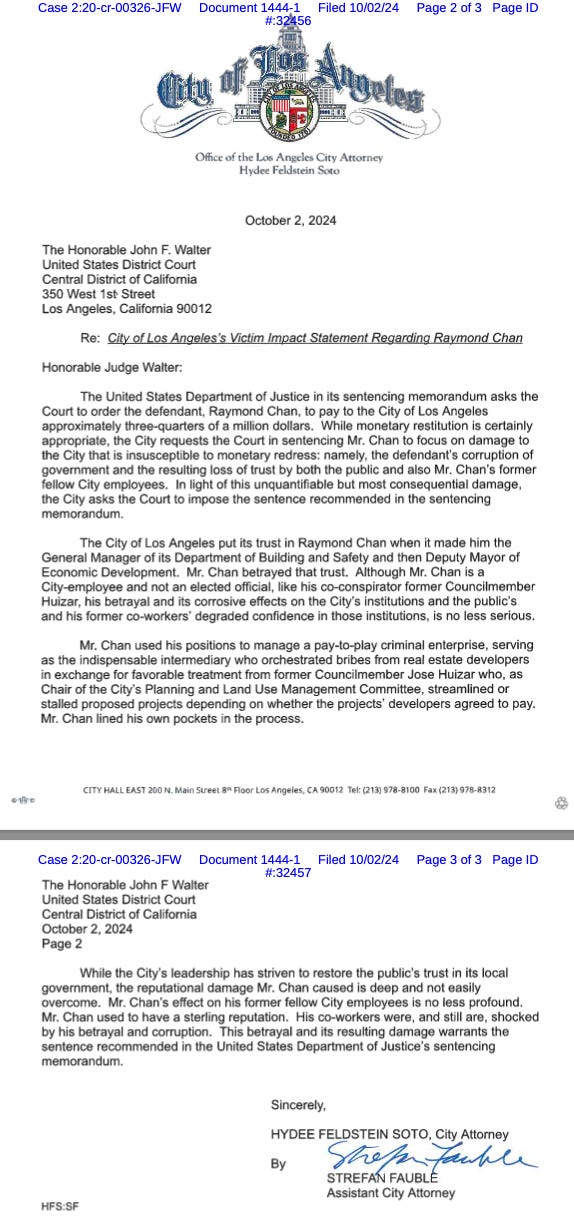
Los Angeles Deputy City Attorney Strefan Fauble said the city supported prosecutors’ recommendation because of Chan’s “betrayal and its resulting damage.”
“While the City’s leadership has striven to restore the public’s trust in its local government, the reputational damage Mr. Chan caused is deep and not easily overcome. Mr. Chan’s effect on his former fellow City employees is no less profound. Mr. Chan used to have a sterling reputation. His co-workers were, and still are, shocked by his betrayal and corruption,” Fauble wrote in a letter to Judge Walter.
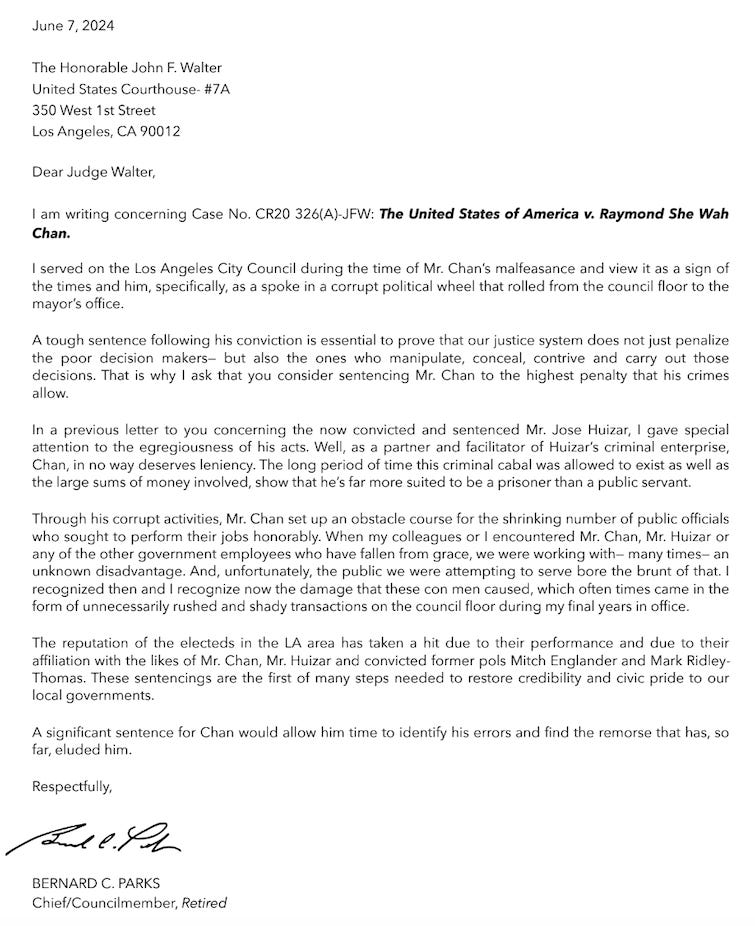
Former Los Angeles City Councilman and Police Chief Bernard Parks told Judge Walter that Chan “in no way deserves leniency.”
“The long period of time this criminal cabal was allowed to exist as well as the large sums of money involved show that he’s far more suited to be a prisoner than a public servant,” Parks wrote. “Through his corrupt activities, Mr. Chan set up an obstacle course for the shrinking number of public officials who sought to perform their jobs honorably.”
Chan’s lawyers, Michael Freedman and John Hanusz, filed 29 character reference letters from Chan’s friends and family that they said “paint a robust picture of a man who is devoted to his family and his extended community, supports charities, and contends with serious health struggles.”
Chan’s wife of 49 years, Sarah Chan, said in her letter that her husband retired in 2016 because he has the hereditary nerve-damaging disease Charcot-Marie-Tooth, and Mayor Eric Garcetti called him directly after he declined a one-year contract as deputy mayor.
“We were shocked. Mayor Garcetti said he was told by many constituents about Ray’s effort in helping their construction projects; their confidence investing in L.A. increased; and, as a result, they had been building more projects,” Sarah Chan wrote. “Because of that, he believed that Ray would be the best person for the Deputy Mayor position to improve the City’s economy. Mayor Garcetti insisted that Ray needed to accept his proposal.”
Freedman said on Friday that Garcetti, who’s currently President Joe Biden’s U.S. ambassador to India, asked Chan “to come out of retirement to be the deputy mayor for economic development.”
“He gave him the name ‘Building Booster,’” Judge Walter said.
“I think that’s right,” Freedman said.
Prosecutors said Chan’s standard sentencing range was 324 months to 405 months — 27 years to nearly 34 years — under U.S. Sentencing Commission Guidelines. They said his health and “prior history as a law-abiding public servant” are “modest mitigating factors” and a 210-month sentence was “significant” enough to “promote respect for the law, send a strong message of deterrence, and achieve the other goals of sentencing.”
The U.S. Probation Office recommended 10 years in prison. Freedman and Hanusz, recommended 33 months, which Walter said on Friday “would be grossly insufficient.”
Prosecutors based their standard range calculation partly on the amount of money associated with Chan’s bribery and honest services fraud convictions, which they said was $1.95 million. The money included $1,679 Chan paid for Kendrick Lamar concert tickets and $1,932.76 he paid for tickets to a San Francisco Giants versus Los Angeles Dodgers baseball game.
Chan’s lawyers said the figure “is a gross exaggeration of Chan’s liability.” They said Chan only received $69,969, and he “should not be held liable for the acts of others in which he played no part or were not foreseeable to him.”
“Any participation on Chan’s part in the scheme resulted in very little gain for himself,” according to the 42-page defense sentencing recommendation.
They also said Chan “was not an organizer, leader, manager, or supervisor in Huizar’s enterprise” and shouldn’t be punished as one, and they said he qualified for a reduced sentence under a new first-time offender adjustment implemented by the U.S. Sentencing Commission in 2023. They also argued he shouldn’t be considered a public official because his job was a “ministerial function,” and they said his false statements to investigators shouldn’t be considered obstruction of justice.
Judge Walter rejected each argument on Friday.
The judge said the sentencing enhancement involving a public official can apply simply because of Huizar’s involvement, but he also said Chan qualifies as a high-level public official “as detailed in his own resume.” He also applied an enhancement for Chan being an organizer or leader because he said Chan was “significantly involved in all aspects of the pay-to-play scheme.” He also said Chan “even exerted some measure of control over Huizar” based on testimony that “Huizar never said ‘no’ to Chan.”
Walter also said Chan “profited significantly from the pay-to-play scheme” in the amount of $752,457, which reflects “defendant’s 50 percent share” of the money his company received from Shenzhen Hazens, a real estate company owned by billionaire Fuer Yuan that was trying to grease the city approval process for the redevelopment of the Luxe Hotel downtown.
Walter said testimony from George Chiang, the real estate developer with whom Chan created his post-retirement consulting company, and “other evidence conclusively demonstrated” that Chan tracked bribe payments not directly going to him. Chan also considered half the payments going to the company “to be his even though he did not begin to draw on those bribes until after he left the city,” the judge said.
Walter also said Chan obstructed justice by deleting texts between him and Huizar, writing”attorney-client privilege” on incriminating documents, trying to influence witnesses and lying to FBI agents, and he ruled Chan can’t be considered a zero-point offender because the aggravating nature of his crimes, despite his lack of criminal history.
The judge also said Chan could have been ordered to pay the City of Los Angeles restitution for all the money his company with Chiang received from the Luxe Hotel company, instead of the half-share of $752,457. Har said she and her colleagues were being “conservative” and understand that even if they had gone for the full amount, it would still fall under $3.5 million and thus wouldn’t have changed the sentencing enhancement under U.S. Sentencing Commission Guidelines when the amount is factored into the total loss amount. Walter said he saw no reason why it couldn’t have applied to restitution.
Prosecutors calculated the loss amount for Chan’s crimes at $1,949,565, with which Walter agreed on Friday.
The judge said Chan’s responsibility for bribes related to the Luxe Hotel project was “not a close call” because he was “intricately involved in every aspect of the large bribery scheme,” including pressuring David Ambroz, then the president of the Los Angeles City Planning Commission, to vote in favor of the project in 2017.
Ambroz testified in trial about meeting with Chan at the Mama Shelter bar in Hollywood and leaving feeling as though he’d “been leaned on.”
“I remember walking out being like, Who do I call? Do I call the mayor? Do I call a hotline and say, ‘Hey, I think the deputy mayor is trying to lean on me?’” Ambroz testified.
Judge Walter said Friday that he was particularly touched by the letter from Chan’s wife describing how he “has always called friends and all members of his family and how he now cares for his 91-yea- old mother, who he probably will never see again.” But, the judge said, corrupt public officials often “can parade before the court a virtual unending stream of letters attesting to those good qualities.”
“This ability is often the result of what brought the defendant to prominence as a public official,” Walter said. He also said Chan should not be credited for his good work for the city “because that’s exactly what was expected of him and what he was paid to do.”
The judge also said Chan cannot escape “an otherwise appropriate sentence by propping up his family to invoke undue sympathy.”
“The effect of defendant’s absence on his family is extremely common, and it’s why a defendant should think about his family before committing crimes,” Walter said.
Walter agreed with prosecutors that Chan’s standard range is 324 months to 405 months, but he went with a larger downward variance than prosecutors recommended in part because of Chan’s health. He said Chan is “prone to tripping and falling” and the Bureau of Prisons “may not be equipped” to handle his health issues.
The judge also said he believes Chan showed remorse when he spoke during the hearing, but the 144-month sentence still accounts for his “lack of his acceptance of responsibility.” Any disparity between public corruption sentencings “is not unwarranted and is fully justified by the unique circumstances of this case.”
“Defendant's sentence must reflect the extraordinary harm done to the City of Los Angeles,” Walter said.
Walter quoted U.S. Supreme Court Justice Kentaji Brown Jackson’s dissent in Snyder v. United States, which held that after-the-fact gratuities to public officials are not illegal under federal bribery laws: “Officials who use their public positions for private gain threaten the integrity of our most important institution. Greed makes governments at every level less responsive, less efficient and less trustworthy from the perspective of the communities they serve.”
Walter repeated what he said when sentencing multimillionaire developer David Lee in July 2023 to six years in prison for paying Huizar a $500,000 bribe.
“I am under the view that political corruption is a unique and infectious crime with rippling and enormous consequences to society. Keeping corruption in check has been a matter of public urgency throughout our nation’s history,” the judge said. “The crushing weight of corruption on the integrity of every democratic element of our government has been in and will continue to be a constant concern.”
The trial in March was Chan’s second time before a jury. His original counsel, longtime Los Angeles lawyer Harland Braun, fell ill during the first trial, and Judge Walter eventually declared a mistrial.
Before the first trial began, prosecutors upset about Braun’s “increasingly unprofessional and bizarre personal attacks” filed emails with the court that included Braun stating on May 26, 2020, six months before Chan was indicted, “that Mr. Chan was preparing a written explanation of relevant facts and that he was interested in cooperating.”
He never did so. Freedman and Hanusz took over his defense after Braun’s illness.
They said in court on Friday that they’ll seek bail as they appeal Chan’s convictions to the 9th Circuit U.S. Court of Appeals.
The other defendants
The other defendants in the City Hall corruption scandal are to be sentenced in the coming months.
They include:
Huizar’s brother Salvador Huizar pleaded guilty on Oct. 19, 2022, to a false statements charge in a cooperation deal. Prosecutors agreed to recommend no more than six months in prison.
Esparza pleaded guilty on July 22, 2020, to racketeering conspiracy. Prosecutors agreed to recommend no more than 87 months in prison, which is 7.25 years. He testified in Chan’s trial.
Chiang pleaded guilty on June 26, 2020, to racketeering conspiracy. Prosecutors agreed to recommend no more than 70 months in prison, which is 5.83 years. He testified in Chan’s trial.
Justin Kim, Huizar’s political fundraiser who helped broker Lee’s $500,000 bribe, pleaded guilty to bribery on June 3, 2020. Prosecutors agreed to recommend no more than 57 months in prison.
Morris Roland Goldman, a former Los Angeles lobbyist who now works at a winery in northern California, pleaded guilty on Sept. 30, 2020, to honest services fraud and conspiracy to commit bribery. Prosecutors agreed to recommend no more than 30 months in prison. He testified in Chan’s trial.
Court documents:
joint statement on disputed loss amount
Prosecutors’ sentencing memorandum
Los Angeles City Attorney’s Office’s letter to Judge Walter
Former City Councilman and Police Chief Bernard Parks’ letter to Judge Walter
Chan’s character reference letters
Previous articles:
July 22, 2023: Cash-flush developer gets 6 years in prison for ‘unique and infectious crime’ of public corruption
March 2, 2023: Testimony implicates ex-L.A. Deputy Mayor Raymond Chan in developer's $600K sex harassment settlement bribe to Jose Huizar
9th Circuit to hear argument in David Lee’s and Mark Ridley-Thomas’ corruption cases
The 9th Circuit U.S. Court of Appeals is scheduled to hear argument on Nov. 21 in longtime Los Angeles politician Mark Ridley-Thomas’ appeal in his University of Southern California bribery case. The same three-judge panel also will hear argument in Lee’s appeal as well as the appeal in his company’s case.
I wrote an article about Ridley-Thomas appeal for the nonprofit news organization L.A. Public Press that explains how the Supreme Court case that Judge Walter cited on Friday factors in. You can read it here. Court documents are linked in the article.
One thing that didn’t make the article: U.S. District Judge Dale Fischer last weighed in on the case in February, when she rejected a request from Ridley-Thomas’ coconspirator, former USC School of Social Work Dean Marilyn Flynn, to loosen her home detention requirements and allow her to leave her home between 8 a.m. and 10 a.m. each day to “walk her neighborhood or nearby flat park area to do the walking exercises prescribed by her doctor.”
Prosecutors didn’t oppose the request, but Fischer said Flynn provided no reason why she can’t use a treadmill or walk on her own property, and she pointed out that Flynn said her doctor told her to walk for 60 to 90 minutes each day, and she was requesting two hours out.
“Ms. Flynn may submit further evidence to supplement her request, keeping in mind that the Court carefully considered the very lenient sentence it imposed rather than what would have been a reasonable sentence of imprisonment,” Fischer wrote. Flynn’s lawyers haven’t filed anything since.
Court documents:
Jan. 3: David Lee’s opening brief
May 13: Prosecutors’ answering brief
Thank you for supporting my independent legal affairs journalism. Your paid subscriptions make my work possible. If you’re not already a paid subscriber, please consider purchasing a subscription through Substack. You also can support me through Venmo (MeghannCuniff), CashApp ($MeghannCuniff) and Zelle (meghanncuniff@gmail.com). Thank you!