
Citing lawyer's illness, judge declares mistrial in ex-Los Angeles deputy mayor's corruption trial
Raymond Chan's lawyer Harland Braun was hospitalized during trial with only a few days of testimony remaining, and his son says he's unable to return to the courtroom.


A legendary lawyer’s health problems have derailed the final trial in a broad federal prosecution over Los Angeles City Hall corruption.
U.S. District Judge John F. Walter declared a mistrial Thursday morning in Raymond Chan’s racketeering case, nearly six weeks after trial was last in session.
“It is my view that the court has no alternative but to grant the defendant’s motion for mistrial,” Walter said. “Defense counsel’s unanticipated and serious medical condition has resulted in a serious delay in the midst of the trial.”
The judge ordered Chan to hire a new lawyer by April 24. He declined Chan’s request for an additional month but said he may consider giving him more time if he hasn’t found someone by the 24th. A status conference is scheduled for April 28.
“Mr. Chan, you’re to be involved in interviewing attorneys. I urge you to complete this process so we can get this trial back on track,” Walter said.
Prosecutors had only two witnesses remaining when Chan’s lead lawyer, Harland Braun, was hospitalized a few hours after court ended on March 2. Jurors were to return March 27, but Braun’s son and law partner, Adam Braun, told Walter at a March 16 status conference that while his father had been released from the hospital, he was unable to return to court.
Braun’s associate Brendan Pratt, a licensed attorney since 2021, filed a motion for mistrial, but the judge deferred ruling and instead demanded more information about the 80-year-old Braun’s medical issues. Walter extended the jury’s return date to April 24, but he said Thursday that a sealed declaration from Braun and a letter from his doctor indicate he won’t be able to return to trial until August or September at the earliest. And even then, Braun may not be capable of full-time work.
The information finally persuaded Walter that declaring a mistrial was his only option.
“If the court were to delay the proceedings until Mr. Braun is fully recovered it will likely be more than five months since the jury last heard testimony,” Walter said.
Prosecutors didn’t oppose the request. Adam Braun attended the hearing and told Judge Walter he’d relay his well wishes to his father.
“I don’t want to see him retire,” Walter said.
“Your hopes for him are mine as well. I hope he can recover and in some form or another continue practicing,” Braun said. He’d told Walter at a previous hearing that his father wishes he could return to the courtroom for Chan.
“He loves trial. He loves his practice,” the younger Braun said.
Chan, who retired from the City of Los Angeles in 2017, faces potentially decades in prison if convicted of his 12 felony charges, which are connected to a years-long organized bribery scheme prosecutors say he helped former Los Angeles City Councilman Jose Huizar orchestrate with real estate developers.
The mistrial is a huge disruption for others charged in the City Hall conspiracy: No one has been sentenced yet, and anyone who is a cooperating witness in Chan’s trial will have their sentencing delayed until after Chan’s case is resolved.
That doesn’t include Huizar, though his sentencing already has been delayed to Sept. 25. But it does include Huizar’s former assistant George Esparza, whose sentencing already has been moved from June 5 to Oct. 27.
The mistrial also a startling disruption to Braun’s storied career as one of Los Angeles’ most prominent criminal defense attorneys.
Mark Werksman of Werksman Jackson & Quinn LLP told Legal Affairs and Trials that Braun has long been a leader in the Los Angeles legal community.
“Harland Braun is a great lawyer and a good person and his career has been an inspiration for many of us in the defense bar,” Werksman said.
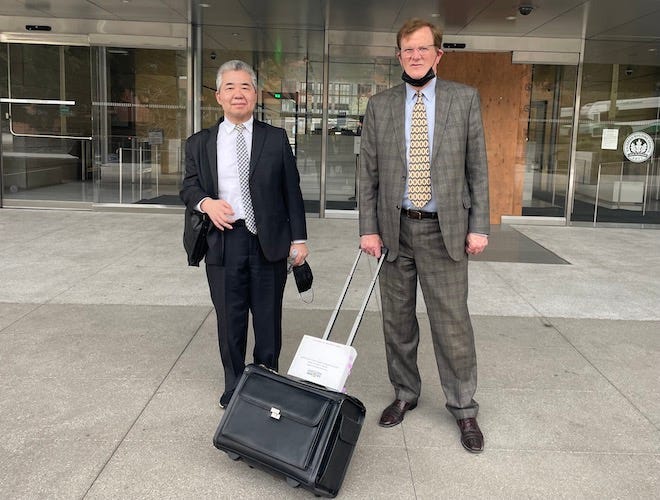
Braun’s illustriously brash approach to criminal defense
A licensed attorney in California since 1968, Braun became well-known early in his career when he successfully defended Vincent Buglosi, a prosecutor in the Charles Manson murders case who was charged with perjury. He went on to win acquittal in 1987 for director John Landis in an involuntary manslaughter trial against the Twilight Zone filmmakers, then successfully defended Los Angeles police Officer Ted Briseno in 1993 on federal civil rights charges over the beating of Rodney King.
John Barnett, a longtime criminal defense attorney who successfully defended Briseno in his state criminal case, said Braun’s representation of Briseno exemplifies his fearlessness.
“When he took Ted Briseno’s case, LAPD hated Ted for telling the truth,” Barnett told Legal Affairs and Trials, referring to Briseno’s testimony in the state trial that his fellow officers were “out of control.”
“The country hated Ted for being LAPD, and after Ted was acquitted, the city got burned down,” Barnett said, calling Braun “scary smart.” “And he took the case after that. He is fearless and has always represented his clients to the exclusion of all else.”
Braun has always been known for his brash approach. In a TV news clip from the Twilight Zone trial, Braun told a reporter that then-Los Angeles County Deputy District Attorney Lea D’Agostiono is “dishonest and a sick woman.” During his representation of Briseno, he said the officer had used his left boot “like a ballet slipper.”
But Braun also had substance: In a press conference after jurors acquitted Briseno but convicted three other officers, he said of federal prosecutors, “Although they can go and have a party tonight I think they have to in the depths of their souls realize that they indicted an innocent man in an attempt to manipulate him to convict someone else.”
‘His streams of non-responsive and non-substantive emails’
Braun took the same brash approach in Chan’s case, but court filings show it may not have had the same effectiveness that previously earned him so many courtroom victories.
Braun missed key case deadlines, including failing to file a proposed statement of the case for prospective jurors. Judge Walter ended up writing his own proposal for the defense. Braun also questioned in a pre-trial conference whether prosecutors can bring racketeering charges over political conduct, which caused Walter to say, “The time for that was in the last two years.”
Walter also sustained at least 12 objections during Braun’s rambling opening statement on Feb. 21, which included Braun telling the jury, “Chinese this. Chinese that.”
He was apparently referencing his belief that prosecutors are targeting Chan because of his Chinese heritage, which Judge Walter had ruled he wasn’t allowed to do in trial.
It was far from the first time he’d raised the subject: Prosecutors said in a pre-trial motion that “unfounded attacks” alleging racial bias “have been a consistent theme from Harland Braun, counsel for defendant Raymond Chan, in his streams of non-responsive and non-substantive emails.”
They included with the motion a Nov. 6, 2022, email in which Braun wrote, “We do not plan to put on a cultural defense nor do we think the government's motive is racist. The government is simply stupid. Obviously some of the government agents are racist. The cultural differences explain but do not excuse any conduct.”
Braun ended the email, “Too bad AUSAs have no intellectual or moral integrity.”
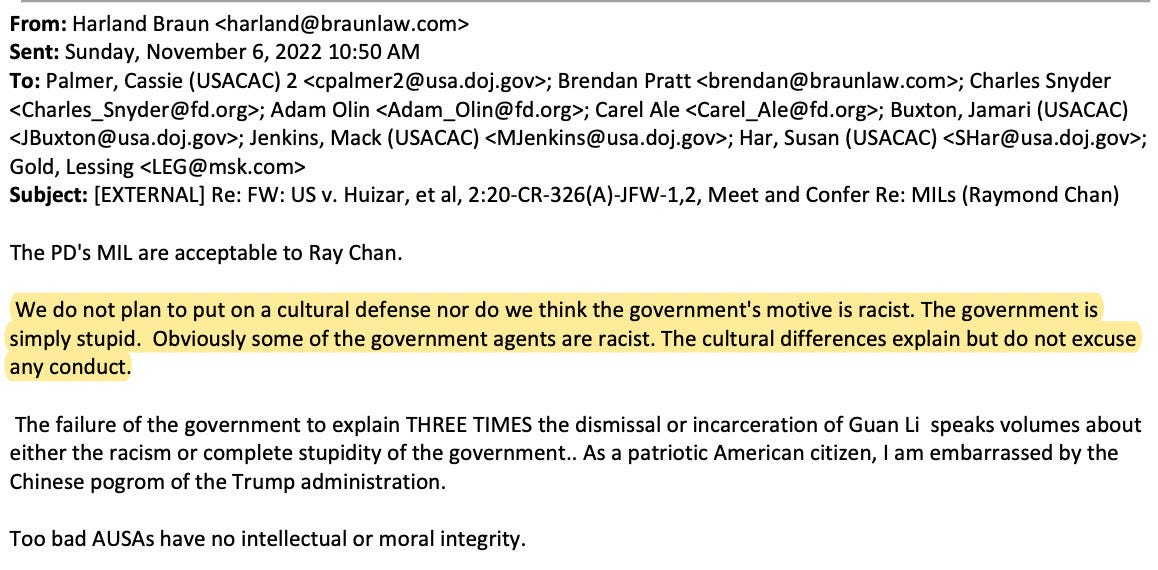
It wasn’t the first time prosecutors alerted Judge Walter to Braun’s correspondence with them In October 2021, they filed a series of emails they described as “increasingly unprofessional and bizarre personal attacks against the prosecutors assigned to this case.”
“Despite the government’s repeated requests to stop such communications and to maintain a professional and respectful dialogue, Mr. Braun has demonstrated an escalating pattern of baseless and non sequitur personal attacks,” according to a declaration from Assistant U.S. Attorney Mack Jenkins, now the chief of the Central District U.S. Attorney’s Office’s criminal section.
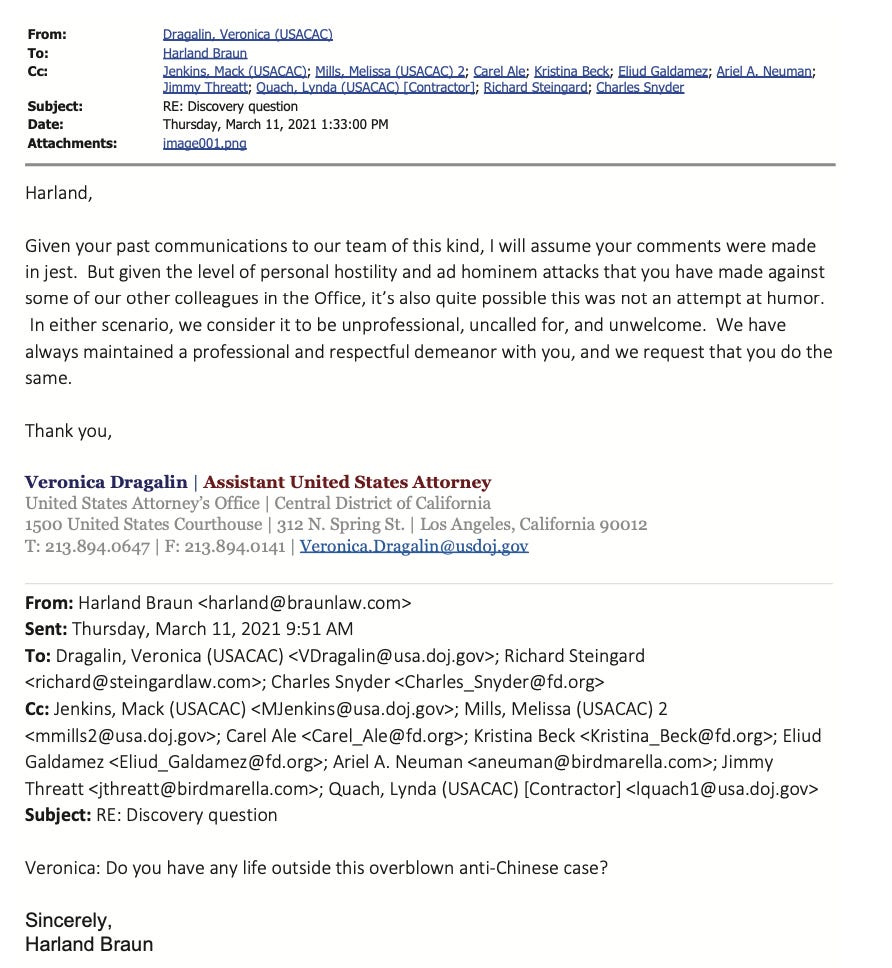
The emails include Braun hitting ‘reply all’ on a March 11, 2021, message then-Assistant U.S. Attorney Veronica Dragalin sent with him and about 10 other attorneys as CC recipients.
His message was brief.
“Veronica: Do you have any life outside this overblown anti-Chinese case?” he asked.
Dragalin’s reply referenced Braun’s previous conduct.
“Given your past communications to our team of this kind, I will assume your comments were made in jest. But given the level of personal hostility and ad hominem attacks that you have made against some of our other colleagues in the Office, it’s also quite possible this was not an attempt at humor,” Dragalin wrote. “In either scenario, we consider it to be unprofessional, uncalled for, and unwelcome. We have always maintained a professional and respectful demeanor with you, and we request that you do the same.”
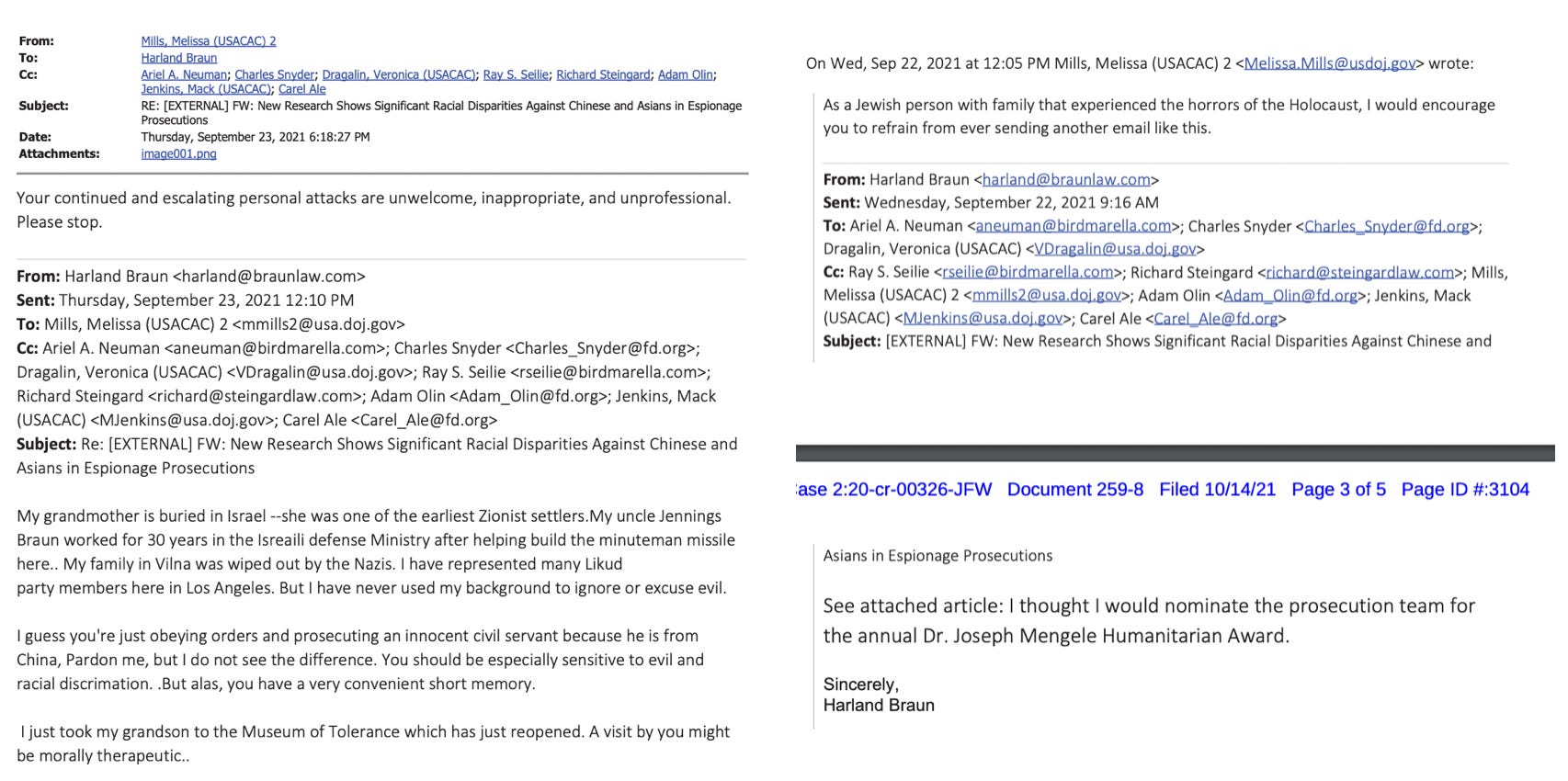
In another email, Braun told prosecutors, “I thought I would nominate the prosecution team for the annual Dr. Joseph Mengele Humanitarian Award.”
Assistant U.S. Attorney Melissa Mills replied, “As a Jewish person with family that experienced the horrors of the Holocaust, I would encourage you to refrain from ever sending another email like this.”
‘I think you take yourself too seriously’
The emails show Chan wanted to cooperate with federal authorities well before he was indicted.
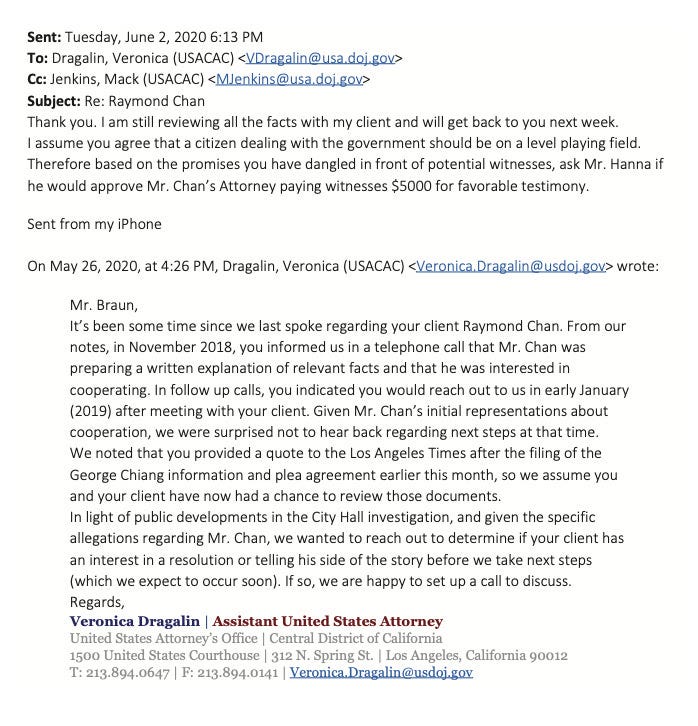
On May 26, 2020, six months before Chan was indicted, Dragalin emailed Braun reminding him that he informed prosecutors in November 2018 “that Mr. Chan was preparing a written explanation of relevant facts and that he was interested in cooperating.”
“Given Mr. Chan’s initial representations about cooperation, we were surprised not to hear back regarding next steps at that time,” Dragalin wrote. “In light of public developments in the City Hall investigation, and given the specific allegations regarding Mr. Chan, we wanted to reach out to determine if your client has an interest in a resolution or telling his side of the story before we take next steps (which we expect to occur soon). If so, we are happy to set up a call to discuss.”
Braun replied a week later saying he was “still reviewing all the facts with my client and will get back to you next week.”
“I assume you agree that a citizen dealing with the government should be on a level playing field. Therefore based on the promises you have dangled in front of potential witnesses, ask Mr. Hanna if he would approve Mr. Chan’s Attorney paying witnesses $5000 for favorable testimony,” Braun wrote, referring to Nick Hanna, then the U.S. attorney for the Central District of California.
When Dragalin replied that she assumed Braun’s comments “were made in jest” and stressed the illegality of paying witnesses to influence testimony, Bran replied, “A bribe occurs every time the government offers the possibility of a reduced sentence for favorable testimony.”
“Just pointing out the obvious inequity in our system. From the tone of your answer, be careful. I think you take yourself too seriously,” he wrote.
Prosecutors have said in filings that they’ve offered to sit down with Braun and Chan to explain the extensive evidence against him and the significant prison term he’s facing if convicted.
Jenkins, the chief of the criminal section, told Walter that they’ll offer to do that with Chan’s new lawyer as soon as he hires one. Jenkins referenced “new evidence” prosecutors gathered during in the five weeks since trial was last in session.
Thank you for supporting my independent legal affairs journalism. Your paid subscriptions enable me to go in-depth and unfiltered on major issues. If you’re not already a paid subscriber, please consider purchasing a subscription for yourself or a gift subscription for someone else. Your support is absolutely essential to my work.
So it sounds like Chan’s going to make the deal he should have in 2018, or they’ll go the Jose Huizar route and charge his kid, wife and Judo pals. Will he flip on others in the City Family who aided real estate corruption? Will Jose? And what about the stalled Assessor case?
The following is not a statement of fact. It is an opinion. A conjecture. 100% speculative:
"The judge ordered Chan to hire a new lawyer by April 24."
“Mr. Chan, you’re to be involved in interviewing attorneys. I urge you to complete this process so we can get this trial back on track,” Walter said.
OOOOhhh, scary! Judge Walters is so very, very strict.
Look what he did with Jose Huizar.
Granted a postponement of one year for trial start date.
Twice!
Request to postpone sentencing?
Sure, no problem - is 5 months enough?
Mistrial - this part of the show is over because the purpose was accomplished.
The purpose - the Councilman Jose Huizar telenovela.
Hang the laundry on the line for all to see.
The Fresh Prince of Boyle Heights.
Princeton educated barrio boy who can't keep his zipper closed.
The man who would be Mayor - a sleazy goofball, jackass who brings shame and humiliation to his loyal spouse and gets his mother and brother mixed up with the Feds.
A wonderful laughingstock for all of City Hall to ridicule and enjoy.
Ray Chan, Harlan Braun running the miracle medical mistrial Chinatown Shakedown.
Braun's dissallowed defense is simply a side hustle, not for domestic consumption.
Big Bad racist, anti-chinese govt. prosecutors coming after Mr. Chan.
That's all they need to hear when its time for the chinese fugitive investors to kick-in for Braun's legal fees for Chan
And it will be a doozy.
Braun's tour-de-force of legal artistry.
170 meetings with defendant Chan, often for several hours at a time, before trial.
All the associated hours of legal research and preparation of filings and composition of baseless ad-hominem emails to the prosecution.
The $600,000 for the extra pie for Huizy will look like a bargain next to Braun's triple-padded invoice.
The invoice will contain enough porkfat to cover the decimated book-value of Braun's reputation and the plain paper bag for Walters.