
Cash-flush developer gets 6 years in prison for 'unique and infectious crime' of public corruption
The Bel Air multimillionaire paid a $500K bribe to ex-Los Angeles City Councilman José Huizar to try to avoid an appellate delay in a downtown real estate development.


A federal judge on Friday sentenced a commercial real estate developer to six years in prison for bribing ex-Los Angeles City Councilman José Huizar in a corruption conspiracy he said embodied standard elements of white-collar crime.
“As with most white-collar defendants who appear before the court, in my view, the only regret they have is that they got caught,” said U.S. District Judge John Walter of the Central District of California in Los Angeles. “They believe that if they get caught, they’ll never be charged and if they are charged, they can favorably resolve the charges.”
“These beliefs and attitudes are present in this case,” Walter continued.
Dae “David” Yong Lee, 58, showed “arrogance” and “a lack of remorse” by directing an employee to falsify business records, Walter said, and by downplaying his crimes and the FBI investigation in a call with a longtime associate who was secretly working as a federal informant.
The judge said he believes Huizar is most culpable in the conspiracy, but he didn’t buy the argument that Lee was victimized, saying instead that the choice to partake was “easy” for Lee.
“He readily accepted and exploited his relationship with Mr. Huizar, and the $500,000 bribe was minuscule” compared to the millions of dollars in additional project costs he sought to avoid, Walter said.
Walter said Lee was “rightly concerned” that a lengthy prison sentence will mean he’ll never see his elderly mother again after he goes to prison. The judge also cited concerns from Lee’s family about his prolonged absence. He said such concerns are “extremely common.”
“It is why defendants should think of their families before committing crimes, not after they get caught,” Walter said.
After the hearing, Assistant U.S. Attorney Mack Jenkins told reporters he was pleased with the six-year sentence, which he noted was much longer than the 20 months Lee requested and longer than the U.S. Probation Office’s five-year recommendation. Prosecutors had recommended seven years.
“We definitely appreciate the court’s view on white-collar defendants,” said Jenkins, who is chief of the Central District U.S. Attorney’s Office’s Criminal Division. He was joined in court by Assistant U.S. Attorneys Cassie Palmer, Susan Har and Brian Faerstein.
About 20 of Lee’s friends and family members attended the hearing. His lawyers also submitted 94 pages of letters from supporters, as well as a seven-page letter from Lee.
In court on Friday, Lee apologized to “the court and the people of Los Angeles” as well as to his family.
“I’m especially sorry for my wife. … I will regret for the rest of my life bringing her through this, as well as my daughter and two sons,” he said. He said he’s “still learning from my mistake.” (Earlier, Walter stopped Lee’s attorney Ariel Neuman after he said “mistake” and told him Lee’s conduct wasn’t merely a mistake, “it was a crime.”
A jury on June 27, 2022, convicted Lee and his company 940 Hill LLC of three felonies each: honest services wire fraud, bribery and falsification of records in a federal investigation.
The crimes stem from a plan to build 14,000 square feet of commercial space and 232 condos at 940 S. Hill St. in downtown Los Angeles. The property was part of Lee’s $180 million real estate portfolio, and he’d worked with the Los Angeles City Planning Department to obtain required approvals. But he ended up in Huizar’s orbit after a labor group appealed the project in August 2016.
At the time, Huizar was settled into a racketeering conspiracy that involved regularly shaking down developers looking to do business in his district. According to trial testimony and court documents, Huizar met with Lee at a karaoke bar to discuss the appeal, and the councilman told the developer he had his support.
The next day, Huizar’s longtime assistant, George Esparza, told Lee there would be a cost, which eventually led to Lee paying $500,000 cash. He paid the money in three drops in February, March and April 2017 to Justin Jangwoo Kim, a real estate appraiser who was close with Lee and “moonlighted as a top fundraiser for Huizar,” according to the prosecution’s sentencing memo. It was Kim who later flipped and secretly recorded Lee discussing the investigation for the feds, in which Lee made several statements that Judge Walter quoted in Friday’s sentencing hearing.
‘A unique and infectious crime’
Lee’s lawyers cited Huizar’s plea agreement when asking for a 20-month sentence. Huizar’s standard range under U.S. Sentencing Guidelines is 262 months to 327 months, which is nearly 22 years to just over 27 years.
Prosecutors’ agreement to instead recommend between 108 months and 156 months, which is nine years to 13 years, “demonstrates that a significant departure from the Guidelines along the lines of what Mr. Lee is requesting here is appropriate,” according to the 32-page memo from Neuman and Ray S. Seilie of Bird, Marella, Boxer, Wolpert, Nessim, Drooks, Lincenberg & Rhow, P.C.
However, Judge Walter hasn’t formally accepted Huizar’s pleas to tax evasion and racketeering conspiracy, and he indicated on Friday he may instead give Huizar more time in prison than prosecutors’ recommendation. Walter said prosecutors have “failed to adequately or persuasively explain why Huizar’s proposed sentence would not create unwarranted sentence disparity.”
The judge said political corruption “is a unique and infectious crime with rippling and enormous consequences to society.”
“Keeping political corruption in check has been a matter of public urgency throughout our nation’s history,” Walter said. He called Lee’s crimes “a very serious offense which requires, in my view, a significant or substantial prison sentence.”
The judge said Lee doesn’t qualify for credit for acceptance of responsibility because he took his case to trial. But Walter also emphasized that the 72-month sentence was not at all influenced by the decision to exercise his right to a jury trial.
Walter called Lee’s 20-month recommendation “extremely low.” His decision to impose 72 months was driven by the seriousness of Lee’s crimes as well as the judge’s belief that Lee is “unique in that his life story is full of struggle, hard work and, ultimately, success.”
“During his journey, defendant has never lost sight of the importance of family, church and friends,” Walter said, citing Lee’s letters of support.
Walter said he found the letter from Lee’s wife most persuasive.
“I agree with his wife’s stated observation that the defendant is a good man who made a huge mistake,” the judge said.
In addition to 72 months in prison, Walter fined Lee $750,000 and his company, 940 Hill LLC, nearly $1.1 million, which Lee has said he’ll pay instead of his business partners. Lee will be on probation for three years after he leaves prison.
The judge also ordered 940 Hill to implement a “compliance and ethics program” to prevent future criminal conduct. He declined prosecutors’ request that the company announce its wrongdoing in the Los Angeles Times, calling it “unnecessary.” Lee’s case was covered by several news outlets, Walter said, and “the court is certain that the media will also widely publicize the court’s sentence.”
Walter ordered Lee to report to prison on Oct. 4.
Lee’s group tries to physically block photos
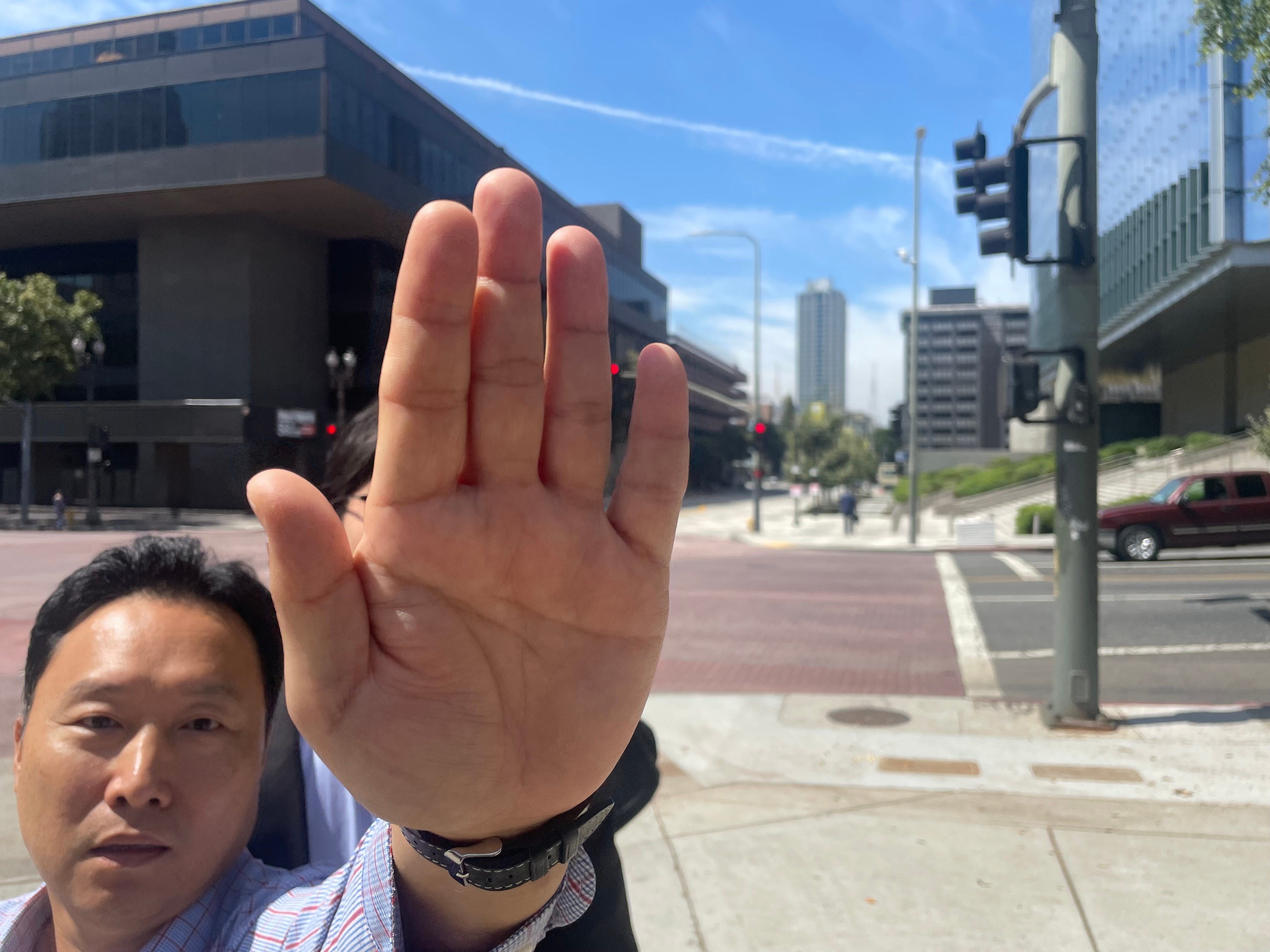
Lee left the courthouse with his family and friends, some of whom actually physically accosted me when I was trying to photograph Lee outside the courthouse.
I had never experienced anything like it, and I hope to never experience anything like it again. Two men repeatedly pushed me and tried to physically block my path. They grabbed me and tried to restrain me, and a woman even ripped my cell phone out of my hands. She gave it back after a few seconds. I didn’t say anything other than I am a journalist covering a public corruption case and also you can’t steal my phone.
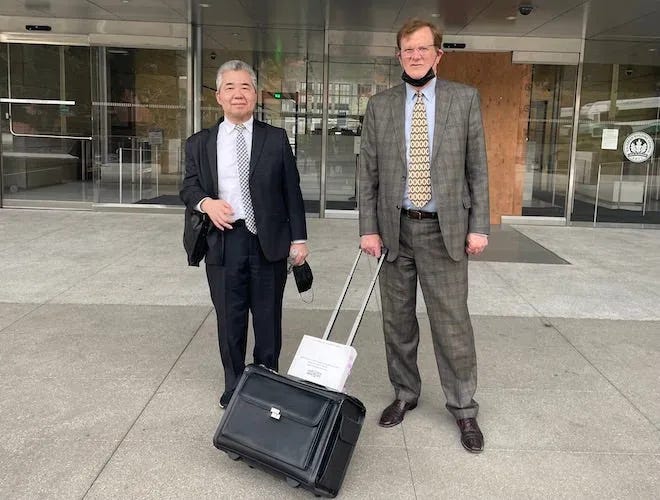
I am not going to apologize for taking photos of criminal defendants in public places, particularly those involved in public corruption cases. Some of them even like it! When I photographed former L.A. Deputy Mayor Raymond Chan leaving his public corruption trial in February, he and his then-lawyer Harland Braun proudly posed.
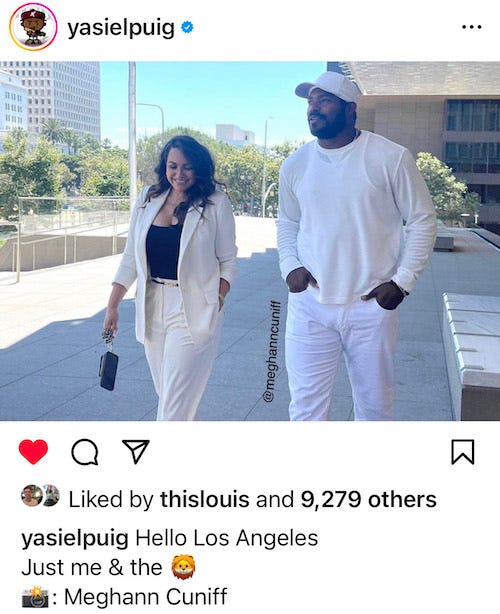
And look what happened on Wednesday when I photographed former Dodgers star Yasiel Puig leaving the courthouse with his agent, Lisette Carnet. (He was there for a hearing in his criminal case for allegedly lying to federal agents in an illegal gambling investigation.) My photography has value, and I’m going to keep doing it.
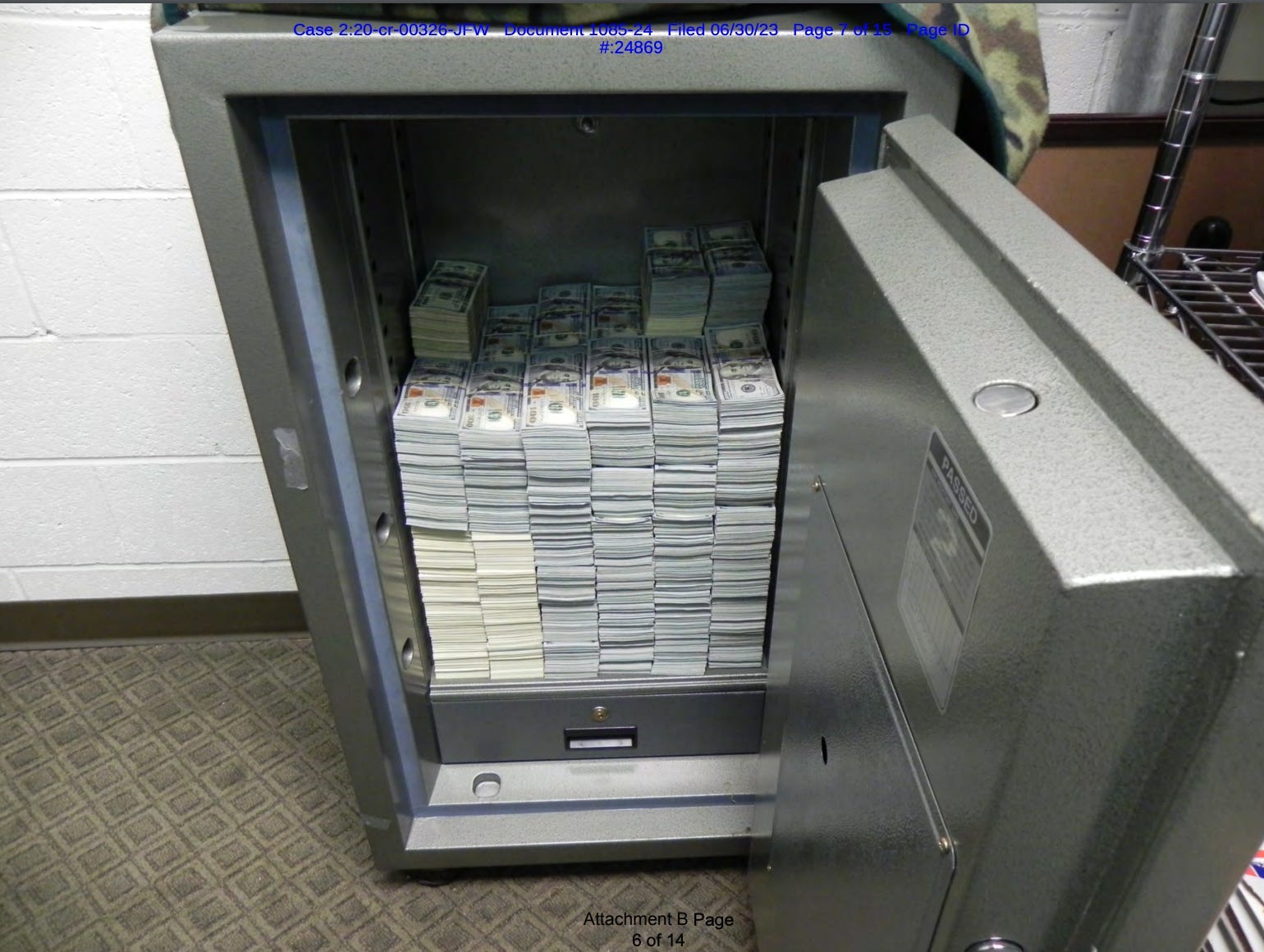
One of the young men with Lee hurled what he thought was an insult at me: “Look at your cracked, poor phone.” It well captured an issue I find intriguing in Lee’s case and in other white-collar criminal cases: Wealth. Lee is a multimillionaire who lives in a mansion in Bel Air, put three kids through expensive private schools all the way up to graduate school and had millions of dollars of cash in safes in his office. He built a small clothing accessory store into a major supplier and employer that helped fuel his real estate empire. His developments include Stanford Plaza in the downtown Fashion District.
Prosecutors noted his “extensive” access to cash in their sentencing memo by referencing a separate money-laundering investigation involving Mexican drug cartels that included a raid at Lee’s office, where investigators seized $4.2 million.
“After the filing of the charges against defendants Lee/940 Hill (more than six years later), defendant Lee requested that the government return the seized cash, which the government did,” prosecutors wrote.
On wealth and criminal defendants…
Prosecutors and Lee’s lawyers argued in their briefs over how his success should factor into his sentence, and it reminded me of the first federal sentencing I remember covering.
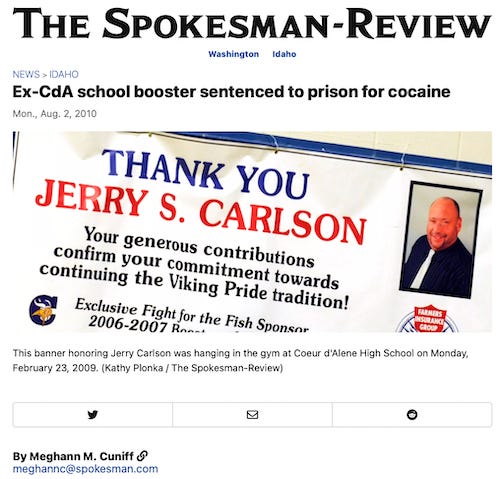
It was a case I’d followed since arrest: Jerry Carlson, an insurance agent in Coeur d’Alene, Idaho, and well-known high school sports booster, was picked up on federal cocaine charges in February 2009.
I was a reporter for The Spokesman-Review, and I knew the Coeur d’Alene school officials because I’d covered K-12 education out of the paper’s Coeur d’Alene bureau. It was the middle of the school day, so instead of picking up the phone, I drove to Coeur d’Alene High School, walked into the administration lobby and asked for the principal. Soon, I was telling him (to a shocked, shocked reaction) that Jerry Carlson had been arrested for cocaine distribution. Yes, the Jerry Carlson whose face is on a banner in the school gymnasium thanking him for his support. That Jerry Carlson.
The principal and the other administrators were speechless. It was a big local story, and I followed Carlson’s federal prosecution through his plea agreement and sentencing. The sentencing hearing focused heavily on privilege and class. It was handled by U.S. District Judge Justin Quackenbush of the Eastern District of Washington in Spokane, who coincidentally has been a visiting judge in the Central District as well as the District of Idaho. (I profiled him for the Daily Journal in 2016.)
I remember Judge Quackenbush waxing philosophical about Carlson’s culpability versus the culpability of a low-income man with no opportunities. My article from then includes this passage: In weighing the request for leniency, Quackenbush compared Carlson, noting his college education and successful career, to an uneducated young Mexican man caught trying to smuggle drugs into the United States in exchange for money to feed his family. “Who is the most culpable?”
Quackenbush sentenced Carlson to 27 months in prison; the standard range was 37 months to 46 months.

The crimes are far different, but the debate between prosecutors and Lee’s lawyers about the role his success should play in sentencing wasn’t all that different than the debate at Carlson’s sentencing. Judge Walter’s approach, however, was more methodical than Judge Quackenbush’s. He didn’t speak off the cuff: He read aloud a written ruling that thoroughly discussed all sentencing factors and applicable procedures. He addressed the debate about Lee’s achievements in a split way: He rejected the defense argument that Lee’s conduct was aberrant, but he credited him for living a life grounded in faith, friends and family and told him he believes his remorse was sincere. That’s what saved Lee from a sentence longer than 72 months.
Another difference between Carlson’s case and Lee’s case: After he was released from prison, Carlson friended me on Facebook, and we are still friends on there. Something tells me I’m not going to be getting any friend requests from Lee’s camp.
The other defendants
AUSA Jenkins said Friday he expects Huizar’s sentencing to take place Dec. 15 as currently scheduled, but the sentencings for defendants with cooperative plea agreements must wait until after former Deputy Mayor Ray Chan’s case is resolved. Trial is scheduled to begin March 12.
Here’s the status of the other cases:
Huizar, who resigned from the Los Angeles City Council in 2020, pleaded guilty in January to racketeering conspiracy and tax evasion and is out of custody awaiting sentencing. Judge Walter has not formally accepted his pleas. His sentencing has been rescheduled twice and is currently set for Dec. 15, with recommendations due Nov. 20. Prosecutors agreed to recommend no more than 13 years in prison and no less than nine. Their recommendation for Lee references the “extremely detailed” 42-page factual basis Huizar signed as part of his agreement: “The public and fulsome admission of corrupt conduct meaningfully serves the public by providing finality and clarity.” Huizar’s agreement does not require his cooperation against other defendants.
Huizar’s plea followed his brother, Salvador Huizar, 56, pleading guilty on Oct. 19, 2022, to a false statements charge in a deal that calls for him to cooperate fully with prosecutors, including through trial testimony. Prosecutors agreed to recommend no more than six months in prison. His sentencing is scheduled for Nov. 3. Judge Walter allowed him to travel to Vancouver and Calgary, Canada, from June 20 to July 1. Walter also allowed him to visit Puerto Vallarta, Mexico, from Jan. 28 to Feb. 2.
Esparza, 36, pleaded guilty on July 22, 2020, to racketeering conspiracy. Prosecutors agreed to recommend no more than 87 months in prison, which is 7.25 years. The deal requires his cooperation against other defendants. He’s scheduled to be sentenced on Oct. 27.
Real estate development consultant George Chiang, 44, pleaded guilty on June 26, 2020, to racketeering conspiracy. Prosecutors agreed to recommend no more than 70 months in prison, which is 5.83 years. The deal requires Chiang’s cooperation against other defendants. (He was a witness in Chan’s trial.) He’s scheduled to be sentenced on Oct. 23.
Kim, Huizar’s political fundraiser who helped broker Lee’s $500,000 bribe, pleaded guilty to bribery on June 3, 2020. Prosecutors agreed to recommend no more than 57 months in prison. The deal requires Kim’s cooperation against other defendants. The 56-year-old is scheduled to be sentenced on Oct. 23.
Morris Roland Goldman, a former Los Angeles lobbyist who now runs a winery in northern California, pleaded guilty on Sept. 30, 2020, to honest services fraud and conspiracy to commit bribery. Prosecutors agreed to recommend no more than 30 months in prison. The deal requires Goldman’s cooperation against other defendants. (He testified in Chan’s trial.) The 60-year-old is scheduled to be sentenced on Nov. 3.
The San Francisco company CP Employer, Inc., formerly known as Carmel Partners, Inc., paid a $1.2 million fine in December 2020 as part of a non-prosecution agreement.
Another company, Jia Yuan USA Co., Inc. agreed to pay $1.05 million in another non-prosecution agreement. Jia Yuan is a subsidiary of the Chinese-based Shenzhen Hazens, which is owned by Fuer Yuan, a wealthy developer hoping to redevelop the Luxe City Center Hotel in downtown Los Angeles
Previous coverage:
Developer who bribed ex-L.A. Councilman José Huizar asks for leniency as feds seek 7 years

Federal prosecutors say a developer convicted of bribing former Los Angeles City Councilman José Huizar should spend seven years in prison, and they’re differentiating him from Huizar by referencing the disgraced politician’s “public and fulsome admission of corrupt conduct.”
The full sentencing memorandums are available below for paid subscribers. Your paid subscriptions make my work possible.
Thank you for being a paid subscriber!