
Feds want corrupt LA politician Jose Huizar to do 13 years for RICO pay-to-play conspiracy
Huizar had been on the Los Angeles City Council for 15 years when he resigned in 2020 amid a criminal case stemming from his Vegas gambling trips with a developer.


Prosecutors want a former Los Angeles politician to serve 13 years in federal prison for turning his downtown City Council district into a racketeering enterprise that included lavish Las Vegas gambling parties and trysts with prostitutes arranged by a billionaire developer who’s now a fugitive.
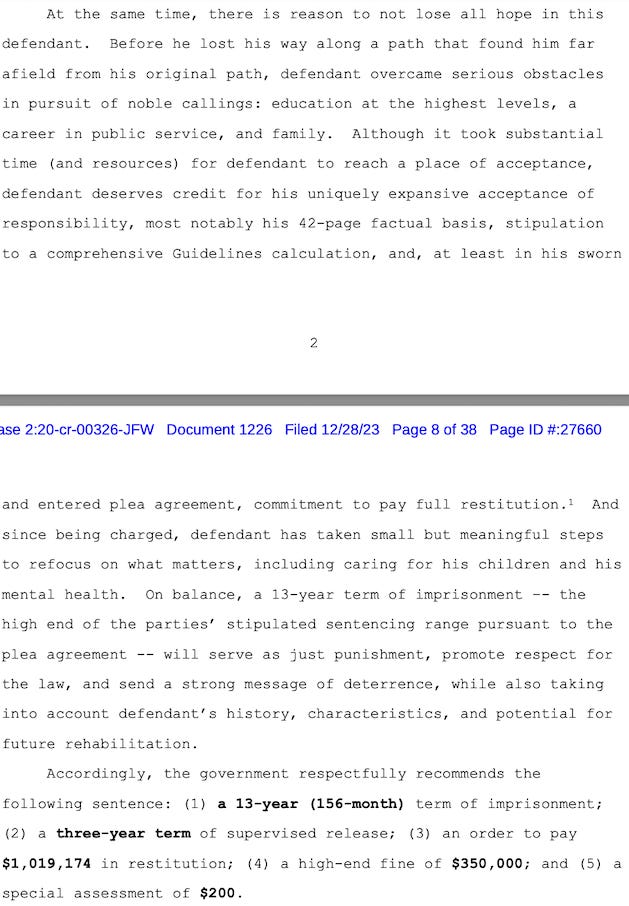
The recommendation from the U.S. Attorney’s Office asks U.S. District Judge John F. Walter to give Jose Luis Huizar a break because of his life’s accomplishments, including as an elected leader, and his acceptance of responsibility for a years-long crime spree that “further degraded an already cynical American public’s trust in the fairness and integrity of government.”
Huizar’s public defenders are asking for an even bigger break, saying a nine-year sentence “is more than sufficient to communicate not only a message of justice, but one of fairness, proportionality, and redemption.” Their recommendation acknowledges Huizar’s crimes but touts achievements that are “virtually impossible to catalogue” and says he “experienced a downfall of almost incalculable proportions” after losing his his way amid alcoholism and “a pattern of increasingly reckless personal misconduct.”
The defense recommendation also says Huizar “became an increasingly marginal participant” in the pay-for-play scheme as deep loyalty formed between his aide and associates of the developers who were bribing him. The young men — George Esparza, George Chiang, Justin Kim and Ricky Zheng — referred to themselves as “the Korean, Chinese and Mexican Mafia,” Huizar’s lawyers said.
“None of this means that Mr. Huizar is not guilty of a RICO conspiracy. Nor does it mean that any of the facts in his plea agreement are untrue. He is guilty, and the facts are true, which is why he entered a plea. But, as with most complex human endeavors, the reality is not as simple as the story has sometimes been made out to be,” according to the memo from Deputy Federal Public Defenders Charles J. Snyder and Adam Olin, which also says, “The truth is that, like all of us, like the city of Los Angeles itself, Mr. Huizar is not easily reduceable [to] a single moral label.”
Judge Walter indicated during developer David Lee’s sentencing in July that he may buck both recommendations and impose a lengthier sentence on the former 15-year councilman. The U.S. Probation Office is calling for him to do so: A report on Huizar recommends 20 years in prison, which still is nearly two years less than he faces under the U.S. Sentencing Guidelines.
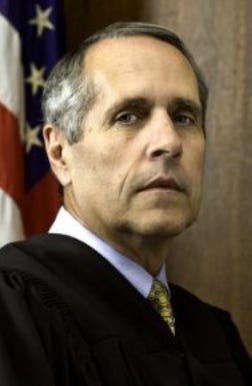
A 2002 George W. Bush appointee, Walter sentenced Lee, a real estate magnate who lives in Bel Air, to six years in prison for paying Huizar a $500,000 cash bribe over a downtown development project. He’s to surrender on Jan. 2 after the 9th Circuit denied his motion for bail pending appeal.
The judge will announce Huizar’s sentence during an 8 a.m. hearing Jan. 26 at the new federal courthouse in downtown Los Angeles. He recently rejected Huizar’s request to delay the hearing to Feb. 26, which cited medical information sealed from public view. In September, Walter granted Huizar’s request to travel to his hometown in Mexico with his mother and sisters “to worship at religious sites important to his Catholic faith.”
Filed Thursday, the sentencing recommendations from the U.S. Attorney’s Office and the Federal Defender’s Office span 180 pages — 142 are the defense’s — and detail the rise and fall of one of Los Angeles’ most prominent politicians. Huizar, 55, moved from rural Mexico to east Los Angeles with his family when he was a boy. He became the first in his family to go to college, then became a lawyer before launching a political career that began with the Los Angeles Unified School Board and eventually put him at the helm of influential development projects in downtown L.A. He has a bachelor’s degree from UC Berkeley, a master’s degree from Princeton University and a law degree from UCLA.
“Like anyone raised in the Boyle Heights area, I am keenly aware of how monumental was Jose Huizar’s journey from Mexico to elected office,” according to a support letter from Gregory J. Boyle, founder of the gang rehabilitation group Homeboy Industries, referring to Huizar’s working class neighborhood just east of downtown L.A.
“The degree of difficulty of any young person in this community, of which I am privileged to live, is challenging and arduous to say the least,” Boyle continued. “I remain in awe at what Jose has had to carry rather than in judgment at how he’s carried it. He has, of late, truly inhabited a humility and remorse and clearly, he is a whole lot more than the worst thing he's ever done.”
Boyle’s letter is one of 52 from Huizar’s family, friends and associates that his lawyers hope will help persuade Judge Walter to sentence Huizar leniently. One from his cousins Evelia and Elpidio Huizar says “the mistakes Jose made later in life are definitely out of character” and he’s “very remorseful and ashamed for all wrong doings but unfortunately they happen and he has to face the consequences.”
“We would love to have him home as soon as possible to continue being the great person he was and can continue to be and more than anything be home and present with his young children,” they wrote.
Huizar’s 83-year-old mother, Isidra Huizar, also wrote to Judge Walter and described her son’s pivotal role in her daily life.
“I call him for everything, and he solves my problems. More than anything, at my age of 83 years old with my medical conditions I need him desperately, and I don’t even want to think about life without him,” she wrote.


Huizar pleaded guilty on Jan. 20, 2023, to one count of conspiracy to violate the Racketeer Influenced and Corrupt Organizations (RICO) Act and one count of tax evasion. His plea agreement came nearly three years after he was charged and three months after his brother, Salvador Huizar, struck a deal with prosecutors that called for him to cooperate fully, including through trial testimony.
Salvador never took the stand, but Huizar’s estranged wife, Richelle Rios, testified last February in the trial of Raymond Chan, a former Los Angeles deputy mayor who is the only defendant in the corruption conspiracy with unresolved charges. Chan’s trial ended in a mistrial after his 80-year-old lawyer, L.A. legal legend Harland Braun, fell ill; his second trial is scheduled to begin on March 12 with new defense counsel.
Prosecutors mentioned Huizar’s family in their 38-page sentencing memorandum, saying the councilman “covered his tracks with layers of concealment, including by shamelessly exploiting his elderly mother, brother, and wife to launder his illicit proceeds.” Huizar also pressured his wife to run for his City Council seat to keep the power in the family, and he orchestrated campaign donations for her through his bribery scheme that targeted developers looking to build in downtown Los Angeles.
Still, prosecutors acknowledge Huizar’s achievements and his extraordinary rise from poverty to power and said he deserves credit for his uniquely expansive acceptance of responsibility” through the 42-page factual basis that accompanied his plea deal.
Huizar’s flashiest relationship was with Wei Huang, a billionaire Chinese developer who wanted to turn the 13-story L.A. Grand Hotel into a 77-story skyscraper.
Esparza, a longtime aide to Huizar who took a plea deal in 2020, has testified in detail about his boss’ corrupt relationship with Huang, which included extravagant trips to Las Vegas with high-end gambling, elaborate meals and expensive prostitutes.
The trips are what led to Huizar’s downfall. After the councilman handed his identification to an employe at a blackjack table at The Venetian Resort’s Palazzo casino, a security officer told him he’d been identified as an elected official and asked him to sign a document confirming his casino chips were his and not a gift.
According to Esparza, Huizar refused and fled the casino, then took steps to “cool off” that didn’t include halting his crimes but did involve changing casinos and sometimes taking Southwest Airlines flights to Vegas instead of Huang’s private jet. It wasn’t enough to stave off detection: According to Esparza, surveillance footage of Huizar with Huang at the Palazzo ended up in the hands of the FBI agents who uncovered the massive scandal in an investigation dubbed Casino Loyale.
The federal probe revealed not only Huizar’s and Huang’s penchant for lavish hedonism but a secret deal that involved Huang giving Huizar $600,000 to settle a sexual harassment lawsuit from a staffer with whom he’d had an extramarital affair.
Esparza said the billionaire referred to as the “most expensive p***y he’s ever paid for” during a Las Vegas rendezvous shortly after the settlement.
Huizar’s conspiracy involved five main schemes
Along with Huang’s hotel project, Huizar’s racketeering scheme included a bribery conspiracy involving the Luxe Hotel project in downtown L.A. that paid Huizar in campaign donations, a trip to China, alcohol for a party and tickets to concerts such as Katy Perry, The Weeknd and Kendrick Lamar.
Huizar also took $150,000 in campaign contributions from the development company Carmel Partners to support a housing project in ways that prosecutors say “highlight how willingly he betrayed the rights of the City and the community in order to serve himself, his rapacious greed, and his criminal enterprise.”
Specifically, the councilman vote against a labor union’s appeal of the project, and he approved changes to the project that prosecutors said “significantly reduced the project’s affordable housing requirements -- hurting the homeless to benefit Carmel’s bottom line.”
“Defendant’s vote had the effect of both decreasing the ratio of affordable housing units and eliminating access entirely for the lowest-income individuals -- contrary to the stringent requirements recommended by a City body earlier in the approval process. Carmel Partners, on the other hand, benefited by way of $14 million in net savings,” according to the sentencing memo from Assistant U.S. Attorneys Mack E. Jenkins, Cassie D. Palmer, Susan S. Har and Brian R. Faerstein.
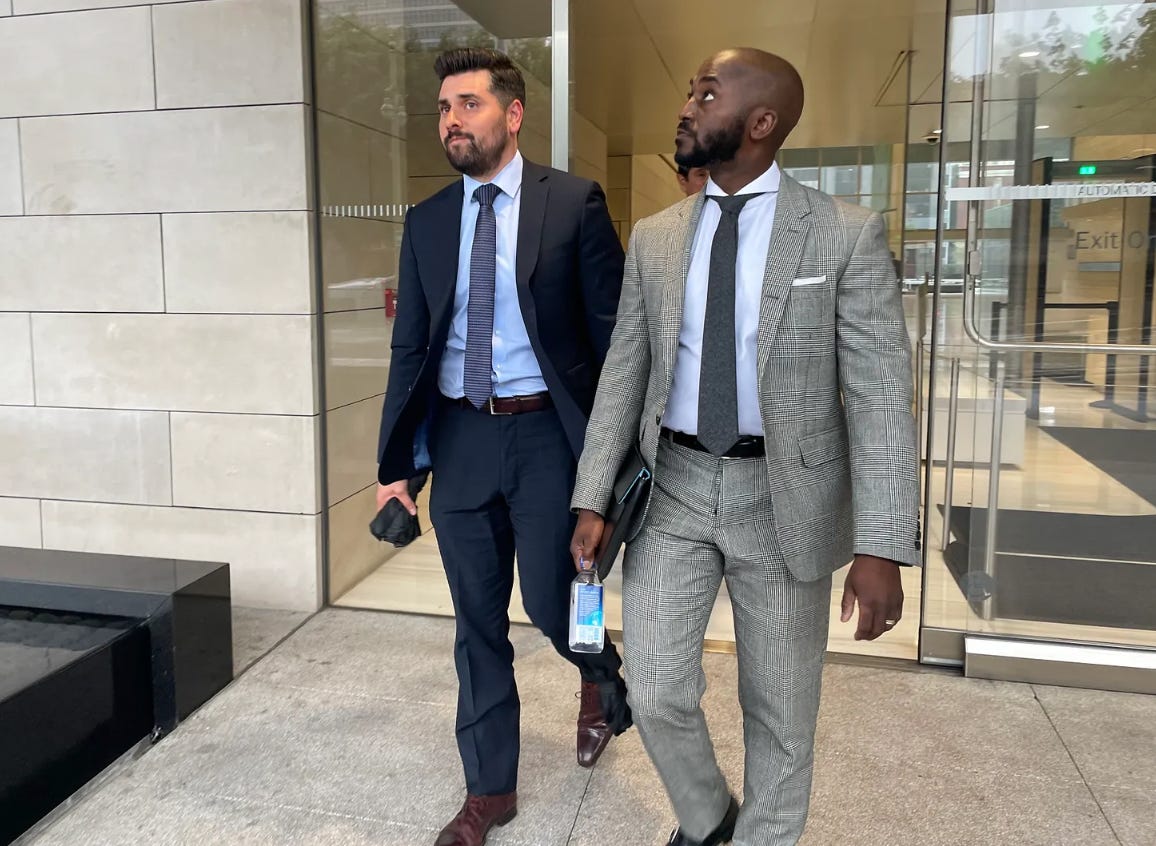
Huizar also took nearly $100,000 in bribes from a businessman, identified by the Los Angeles Times as Andy Wang, that included hotels, prostitutes, meals and other gifts. He also took $25,000 for his wife’s campaign in exchange for city recognition of his contributions to the city.
Update: The prosecution memo identifies the man as Businessperson A, who would be Wang, but it appears to be Huang who got the city commendation, not Wang.
Additionally, Huizar took $500,000 in cash as a bribe from developer David Lee to support his downtown condo and commercial project in the face of labor union’s appeal.
“By this point, defendant was keenly aware that the FBI was circling, and so he instructed his right-hand man and de facto corruption coordinator, George Esparza, to hold and hide the money on his behalf,” prosecutor wrote.
Esparza testified last year that he hid $200,000 in cash for Huizar in two liquor boxes — Johnnie Walker Blue Label and Don Julio — stored in his bedroom at his grandparents’ home in Boyle Heights.
Prosecutors have photos of the cash in the boxes, along with photos of cash spread out with notes attached saying, “Giving cash to CM Huizar 2/10/2017” and “Giving him cash from Justin Kim for Olympic & Hill project. - No Unions 2/10/17.”


Esparza wasn’t yet cooperating with investigators, but he testified he was documenting his actions to protect himself.
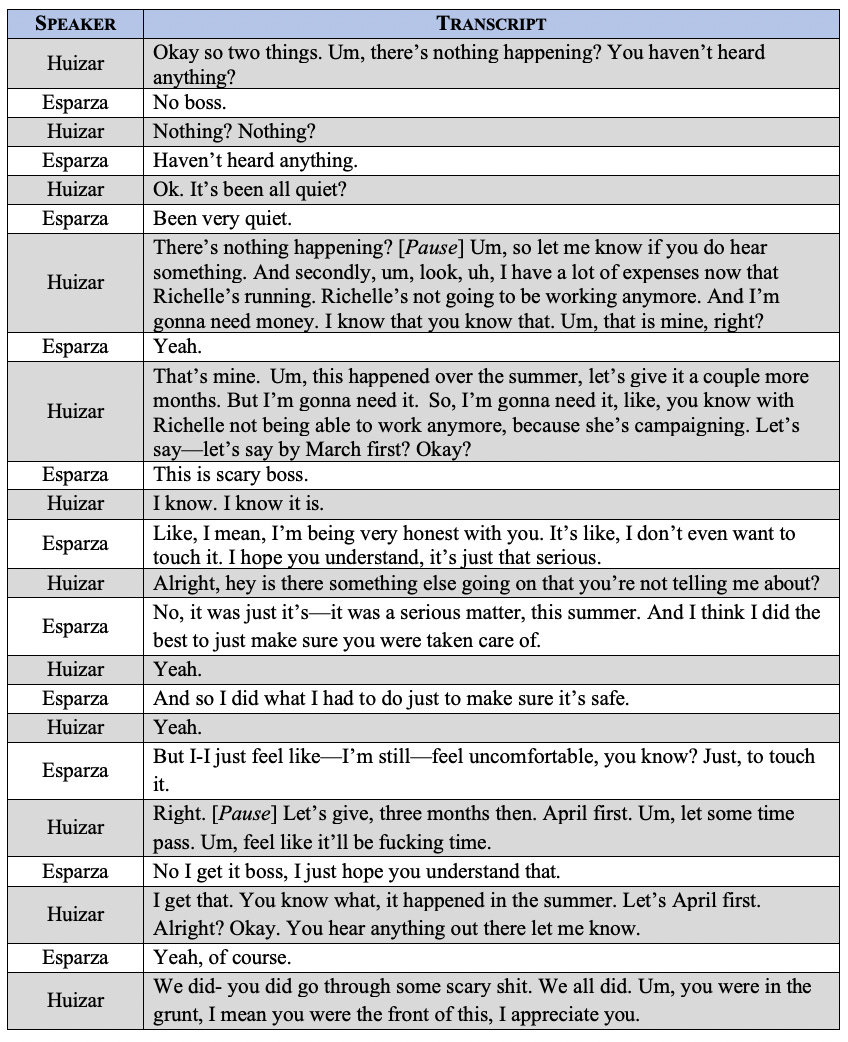
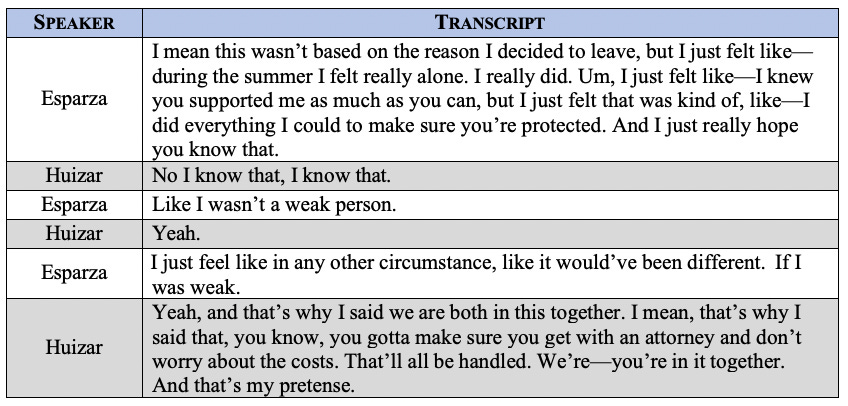
That included covertly recording a bathroom conversation he had with Huizar in December 2017 in which he told his boss he was quitting and said “This is scary, boss” as Huizar pressed him about the hidden money.
Here’s a copy of part of the recording:
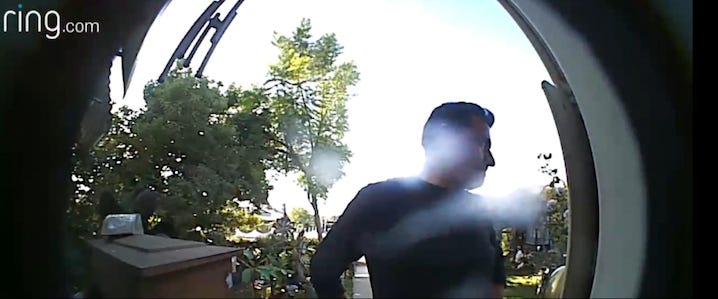
Prosecutors also have a recording of Huizar at Esparaza’s front door in 2018. Esparza testified that he wasn’t home at the time, so Huizar told his grandfather he owed him money.
Prosecutors’ recommendation
The U.S. Probation Office calculated Huizar’s standard sentencing range under the federal guidelines at 262 to 327 months, which is about 22 years to 27 years. The maximum penalty for Huizar’s two convictions is 25 years, so the probation office decreased the maximum range from 327 to 300.
The probation report isn’t publicly available, but the U.S. Attorney’s Office agrees with the range, which accounts for Huizar’s bribes of more than $1.5 million, his status as an elected official and as a conspiracy leader, as well as his obstruction of justice but also, his acceptance of responsibility through his plea agreement.
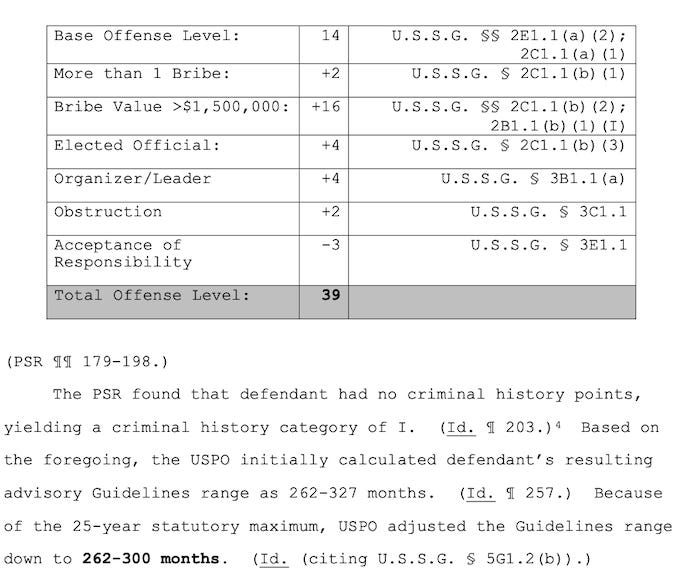
Probation recommends Judge Walter impose a 20-year sentence by applying a downward variance that would reduce Huizar’s offense level by 1 point and bring his sentencing range to 235 months to 293 months, which is about 19 1/2 years to about 24 1/2 years.
Prosecutors want him to go further by applying a five-level variance. They cite Huizar’s history and characteristics but also say he deserves “the benefit of his bargain of his plea agreement — with respect to the stipulated sentencing range — on which the parties expended significant resources negotiating numerous discussions and many months.”
A five-level reduction would bring Huizar’s range to 151 months to 188 months; prosecutors recommend 156 months, which is the maximum sentence they agreed to recommend.
In explaining their recommendation, prosecutors say Huizar’s conduct “is undeniably aggravating by every metric” and “an incredible breach of trust that escalated over time.”
“Indeed, it can be difficult to fathom the breadth and scale of defendant’s corruption, which was fueled by his repeatedly and successfully commodifying his elected office for profit and power for wide range of willing bribe payors,” according to the memo.
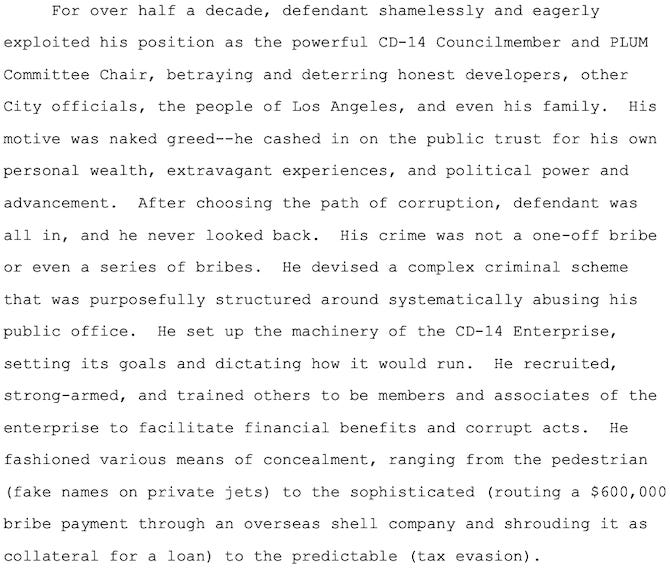
Prosecutors say Huizar had “dozens of moments that could have served as a belated wake-up call,” but he “instead resolutely pursued his corrupt plans and doggedly abused his position at every turn to advantage himself to the direct and immediate detriment of the public he served.”
“Even when the time came and defendant was caught, he did not exhibit remorse for what he had done. He doubled down and acted out of self-preservation, tampering with witnesses to cover his tracks and lying to the FBI and the USAO,” prosecutors wrote. “Had it not been for the government’s disruption, it is clear that defendant would have kept his criminal enterprise running, long after he left public office.”
Prosecutors say Huizar had “dozens of moments that could have served as a belated wake-up call,” but he “instead resolutely pursued his corrupt plans and doggedly abused his position at every turn to advantage himself to the direct and immediate detriment of the public he served.”
“Even when the time came and defendant was caught, he did not exhibit remorse for what he had done. He doubled down and acted out of self-preservation, tampering with witnesses to cover his tracks and lying to the FBI and the USAO,” prosecutors wrote. “Had it not been for the government’s disruption, it is clear that defendant would have kept his criminal enterprise running, long after he left public office.”
Prosecutors say Huizar “played an integral role in facilitating their corrupt decisions and incentivizing them” the eight other defendants who’ve been convicted in the case, including Esparza, whom they described as a “young and impressionable staffer” who considered Huizar a father figure. Huizar’s crimes “also harmed honest developers who played by the rules” and the harm he inflicted on the city “was not merely abstract or academic.”
“Developers who refused to acquiesce to defendant’s demands were swiftly punished, resulting in their projects--and all their attendant public benefits—being held in abeyance or being killed off,” according to the memo. “Defendant deprived the rights of honest businesspeople and made decisions on their projects based on the payment of bribes (or lack thereof) instead of on merit, which further harmed the City and its citizens.”
But Huizar’s conduct isn’t all bad, prosecutors say. The probation report cites things he’s done since his arrest such as serving as a caregiver to his youngest child, according to the memo, and it says he’s “re-devoted himself to his mother and cares for her by running errands, acting as her translator, and assisting with doctor appointments and medical decisions.”
“He has confronted other personal demons, including by stopping gambling and marijuana use, and he is making efforts (admittedly, a struggle) to accept and control his alcohol abuse--none of which defendant was required to do,” prosecutors wrote. “And defendant maintains hope: he aspires to work with a public interest organization to aid others in navigating the health insurance system and obtaining health care benefits.”
roscutors also cited the need to deter other public officials froma cting corruptly and said Huizar is at the top of L.A.’s public corruption pyramid.
“It is for good reason that defendant is often seen as the face of corruption in Los Angeles--even as news of the latest public official misdeed comes to light on a seemingly weekly basis,” according to the memo. “Defendant is in a league of his own because the breadth, longevity, and egregiousness of his criminal acts are in a league of their own.”
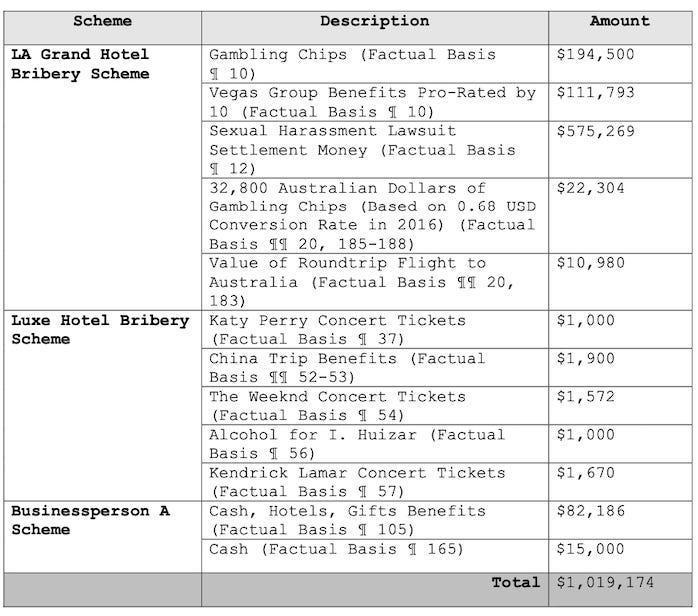
In addition to 13 years and prison and three years probation, prosecutors want Huizar to pay $1.019 million in restitution to the City of Los Angeles. They broke down the money this way:
Defense recommendation
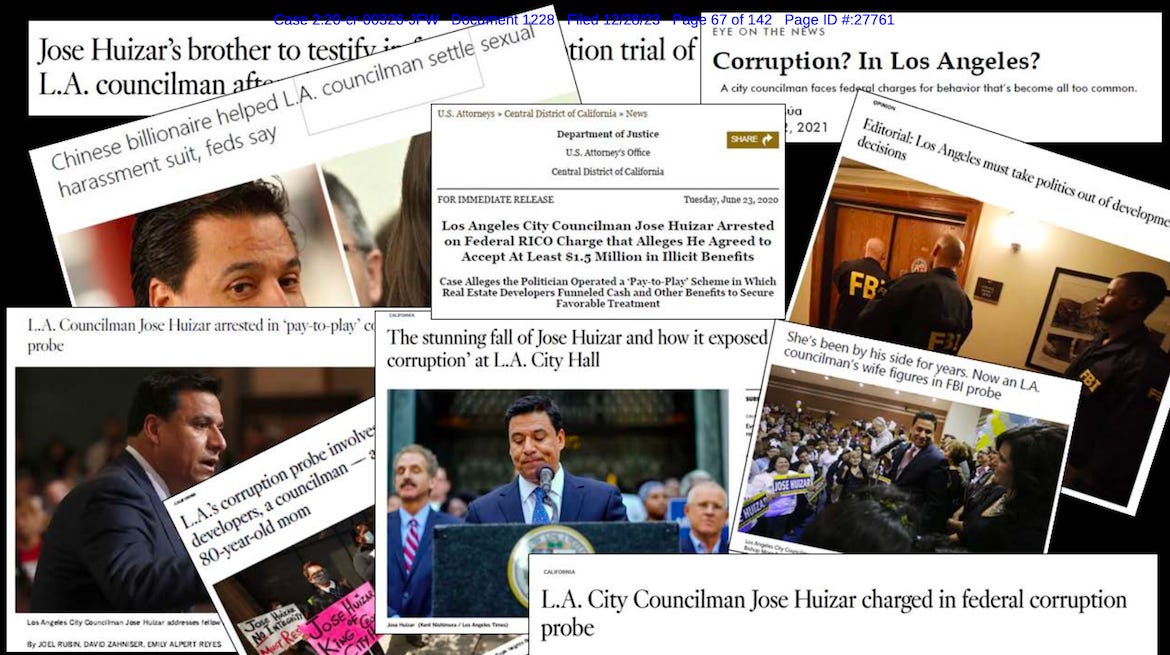
Snyder and Olin included 60 pages of photos to start their memo, then opened their narrative with a quote from Robert Penn Warrne’s 1946 novel All the King’s Men.
“And what we students of history always learn is that the human being is a very complicated contraption and that they are not good or bad but are good and bad and the good comes out of the bad and the bad out of the good, and the devil take the hindmost.”
The defense memo says describing Huizar as “chastened and remorseful – for committing crimes, for hurting his family, for disappointing his friends and the community, for wasting his potential – would make understatement blush.”
“He has been publicly pilloried and subjected to the mob. He has been personally humiliated and destroyed,” Snyder and Olin wrote.
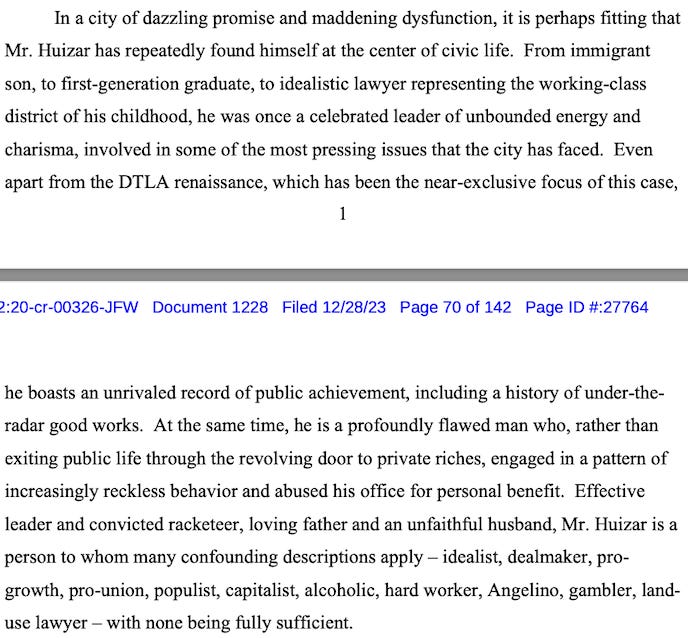
They said Huizar’s “nuanced reality” can easily be overridden by simplicity or appearances “in a case like this one, where emotions run high and the public spotlight shines bright.”
“But the role of a sentencing judge is not to act ‘as a hooded executioner for an outraged populace,’” prosecutors wrote, quoting U.S. District Judge Joseph R. Goodwin in the Southern District of West Virginia, from the 2009 case United States v. Raby. “It is to look deeper, and to carefully balance justice with mercy, punishment with rehabilitation, and legal doctrine with compassion and life experience based a more complex truth.”
They said Huizar “made grievous errors of judgment, for which he deserves to be punished” but he also “devoted his life to public service, at great cost to himself and his family, and made significant and often-unseen contributions to the city even as he tarnished his legacy.”
“The truth is that Mr. Huizar did not set out to break the law, but traveled the arc of idealism to cynicism to illegality through a process of personal weakness and incremental self-justification. The truth is that, like all of us, like the city of Los Angeles itself, Mr. Huizar is not easily reduceable [to] a single moral label,” according to the memo.
Huizar’s lawyers also say the 13-year recommendation was “plucked from the air” and asked “what necessary message would not be sent by a 9-year sentence that would be sent by 13?”
“If the point of the message is that public officials who breach the community’s trust will be humiliated, lose everything, and receive substantial prison terms, even on a first offense, one would be hard-pressed to explain why nothing less than 13 years – a number plucked from the air by the parties – will possibly do. Indeed, if 13 years is necessary, why is 13 years and one day not?” according to the memo.
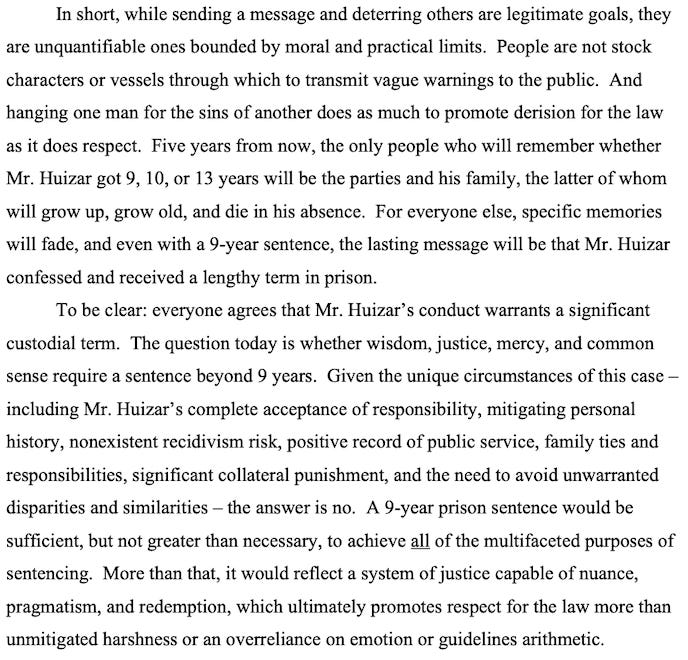
The defense memo described Huizar’s achievements during his nearly 20 years of elected office such as working to improve the quality of public schools and dealing “with countless issues, both grand and parochial, to improve the city.”
“Simply put, Mr. Huizar’s days were bursting at the seams with the work of a committed public servant handling all matter of issues beyond development,” according to the memo.
“While this case will undoubtedly be the legacy of his public life, it is not the sum of his work in politics, and the Court should consider Mr. Huizar the politician holistically in fashioning the appropriate sentence,” his lawyers continued.
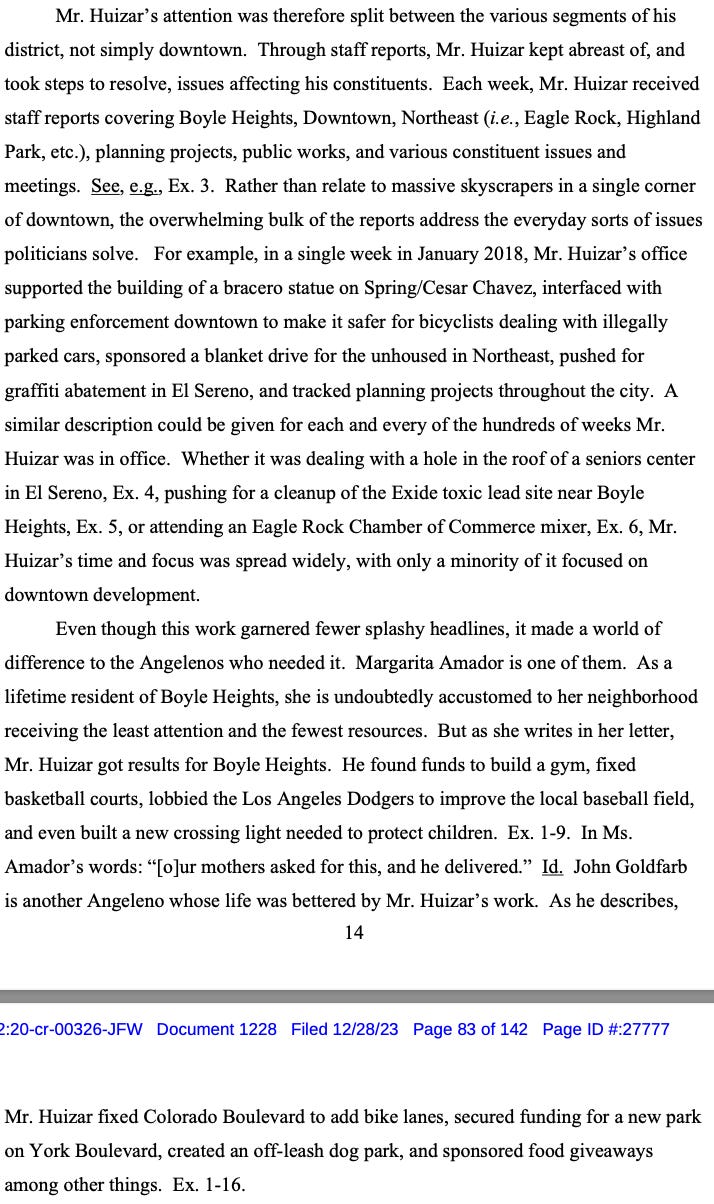
Even amidst his corruption, Huizar still worked to do right for his constituents, his lawyers said, including righting “to protect his poorer constituents in Boyle Heights and El Sereno, supporting rent control in the former and preventing the development of treasured open space in the latter.”
“Mr. Huizar accepted benefits from developers who wanted to build developments that were good for the city, and, in this case, he did so in a criminal way,” according to the memo. “But at the same time, he jealously guarded the interests of his constituents in the poorer parts of his district.”
Huizar’s lawyers also said he accomplished great things for downtown Los Angeles by guiding development that helped it compete with business districts in Century City and Santa Monica.
“What had been a sleepy, 9-to-5 neighborhood abandoned on the weekends transformed over the course of the 2010s, at a time when the city needed badly to recover from a recent financial crisis,” according to the memo, which includes as exhibits news articles about downtown Los Angeles’ revitalization.
The memo says Huizar’s policy initiatives regarding parks and homelessness “bettered the city for all,” and it credits him with securing the new Sixth Street Bridge that connects his Boyle Heights neighborhood to downtown. Both areas are in his City Council District 14.
The memo also lists roughly 25 of Huizar’s “diverse policies and initiatives,” including urban gardens, bicycle lanes, residential beekeeping, farmers markets and ending the city’s ban on murals. It says Huizar’s downfall is “a profoundly tragic story that has affected many people,” including his four children as “his family has been slowly destroyed.”
Huizar’s children wrote letters to Judge Walter that are redacted from public view. (All 52 letters are available here. Other defense exhibits can be viewed for free in the Courtlistener file.) His lawyers quoted them in their memo, along with his mother’s letter and several others.
“The painful reality is that, even with a 9-year sentence, Mr. Huizar’s mother may die while he is in prison, an incalculable loss that becomes likelier with each additional day of his sentence,” according to the memo. “And every moment that he is separated from his children — to say nothing of other family members for whom he has acted as a parental figure — will negatively impact their development and make it harder for them to lead happy and productive lives.”
Huizar’s lawyers said federal agents “put guns in the faces of his young children” when they first raided his home in 2018, and they’ve served grand jury subpoenas “to his children’s school” and listened to “the entirety of his phone calls with his medical providers” while “soliciting any negative word that could be said about him from any rival looking to settle a score.”
The memo says prosecutors held a “rare pandemic press conference” to announce Huizar’s criminal charges, in which they declared him a “cancer” and a “disease” on Los Angeles.
“At every step, the case was made public and personal in ways that few in this District have been,” Snyder and Olin wrote. “Between prosecutors and the press, nearly every negative thing that Mr. Huizar has ever done was paraded before the city, and many things that he did not do were attributed to him as well.”
The memo says Huizar’s children now wear his name “with shame and humiliation.”
“They have seen their father, a once-proud pillar of the community caricatured and reduced to a pariah,” according to the memo, which goes on to apparently reference one of the children’s sealed letters. “Every problem in their parents’ marriage has been on display for curious observers to inspect and ridicule.”
The memo includes as an exhibit text messages between Esparza and his co-conspirators that show Huizar’s lawyer say demonstrate “they lied to and hid things from each other — perhaps foremost from Mr. Huizar.”
The memo says the U.S. Sentencing Guidelines “provide little help in fashioning a parsimonious sentence in this case.” Before a reduction for acceptance of responsibility, Huizar’s offense level of 42 “is one shy of the offense level that would have been calculated for the 9/11 attackers, as well as other terrorists and murderers.”
Snyder and Olin also point out that, by prosecutors agreeing to recommend between nine and 13 years in their January 2023 deal, “the government has tacitly acknowledged that, while it may request additional custody time, even 9 years would be sufficient to achieve the purposes of federal sentencing.”
The other defendants
Here’s the status of the other defendants. Sentencings are scheduled to begin in the summer.
Wei Huang is a fugitive whose charges include wire fraud and interstate and foreign travel in aid of racketeering. He lives in Shenzhen, China, and also maintains a residence in San Marino, California, but authorities believe he’s in China. A jury in November 2022 convicted his company Shen Zhen New World I LLC of eight crimes. Judge Walter fined the company $4 million at sentencing in May.
Salvador Huizar pleaded guilty on Oct. 19, 2022, to a false statements charge in a deal that requires his cooperation against other defendants. Prosecutors agreed to recommend no more than six months in prison.
Esparza pleaded guilty on July 22, 2020, to racketeering conspiracy. Prosecutors agreed to recommend no more than 87 months in prison, which is 7.25 years. The deal requires his cooperation against other defendants.
Real estate development consultant George Chiang pleaded guilty on June 26, 2020, to racketeering conspiracy. Prosecutors agreed to recommend no more than 70 months in prison, which is 5.83 years. The deal requires Chiang’s cooperation against other defendants. (Like Esparza, he was a witness in Chan’s trial.)
Justin Kim, Huizar’s political fundraiser who helped broker Lee’s $500,000 bribe, pleaded guilty to bribery on June 3, 2020. Prosecutors agreed to recommend no more than 57 months in prison. The deal requires Kim’s cooperation against other defendants..
Morris Roland Goldman, a former Los Angeles lobbyist who now works at a winery in northern California, pleaded guilty on Sept. 30, 2020, to honest services fraud and conspiracy to commit bribery. Prosecutors agreed to recommend no more than 30 months in prison. The deal requires Goldman’s cooperation against other defendants. (He testified in Chan’s trial.)
The San Francisco company CP Employer, Inc., formerly known as Carmel Partners, Inc., paid a $1.2 million fine in December 2020 as part of a non-prosecution agreement.
Another company, Jia Yuan USA Co., Inc. agreed to pay $1.05 million in another non-prosecution agreement. Jia Yuan is a subsidiary of the Chinese-based Shenzhen Hazens, which is owned by Fuer Yuan, who was hoping to redevelop the Luxe City Center Hotel in downtown Los Angeles.
Previous coverage:
'This is scary, boss': Jurors hear ex-Los Angeles Councilman Huizar's covert bathroom meeting

A longtime assistant to ex-Los Angeles City Councilman Jose Huizar testified Friday of his former boss’ persistent efforts to collect $200,000 in cash bribes the you…
Cash-flush developer gets 6 years in prison for 'unique and infectious crime' of public corruption

A federal judge on Friday sentenced a commercial real estate developer to six years in prison for bribing ex-Los Angeles City Councilman José Huizar in a corruption conspira…
Thank you for supporting my independent legal affairs journalism. Your paid subscriptions make my work possible. If you’re not already a paid subscriber, please consider purchasing a subscription through Substack. You can also support me through Venmo (MeghannCuniff), CashApp ($MeghannCuniff) and Zelle (meghanncuniff@gmail.com). Thank you!