
A rapper, a developer and a politician each requested bail pending appeal. Only one got it.
A trio of bail requests from Tory Lanez, Dae Yong Lee and Mark Ridley-Thomas offers a teachable moment.


A California appellate court on Friday rejected rapper Tory Lanez’s request for bail as he appeals his convictions for shooting Megan Thee Stallion.
The order follows two other bail-related developments in cases I’ve covered that, taken together, highlight how prosecutors and judges approach bail requests.
In one, U.S. District Judge John F. Walter rejected bail pending appeal for real estate developer Dao Yong “David” Lee, whom he sentenced in August to six years in prison for bribing now-former Los Angeles City Councilman José Huizar.
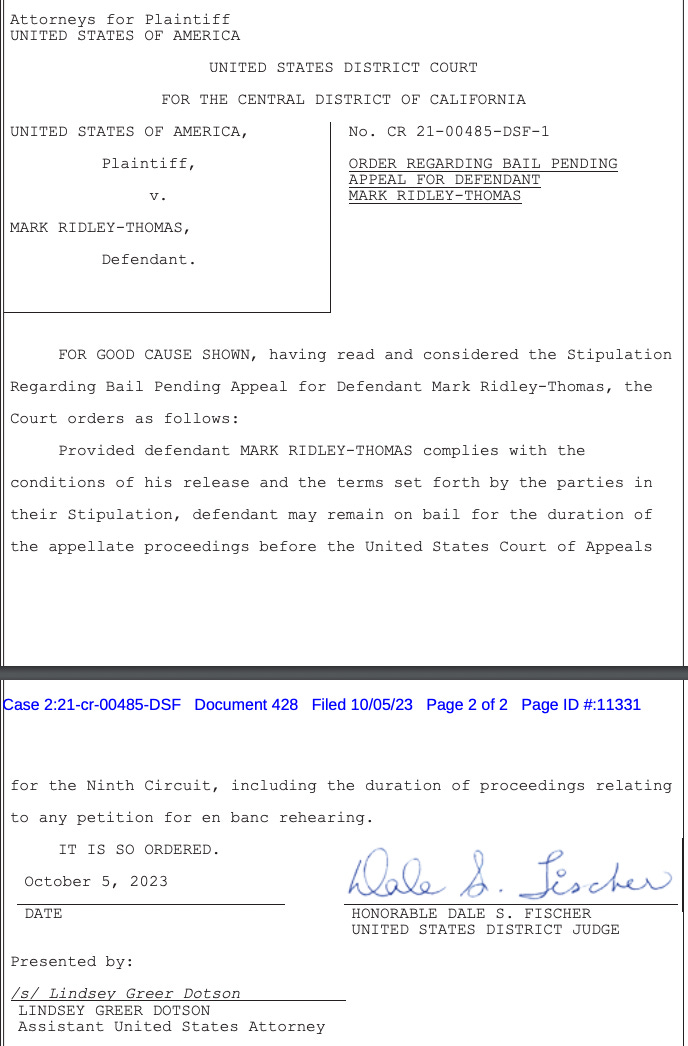
In the other, federal prosecutors agreed Los Angeles politician Mark Ridley-Thomas should be allowed to remain free on bail as he appeals his convictions for a bribery scheme involving the University of Southern California. U.S. District Judge Dale S. Fischer signed the order on Oct. 5.
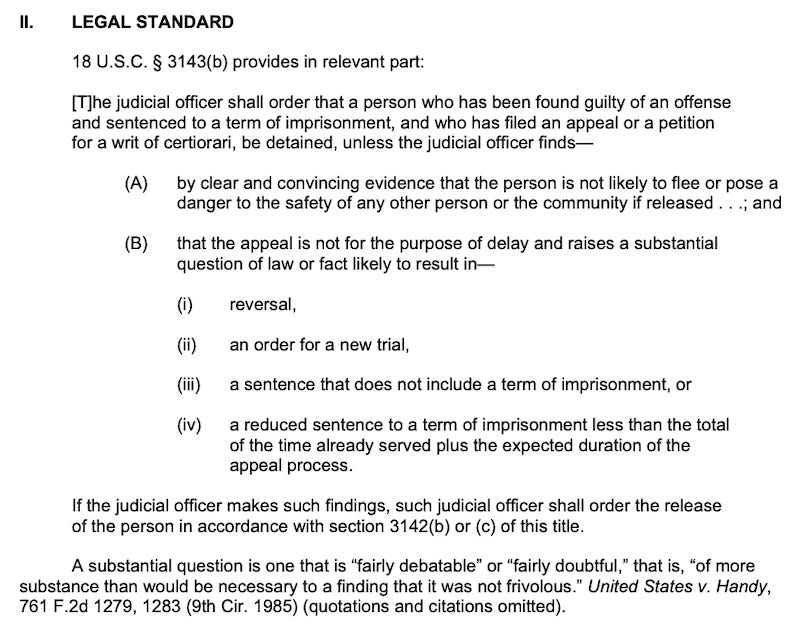
The common factor in the decisions appears to be flight risk. Judge Walter’s Oct. 24 order said Lee “has failed to demonstrate by clear and convincing evidence that he is not likely to flee,” but prosecutors said in an Oct. 5 stipulation that Ridley-Thomas “has met his burden of establishing, by clear and convincing evidence, that he is not likely to flee or pose a danger to any other person or the community.”
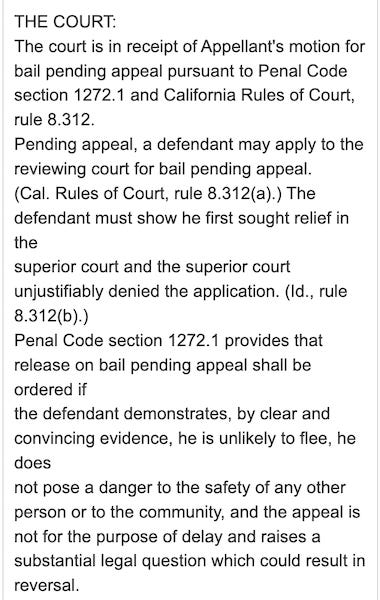
Lanez, meanwhile, was deemed a flight risk first by Los Angeles County Superior Court Judge David V. Herriford on Sept. 14, then again on Friday by California’s 2nd District Court of Appeal, Divison 3 in Los Angeles. The order cited Lanez’s lawyers’ admission that Herriford “denied his motion because Appellant is a Canadian citizen, which is a factor to consider in determining his likelihood of fleeing.”
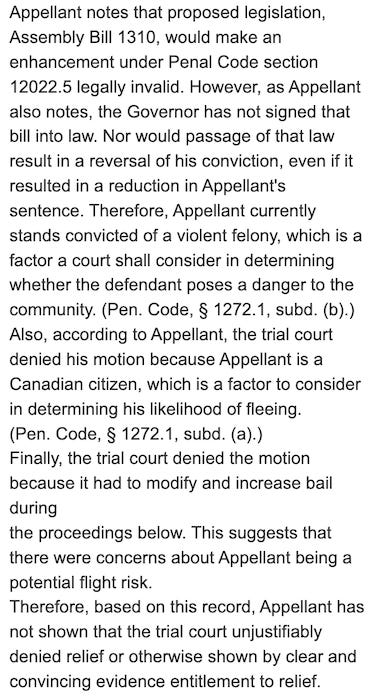
“Finally, the trial court denied the motion because it had to modify and increase bail during the proceedings below. This suggests that there were concerns about Appellant being a potential flight risk,” according to the order.
The order also said Lanez didn’t show he’s not a danger to the community, nor did he demonstrate his appeal “is not for the purpose of delay and raises a substantial legal question which could result in reversal.”
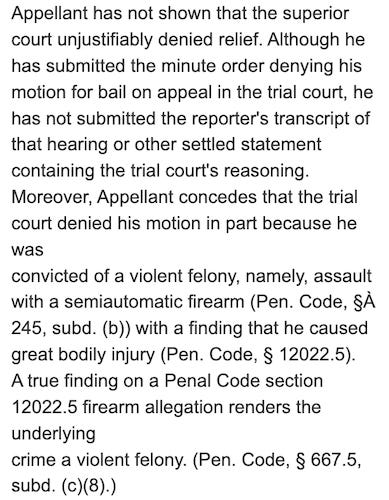
“Appellant has not shown that the superior court unjustifiably denied relief. Although he has submitted the minute order denying his motion for bail on appeal in the trial court, he has not submitted the reporter’s transcript of that hearing or other settled statement containing the trial court’s reasoning. Moreover, Appellant concedes that the trial court denied his motion in part because he was convicted of a violent felony, namely, assault with a semiautomatic firearm (Pen. Code, §À 245, subd. (b)) with a finding that he caused great bodily injury (Pen. Code, § 12022.5). A true finding on a Penal Code section 12022.5 firearm allegation renders the underlying crime a violent felony. (Pen. Code, § 667.5, subd. (c)(8).”
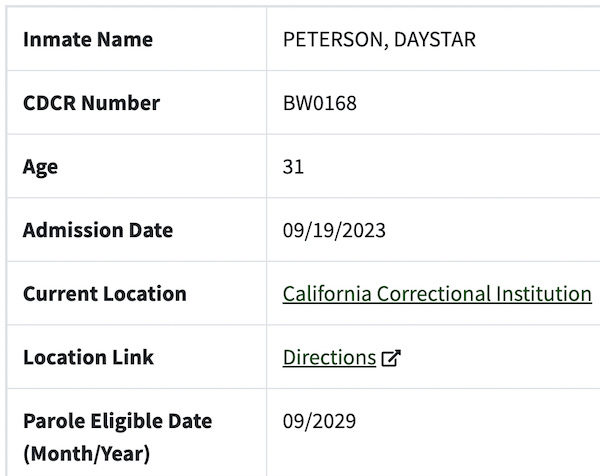
Lanez, legal name Daystar Peterson, has been in custody since Dec. 23, 2022, after a jury convicted him of shooting Megan Thee Stallion in the feet in July 2020. Judge Herriford in August sentenced him to 10 years in prison with credit for 305 days served. He’s currently incarcerated at the California Correctional Institute in Tehachapi, about 120 miles north of Los Angeles. His earliest possible parole date is in September 2029.
His bail motion was filed by Crystal Morgan, a licensed California attorney since February 2021 who is a staff attorney with Unite the People Inc., a Long Beach organization that provides legal services to incarcerated inmates. Lanez is a board member who has donated hundreds of thousands of dollars to Unite the People to cover payroll and legal fees for clients. Unite the People cofounder and CEO Cesar McDowell spoke at his sentencing, and he’s made clear he’s a close friend of Lanez who talks to him regularly from prison.
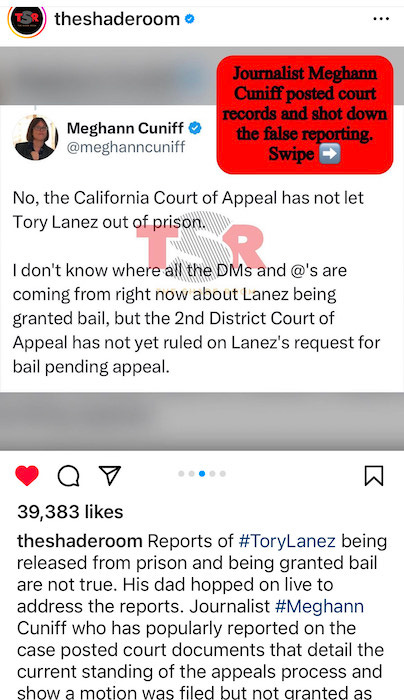
On Oct. 11, McDowell, who is not an attorney, mistakenly told Lanez’s father and some of his fans that the court granted bail. He did so after he said he received notice of a new filing in the appellate case that a clerk told me turned out to be an irrelevant filing from an apparent Lanez fan who took the time to register a filing account through the appellate court website.
Filed Oct. 5, Morgan’s bail request said “it is of importance to consider” that Gov. Gavin Newsom is considering “passing” Assembly Bill 1310, which she claims would invalid Lanez’s sentencing enhancement for using a firearm. She didn’t mention that the bill hasn’t yet been considered by the California State Senate, which doesn’t convene again until Jan. 3, but that didn’t seem to matter to the appellate court: Friday’s order cites Morgan’s admission that Newsom is merely considering the bill.
“As Appellant also notes, the Governor has not signed that bill into law. Nor would passage of that law result in a reversal of his conviction, even if it resulted in a reduction in Appellant’s sentence. Therefore, Appellant currently stands convicted of a violent felony, which is a factor a court shall consider in determining whether the defendant poses a danger to the community.”
Here’s a video of McDowell, Morgan and Unite the People attorney, Michael Raymond Hayden, speaking outside court after Herriford rejected Lanez’s bail request last month.
It’s preposterous to think that Judge Herriford or the appellate court would grant Lanez bail pending appeal after he was convicted of a violent felony and snagged pre-trial bail increases and even a house arrest order.
But Ridley-Thomas, the longtime Los Angeles politician staring down a 3.5 year federal sentence for bribery, is a different story. Not only was he not convicted a violent crime, he’s been out on bail through his entire case without incident.
So was Lee, the developer convicted of bribery and falsifying records, but unlike Ridley-Thomas, prosecutors opposed Lee’s bail request because they argued he was a risk to flee the country. They also said he hasn’t shown that his appeal is intended to delay.
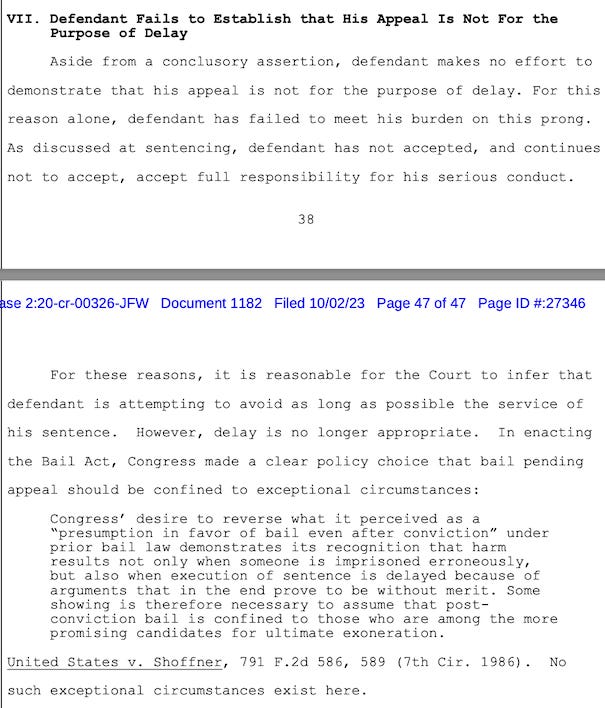
The opposition from Assistant U.S. Attorney Cassie D. Palmer referenced Lee’s access to cash, which was illustrated in previous filing that included photos of the stacks of cash found in his office safe when federal agents searched it. The opposition also referenced something Lee told an FBI informant in a surreptitiously recorded conversation: “The first time I was hit, I really thought I had to run away to Korea.”
Judge Walter called it “extremely troubling and significant that, despite Defendant’s apparently strong connections to the Central District of California and the United States, he considered fleeing to Korea.”
“The Court’s concerns regarding Defendant’s risk of flight are greatly heightened by the fact that Defendant possesses or has access to large sums of cash that could be used to facilitate flight and allow him to live very comfortably in Korea,” Walter wrote in his four-page order. “Moreover, Defendant was convicted of obstruction of justice through falsification of records, which demonstrates his willingness to evade responsibility for his crimes.”
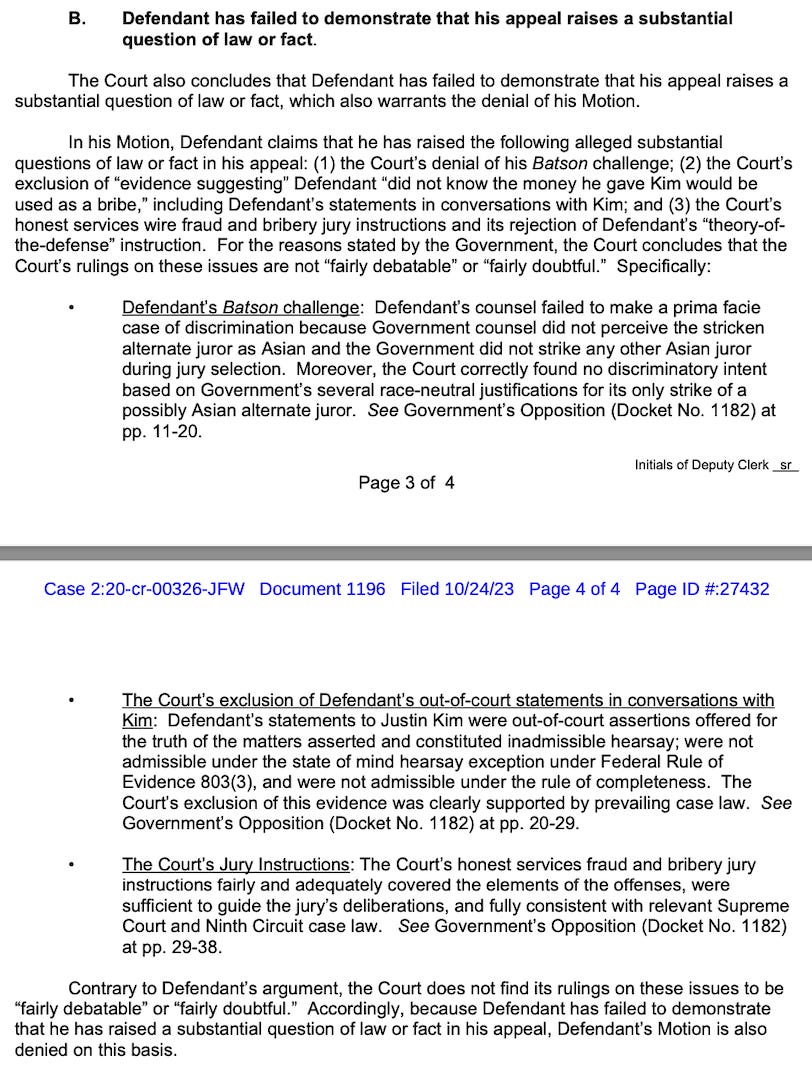
The judge also said Lee “failed to demonstrate that his appeal raises a substantial question of law or fact.”
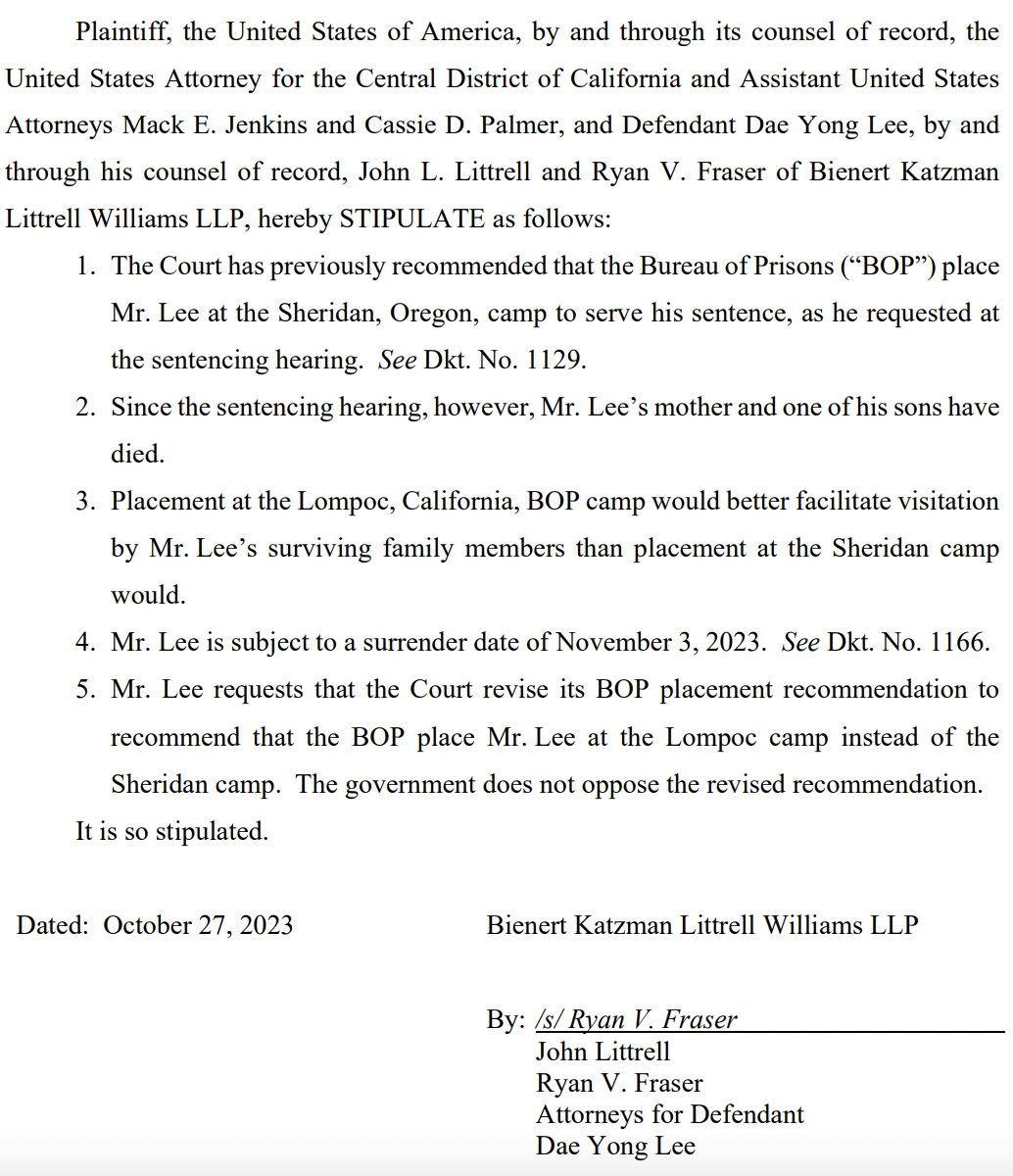
Lee is to surrender to federal custody on Friday, Nov. 3. Prosecutors and his lawyers are asking Judge Walter to recommend the U.S. Bureau of Prisons place him in the Lompoc, California, minimum-security camp.
In September, Judge Walter delayed Lee’s surrender date a month to allow him to file a motion for bail pending appeal. Lee was represented by Ariel Neuman and Ray S. Seilie of Bird, Marella, Boxer, Wolpert, Nessim, Drooks, Lincenberg & Rhow, P.C., during trial and post-conviction proceedings, but he replaced them with John Littrell and Ryan V. Fraser of Bienert Katzman Littrell Williams LLP after sentencing.
The request filed Friday regarding Lompac shows Lee may have had unstated reasons for hiring new counsel for a doomed bail motion who could cite their inexperience with his case to delay his prison date: His mother and one of his sons recently died.
In Ridley-Thomas’ case, prosecutors made clear they don’t believe he stands a chance at the 9th Circuit U.S. Court of Appeals. But they said they’re not disputing that his appeal involves a “substantial question” of law, which they acknowledged is the “minimal legal threshold necessary” to secure bail.
More than 100 supporters attended Ridley-Thomas’ Aug. 28 sentencing. About 130 people wrote letters to Judge Fischer describing their experiences with him, including Laphonza Butler, who Gov. Gavin Newsom recently appointed to the U.S. Senate to replace the late Dianne Feinstein.
His bail agreement with prosecutors requires him to file his opening brief with the 9th Circuit by Jan. 25 as currently scheduled. He’s prohibited from requesting an extension, and he agreed to seek oral argument “for the earliest available date.”
Ridley-Thomas’ lawyers said prosecutors’ support for his bail “should be seen as an acknowledgement of the strength of his upcoming appeal.”
Alyssa Bell and Michael Schafler, partners at Cohen Williams LLP, are handling the appeal along with Paul J. Watford, a partner with Wilson Sonsini Goodrich & Rosati in Los Angeles, and Erwin Chemerinsky, dean of UC Berkeley School of Law.
Bell said in a press release she believes their brief “will present exceptionally strong issues,” including the dismissal of two Black women from the jury pool.
Ridley-Thomas is Black, and his lawyers during voir dire objected to prosecutors dismissing the women under the 1986 U.S. Supreme Court ruling Batson v. Kentucky, which says prosecutors can’t use a peremptory challenge, which is the dismissal of jurors without stating a valid cause for doing so, based solely on race. Prosecutors said at the time that they had other reasons for dismissing the jurors, and Judge Fischer rejected Ridley-Thomas’ objections and allowed the dismissals.
Lee raised a similar Batson issue in his motion for bail, citing the dismissal of the lone Asian potential juror when Lee is Asian. But prosecutors pointed out that they didn’t believe the person was actually Asian, and Walter seemed to agree by saying, “That’s my concern.”
Judge Walter addressed the issue when rejecting Lee’s bail request.
“Defendant’s counsel failed to make a prima facie case of discrimination because Government counsel did not perceive the stricken alternate juror as Asian and the Government did not strike any other Asian juror during jury selection,” according to the order. “Moreover, the Court correctly found no discriminatory intent based on Government’s several race-neutral justifications for its only strike of a possibly Asian alternate juror.”
I discussed the bail pending appeal in a YouTube live on Friday.
Thank you for supporting my independent legal affairs journalism. Your paid subscriptions enable me to go in-depth and unfiltered on major issues. If you’re not already a paid subscriber, please consider purchasing a subscription trough Substack. You can also support me through Venmo (MeghannCuniff), CashApp ($MeghannCuniff) and Zelle (meghanncuniff@gmail.com). Thank you!