
Thank you to the LA Criminal Courts Bar Association for the Journalism Excellence Award
The recognition reminds me who I am as a journalist, and what I want my core values to always be.

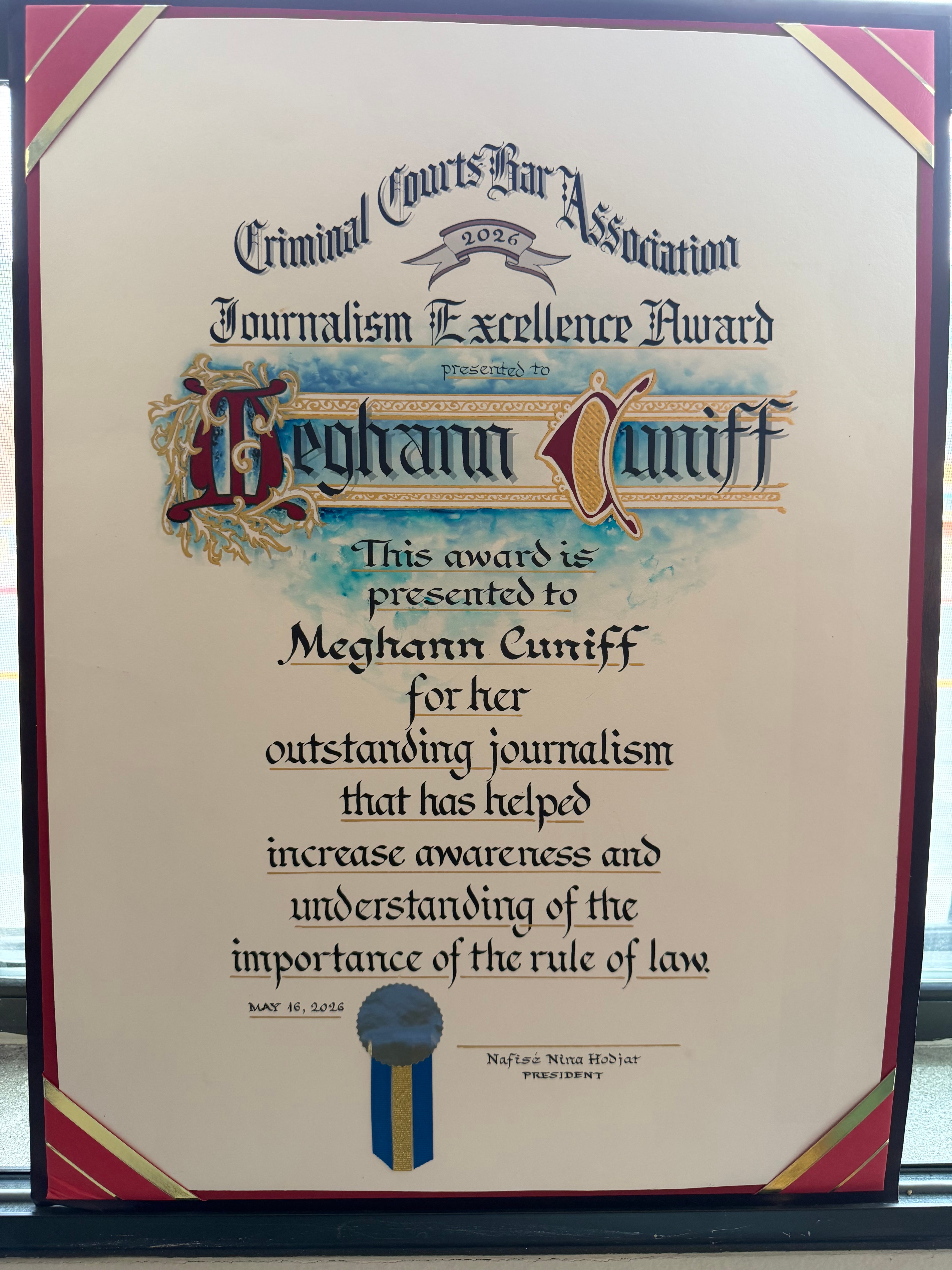
I’m proud and humbled to have accepted the Los Angeles Criminal Courts Bar Association’s Journalism Excellence Award last night.
Thank you to the board members for the amazing recognition. And thank you, retired California Court of Appeal Justice Tom Goethals in Orange County for the generous introduction.
Here’s what Justice Goethals said:
I met Meghann Cuniff about 10 years ago late one afternoon in the hallway on the 11th floor of the main Orange County Superior Courthouse in Santa Ana. I recognized her because I had seen her in my courtroom almost daily for nearly two years, pounding away on the keyboard of her laptop, but we had never spoken.
The day’s hearing was over, and the hallway was empty, except for Meghann, and there she was again, pounding on her keyboard, trying to finish her story. She looked up and gave me her biggest and most embarrassed smile. I introduced myself, and she immediately said she knew who I was. I soon discovered that she was the Daily Journal’s Orange County courthouse reporter, and for some reason I sat down, and we had a nice visit, and we have been friends ever since.
As you know, Meghann is an extraordinary reporter. She’s smart. She’s determined and insightful and creative. She has an uncanny ability to simplify a complicated legal story to make it interesting and readable for both lawyers and non-lawyers. She also relates to people in a very human way, and it makes them feel comfortable to share their stories with her.
Every solid reporter I have ever known over the years, and it’s been 50 years, has taken great pride in her work, and Meghann certainly does that, and it shows. She works hard every day to get at the facts and to report them to her audience. These are her real gifts, but what makes her the whole package, the complete package, as a reporter, I think, is she also seems to really love her job. She gets up every morning, and she wants to go to work. How many of us can say that? I congratulate the Criminal Courts Bar Association on its wisdom in choosing to give Meghan this award, and I congratulate you, Meghan, on receiving this well-deserved honor. I now give you, ladies and gentlemen, your 2026, Journalism Excellence Award recipient, Meghan Cuniff.
I spoke a few words at the dinner, mostly about what a pinch me I’m dreaming moment this is for someone who grew up in Oregon and had never been to Southern California until I was 25.
I wrote a blog for The Spokesman-Review in Spokane, Wash., called Sirens & Gavels, and every Friday I posted Associated Press articles about crime and courts news around the country. I remember sharing articles in 2010 about a trial in Los Angeles for a man who killed the rapper Dolla, and I thought to myself at the time that the cases down here seemed like a totally different world from what I knew.
One thing I learned in Spokane is that the criminal justice system universally matters to communities and the real people who live in this country. Then I got to the Los Angeles Daily Journal and learned about Big Law and realized there are some attorneys who work misdemeanor theft cases, and there are some attorneys who try to turn theft into a $20 million trade secrets lawsuit. Those cases are important, too, but I always think about my time covering crime in communities when I think about how important our state criminal courts are, even the ones without celebrities in them.
As a journalist, I want to continue teaching people about the important work of the people in the trenches of our criminal justice system, and I want to spotlight the humanity that happens in our courtrooms every day. The recognition from the bar association reminds me who I am as a journalist, and what I want my core values to always be.
Congratulations to the other honorees:
Joseph H. Low IV — President’s Award, Extraordinary Contributor to the Criminal Justice System
Joseph A. Gutierrez — Joseph Rosen Award, Lifetime Achievement
Joseph A. Markus and Joseph E. Markus — Johnnie Cochran Jr. Award, Relentless Pursuit of Justice
Hon. H. Clay Jacke II — Hon. Robert Takasugi Award, Judicial Excellence
Vanessa Rownaghi and Yusun Kang — Jerry Giesler Award, Trial Attorney of the Year
Cameron J. Gomez — Richard Hutton Award, Rising Trial Attorney
What I’m covering right now
Testimony continues Monday in a civil wrongful death trial over two young brothers killed by a speeding driver near Westlake Village, California.
Defendant Scott Erickson testified last Monday and Wednesday. Plaintiffs’ attorney Brian Panish questioned him for about six hours. Panish represents Nancy and Karim Iskander, whose sons 11-year-old Mark and 8-year-old Jacob died after Rebecca Grossman struck them with her 2018 Mercedes-Benz AMG.
Grossman is in prison. Prosecutors dismissed a misdemeanor reckless driving charge against Erickson, who was speeding near her, after he filmed a public service announcement about safe driving.
Erickson’s lawyer Jeff Braun has not finished questioning him. Karim Iskander testified last Thursday, and Nancy Iskander is expected to testify this Tuesday.
Panish will get another chance to question Erickson after Braun questions him. Esther Holm, who represents Grossman and her husband, Peter Grossman, questioned him for about 25 minutes on Wednesday before Braun questioned him for about an hour.
Jury rejects death penalty in Florida gang murder
A Florida jury on Friday rejected the death penalty and recommended the men who murdered gang member and rapper Charles “Julio Foolio” Jones Jr. be sentenced to life in prison without parole. The same jurors a week earlier convicted Sean Gathright, 20; Isaiah Chance, 23; Rashad Murphy, 32; and Davion Murphy, 29.
Jurors deliberated less than two hours after hearing four days of testimony about the men’s childhoods and families.
They found prosecutors proved all aggravating factors, including the men were gang members, that the homicide was committed “a cold, calculated, and premeditated manner without any pretense of moral or legal justification” and “created a great risk of death to many persons,” but they agreed the mitigating factors outweighed them and recommended Judge Michelle Sisco sentence the men to life in prison without parole. The judge scheduled sentencing for June 22.
Chance’s girlfriend, Alicia Andrews, is to be sentenced this Friday (May 22) after a jury last October convicted her of manslaughter, a lesser included offense to first-degree murder charge, and acquitted her of conspiracy.
Gathright and the Murphys were convicted of first-degree murder, conspiracy to commit first-degree murder and three counts of attempted second-degree murder, which was a lesser included to attempted first-degree murder. Gathright also was convicted of evidence tampering.
Chance was convicted of the murder and conspiracy charge. He was not charged with attempted murder.
Gathright and the Murphys were the gunmen on June 23, 2024, outside the Home2 Suites hotel next to the University of South Florida while Chance and Andrews stood by in the same hotel parking lot after tracking Jones through the city.
Jones was prominent in drill rap, which celebrates violence and mocks death, and was in Tampa celebrating his 26th birthday.
He’d been shot several times before, including a shooting in Texas linked to one of the guns used to kill him.
The huge amount of evidence against the men ranged cellular location data and surveillance video, including from a Tesla that was charging in the lot when the men ran by and executed Jones.
I heard all the testimony while covering the trial on YouTube, and while the men’s guilt seemed certain, their punishment seemed totally in question. Florida lawmakers changed the state’s death penalty laws to allow for a jury to recommend death on an 8-4 vote, after a jury in 2022 rejected death for the mass murderer at a high school in Parkland on a 9-3 vote in favor.
Defense witnesses in the penalty phase included Nahshon Nicks, a community activist who has a child with Chance’s mother and has known Chance since he was six years old. He testified on Wednesday about Chance’s childhood, and he wanted to read a letter aloud to the jury.
Judge Sisco wouldn’t let him, and she sent the jury out of the courtroom to discuss that with him. Nicks told the judge, “The number one concern for our youth and our urban communities is homicide and suicide, right?” Sisco cited trial testimony from Robert Howard. who was with Jones when he was shot.
“I think it was Robert Howard testified that the people that are in the gangs in Jacksonville consider themselves the little Chicago, which I think would be distressing for any member of the community,” said Sisco, who presides in Florida’s 13th Judicial Circuit Court in Tampa.
“When it comes to gang violence, you certainly don’t want your community to be the little Chicago. … I’m just curious if there’s something going on in Jacksonville in particular that has made this scourge really blossom?” the judge asked.
Nicks said “a big self-fulfilling prophecy component” leads people to “look at it as entertainment until it becomes reality.”
“Unfortunately, the glamorization and attention hijacks the pleasure sensors to where endorphins, dopamine, cytosine is almost like a high that you’re constantly chasing, but it’s leading to counterproductive behaviors,” Nicks said.
Judge Sisco referenced the videos for the drill rap that Jones produced and said, “The more clicks you get, the more violent, the more outrageous the conduct, the more clips — clicks and it becomes lucrative, right?”
“Yes, Your Honor,” Nicks said.
The only other death penalty trial I’ve covered was the federal sentencing of serial killer Joseph Duncan in Idaho in 2008, and the main argument was defendant’s violent history — including murdering adults and attacking prison guards — means he’ll continue victimizing society in prison.
The argument in Florida last week seemed to be, “They are evil.”
Assistant State Attorney Scott Harmon detailed the men’s calculated planning in a 2 1/2 hour closing argument in which he said there was enough premeditation “to convict thousands of men.”
Harmon and prosecutors Michelle Doherty and Anna Ismer were like the Grim Reaper as they aggressively cross-examined defense witnesses who testified about the men’s childhoods and their current relationships. When witnesses indicated the men had nice relationships and childhoods, they’d emphasize that to try to show the jury the men knew better and were not victims of their own circumstances.
One testimony moment drew huge attention online as people noted what was being described was essentially modern-day slavery. It was from Raul Banasco, a jail administrator in Travis County, Texas, and private conultant who testified enthusiastically about putting these young men to work.
“In reality, we need that labor. We need that sweat equity, and we will put them out there to work because we do have an aging prison population,” Banasco said.
The youngest defendant, Gathright, was the only one to testify.
He acknowledged murdering Jones, apologized to Jones’ family and said he wants to build a productive life in prison.
“To the victim’s family, you know, I want to send my deepest condolences and my you know — I understand that it’s hard losing a child, a best friend, a brother, a cousin, and for that, I just cannot say sorry enough,” Gathright said.
“You know, I feel terrible about the situation, but I’m a firm believer that God can use anything for good that the devil wanted for bad, and so I am grateful for the people I’ve met, for the lessons that I’ve learned, for just this experience in general, because it’s one that I’ll never forget, and it’s going to shape the rest of my life,” Gathright said about being convicted of murder and ensuring he’ll die in prison.
“There’s that saying, it’s kind of cheesy, but you make lemons out of lemonade, or whatever?” his lawyer Jenna Finkelstein asked.
“Lemonade out of lemons,” Gathright corrected her.
“I obviously don’t make lemonade, but it sounds to me like you are going to try and make the best of a bad situation. Does that sound about right?” Finkelstein asked.
“Of course,” Gathright answered.
“And are you going to continue to do that?” Finkelstein asked.
“Of course. I’m going to try to, you know, continue a humble life, a righteous life, you know, try to do the right things at all times,” Gathright answered.
In cross-exam, Harmon asked Gathright, “Were you remorseful as you were running back with that AR-15 in your hands?”
“Like I said, I try to remember nothing from that night,” Gathright answered.
“Was it traumatic to you as you went back to the car with that AR-15? Was it still smoking? Was it still warm in your hands from firing?” Harmon asked.
Judge Sisco sustained Gathright’s lawyer’s objection.
“Were you feeling remorse as you were getting back into the Impala?” Harmon asked.
“Like I said, I just try to focus on today and moving forward,” Gathright answered.
The generational cycle of poverty and prison was on full display as the Murphy cousins’ uncle Winston Leo Murphy testified. He’s serving 70 years in prison for second-degree murder, as is his brother and Davion Murphy’s father, David Murphy, who had schizophrenia.
I’ll cover Andrews’ sentencing on Friday. I’ll also continue covering the Iskanders’ wrongful death trial and will send out another Substack this week with more testimony highlights.
Here’s a playlist with all YouTube coverage of the Julio Foolio capital murder trial.
Previous article:

Judge disqualified from rapper's murder case after defense cites 'hostile comments', 'obvious bias'
Thank you for supporting my independent legal affairs journalism. Your paid subscriptions make my work possible. If you’re not already a paid subscriber, please consider purchasing a subscription through Substack. You also can support me through my merchandise store and by watching my YouTube channel. Also, please follow me on Facebook and Instagram as I grow my Meta presence. Thank you!