


The chief of police in New Haven, Missouri, and a law professor at Arizona State University are among the people who asked a judge to be lenient before he sentenced rapper Tory Lanez to 10 years in prison for shooting Megan Thee Stallion.
Chris Hammann and Erik Luna, a former prosecutor in San Diego who’s now a professor at ASU College of Law, are named at the end of a request for leniency that cites Lanez’s “tremendous artistic talent” and “significant contribution to the music industry.”
They’re joined by marijuana entrepreneur and former Torrance, California, police officer Kyle Kanza, former Missouri state representative and Kansas City Councilman Brandon Ellington; and Jacob Flores, a former city parks commissioner in San Bernardino.
“While we acknowledge the serious nature of the charges against Mr. Peterson, we also believe in the power of redemption and the potential for personal growth,” according to the July 26 letter, referring to Lanez’s legal name, Daystar Peterson. “Our legal system should not solely focus on punishment but should also provide opportunities for rehabilitation and reintegration into society.”
The letter also says Lanez’s music “has resonated with millions of fans worldwide, and he has the ability to positively influence and inspire others through his art.”
“We firmly believe in the transformative power of music and recognize its ability to bring people together, foster empathy, and promote social change,” according to the letter.
The letter does not include signatures from Hammann, Luna, Kazan, Curtis, Ellington or Flores. It selectively describes their credentials and does not list Luna’s current position or mention Arizona State University. It also includes an asterisked disclaimer: “Affiliations provided for identification only.”


Lanez’s lawyers, Jose Baez of Miami, Florida, and T. Edward Welbourn of Newport Beach, California, filed the letter and 75 others with their Aug. 1 memorandum that asked Los Angeles County Superior Court Judge David Herriford to sentence Lanez to probation for his felony convictions of first-degree assault with a firearm, negligent discharge of a firearm and possession of an unregistered and concealed firearm in a vehicle.
It’s unclear if everyone knew the letters would be part of the public record, including Lanez’s lawyers. After word of her letter spread online, rapper Iggy Azalea wrote on X, formerly known as Twitter, “I was told this was for a judge only, yet it’s being discussed in public? I never intended to publicly comment.”
At least two letters were written three years ago to try to thwart Lanez’s criminal charges: They are dated in August 2020; Lanez was charged in September 2020.
It’s common for a criminal defendant’s family members, friends and other associates to write to the judge before sentencing. Most letters share opinions and personal experiences and lobby for leniency. Judges aren’t required to put any specific emphasis on them, but Judge Herriford made clear last week that he’d read each one when he briefly described the contents and identified each writer.
It’s unclear, however, how much good Lanez’s letters did for him. Many describe the charitable work and kindness that Herriford concluded was a factor in Lanez’s favor, but many also say he’s innocent and praise the music and celebrity status that prosecutors said Lanez used to harass Megan. Herriford said Lanez’s post-shooting conduct was a “major aggravating factor” in the 10-year sentence.
Along with social media posts and song lyrics directed at Megan after the July 12, 2020, shooting that injured her feet, Lanez publicized false misconduct claims against prosecutors in April that Los Angeles County Deputy District Attorney Alex Bott said last week “placed a target” on his and Deputy District Attorney Kathy Ta’s backs. He also repeatedly violated his pre-trial release.
‘Former’ officials joining police chief include federal felon
Hammann is the only current public official to back 31-year-old Lanez. His letter does not state how he and the five former officials know Lanez or of him, and he did not respond to an email with questions from Legal Affairs and Trials with Meghann Cuniff.
Most of the men have public ties to the marijuana law reform movement, including Hammann, who’s quoted in several news articles in the two years about marijuana-related laws in Missouri. The letter to Herriford touts Lanez as a good candidate for substance abuse rehabilitation.
Lanez is legally ineligible for probation because the jury found aggravating circumstances for his first-degree assault conviction, including great bodily harm, but Baez, Welbourn and a third attorney, Matthew Barhoma, tried to persuade Herriford Lanez’s case is unusual because he has a mental disorder that caused him to be an alcoholic. Marijuana was never mentioned in trial, only alcohol, and his crimes are not considered marijuana related. But his marijuana use was mentioned during his sentencing hearing in relation his alcohol use.
During last week’s two-day sentencing hearing, the attorneys highlighted Lanez’s support for criminal justice reform, and they mentioned charity work Lanez did in Missouri. (Updated to add that Lanez also has a partnership with the marijuana company Bay Smokes, which in 2021 released a strain in his honor called Black Leprechaun.)
But Lanez’s connections to Hammann and the other men named at the end of the letter, if any, are unclear.
The City of New Haven has a population of about 2,500 and is located 65 miles west of Ferguson, where riots over a police officer’s fatal shooting of Black teenager Michael Brown in 2014 launched a national reckoning on police violence against Black men.
Hammann has been chief of the New Haven Police Department since 2018, but his ambitions extend beyond New Haven: He has a green “open to work” symbol on his LinkedIn profile picture, and in the last two years he’s applied for police chief jobs in Dodge City, Iowa; Ypsilanti, Michigan; Springfield, Missouri; and Hot Springs and Little Rock, Arkansas.
Curtis, the former Missouri state representative, is from Ferguson. He’s had personal experience with the criminal justice system: He was sentenced to 21 months in federal prison in March 2021 for spending nearly $48,000 in campaign money on himself. He was released in October 2022, according to the U.S. Bureau of Prisons.
Luna, the law professor, specializes in criminal justice: He teaches constitutional and criminal law at ASU’s Sandra Day O’Connor College of Law, which is named for the first woman to serve as a U.S. Supreme Court justice.
Luna was a deputy district attorney in San Diego County for a year after graduating Stanford Law School in 1996, according to his curriculum vitae. His work with the Hague International Criminal Court was in 2011, when he also was a professor at Washington and Lee University School of Law. He moved to Arizona State University in 2015 and opened the law school’s Academy for Justice in 2017 with money from the Charles Koch Foundation.
Along with not mentioning ASU, the letter does not list Luna’s other lengthy academic credentials. Instead, it focuses only on his prosecutorial background by describing him as a “former prosecutor in San Diego District Attorney’s Office” and a “former visiting professional in the Office of the Prosecutor of the International Criminal Court (The Hague, NL).”
Luna did not reply to an email with questions from Legal Affairs and Trials with Meghann Cuniff, including whether he knows of Lanez’s false prosecutorial misconduct claims.
The letter indicates none of the men would lobby a judge for leniency without knowing all facts related to the case.
“As current and former government and elected officials who have dedicated our careers to upholding justice and fairness, we believe it is essential to consider all aspects of a case before making decisions that can have a profound impact on individuals and society as a whole,” the letter reads.
It asked Herriford to consider three factors when sentencing Lanez: His potential for rehabilitation, his contributions to society through his “artistic endeavors” and charity work and the sentence’s impact on the community.”
“A punitive approach that disregards the potential for reintegration into society can have detrimental effects on individuals and their communities. We must strive to create a justice system that seeks to health rather than solely punish,” the letter reads.
“We understand that our request for leniency may be met with differing opinions, and we respect the complexity of the legal process. Nonetheless, we believe that considering the facts mentioned above will lead to a more just and compassion,” it continues.
One of the former officials on the letter is connected to a charity Lanez supports that’s focused on criminal justice reform for marijuana-related offenses. Kyle Kazan is a former University of Southern California basketball player who was a police officer in Torrance from 1995 to 1999.
In a LinkedIn post on Sunday, Kazan congratulated his friend Weldon Angelos “on the launch of his brand ReeformNow!” and said his company Glass House Brands, Inc. “has worked closely with Weldon in the fight for policy reform” related to marijuana.
Angelos is a music producer who was sentenced to 55 years in federal prison for selling marijuana in 2002. He was released in 2016, and he wrote to Judge Herriford describing Lanez as “an advocate for criminal justice reform” who “has been vocal about his desire to learn from his mistakes and become an agent of change within his community.”


Barhoma, who started representing Lanez after he was convicted, focuses his law practice on appellate work for currently incarcerated people, including work related to new sentencing reform laws that include more leniency for marijuana-related crimes. He has his own practice and has worked as of counsel for attorney Aaron Spolin, whose post-conviction legal work was the subject of two Los Angeles Times investigative articles in April.
Lanez’s other post-conviction lawyers are trial lawyers, though they didn’t represent him in trial. Baez is a prominent criminal defense attorney who successfully defended accused child killer Casey Anthony and NFL player Aaron Hernandez. Welbourn is a longtime criminal defense attorney in Orange County who also practices in Los Angeles.
‘Low-bono’ legal services depend on Lanez’s donations
At least eight of Lanez’s letters for Judge Herriford are from people connected to Unite the People, an organization that helps incarcerated people with legal services and of which Lanez is a board member.
Unite the People is recognized as an official non-profit charity under section 501(c)(3) of the Internal Revenue Code. In 2020, it reported $674,782 in income and $648,884 in expenses, including $393,683 in employee salaries, according to its IRS Form 990.
Co-founder Cesar McDowell spoke at Lanez’s sentencing in person on Monday and said the organization offers “low-bono legal services,” playing off the “pro-bono publico” phrase that’s Latin for “for the public good” and is associated with free services. McDowell said Lanez has donated “over $100,000 multiple times,” and he said he sometimes needed the rapper’s money to pay his staff on time.
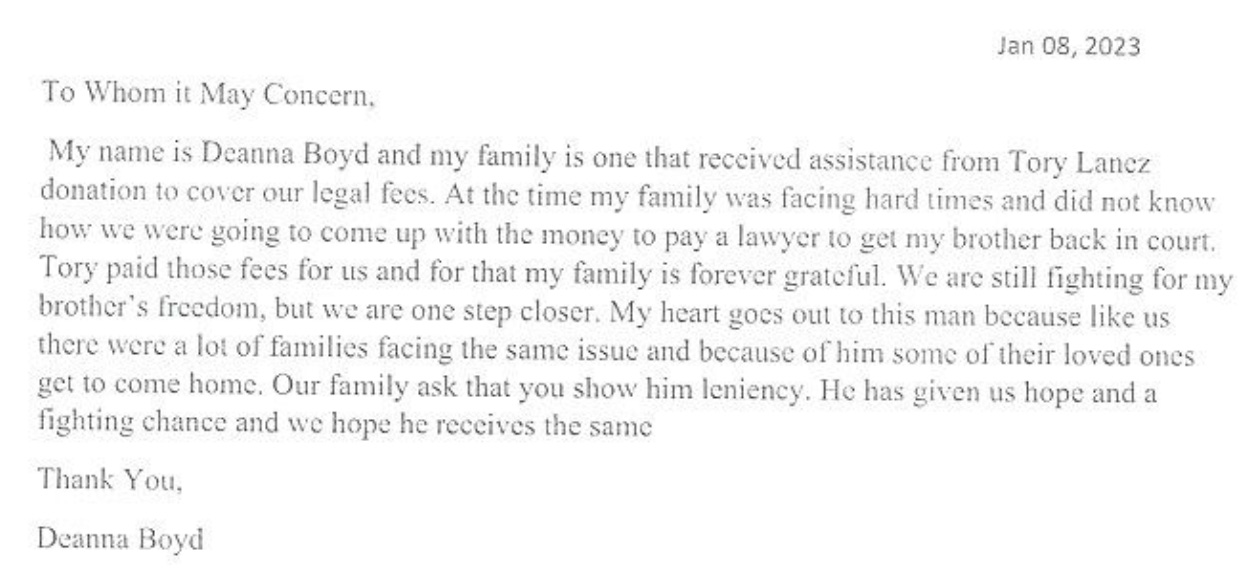
Two other letter writers told Herriford that Lanez paid their families’ fees for lawyers seeking to free their long-imprisoned family members. Deanna Boyd said her family “was facing hard times and did not know how we were going to come up with the money to pay a lawyer to get my brother back in court.”
“Tory paid those fees for us and for that my family is forever grateful. We are still fighting for my brother’s freedom, but we are one step closer,” Boyd wrote.
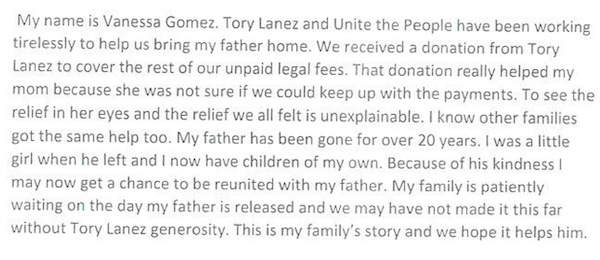
Vanessa Gomez wrote that Lanez and Unite the People “have been working tirelessly to help us bring my father home.” Lanez paid her family’s legal fees, which she said “really helped my mom because she was not sure if we could keep up with the payments.”
“My family is patiently waiting on the day my father is released and we may have not made it this far without Tory Lanez’s generosity,” Gomez wrote.
Many letters discuss the huge number of people who depend on Lanez for their livelihoods, from Unite the People to his own employees who are accustomed to being highly compensated.
“Their ability to care for their families hinges significantly on Daystar’s freedom. His incarceration would impact not only those directly employed by him but also the countless others he crosses paths with and blesses with his assistance,” wrote Raymond Martinez, Lanez’s former personal assistant.


Sascha Stone Guttfreund, Lanez’s former manager, said his criminal convictions “will forever be an asterisk for his career.”
“It will forever be something his son is asked about. It will forever be something that hurts him and his potential … and his legacy. He may never be able to return to what he once was - and thus in many ways he’s already suffered - and thats in addition to the death threats and other awful treatment he’s received,” Guttfreund wrote. “He struggled long before this incident and he’s struggled through. Let the suffering stop.”


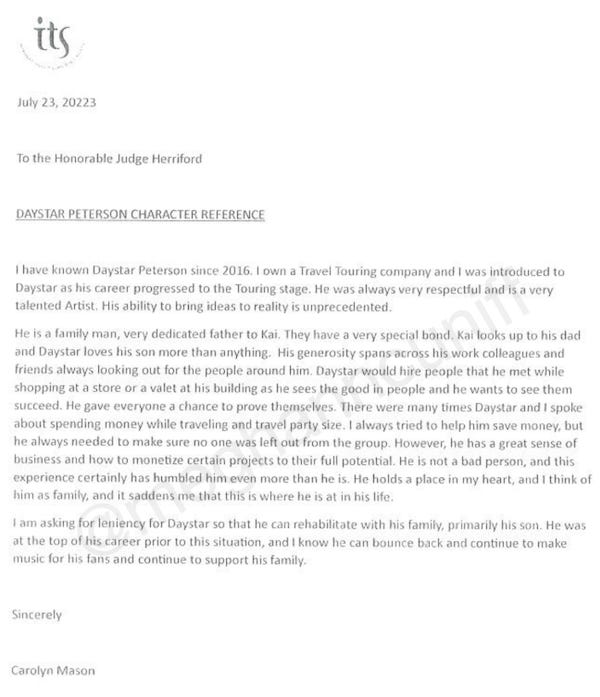
Carolyn Mason, who managed Lanez’s tours, said she tried to counsel Lanez about his finances.
“There were many times Daystar and I spoke about spending money while traveling and travel party size. I always tried to help him save money, but he always needed to make sure no one was left out from the group,” Mason wrote to Judge Herriford. “He was at the top of his career prior to this situation, and I know he can bounce back and continue to make music for his fans and continue to support his family.”
Elis Pacheco of Digital Launch told Herriford in person during last week’s hearing that Lanez’s business finances were in “disarray” because he was distracted with his music and charitable work. He started building a nest egg, but an accountant “did some things that were not in his best interest and he had to write the IRS a multimillion dollar check.”
Baez asked if Pacheco is being paid for currently managing Lanez’s business affairs. Pacheco said no because Lanez’s finances are in too much “disarray.”
“He trusted the wrong people,” Pacheco said.
Look for another article soon about Lanez’s letters. I’ll also be live on YouTube on Wednesday at 11 a.m. PST / 2 p.m. EST to discuss this article and everything else I’ve been doing. If you’re not already a paid subscriber to my website, please consider purchasing a subscription to support my work. You can pay through Substack or through Venmo (MeghannCuniff), CashApp ($MeghannCuniff) or Zelle (meghanncuniff@gmail.com).