

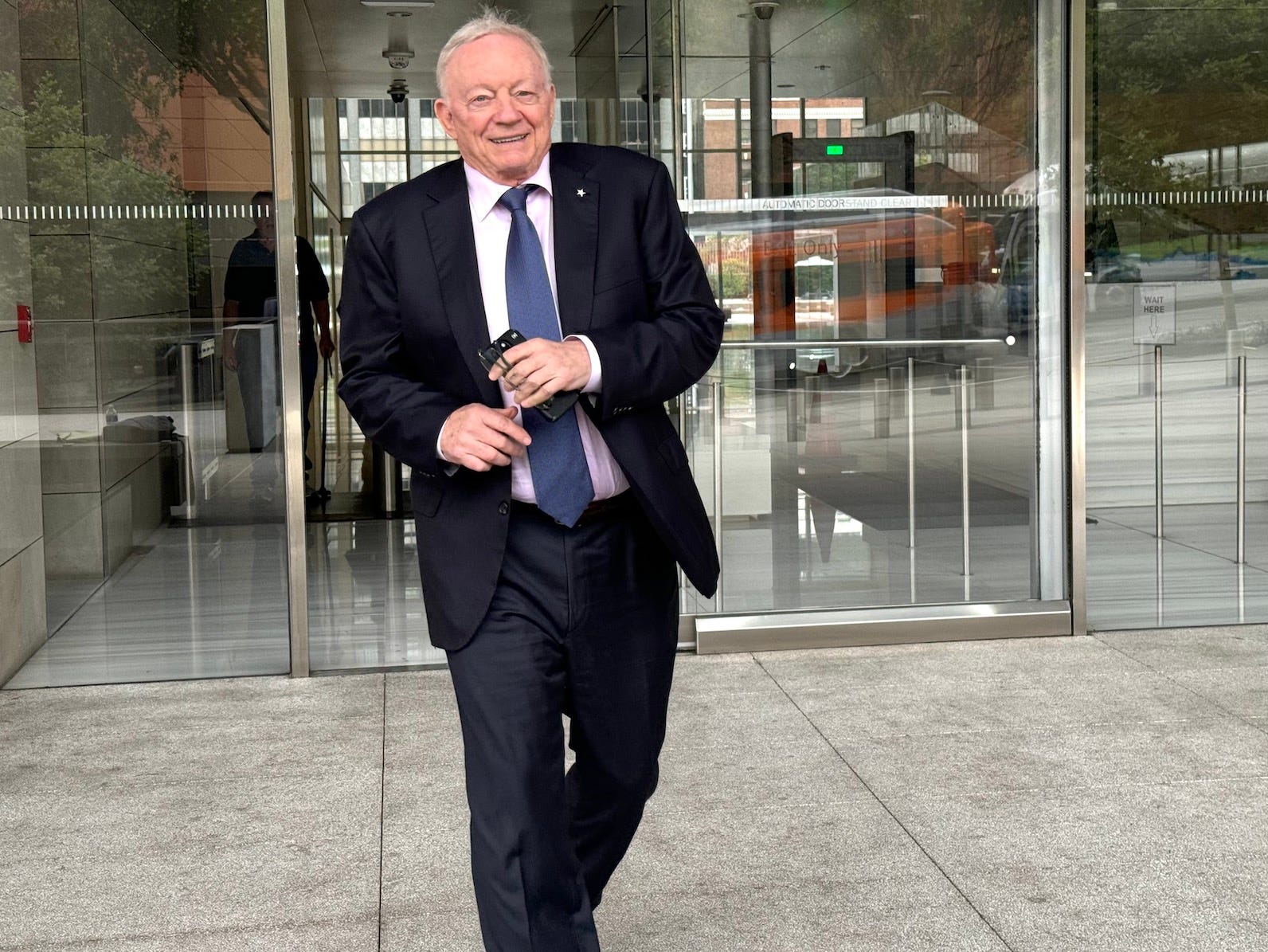
I watched Dallas Cowboys owner Jerry Jones return to the witness stand last Tuesday in the civil antitrust trial over NFL Sunday Ticket that could change how the United States watches professional football.
Jones continued testifying under cross-examination from Kalpana Srinivasan of Susman Godfrey LLP, who focused on the Cowboys’ current licensing of radio rights and pre-game rights.
Increasing distribution of games outside of Fox and CBS “would be a good thing for fans, wouldn’t it, sir?” Srinivasan asked.
Jones answered no because “it would undermine the free television that we have right now.”
Much of Jones’ direct testimony last Monday focused on his opposition to NFL teams controlling their own TV rights and his support for the current revenue-sharing model that he said helps the 32 teams compete more evenly.
“I haven’t won a Super Bowl in 25 years or more. And I would be embarrassed to tell you what I do to get to win a Super Bowl,” Jones said. But because of the “equity” within the NFL, “you have to earn it and scrap for it.”
Srinivasan focused her cross on Monday on the multibillionaire’s own lawsuit against the NFL in 1995 that sought the right for the Cowboys to license its merchandise and said the NFL’s centralized control of team merchandise was a “classic price-fixing cartel.”
On re-direct Tuesday, the NFL’s lawyer Beth Wilkinson pointed out a paragraph of Jones’ old lawsuit that Srinivasan didn’t. It reads in part, “the overwhelming bulk of the club revenue derives” from shared TV rights, which aren’t controlled by the “licensing cartel” and weren’t at issue in the lawsuit..
The current witness is defense expert Douglas Bernheim, a Stanford University economics professor and probably one of the best experts possible for the NFL in this trial, if not the best. His resume includes testifying in the blockbuster antitrust bench trial between Epic Games and Apple Inc. before U.S. District Yvonne Gonzalez Rodgers in 2021.
Bernheim was on the opposite side of the antitrust battle then and testified as a witness for Epic that Apple’s App Store practices were anticompetitive. In the NFL trial, he’s testifying that the NFL Sunday Ticket promotes competition, and he’s explaining why he disagrees with plaintiffs expert Daniel Rascher, a sports economist at the University of San Francisco.
At the same time, U.S. District Judge U.S. District Judge Philip Gutierrez appears increasingly frustrated with plaintiff attorneys and has said he may issue a defense judgment under Rule 50 of the Federal Rules of Civil Procedure, which allows judges to issue a direct judgment if they believe claims don’t have enough evidence for a jury to consider them.
“The way you have tried this case is far from simple. This case has turned into 25 hours of depositions and gobbledygook,” Gutierrez said on Thursday, according to The Associated Press.
I understand what the judge means based on my time in the courtroom. As a lifelong, extremely casual fan of the NFL, it’s not difficult for me to get behind the idea that it is a price-fixing cartel, and as the judge said, the basic premise of the case is simple: NFL Sunday Ticket was priced in a way to intentionally prevent some people from buying it, which kept millions of fans from watching games they wanted to watch because NFL Sunday Ticket was their only option.
The NFL documents I’ve seen in trial seem to lay this all out, but much of the testimony I’ve heard is about whether the current revenue sharing model truly helps teams compete more evenly, and whether individual team TV licensing is anticompetitive or pro-competitive. That’s because one of two damages models presented by the plaintiffs involves what would have happened if the 32 teams had been able to license their own TV deals during the class period (2011 to 2023). The other involves what would have happened if NFL Sunday Ticket was available for a lower price if DirectTV had competition.
The individual licenses model puts damages at about $7 billion, while the seemingly more simple competitive pricing model puts it around $3.6 billion. Any final damages total could triple post-jury under the treble damages rule often applied in antitrust cases.
I’ve heard much more testimony related to the first because there’s a lot to say about the individual licensing theory and the plaintiffs’ argument that revenue sharing doesn’t actually promote competitiveness within the NFL. At one point I heard a long line of questioning from the defense about the demise of the Pac-12, highlighting what a horrible thing it is and really hitting home for a Corvallis, Oregon, native like me whose hometown is going to be severely hurt by it. As a casual trial watcher, it seems to me like a distraction from the central issue of, “Did the NFL fix the price of Sunday Ticket?”
Bernheim will continue testifying Monday. Closing arguments are expected Wednesday. Defense attorneys have not yet filed their Rule 50 motion, but Wilkinson told Judge Gutierrez on Thursday she’s hoping for a “robust” hearing. I think the major luminaries are gone for good: Jones and Commissioner Roger Goodell aren’t coming back, and neither is former CBS Sports chairman Sean McManus, who testified for the defense after Jones on Thursday.
Wilkinson’s husband, journalist and former Meet the Press host David Gregory, also won’t return, Wilkinson confirmed with me.
Previous article:
Roger Goodell and Jerry Jones testify in NFL antitrust trial at LA federal courthouse

National Football League Commissioner Roger Goodell and Dallas Cowboys owner Jerry Jones testified Monday in an antitrust trial in Los Angeles federal court over the NFL’s DirectTV Sunday Tic…
Thank you for supporting my independent legal affairs journalism. Your paid subscriptions make my work possible. If you’re not already a paid subscriber, please consider purchasing a subscription through Substack. You also can support me through Venmo (MeghannCuniff), CashApp ($MeghannCuniff) and Zelle (meghanncuniff@gmail.com). Thank you!