

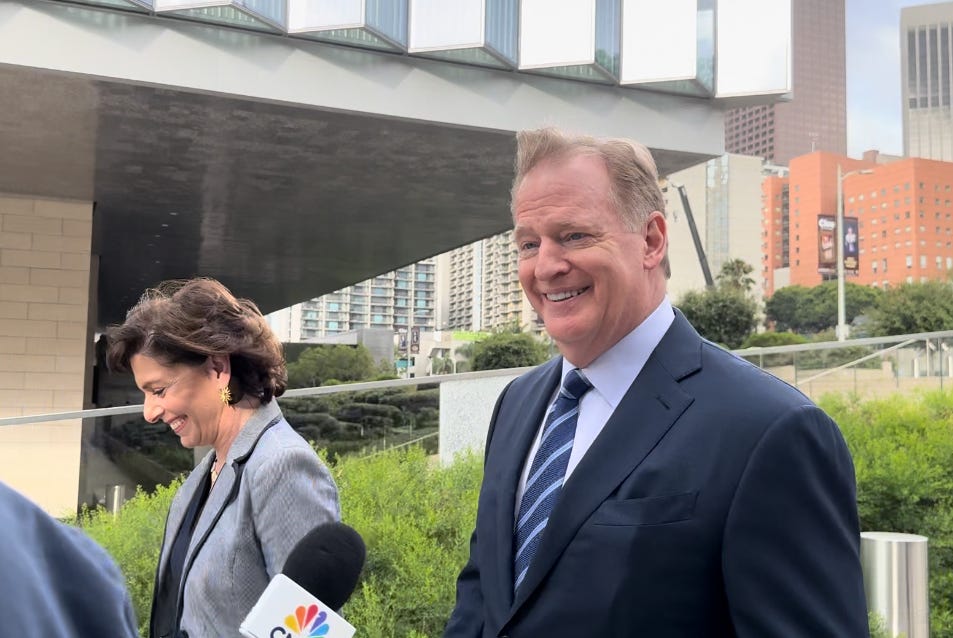
National Football League Commissioner Roger Goodell and Dallas Cowboys owner Jerry Jones testified Monday in an antitrust trial in Los Angeles federal court over the NFL’s DirectTV Sunday Ticket package.
Both are defense witnesses in a class action seeking billions of dollars for what plaintiff attorneys describe as a years-long monopoly and price-fixing scheme that intentionally priced some fans out of the Sunday package to maintain high profits from broadcast deals with CBS and Fox.
Jones will return for more cross-examination Tuesday morning from Kalpana Srinivasan, who focused Wednesday on a lawsuit Jones filed against the NFL 30 years ago that described the league’s approach to merchandise sales much the same way the current lawsuit describes the DirectTV Sunday deal.
Jones’ lawsuit, filed after the NFL sued him in 1995, said the league’s exclusivity on merchandise licensing “was a classic price-fixing cartel,” said Srinivasan, managing partner of Susman Godfrey LLP’s Los Angeles office.
“I do not deny what was in my suit at all, and I don’t have a problem, frankly, with saying one more time I wanted all clubs to sell their own hats,” Jones answered.
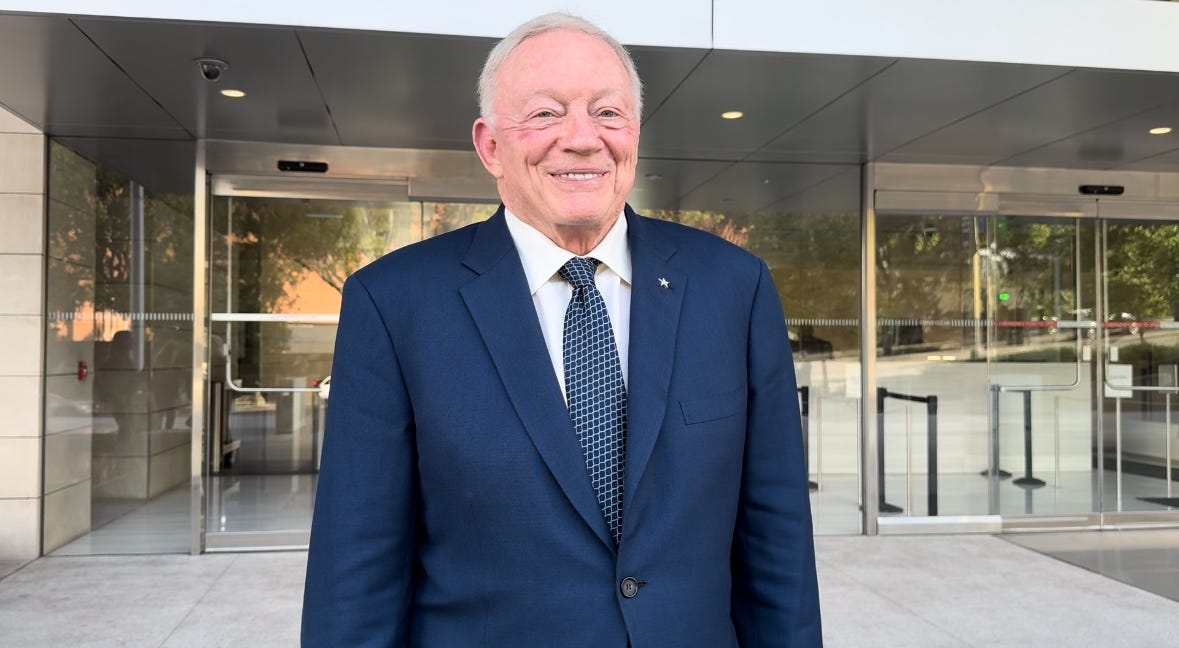
Srinivasan tried to further emphasize the similarities between Jones’ proposed solution to the decades-old merchandise fight and the current class action.
Jones thought fans “would be better off if these teams could individually be out there competing to license their logo,” Srinivasan said. Plaintiff experts in the lawsuit over Sunday Ticket have opined that Individual licensing agreements would better serve fans than the single all-in-one TV package that includes each of the 32 teams.
“What you said is that you’re ready, willing and able to complete vigorously with others in a free market,” Srinivasan told Jones.
“Yes … you did read it correctly,” Jones replied. “Where I’m responding to you is that word ‘competition.’ Because I never thought there was any competition between a Redskin hat and a Cowboy hat.”
Jones differentiated between Srinivasan’s use of “consumer” and his use of “fan.”
“You’re talking about a consumer competition, and I’m talking about a fan enhancement,” Jones said.
After about 20 more minutes of questioning, the legendary NFL owner asked Srinivasan, “Do you really want to know why I brought this lawsuit?”
“Because the NFL sued me. I would have never sued the NFL. We would have gotten in and worked it out. The NFL sued me. And I responded,” Jones testified.
Jones’ witness stand appearance followed about 2 1/2 hours of testimony from NFL Commissioner Roger Goodell, who defended the DirectTV deal as a “premium” product meant to complement and not replace the league’s free CBS and Fox broadcasts. DirectTV set the price, not the NFL, he said.
“I think we’ve been very clear … that this was a premium product. And not just on pricing, but on the quality of the product itself,” Goodell testified.
“The high price was geared to limit its distribution, fair?” asked Bill Carmody, a partner in Susman Godfrey’s New York City office.
“I didn’t say that, no,” Goodell answered, but the Sunday package “is a premium product” and “should be priced accordingly.”
Goodell and Jones are the most famous witnesses in a high-stakes trial nine years in the making. The lawsuit was filed in 2015, and U.S. District Judge Philip Gutierrez certified two damages classes and two injunctive-relief classes in February 2023, separating DirectTV residential and commercial subscribers. The subscribers include anyone who purchased NFL Sunday Ticket any time between June 17, 2011 and Feb. 7, 2023. The class representatives include a New Orleans Saints fan who subscribed to Sunday Ticket while living in California and a New York City bar owner who hosts Chicago Bears games and had to subscribe to do so.
The NFL no longer contracts with DirectTV to distribute Sunday Ticket, but Susman Godfrey partner Amanda Bonn said in her opening statement on June 6 that price-fixing continues with the new distribution partner, Google-owned YouTube TV.
Part of the NFL’s defense is that the plaintiffs’ idea for individual license rights would hurt competition by ending the current revenue-sharing agreement that splits profits equally between the 32 teams. The plaintiff attorneys at Susman Godfrey dispute whether NFL officials truly believe shared revenue enhances competition.
Early in the trial, the Susman Godfrey team played video from the deposition of New England Patriots owner Robert Kraft, who seemed to connect the number of Sunday Ticket subscribers to the NFL’s desire “to keep this as a premium product that doesn't devalue over the air, TV product.”
“We’re not looking to get multitudes of people,” said Kraft, who did not appear at the courthouse.
Asked if he’d considered a cap on subscribers, Kraft said he’d never thought of it, “but maybe.”
“I don’t know,” Kraft said in the video.
An attorney asked Kraft about Apple Inc.’s offer to host Sunday Ticket, and if he considered drawing more subscribers to be a good thing. Kraft said it depends on where they’re located.
“If it’s in the U.S., my personal opinion is it’s too many,” Kraft said.
On the witness stand Monday, Goodell said the NFL gave DirectTV exclusivity over Sunday Ticket because of “the investment with innovation.” He cited DirectTV’s invention of the “red zone,” which allows fans to switch into games when a touchdown is within reach.
“I think the innovation for our fans is really critical to the future of our game. And having that exclusivity is important,” Goodell said.
Goodell and Jones were questioned in direct-exam by Beth Wilkinson, a prominent national trial lawyer and partner at Wilkinson Stekloff in Washington, D.C. She asked them about their backgrounds, career paths and job duties before moving into soft questions about the NFL’s media contracts and desire to reach fans. She brought up Jones’ 1995 lawsuit first, asking him if anything he said or did during the litigation “has anything to do with free TV?”
“None at all. They’re daylight and dark,” Jones answered.
Carmody opened his cross of Goodell with a hint of condescension, telling the NFL boss he knows they disagree on a lot, but he wanted “to try something really different” and discuss what they agree on.
“Can we try that?” Carmody asked
“OK,” Goodell answered.
Carmody confirmed with Goodell that he went to “Washington and Jefferson University” — “College,” Goodell corrected — and studied economics and business.
“OK. So now let’s focus on economics,” Carmody said, before moving into leading questions about the NFL’s popularity on TV and its many media deals.
He questioned Goodell about a 2009 document regarding negotiations with CBS that said the NFL needed “clarification on the premium pricing for NFL Sunday Ticket” because the concept is to price it “at a premium, thereby limiting distribution.”
“I didn’t write this,” Goodell said.
As Carmody’s questions continued, Goodell said he’d never seen the document “so I have a very difficult time understanding what you’re asking.” He said he knew “premium pricing” would exclude people who chose to only watch football on free TV.
“They make that choice,” Goodell said.
Carmody asked if NFL officials “ever pushed back hard” when DirectTV suggested lowering the price of Sunday Ticket, and Goodell answered, “we probably did” but that DirectTV has “the right” to decide.
Goodell stayed in the courtroom to watch Jones’ testimony. Jones is due back at 9 a.m. Tuesday. I haven’t been able to watch as much of the trial as I like because I’ve been focused on rapper Jeffery “Young Thug” Williams’ racketeering conspiracy trial in Georgia state court, but I plan to watch the end of Jones’ testimony and will hopefully be in court for the verdict.
Thank you for supporting my independent legal affairs journalism. Your paid subscriptions make my work possible. If you’re not already a paid subscriber, please consider purchasing a subscription through Substack. You also can support me through Venmo (MeghannCuniff), CashApp ($MeghannCuniff) and Zelle (meghanncuniff@gmail.com). Thank you!