
Megan Thee Stallion seeks permanent injunction against sued blogger after jury's liability findings
The motion cites the Dec. 1 jury verdict and Milagro Cooper's "five-year cyberstalking campaign" under a Florida law that allows for injunctions against cyberstalking.

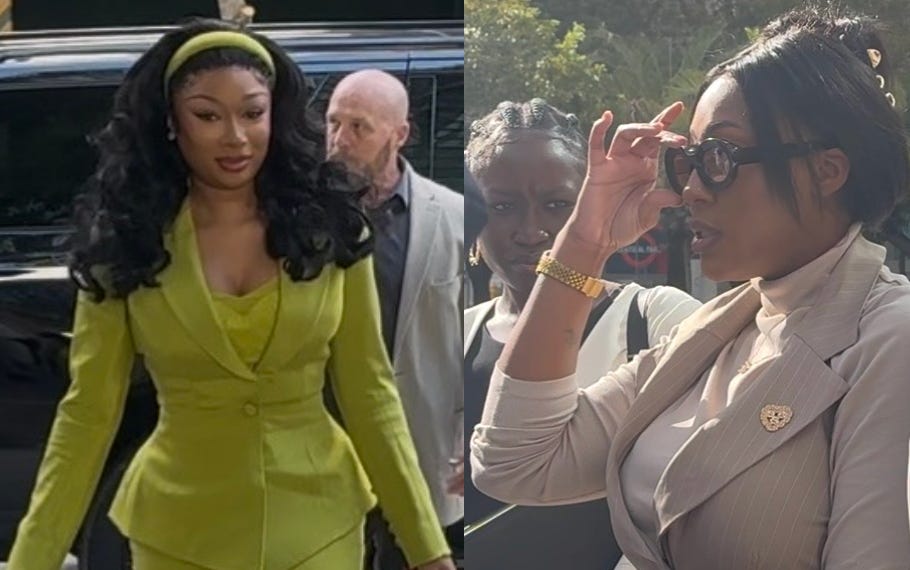
Lawyers for rapper Megan Thee Stallion are asking for a court order that would require the online commentator she sued to delete old posts and limit her future ability to discuss Megan.
The motion for a permanent injunction against cyberstalking cites the federal jury verdict in Miami, Florida, last month that found Milagro Cooper liable for defaming Megan and intentionally inflicting emotional distress on her by coordinating with rapper Tory Lanez, legal name Daystar Peterson, who is serving a 10-year prison sentence in California for shooting Megan.
Jurors also concluded Milagro knowingly promoted a digitally altered sexual depiction of Megan in violation of a Florida law enacted in 2024.
Jurors awarded Megan, legal name Megan Pete, $75,000 in damages, but U.S. District Judge Cecilia M. Altonaga in the Southern District of Florida didn’t enter judgment for the defamation claim because jurors concluded Milagro was a media defendant and Megan’s lawyers didn’t serve her with a cease and desist notice before suing her.
That reduced damages to $59,000, but Megan’s lawyers said in the motion filed Wednesday that the judgment for only emotional distress and the video promotion “has no bearing” on the jury’s decision to find Milagro liable for defamation.
“This Court’s finding regarding the entry of judgment on the defamation count does not change Ms. Pete’s entitlement to equitable relief because Ms. Pete has established actual success on the merits. The legal test for injunctive relief makes clear that the established facts matter, not the question of whether judgment was ultimately entered,” according to the motion.
The proposed injunction is two pages and says Milagro must “remove from the internet and related public forums all statements and postings that formed the basis for the jury’s verdict in this case.”
It also prohibits:
“any direct, indirect, or third-person contact with Plaintiff, including but not limited to written, telephonic, electronic, and social media contact for a period of five years”
“defamatory statements” about Megan regarding her testimony in Lanez’s trial “including the circumstances and causes that gave rise to Plaintiff’s injuries,” her “mental and emotional state,” her “recreational use of alcohol” and her “extended family”
any communications about Plaintiff that are intended to incite third parties to engage in threats or violence against Plaintiff, her professional team, and/or her family”
coming within 500 feet of Megan, her residence or any place she’s expected it to be, and it prohibits her from coming within 1,000 feet from Megan’s musical performances for five years
promoting or sharing the fake sexual depiction of Megan, and it prohibits her from disclosing Megan’s personal identifying information such as her home address and phone number


Megan’s lawyers requested the injunction under a cyberstalking claim Megan brought in her federal against Milagro. The legal remedy for a civil cyberstalking claim brought under Florida law is an injunction ordered by a judge, and Judge Altonaga said she’d consider a request for one in the judgment she signed on Dec. 2.
They said their proposal “is narrowly tailored to protect Defendant’s First Amendment rights, while also targeting specific statements for which a jury already found Defendant liable and for which Defendant has no intention of stopping absent an injunction.”
“Defendant’s First Amendment rights will not be infringed with the proposed narrowly tailored injunction. The Supreme Court has recognized that speech falling into certain categories—obscenity, defamation, speech integral to illegal conduct, so-called ‘fighting words,’ fraud, and true threats, among other categories—is unprotected and may be restricted based on its content,” the motion says.
The 23-page filing casts all of Milagro’s written comments and audio streams about Megan as part of a “five-year cyberstalking campaign” that trial evidence showed “was to retaliate against Ms. Pete for her complaint against Mr. Peterson; to bully her into future silence; to dissuade her from cooperating in the investigation and eventual prosecution; and to punish her after she did.”
Legal Affairs and Trials with Meghann Cuniff is a reader-supported project that utilizes my 20 years of reporting experience in traditional media to bring you in-depth news about major legal issues. If you want to support my work, consider upgrading to a paid subscription.
The motion quotes a February 2024 ruling in a defamation lawsuit in the Northern District of Florida that said a communication “serves a legitimate purpose when there is a reason for the contact other than to harass the victim.”
“Here, the reason for the posts went beyond mere harassment—but only insofar as they were aimed at obstruction and witness tampering. Such purposes are not legitimate and highlight the need for injunctive relief,” according to the motion.
The filing cites Milagro’s actions since the verdict, including “posting yet more disparaging comments directed at Ms. Pete” and saying on Instagram Live that she is going to work on a mixtape “because apparently, the only place you can bully people and talk crazy and pop shit is in the studio, but anywhere else is off limits.” Milagro also “mocked Ms. Pete’s emotional distress” by saying she only blocks her critics on social media and doesn’t “get on the Internet and cry about what y’all say.”
“Defendant has been wholly undeterred by the recent verdict in this matter,” Megan’s lawyers wrote. “Monetary damages and sanctions imposed against her clearly have not deterred Defendant, and they will not adequately compensate Ms. Pete for the severe emotional distress and reputational harm she has and will continue to suffer.”
The attorneys also cite Milagro’s social media post that her comments about Megan being mentally incapacitated and an alcoholic weren’t on the verdict sheet, which they said disregards that the comments supported the claim of intentional infliction of emotional distress.
“Defendant also wrote that the three defamatory statements for which the jury found her liable were not ‘statement[s] of fact,’ even though the Court previously determined that they were,” according to the motion. “The message of this post was clear: Defendant unequivocally denied the jury’s finding and suggested to her “mob” of followers that prior statements about mental capacity and alcoholism were, in fact, true when she knew full well that they were false and defamatory.”
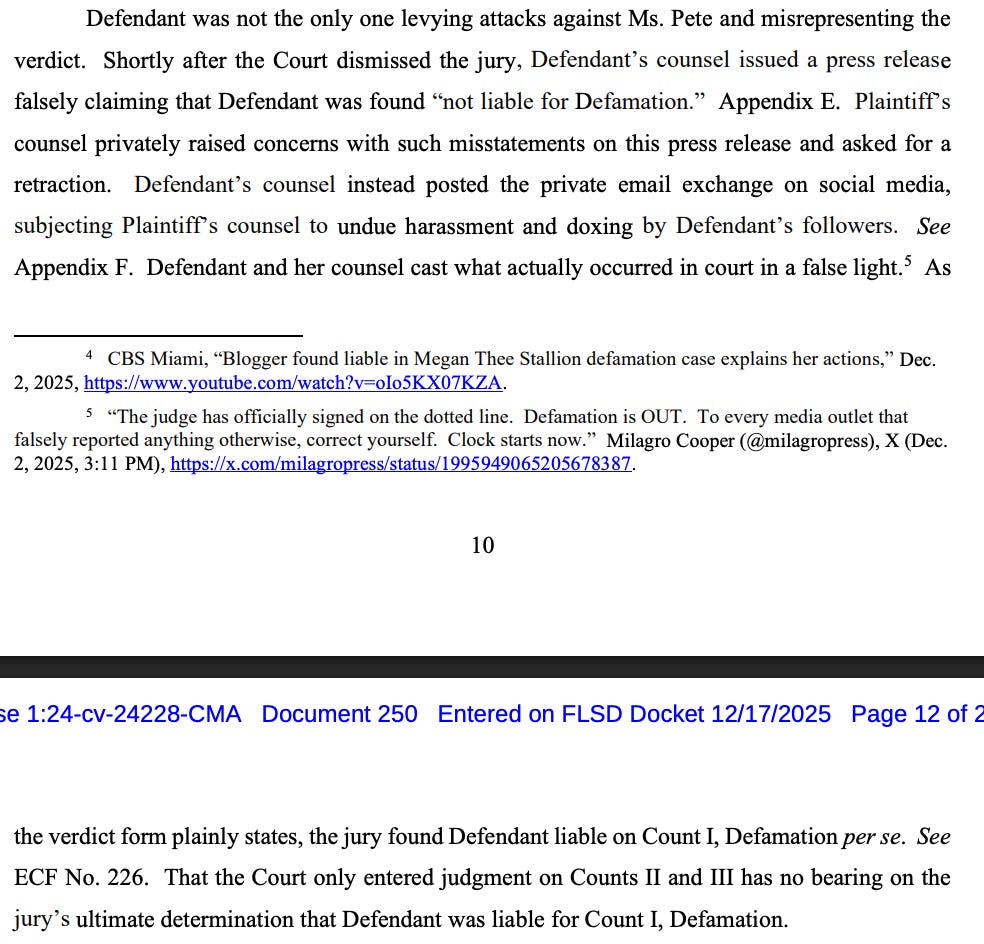
The motion cites a press release from Milagro’s lawyer Jeremy McLymont that said “the final judgment of the court is that Milagro is not liable for defamation.” Megan’s lawyers wrote that he “issued a press release falsely claiming that Defendant was found ‘not liable for Defamation.’”
“Plaintiff’s counsel privately raised concerns with such misstatements on this press release and asked for a retraction. Defendant’s counsel instead posted the private email exchange on social media, subjecting Plaintiff’s counsel to undue harassment and doxing by Defendant’s followers,” according to the filing.
The filing includes a copy of McLymont’s law firm’s Instagram post about the email, which has no identifying information beyond the names of attorneys. Megan’s lawyers says Milagro and McLymont “cast what actually occurred in court in a false light.”
“As the verdict form plainly states, the jury found Defendant liable on Count I, Defamation per se. That the Court only entered judgment on Counts II and III has no bearing on the jury’s ultimate determination that Defendant was liable for Count I, Defamation,” according to the motion.
The motion says Milagro’s “message throughout the entire cyberstalking campaign was clear: to retaliate against Ms. Pete for reporting Mr. Peterson’s crimes to law enforcement.” It quotes Megan’s trial testimony about feeling “tired of being alive,” and cited her friend and manager Travis Farris’ testimony “about the length and severity of Defendant’s cyberstalking—nonstop for five years and so egregious that Defendant could find herself in ‘the Guinness Book of World Records of hating.’”
It also cites trial evidence showing Milagro had two screenshots of Megan’s home on her phone.
Milagro spoke about Megan and other trial witnesses “as recently as December 15,” including saying that Megan acted like “the black Regina George, who in the film [Mean Girls] was a bully.”
“And she attempted to shift blame to … Farris, stating that he ‘should have been up there’ for intentionally inflicting emotional distress because he showed Ms. Pete several of Defendant’s harassing social media posts,” according to the motion. “Throughout the livestream, Defendant downplayed her defamatory statements as mere questions, undermining the defamatory and severe emotional impact of her posts on Ms. Pete.”
Injunction sought under Florida state law
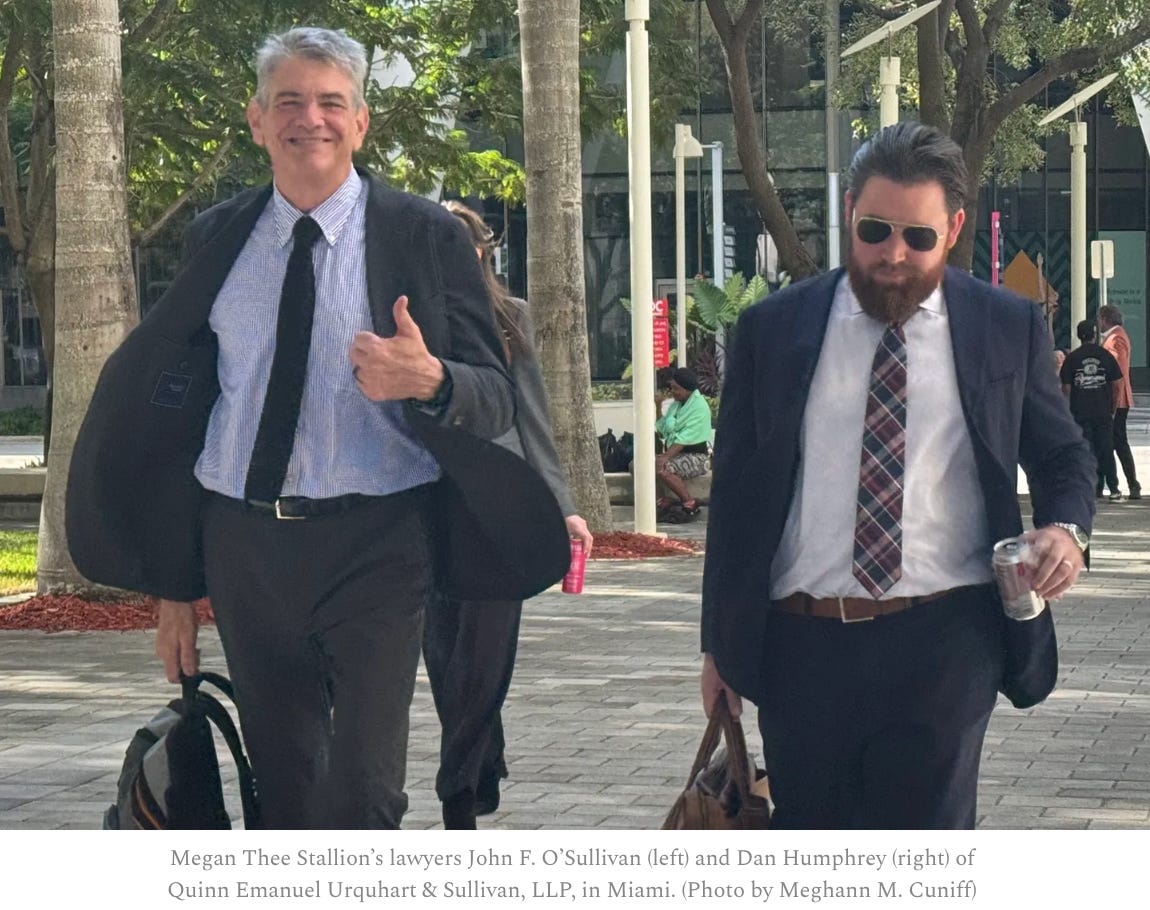
Megan’s lawyers at Quinn Emanuel Urquhart & Sullivan LLP brought the cyberstalking claim under a Florida statute that allows for judges to include the offense in permanent injunctions against stalking.
“Florida courts consistently recognize that the trial judge is the finder of fact in these proceedings and have broad discretion to grant permanent stalking injunctions,” they wrote.
They said “all factors” support an injunction that restrains Milagro “from harassing and cyberstalking Ms. Pete through her persistent and egregious online activity.”
“Defendant’s relentless campaign to defame Ms. Pete and to destroy her public image and livelihood serves no legitimate purpose but rather an illicit one: to retaliate against Ms. Pete for her cooperation with law enforcement in the prosecution of her assailant,” according to the motion. “The sole and apparent aim of this aggressive cyberstalking campaign, as the evidence at trial revealed, was to punish Ms. Pete for none other than her status as a shooting victim of someone who happened to be close friends with the Defendant.”
Florida law defines cyberstalking as “a course of conduct to communicate, or cause to be communicated, directly or indirectly, words, images, or language by or through the use of electronic mail or electronic communication, directed at or pertaining to a specific person ... causing substantial emotional distress to that person and serving no legitimate purpose.”
A permanent injunction against it must be based on “substantial evidence” of a course of conduct directed at or pertaining to a specific person, the use of electronic communication, evidence of substantial emotional distress and evidence that the behavior serves no legitimate purpose.
“Ms. Pete proved—from her Second Amended Complaint through trial—all elements of cyberstalking exist here, warranting a permanent injunction,” according to the motion.
The motion does not mention the jury’s finding that Milagro should be treated as a media defendant and that her conduct is similar to others in media. It instead says the jury “determined that Defendant’s intentional and malicious online harassment served no legitimate purpose.”
“As the evidence successfully showed at trial, Defendant published her social media posts and livestreams to harass Ms. Pete, to retaliate against her, and to hijack Ms. Pete’s fame,” according to the motion. “Defendant’s motivation to harass Ms. Pete sprung from her longstanding personal and professional relationship with the Peterson family, which in turn led to her efforts to interfere with the Peterson prosecution.”
Filing cites ‘potentially criminal nature’ of Milagro’s conduct
Megan’s lawyers say federal law also supports a permanent injunction against Milagro and says her conduct “tracks the elements of federal criminal cyberstalking,” including using an “interactive computer service” for a course of conduct that put Megan in “reasonable fear of the death of or serious bodily injury to a person,” and also “cause[d], attempt[ed] to cause, or would be reasonably expected to cause substantial emotional distress.”
“Defendant’s conduct since the verdict demonstrates that she does not grasp the severity and potentially criminal nature of her conduct. The cyberstalking was itself done for separate illicit purposes—to interfere with the California investigation and prosecution of Mr. Peterson by retaliating against Ms. Pete and bullying her into further silence,” according to the motion.
The motion says Milagro attempt to tamper with a witness by “retaliating” against her former online comment moderator, Amiel Holland-Briggs, who wept on the witness stand as he testified in trial about quitting amid increasing online vitriol that included people threatening suicide.
“Were Defendant to be held criminally responsible for her actions and charged with federal criminal cyberstalking, her pattern of conduct could well result in the denial of pretrial release, given her efforts to obstruct and the threat she poses to Ms. Pete,” Megan’s lawyers wrote.
Lawyers complain of ‘undue harassment’, ‘doxing’
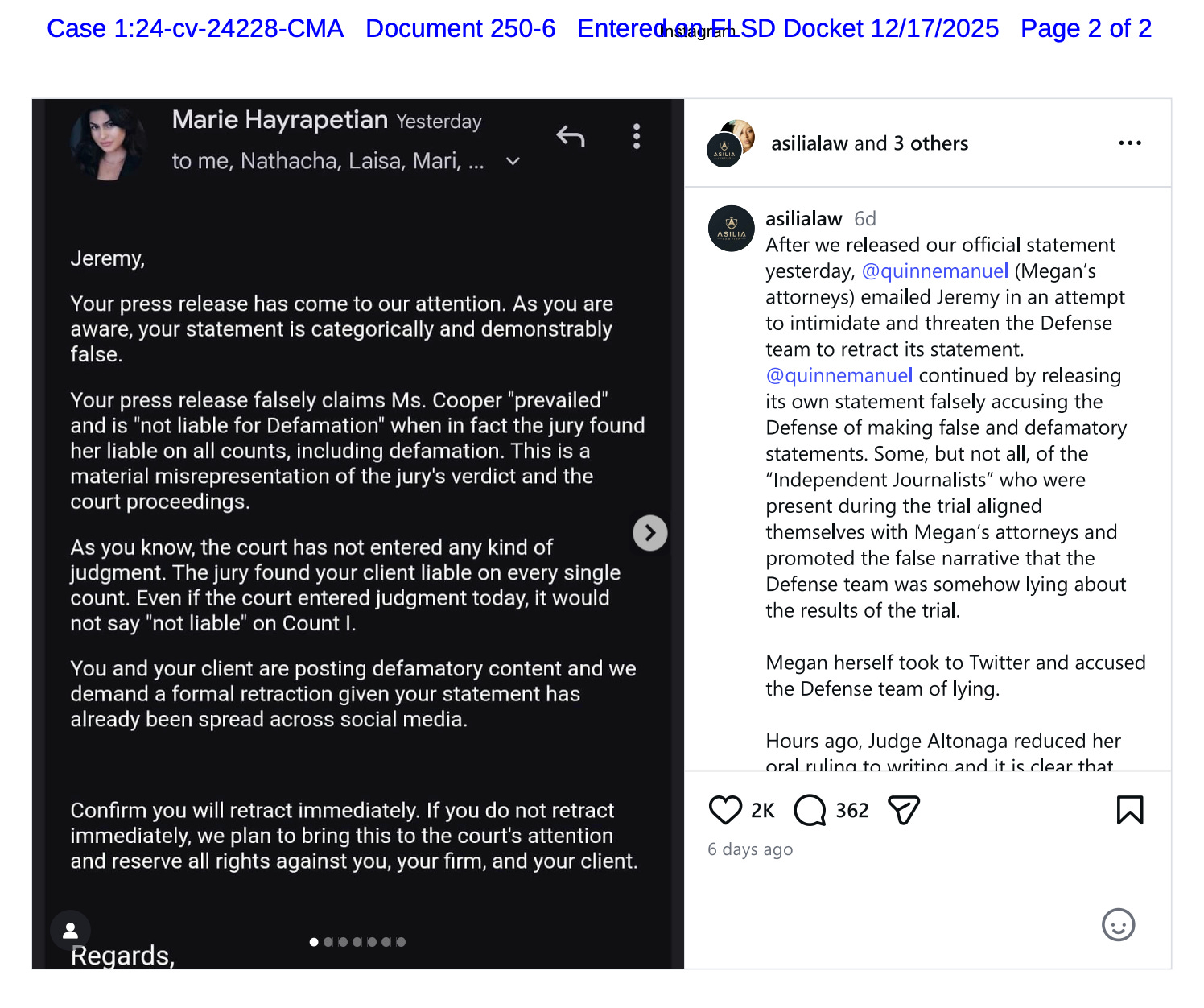
As a victim of cyberbullying by Milagro’s followers, I had to roll my eyes at Megan’s lawyers claim that McLymont posting a screenshot of an email on Instagram led to them being targeted with “undue harassment and doxing” by Milagro’s followers.
They didn’t include examples, but “doxing” is generally defined as the distribution of someone’s personal information such as home addresses and phone numbers with the aim of causing harassment.
The email McLymont posted has the names of attorneys and a photo. If he’s violating a professional code of conduct by posting that, Megan’s lawyers should say so, but otherwise accusing him of causing “undue harassment and doxing” seems a bit extreme.
I have been enduring cyberbullying from Milagro’s followers for three years. At least Megan’s lawyers can include the time they spend reading hateful comments in their billable hours.
The complaint about McLymont supposedly misrepresenting the verdict seems off, too. Yes, the jury found Milagro liable for defamation. But Judge Altonaga pretty soon after said she was entering judgment only for intentional infliction of emotional distress and the video promotion because the jury said Milagro should be treated as a media defendant, and Megan’s lawyers didn’t serve her with a cease-and-desist notice before suing her as Florida law requires of media defendants.
McLymont’s press release said, “While many outlets are reporting that Ms. Cooper was found liable for Defamation, the Final Judgment of the Court is that Ms. Cooper is not liable for defamation.”
That’s an accurate statement. Yes, at the time, the final judgment hadn’t been filed, and I was confused because Judge Altonaga referenced “post-judgment issues” that needed to be sorted out. Doesn’t she need to sort those out before she issues judgment? But the judge made clear when she filed the final judgment the next day that the “post-judgment issues” will be addressed by the appellate court.
I think the press release could be characterized as misleading because it doesn’t mention that the jury did find Milagro liable for defamation and it says, “The jury’s verdict also reminds us all that you cannot sue media defendants without providing the proper due process” when the jury knew nothing about the pre-suit notice issue when deciding whether Milagro is a media defendant.
But I was surprised at the posture Megan’s lawyers took over McLymont’s press release in an official court filing, especially when the injunction they’re requesting wouldn’t prohibit McLymont from doing what he did. They also didn’t fully quote the line about the court not finding liable. Instead, they said McLymont “issued a press release falsely claiming that Defendant was found ‘not liable for Defamation,’” implying he denied the jury verdict and not mentioning he specifically said the judgement “of the court.”
Megan hires new lawyers
Speaking of Megan’s lawyers, she hired new counsel after trial who are experienced not only in federal defamation law, but with Judge Altonaga.
Alejandro Brito and Jalaine Garcia of Brito, PLLC, filed notices of appearance on Dec. 8.
Brito’s firm represented President Donald Trump in his defamation lawsuit against ABC News for George Stephanopolous’s report that Trump had “been found liable for rape” in E. Jean Carroll’s lawsuit against him when he’d actually been found liable for sexual abuse. The case was with Judge Altonaga before it settled in December 2024 for $15 million.
Brito and Garcia have not replaced Megan’s Quinn Emanuel lawyers, who remain on the case and are listed on the injunction motion.
It remains to be seen what exactly they will do on appeal, if anything.
The obvious issue for them is Judge Altonaga’s decision to reverse course on whether Milagro is a media defendant.
The judge said in February that she wasn’t, but she decided during trial that the jury would say if she is or isn’t, then she’d decide whether to adopt the decision in final judgment. I never heard anyone vehemently object to this and tell the judge she can’t insert a major legal issue like that in the middle of trial, after attorneys have given opening statements and the witness lists are set.
The jury of five men and four women deliberated about 10 hours over two days, and their notes to the court show they struggled with the question of whether Milagro is media.
They said Milagro regularly disseminated news to the public but did not provide “disinterested and neutral commentary, rather than advocacy for a particular client or personal interest,” nor did she impartially disseminate information.
But they also agreed she “operated for the purpose of informing the public about matters of public concern through news reporting, analysis, or commentary,” and they agreed she “functioned in a similar manner to traditional news media, such as newspapers, magazines, television, radio, or their online equivalents.”
After they answered those four questions, they wrote the court, “We are confused if we believe half is that considered yes?”
The judge answered, “There is no set number.”
Jurors then concluded Milagro “should be treated as a media defendant with regard to the statements made in this case.”
Under Florida defamation law, that means damages are not assumed and must be proven, but in Megan’s case, it also thwarted the defamation claim because her lawyers didn’t notify Milagro before they sued her.
Right now, the only appeal that’s been noticed is that of Lanez’s lawyer Crystal Morgan, who is appealing to the 11th Circuit U.S. Court of Appeals U.S. Magistrate Judge Lisette M. Reid’s decision to sanction her $5,000 for disruptive conduct during Lanez’s Nov. 14 deposition in prison. Morgan is represented by Robert L. Sirianni, Jr., managing partner of Brownstone, P.A. in Winter Park, Florida.
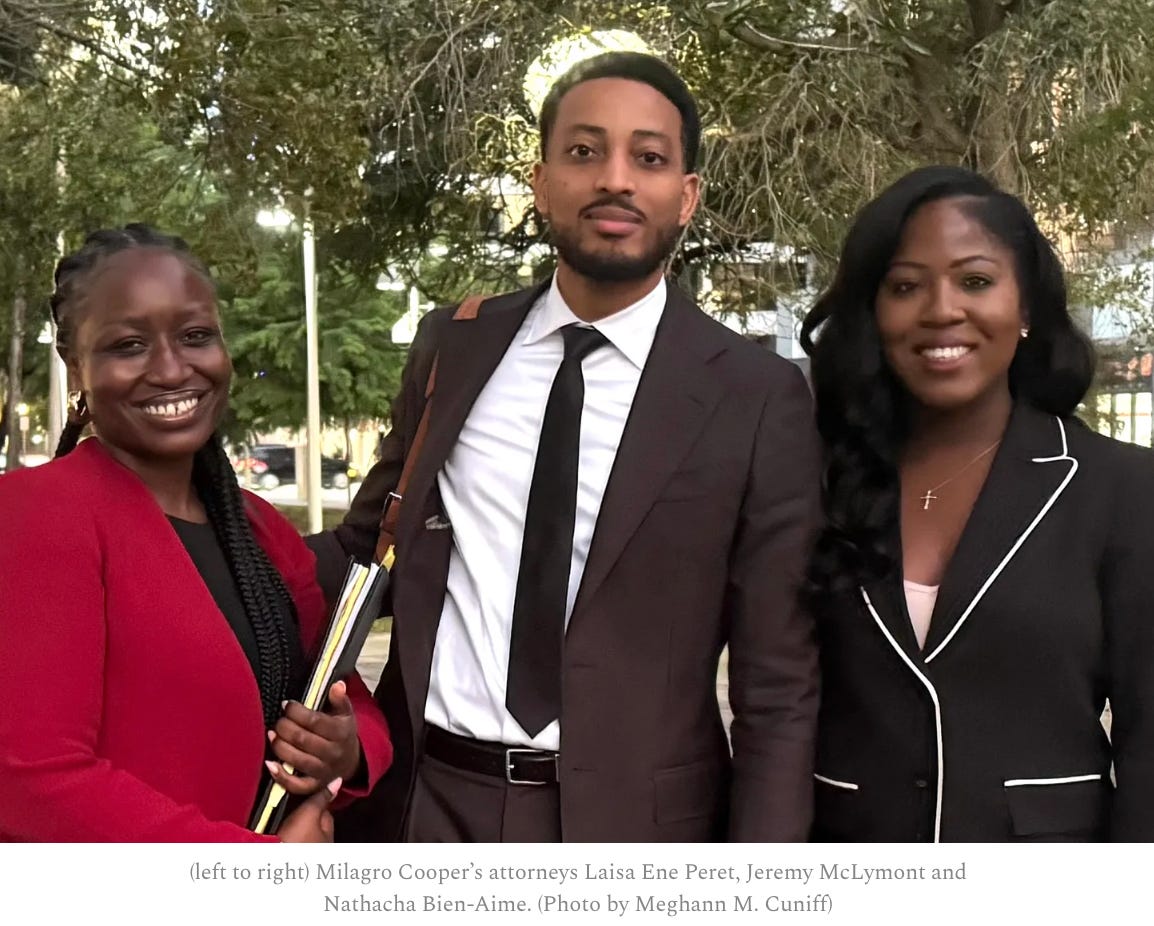
Judge Altonaga granted Milagro’s lawyer Laisa Ene Pertet’s motion to withdraw from the case on Tuesday. Pertet, who is based in New York City, wrote that Milagro is “unable to afford any future legal services for my continued representation” but that McLymont will continue to represent her.
What’s next?
McLymont likely will file an opposition to the motion on Milagro’s behalf. Judge Altonaga could hold a hearing before she issues an order. If she does, I’ll try to be there in person.
The Florida statute regarding the sexually explicit video allows Megan to recover attorney fees from Milagro for the work her lawyers did related to the claim. Judge Altonaga said after the verdict was published on Dec. 1 that she’ll address attorney fees after the appellate process is closed.
I’ll discuss this and more about the case on my YouTube channel on Friday at 12 p.m. PST / 3 p.m. EST. It’ll be my first YouTube live since my eventful visit to Florida, so we’ll have a lot to discuss regarding the trial and the aftermath. You can ask me questions in the chat, and I may share a few photos from my visits to Biscayne, Everglades and Dry Tortugas national parks.
Court documents:
Dec. 17 Motion for permanent injunction
Previous articles:
Dec. 1: Jury in defamation trial awards Megan Thee Stallion $75,000 in damages for three claims
Thank you for supporting my independent legal affairs journalism. Your paid subscriptions make my work possible. If you’re not already a paid subscriber, please consider purchasing a subscription through Substack. You also can support me through my merchandise store and by watching my YouTube channel. Also, please follow me on Facebook and Instagram as I grow my Meta presence. Thank you!