
Jury returns in Young Thug trial as judge orders 'Brady' evidence training for DAs
After two months away, jurors on Monday will be asked if they can disregard all previous testimony by key prosecution witness Kenneth "Woody" Copeland.

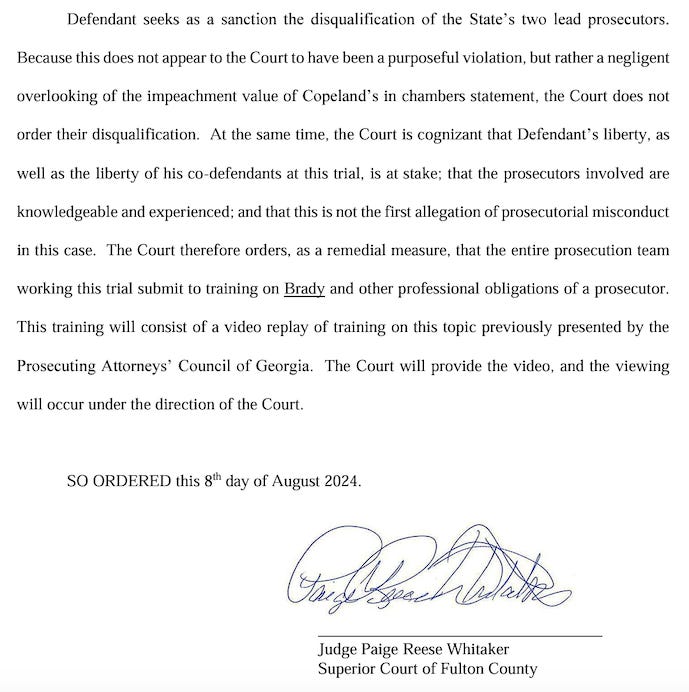
Prosecutors in rapper Jeffery “Young Thug” Williams’ racketeering conspiracy trial in Atlanta, Georgia, must watch a training video about exculpatory evidence because of their “negligent overlooking” of the defensive value of a key witness telling them, “I have never been truthful a day in my life until I just made this statement right now.”
Fulton County Superior Court Judge Paige Reese Whitaker ordered the training in response to requests from defense attorneys to disqualify the prosecutors because of “prosecutorial misconduct and judicial partiality.”
The judge believes prosecutors did not purposely violate their legal requirements to disclose evidence, so she didn’t recuse them, but she said their initial argument that defense attorneys didn’t need to know about the statement “amounted to suppression, whether willful or otherwise, of what was objectively Brady impeachment material,” referring to the 1963 U.S. Supreme Court ruling Brady v. Maryland, which requires prosecutors release potentially exculpatory evidence to a defendant.
“The contents of the meeting were ultimately revealed during the course of trial and in time for the defense to utilize it. So the failure to produce/suppression of this information does not – technically – amount to a Brady violation,” the judge wrote in a nine-page order issued Thursday. “But the fact that a violation of a defendant’s Constitutional rights has been averted does not, under these circumstances, provide cause for celebration. What it does provide is cause for sober reflection and an examination of processes, procedures, and approaches that permitted this likely inadvertent but nonetheless serious Brady lapse to occur.”
The discussion with Williams’ former friend Kenneth “Woody” Copeland occurred during a secret chambers meeting with Judge Ural Glanville on June 10, three days after Copeland was jailed for contempt of court after refusing to testify despite being granted immunity. Glanville, who is the chief judge in Fulton County Superior Court, did not tell defense lawyers of the meeting before Williams’ lawyer Brian Steel confronted him about it in open court.
Another judge on July 15 recused Glanville from the case because of his public defense of himself against recusal motions the defense filed against him over the June 10 ex parte meeting.
The case ended up with Whitaker, who pledged to more deeply analyze the legality of the meeting amid fury from defense attorneys seeking mistrials and prosecutorial disqualifications they hoped would prevent their clients from being retried.
The anger mounted when Whitaker confirmed another ex parte between prosecutors and Glanville on June 7 in which they discussed Copeland’s arrest and prosecutors’ concern that Copeland’s lawyer, Atlanta solo practitioner Jonathan Melnick, wasn’t representing his best interests and was instead colluding with defense attorneys to keep him from testifying.
According to the court reporter’s transcript, Glanville said of defense attorneys, “there’s a lot of innuendo that they have asserted.” He also mentioned “outside agitators and everybody else who I think are trying to influence” the case, which Whitaker concluded “are virtually identical to the remarks he had just made on the same topic in open court – remarks which he addressed to all counsel and which could not therefore logically include defense counsel.”
Still, Doug Weinstein, who represents Williams’ co-defendant Deamonte “Yak Gotti” Kendrick, indicated he believes the comment was about the defense, writing on X on Friday, “I can’t wait for Monday. This outside agitator is tanned, rested, and ready.”
Weinstein said in a court filling that the contents of the June 7 transcript “highlights that which has been obvious to all observers, except for Kendrick’s counsel, for the past 19 months.”
“Judge Glanville has been willfully biased and acting as a member of the prosecution team since the inception of this case,” Weinstein wrote in a supplement to his motion for mistrial. He said it’s “not a fair trial” when Glanville, Fulton County Chief Deputy District Attorney Adriane Love and Deputy District Attorney Simone Hylton “gossip like yentas over 13 pages of transcript about” defense attorneys.
“This case is like an old house that the present Honorable Judge is tasked with renovating. Every time a piece of pasted-up wallpaper is removed more rot is found hidden underneath,” Weinstein wrote. “No herculean effort by the present Court can fix the Due Process violations of the last Judge. This house must be torn down.” Weinstein asked that a retrial “be barred due to prosecutorial and judicial misconduct that has goaded Kendrick into the present motion.”
Max Schardt, an Atlanta solo practitioner who represents Shannon Stillwell, cited the ex parte meetings in his motion for “a fair and constitutional trial and appropriate remedies for constitutional violations.”
Schardt said Glanville “was clearly working in concert with the State and abandoned any semblance of impartiality.” He called the June 7 transcript “shocking” and said it “sheds light on how this case has become irretrievably broken.”
Steel later alleged the June 7 transcript was incomplete, and that Copeland “did talk about the killing of Donovan Thomas, and it’s not on the transcript.”
Whitaker heard testimony from Kayla Bumpus, an attorney who who represented Copeland during the June 10 ex parte and told Whitaker he referenced an “Infiniti.” That’s the type of car Williams rented that prosecutors say was involved in the April 10, 2015, drive-by shooting that killed Thomas, whose Inglewood Family or Atlanta Bloods gang had, according to Atlanta police, been feuding with Williams' Young Slime Life gang.
Antonio Long, the deputy chief investigator with the Fulton County District Attorney’s Office, who attended the meeting, said Copeland never mentioned an Infiniti. Whitaker said in her order that she believed Long over Bumpus. She said Bumpus “consciously endeavored to ensure that she immediately placed on the record everything about the substance of the off-the-record conversation” but didn’t say anything about the Infiniti.
Long confirmed an off-the-record discussion occurred as Steel alleged, testifying that Hylton asked to speak to Bumpus without the court reporter transcribing then told her that she’d charge Copeland with perjury if he testified he killed Thomas. Long also testified that Copeland told Hylton, “You don’t know what I did or didn’t do.”
But without the Infiniti comment, Judge Whitaker wasn’t persuaded that anything in the conversation should have been revealed to the defense, writing that the perjury threat over Copeland’s possible claim that he murdered Thomas was because “the prosecution knew this to be demonstrably untrue.”
“As the Court finds that as there was no Brady violation with respect to the unreported portion of the June 10, 2024 ex parte meeting, there is no relief to be provided,” the judge wrote.
Whitaker also said in court last week that prosecutors requested the June 7 ex parte in open court, “so it’s not quite the salacious revelation that y’all make it out to be.” Her order said attorneys “knew the request was not to secure immunity for Copeland, as the immunity order had been signed in open court earlier in the same day’s proceedings.”
“Even assuming a right to be present for this June 7, 2024 conference, no one on the defense team objected to the request or sought more information about it, thereby waiving any right to be present for that conference,” the judge wrote.
Weinstein indicated on social media he believed Whitaker was too lenient with prosecutors, writing, “Watch a training video?! As a former prisoner of corporate America for 7 years, I get that watching a training video is miserable. But I was expecting more.”
Whitaker is a former Fulton County deputy district attorney who worked in the appeals division. She graduated from Duke University School of Law in 1992 and has been a Fulton County Superior Court judge since 2017.
Her trial management approach so far has been in stark contrast to that of her predecessor, who had presided over the 65-count, 28-defendant case since shortly after the first indictment was filed in May 2022.
Under Glanville, jury selection lasted 10 months as he brought 2,000 Fulton County residents in for questioning, though the jury was selected from the first 500 interviewed. Opening statements began on Nov. 27, and by July 1, court had been in session for 100 days, some of them half days, and prosecutors were not yet half way through their case.
Glanville never started court at the scheduled time, oftentimes not convening until 10:30 a.m. or later, and he took lengthy recesses called “comfort breaks” that interrupted testimony and disrupted legal arguments. He also required little to no preparation from attorneys: Whitaker last week remarked that the discussions she’s currently having about the admissibility of past statements by upcoming witnesses should have been addressed in motions in limine before trial.
The defendants, meanwhile, are in jail with no bail allowed. One, Rodalius Ryan, already is serving a life sentence after being convicted of murder in 2019. That murder is the basis for some of the 191 “overt acts” prosecutors say were done to further the racketeering conspiracy; others overt acts include social media posts, song lyrics and violent crimes.
In addition to racketeering conspiracy, Stillwell and Kendrick are charged with Thomas’ murder. Three other defendants are charged but were severed from trial and are in jail awaiting their own proceedings. Stillwell also is charged with the March 2022 murder of Shymel Drinks, as is Quamarvious Nichols.
The trial promises to be much different under Whitaker, who has pledged to begin at 8:45 a.m. and spent last week sorting through possible impeachment material for upcoming witnesses. She’s also taken a tougher tone with prosecutors, including telling Love to take her “duty of candor to the court more seriously” after the prosecutor wrote a brief the judge believes misrepresented case law to make it sound as though a defendant has duty to disclose potential impeachment material for witnesses.
Whitaker also lectured Love on Friday about the importance of following court orders.
“Make sure that before it shows up on a screen with the jury that whatever limits have been placed on this, you abide by them,” the judge said.
In addition to the mistrial and recusal motions, Whitaker also considered how to proceed with Copeland as a witness because in Georgia, if a judge is recused, case law calls for anything that happened after the recusal motion to be invalidated. In this trial, that’s all of Copeland’s testimony.
Whitaker initially asked the attorneys to see if they could agree on what could stay. But at the same time, she had to decide if prosecutors and Judge Glanville coerced Copeland to testify during the June 10 meeting as defense attorneys alleged.
Last Monday, she called the issue a “close call” and urged prosecutors and the defense to consider plea negotiations. Her final order, however, concluded Glanville “did not on the whole use intimidating rhetoric, but rather sought to ensure that Copeland understood the nuances of the decision he had to make.”
Still, Whitaker believes Glanville errored when he told Copeland he could be jailed for not just the duration of the current trial, but the duration of the upcoming trials for the other defendants, so she decided to bring him into court and tell him so.
“While it is likely that Copeland was not induced by any inadvertent or other inaccuracy to testify, the cleaner approach is simply to pretermit this issue, acknowledging past inaccuracies and advise Copeland anew,” according to her order. “This is the course that the Court has proposed, and the parties have affirmed its efficacy.”
Copeland is a former close friend of Williams who spoke extensively to police in several interviews in 2015. He was not charged in the current case, but prosecutors subpoenaed him to testify. Steel, meanwhile, blamed Copeland for Thomas’ murder in his Nov. 28 opening statement.
Copeland was arrested for Thomas' murder in 2015, but prosecutors determined not enough evidence existed to charge him.
Copeland went to Atlanta police headquarters just hours after Thomas was gunned down, and he sat for a recorded interview with detectives in which he discussed is problems with Thomas’ brother and an on ongoing feud between Thomas’ gang and Thug’s gang. In a later interview, he said one of the defendants charged in Thomas’ murder, Damekion Garlington, told him shortly after Thomas’ murder that he and Stillwell had killed Thomas.
Copeland testified he lied in all his interviews, but prosecutors are hoping jurors believe he’s lying now and was telling the truth then. Judge Whitaker said Copeland’s statement in the June 10 ex parte about never telling the truth before then is of huge value to the defense.
“Copeland may have little credibility. He may speak in hyperbole. But the fact remains that for a defense attorney, this nugget by a key State’s witness is gold,” Whitaker wrote.
Judge Glanville released the transcript of the June 10 ex parte on July 1, but he’d previously said the meeting contained “privileged” information, and prosecutors argued the defense shouldn’t get the transcript.
Whitaker cited prosecutors objection to the release when explaining why the transcript’s ultimate release didn’t solve the problem.
“When the prosecution not only did not reduce this statement to writing and produce it, but also asserted in court filings that the defense had no entitlement to know the contents of the ex parte proceedings, this amounted to suppression, whether willful or otherwise, of what was objectively Brady impeachment material,” Whitaker wrote.
Attorneys are due back before Whitaker at 8 a.m. Monday in Atlanta. Copeland is due in court at 8:45 a.m. He told Whitaker whether he testifies “depend on how I wake up,” so his return to the witness stand might be the most anticipated moment of the trial so far.
But before he testifies, Whitaker is going to ask the 12 jurors and four alternates if they believe they can disregard his previous testimony. If enough say no, she’ll have to call a mistrial. She’s also going to tell them she’s the new judge and to disregard any disparaging comments Glanville may have made about the attorneys.
I’ve streamed every single day of the trial on my YouTube channel since opening statements, and I’m not stopping now. That means I’ll be up early in Los Angeles on Monday to catch the 8 a.m. ET / 5 a.m. PT attorney arguments.
https://www.youtube.com/live/Py_k7_ZCwSo
I’m also watching Tom Girardi’s fraud trial in L.A. federal court, and testimony is underway again at 9 a.m. PT. I said last week I wasn’t going to be able to watch much of the trial, but I’ve seen more than I anticipated, and I plan to watch as much as I can this week, so look for an article soon.
Court documents:
Order on Doug Weinstein’s mistrial motion
Order on Max Schardt’s motion for fair trial
Order on Brady violations in off-the-record ex parte
Schardt’s motion for fair trial
Weinstein’s supplement to mistrial moiton
Previous articles:
Judge Glanville recused from Young Thug trial as attorneys plan mistrial, bail requests

A judge in Atlanta, Georgia, on Monday removed her colleague from the high-profile trial of rapper Jeffery “Young Thug” Williams because of his handling of recusal requests about a secret chambers meeting.
Thank you for supporting my independent legal affairs journalism. Your paid subscriptions make my work possible. If you’re not already a paid subscriber, please consider purchasing a subscription through Substack. You also can support me through Venmo (MeghannCuniff), CashApp ($MeghannCuniff) and Zelle (meghanncuniff@gmail.com). Thank you!