
Judge Glanville recused from Young Thug trial as attorneys plan mistrial, bail requests
The future of the trial against the rapper and his co-defendants is uncertain after another judge said Glanville can't continue. He's presided over the case since 2022.


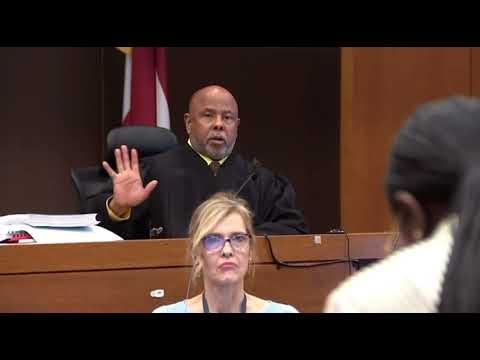
A judge in Atlanta, Georgia, on Monday removed her colleague from the high-profile trial of rapper Jeffery “Young Thug” Williams because of his handling of recusal requests about a secret chambers meeting.
Fulton County Superior Court Judge Rachel Krause said she “has no doubt that Judge [Ural] Glanville can and would continue presiding fairly over this matter if the recusal motions were denied, but the ‘necessity of preserving the public’s confidence in the judicial system’ weighs in favor of excusing” him.
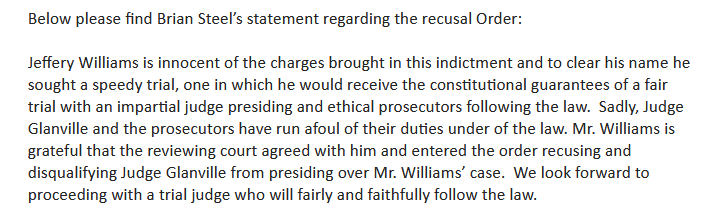
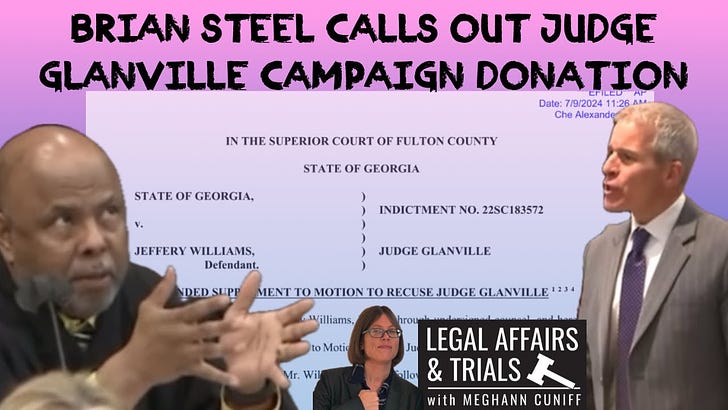
Williams’ lawyer Brian Steel said they “look forward to proceeding with a trial judge who will fairly and faithfully follow the law.”
The 65-count indictment against Williams and his five trial co-defendants, which includes a racketeering conspiracy charge with 191 overt acts, was re-assigned to Judge Shukura L. Ingram. It’s unclear what will happen with the trial, which was in its 100th day when Glanville halted it on July 1.
Doug Weinstein, who represents Deamonte Kendrick, said he’ll ask this week for a mistrial and for Kendrick to be released on bond.
“There’s so many grounds for mistrial at this point,” Weinstein told me during a live interview on my YouTube channel Monday night.
Krause’s 10-page order grants motions from Steel and Weinstein but is largely based on the judge’s own reasoning instead of arguments from the attorneys. The judge said Steel’s recusal argument contained “hyperbole,” but she faulted Glanville for initially refusing to refer the motions to another judge and for defending himself in public comments.
“It is worth noting that this Court agrees generally with Judge Glanville’s assessment of the propriety of the ex parte meeting,” Krause wrote. “While the meeting could have – and perhaps should have – taken place in open court, nothing about the fact of the meeting or the substance discussed was inherently improper.”
“However, in his order denying Defendant Kendrick’s motion and in the process of making his record on July 1, 2024, Judge Glanville added facts, provided context, questioned the veracity of allegations, and otherwise explained his decisions and actions and argued why those actions were proper,” Krause wrote.
Weinstein said he “may not agree with everything that’s in her ruling. But she got to the right place, and I’m really happy about that.”
“I think he’s a good judge,” Weinstein said of Glanville. “I’m not sure exactly what happened here. But I think he’s a good judge. And I don’t want to dirty him up. So the fact that she could find a narrow way to recuse him? I mean, I’m okay with that.”
The recusal motions against Glanville stemmed from a June 10 ex parte meeting he had with prosecutors and key witness Kenneth “Woody” Copeland, who was jailed for contempt of court after defiantly trying to invoke his 5th Amendment right against self incrimination when asked his age, despite prosecutors granting him immunity.
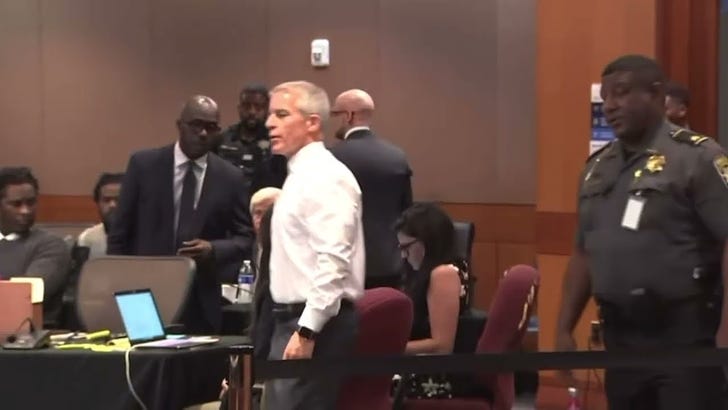
Glanville hadn’t told defense counsel about the meeting when Steel learned of it from someone else and confronted the judge about it during a break in Copeland’s testimony. Steel refused to say how he learned of the meeting, so Glanville ordered him into custody for contempt of court. He soon let Steel back into the courtroom, but he formally held him in criminal contempt at the end of the day and sentenced him to 10 weekends in jail. The Georgia Supreme Court stayed the sentence as Steel appeals the contempt order.
Weinstein’s team filed the first recusal motion on June 12, which Glanville rejected orally that day, then in a seven-page written order on June 14. Glanville refused to send the recusal motions to another judge, which is where his problems with Judge Krause began, according to Monday’s order.
“Judge Glanville was required to refer the motion for reassignment and was prohibited from opposing the motion,” Krause wrote.
Under Georgia law, a judge must send recusal motions to another judge if the allegations as assumed to be true are enough to warrant recusal. Glanville’s written order said Weinstein’s motion “contains assertions of fact to support the allegations of bias and impartiality.” He went on to say “there is a notable lack of evidence to support the assertions,” but under Georgia law, his analysis should have ended after the first finding, and the motion should have been reassigned.
Georgia case law also says the targeted judge can’t respond to the allegations “no matter how false or even defamatory the judge might know or perceive the allegations to be,” according to Krause’s order, quoting a 2015 Georgia Supreme Court case.
Glanville on July 1 announced he’d changed his mind and that the recusal motions would be decided by another judge. His comments then, along with his comments in his June 14 order, persuaded Krause to recuse him. Krause’s order does not specifically address the misconduct allegations in Weinstein’s and Steel’s motions about the June 10 meeting beyond referencing “hyperbole” in Steel’s and saying the meeting appeared in general to be proper though it “could have – and perhaps should have – taken place in open court.”
Steel and Adams supplemented their motion after Glanville’s July 1 announcement, but they focused mostly on the newly released transcript of the June 10 meeting, not Glanville’s defense of himself in the recusal motions. Weinstein did not supplement his motion.
Under Georgia law, anything that occurred in the case after the first recusal motion was brought on June 12 is invalid. Copeland, the witness at the center of the ex parte hearing, testified for several days after June 12. Weinstein said that alone should warrant a mistrial, and he plans to argue prosecutors and Glanville caused the defense to have to ask for one.
“Having been goaded into it, I believe double jeopardy should attach and there shouldn’t be another trial,” Weinstein said.
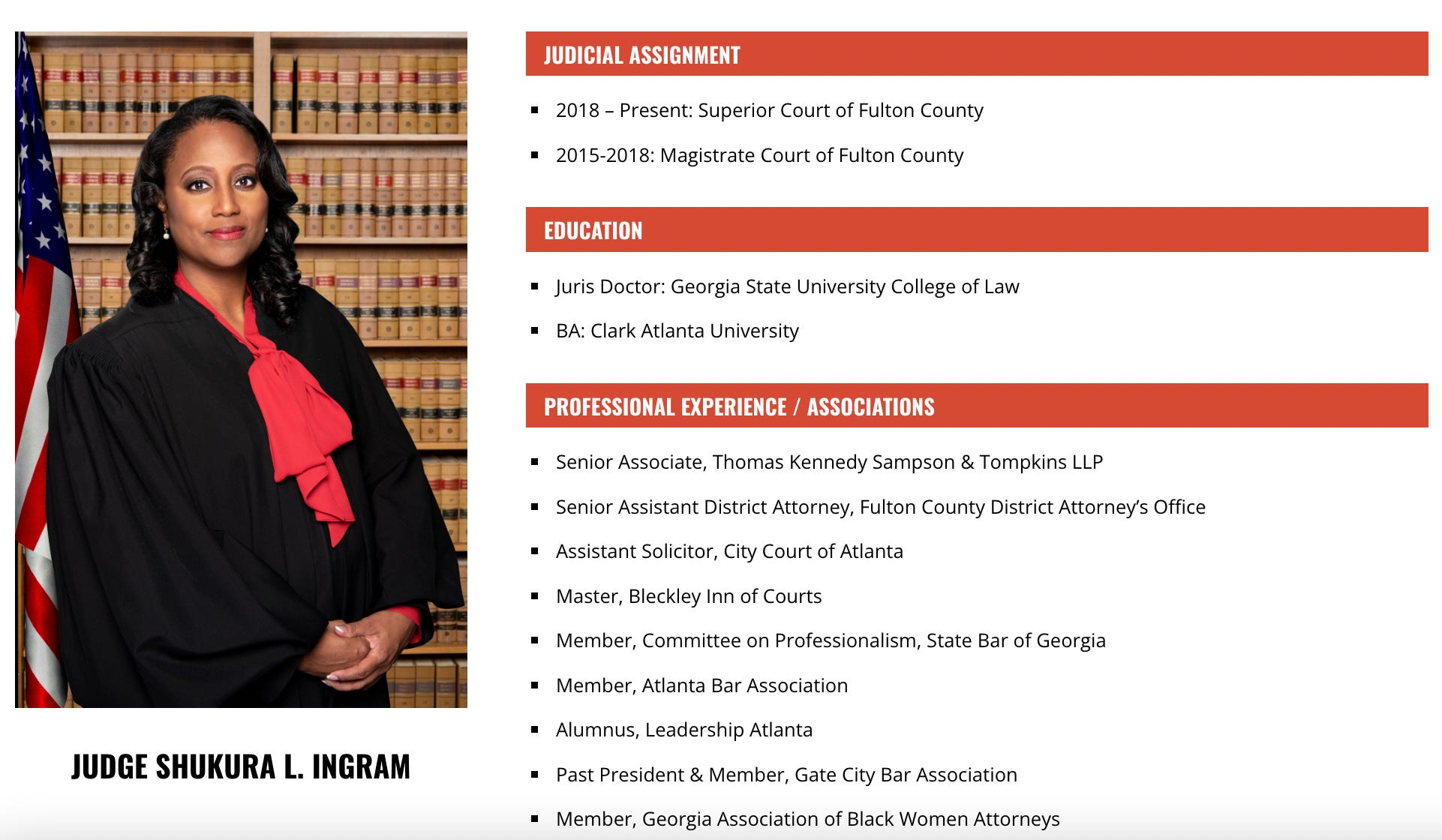
The new judge, Judge Ingram, has been a superior court judge since 2018 after three years as a Fulton County Magistrate Court judge. She earned her law degree from Georgia State University College of Law and was a Fulton County senior district attorney before taking the bench. She also was senior associate at Thomas Kennedy Sampson & Tompkins LLP, a prominent personal injury firm in Atlanta.
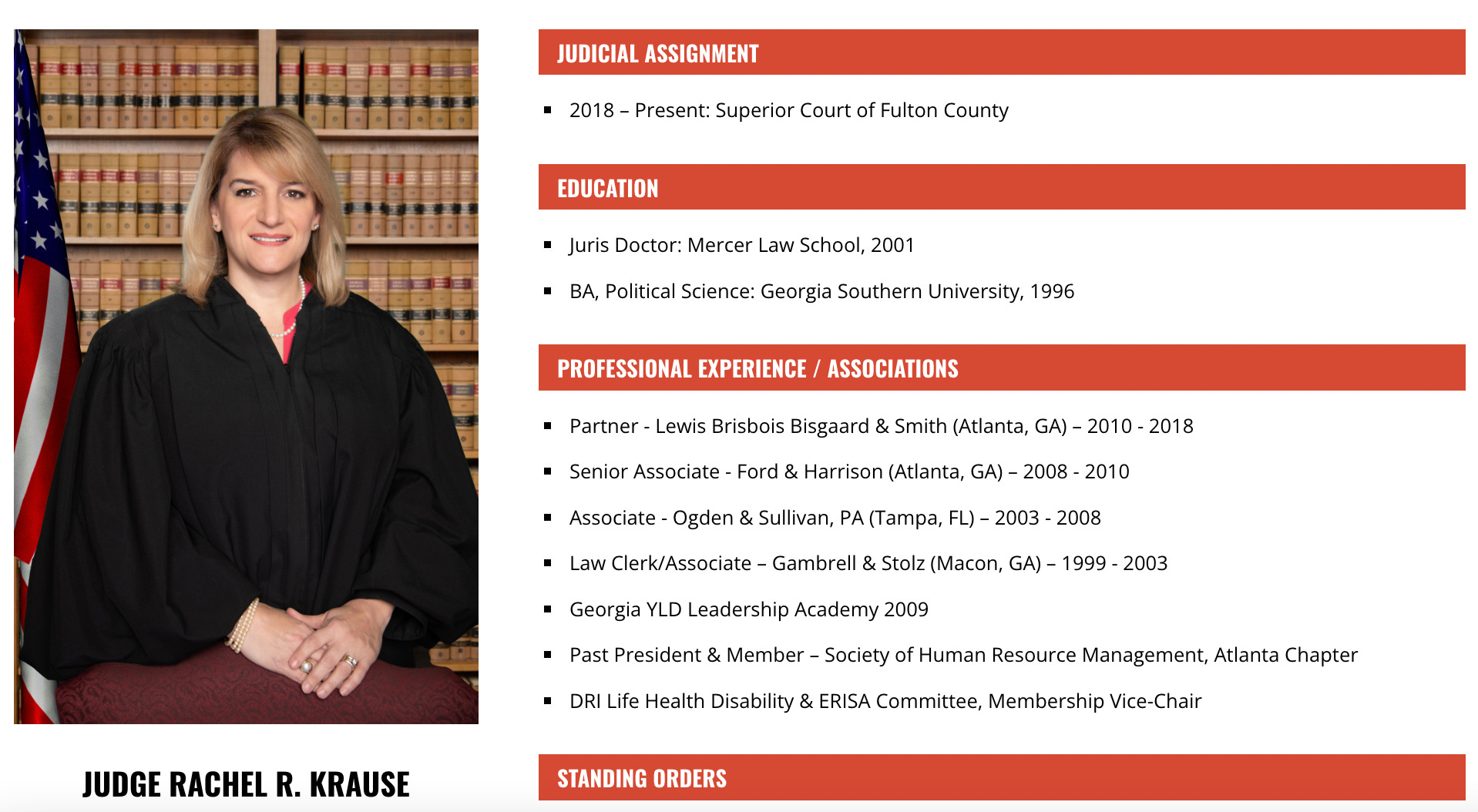
Krause is a former a partner in Lewis Brisbois Bisgaard & Smith LLP’s Atlanta office who because a superior court judge in 2018. She earlier rejected a motion asking her to recuse herself from Glanville’s recusal motions because she works in the same circuit as him and because he donated $2,000 to her reelection campaign in April. Other jurists who donated to Krause include Scott McAfee, the Fulton County Superior Court judge who is presiding over the racketeering conspiracy case against former President Donald Trump.
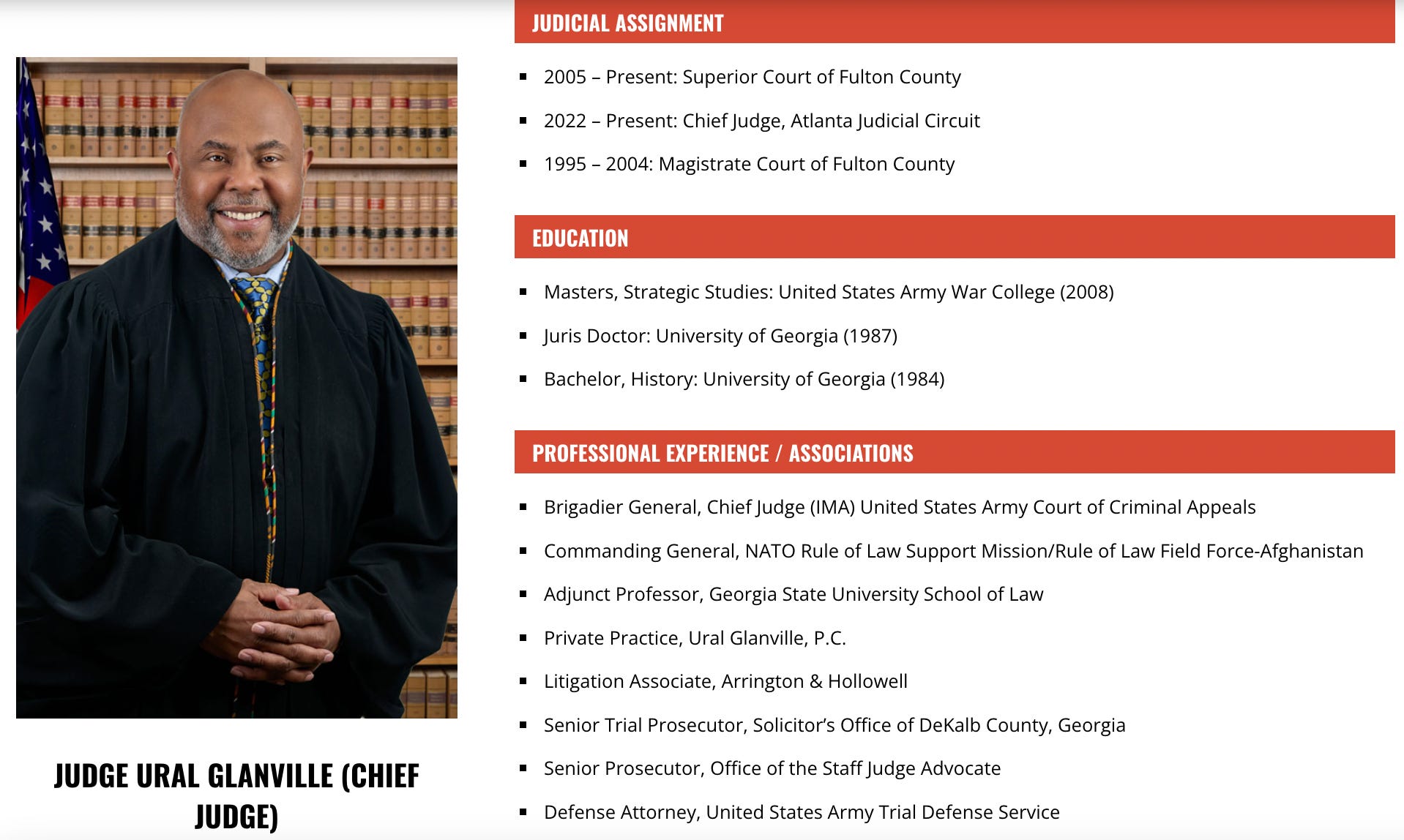
Glanville has been a superior court judge since 2005 and the chief judge of the Atlanta Judicial Circuit since 2022. He was a judge with the Fulton County Magistrate Court from 1995 to 2004 and has extensive military law experience. He has a black lab named Jack that joins him in court every day and serves as a therapy dog for his post-traumatic stress disorder. Glanville also enjoys taking marathon-style breaks at random times and calling them “comfort breaks.”
He’d been presiding over Williams’ case since its inception in May 2022. Jury selection began in January 2023 and opening statements began Nov. 27.
Weinstein told me he believes Glanville is “a good judge” who made mistakes.
“He’s a good man. He’s a professional,” Weinstein said.
“I would expect given his years and years of excellent reputation that he’s built over decades, I would hope that that one ruling on a recusal would slide off his back, but I don’t know. I don’t know if that’s what I would hope. I would hope he wouldn’t take it to heart,” Weinstein continued.
I also spoke with Atlanta Journal-Constitution reporter Jozsef Papp about the recusal and his coverage.
On Tuesday at 2 p.m. ET / 11 a.m., I’ll interview Max Schardt, lawyer for Young Thug’s co-defendant Shannon Stillwell, on YouTube.
https://www.youtube.com/live/-1cjR7jG6Bo
Previous articles:


Court documents:
June 10 ex parte hearing transcript
June 12 Weinstein team’s motion to recuse Judge Glanville
June 12 Glanville rejects Weinstein team’s recusal motion
June 14 Kayla Bumpus’ motion to quash and recuse
June 17 Steel’s motion to recuse Glanville
June 20 Georgia Supreme Court petition re: Glanville
June 28 Fulton County emergency petition re: Glanville
July 7 Brian Steel and Keith Adams affidavit re: June 10 meeting
July 7 Steel and Adams’ full supplement to recusal motion
July 9 Judge Krause rejects Steel’s and Adams’ recusal request
July 9 Judge Krause rejects Weinstein’s team’s recusal motion
July 10 Prosecutors respond to recusal motions
July 15 Judge Krause recuses Judge Glanville
In other news
I got up at 1 a.m. on Saturday to discuss Alec Baldwin’s case dismissal on BBC World News. It was worth it.
Thank you for supporting my independent legal affairs journalism. Your paid subscriptions make my work possible. If you’re not already a paid subscriber, please purchase a subscription through Substack. You also can support me through my merchandise store. Thank you!