
Judge rejects Megan Thee Stallion's injunction request in defamation lawsuit | Singer D4vd arraigned for teen girl's murder
I also have video of opening statements in the civil trial over a Los Angeles police shooting that killed a girl in a clothing store. Testimony continues Tuesday.

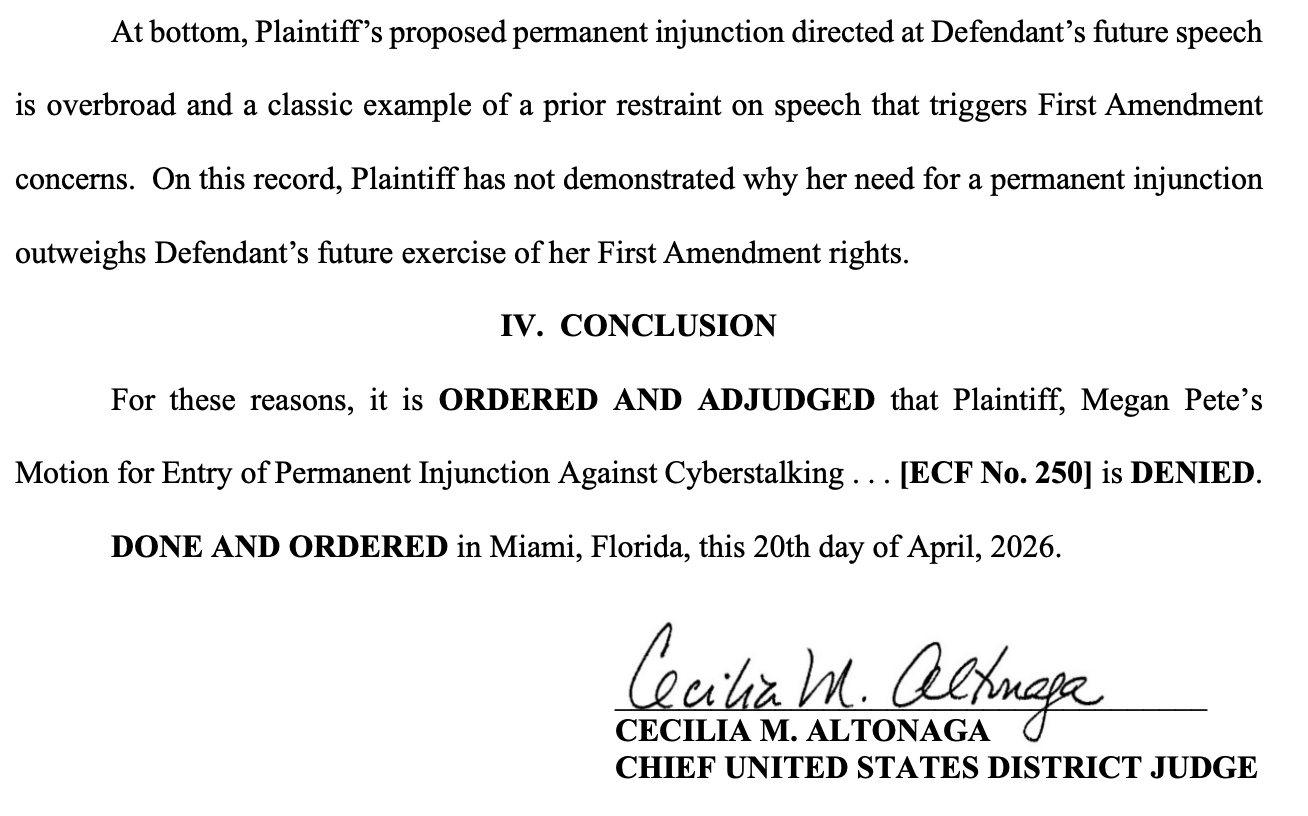
A federal judge in Florida on Monday rejected Megan Thee Stallion’s request to legally bar commentator Milagro Cooper from talking or posting online about her, calling the request an “overbroad and a classic example of a prior restraint on speech that triggers First Amendment concerns.”
U.S. District Judge Cecilia M. Altonaga said in her 21-page order that parts of the injunction sought by Megan’s lawyers at Quinn Emanuel Urquhart & Sullivan, LLP “fall outside the scope of the harassment described” in her cyberstalking petition, and that there was no evidence Milagro tried to contact her or appear at her performances.
A jury in Miami on Dec. 1, 2025, found Milagro liable for defaming Megan and intentionally inflicting emotional distress on her by coordinating with rapper Tory Lanez, legal name Daystar Peterson, who is serving a 10-year prison sentence in California for shooting Megan. Jurors also concluded Milagro knowingly promoted a digitally altered sexual depiction of Megan in violation of a Florida law enacted in 2024.
Jurors awarded Megan, legal name Megan Pete, $75,000 in damages, but Judge Altonaga didn’t enter judgment for the defamation claim because jurors concluded Milagro was a media defendant and Megan’s lawyers didn’t serve her with a cease and desist notice before suing her.
That reduced damages to $59,000.
Megan’s lawyers asked Altonaga to permanently enjoin Milagro from making “defamatory statements” about Megan regarding her testimony in Lanez’s trial and from statements “that are intended to incite third parties to engage in threats or violence against [Megan], her professional team, and/or her family.”
They also wanted the judge to order Milagro to delete statements “that formed the basis for the jury’s verdict in this case,” and they wanted Milagro prohibited from coming within 500 feet of Megan, her residence or any place she’s expected to be, and within 1,000 feet from Megan’s musical performances for five years.”
“On this record, Plaintiff has not demonstrated why her need for a permanent injunction outweighs Defendant’s future exercise of her First Amendment rights,” wrote Altonaga, the chief judge in the Miami-based Southern District of Florida.
The judge said some of Megan’s requested restrictions “fall outside the scope of the harassment” she describes, including baring Milagro “from direct, indirect, or third-party contact” and requiring her to stay away from Megan and her performances.
“There is no evidence that Defendant has ever attended Plaintiff’s performances or attempted to contact or seek out Plaintiff,” according to the order. “It is unclear how Defendant could govern her conduct to be at least 500 feet from any location Plaintiff is expected to be, nor how the claimed cyberstalking is associated with any physical proximity to Plaintiff.”
The judge also said the issue of Megan’s “personal identifying information” regards only Megan’s Florida residential address that she “testified she obtained the address from public voter registration records after the lawsuit was filed to brief a venue challenge.”
“Plaintiff does not contend that Defendant has threatened to disclose it or any other private information,” according to the order.
Altonaga also said Megan request that Milagro “be required to remove all statements and postings addressing the jury’s Verdict is far removed from any redress for the claimed harassment and is far too broad a restriction on speech.”
Megan’s lawyers requested the injunction under a claim Megan brought against Milagro for cyberstalking. The legal remedy for a civil cyberstalking claim brought under Florida law is an injunction ordered by a judge, and Judge Altonaga said she’d consider a request for one in the $59,000 judgment she signed on Dec. 2.
The judge, however, said in Monday’s order that she’s “not convinced the Verdict shows Plaintiff succeeded on the merits of her cyberstalking claim,” and she’s not convinced “that Plaintiff met the requirement of showing Defendant’s communications ‘served no legitimate purpose’ with the trial evidence and the post-Verdict events described in the Motion.”
Altonaga detailed two reasons for denying the injunction: lack of irreparable injury to Megan and the existence of a remedy she said is already adequate.
Regarding injury, the judge said the jury’s verdict “represents an adequate remedy at law for Defendant’s past conduct.”
“Because the Petition is based on the exact conduct for which Plaintiff received a complete, legal remedy, Plaintiff must show a likelihood of future irreparable harm that cannot be redressed by monetary damages to obtain a permanent injunction prohibiting future conduct,” according to the order.
“But Plaintiff has not shown that any of the content at issue in the [Second Amended Complaint] and addressed at trial remains publicly available,” the judge wrote. “Nor does she point to new content that is causing injury. Indeed, Defendant advises that her ‘prior pages have been deleted, are inaccessible,’ and ‘no longer exist.’”
Altonaga said she isn’t persuaded by Megan’s lawyers argument that Milagro continues to harass Megan and “her wrongful conduct could resume through new accounts and platforms.”
“Plaintiff does not assert that Defendant’s ‘post-Verdict harassment’ consists of cyberstalking. Instead, Defendant’s alleged post-Verdict harassment consists of Defendant:
saying she is ‘gonna start working on [her] mixtape[;]’
responding to a social media user that she does not ‘get on the Internet and cry about what” social media users say
posting images with a promotional photograph of CBS news reporter Gayle King
sharing her perspective of the action during a CBS News Miami interview
posting about the contents of the Verdict form
accusing a witness who testified for Plaintiff of perjury
saying Plaintiff made herself out to be the ‘the black Regina George’
allegedly downplaying her defamatory statement
“This described post-Verdict conduct, for which no cyberstalking Petition was filed, does not satisfy the definition of cyberstalking,” the judge wrote.
Altonaga said an “additional defect” in the requested injunction is that Megan’s lawyers don’t explain how Milagro’s post-verdict conduct “has caused or is likely to cause irreparable harm, nor why she believes Defendant is likely to repeat her wrongful conduct.”
The judge also noted that Milagro could have to pay Megan’s attorney fees.
“Plaintiff does not provide the Court with any reason to believe that Defendant — who is not accused of creating or initially posting the Deepfake Video and voluntarily removed her post — has not been adequately deterred by the Judgment awarding Plaintiff damages and Plaintiff’s potential future recovery of reasonable attorney’s fees and costs,” according to the order.
“Following the trial, Defendant has acknowledged having learned her lesson and expressed regret “that someone was hurt” because of
her words,” Altonaga wrote, citing Milagro’s interview on CBS local news in Miami.
“At bottom, Plaintiff offers no evidence or arguments sufficient to persuade the Court that she will suffer irreparable harm if a permanent injunction is not entered. Based on this record, the Court is hard pressed to find any evidence of an actual and imminent injury flowing from Defendant’s conduct that has not already been redressed by money damages,” she wrote.
She also said that even if Megan’s lawyers showed a likelihood of irreparable harm, her alleged injury “does not outweigh the harm a permanent injunction would inflict on Defendant because Plaintiff’s requested relief constitutes an impermissible prior restraint on Defendant’s speech.”
She said her conclusion is “bolstered by Florida law” and cited a 2024 ruling by Florida’s Third District Court of Appeal that said “injunctions are not available to stop someone from uttering insults or falsehoods.”
Angry social media postings are now common. Jilted lovers, jilted tenants, and attention-seeking bloggers spew their anger into fiber-optic cables and cyberspace. But analytically, and legally, these rants are essentially the electronic successors of the pre-blog, solo complainant holding a poster on a public sidewalk in front of an auto dealer that proclaimed, “DON’T BUY HERE! ONLY LEMONS FROM THESE CROOKS!” Existing and prospective customers of the auto dealership considering such a poster made up their minds based on their own experience and research. If and when a hypothetical complainant with the poster walked into the showroom and harangued individual customers, or threatened violence, however, the previously-protected opinion crossed the border into the land of trespass, business interference, and amenability to tailored injunctive relief. The same well-developed body of law allows the complaining blogger to complain, with liability for money damages for defamation if the complaints are untruthful and satisfy the elements of that cause of action. Injunctive relief to prohibit such complaints is another matter altogether.
You can read the entire ruling here.
Previous article:

Megan Thee Stallion seeks permanent injunction against sued blogger after jury's liability findings
Judge schedules singer D4vd’s preliminary hearing in murder case for this Thursday
A 21-year-old alternative pop singer known as D4vd will remain in jail without bail in Los Angeles after pleading not guilty today to the murder of a 14-year-old he’s also accused of sexually abusing.
Prosecutors allege D4vd, legal name David Anthony Burke, murdered Celeste Rivas Hernandez to try to end a criminal investigation into his sexual abuse of her and to protect his lucrative music career after she went to his home in the Hollywood Hills on April 23, 2025.
Her family reported her missing a year before, on April 5, 2024. Her remains were found in the front trunk Burke’s impounded Tesla on Sept. 8, 2025.
He is charged with first-degree murder, continuous sexual abuse of a child under the age of 14 and unlawful mutilation of human remains.
He faces a possible death penalty if convicted of the murder charge under three special circumstances: lying in wait, committing the crime for financial gain and murdering the witness in an investigation.
Los Angeles County District Attorney Nathan Hochman announced the charged at a press conference today. Prosecutors have not decided if they’ll seek the death penalty.
Hochman said Celeste was a witness in an investigation “into the lewd and lascivious sexual acts committed by Mr. Burke.”
“I had the chance to meet with some of the family members of Celeste, and their grief is incalculable as to what happened to their daughter,” Hochman said.
“What they have demanded, what we have assured them that the District Attorney’s Office, working with LAPD, would give them: ...is the proof beyond a reasonable doubt on who killed their daughter, on how their daughter was killed, when their daughter was killed, and bring that killer to justice. That killer that we have now charged is David Anthony Burke,” Hochman said.
In court, D4vid’s attorney Blair Berk said they “believe the actual evidence will show David Burke did not murder Celeste Vivas Hernandez, nor was he the cause of her death.”
“And we would like to be able to have the evidence come into the light of day at the earliest opportunity in order to establish that,” Berk said.
Berk was joined in court by D4vid’s other lawyers Regina Peters, who works with Berk at the West Hollywood law firm Berk Brettler LLP and Marilyn Bednarski of McLane, Bednarski & Litt, LLP in Pasadena, whose other recent clients include journalist Don Lemon.
Los Angeles County Superior Court Judge Theresa R. McGonigle scheduled the preliminary hearing conference for April 23 as Berk requested.
If it happens, Berk and her co-counsel may not have seen much of the discovery because transferring the electronic files will take so long.
Berk said she’s been given “almost no discovery thus far.”
“We’ve received a three-page follow up report, no autopsy report, and a copy of the complaint, and we would ask the people respectfully to produce discovery at the earliest opportunity,” she said.
In response, Deputy District Attorney Beth Silverman told Judge Theresa McGonigle that prosecutors have “approximately 40 terabytes of discovery in this case.”
“Moreover, in order to obtain the transcripts from a grand jury investigation, counsel has to file a motion. She knows the way the system works. I’m not able to gather those they have to be provided after the court orders them released because it was an investigation,” Silverman said.
Silverman said it’s “unlikely that there will be very much discovery provided” soon “given the voluminous nature and how long it’s going to take to copy onto drives.”
Silverman also said she’s trying to get the medical examiner to unseal the coroner’s report, which Berk said is “surprising news given the District Attorney’s Office held a press conference this morning where they discussed the cause of death, apparently under seal and not released by the coroner’s office, as did the robbery-homicide unit, to the press.”
“So we would again reiterate we believe that Mr. Burke is entitled to discovery. We have served the people with notice. They have 15 days to produce discovery in this case. We would ask that they do that in conscientious earnestness and as quickly as possible. I ask the court to make an order today,” Berk said.
The judge did so.
D4vd’s case was assigned to Los Angeles County Superior Judge Charlaine F. Olmedo, who oversees complex and/or lengthy criminal cases.
Olmedo’s previous high-profile trials include the rape case against “That 70s Show” actor Danny Masterson.
In the press conference this morning, the chief of the Los Angeles Police Department defended the length of time investigators took to build a case.
“I want to be clear about something. My duty is not to fuel speculation. It’s to deliver justice, and that requires patience and discipline on everybody’s part. This investigation was driven by a single purpose, to secure justice for Celeste Rivas and for those who loved her,” LAPD Chief Michel Moore said.
“We had to be certain that nothing we did or said would ever jeopardize this case. Ms. Rivas was a reported runaway from Riverside County. During the course of our investigation, detectives learned that she had been involved in a sexual relationship with Mr. Burke when she was a minor and he was an adult,” Moore said.
“The condition of her remains delayed the medical examiner’s ability to be able to determine cause of death. The substantial amount of time that passed between her death and discovery meant that crucial evidence had degraded or disappeared, and as detectives worked to uncover the truth,” Moore said.
Detectives “also had to sift through and debunk a great deal of false information circulating publicly,” the chief said.
“These challenges were real, and they required patience, precision and an unwavering commitment to the facts, despite these obstacles and despite intense public pressure,” Moore said. “Our Robbery-Homicide Division detectives remained steadfast in their duties. They recovered and analyzed a substantial amount of digital and forensic evidence. They stayed focused, disciplined and committed to uncovering the truth. Their work in close collaboration with the District Attorney’s Office, has brought us to this moment today.”
“Why has it taken so long for an arrest?” a reporter asked Hochman.
“I think the police chief got it right that in a situation where you don’t have an eyewitness account, or we can’t put point to a video that shows the killer killing someone. You have to go through the very rigorous and thorough investigation to look at all the digital and forensic evidence. You have to speak with witnesses, often who are cooperative and some who are not cooperative, in order to obtain all the information necessary to decide who did what, when, how, and what their mental state was at the time. That is what we’ve been doing ... between September 8, roughly, and today, when we bring these charges on April 20,” Hochman said.
LA police shooting trial continues on Tuesday
I obtained video of the April 8 opening statements in the civil trial over the Los Angeles police shooting that killed a 14-year-old girl in a Burlington Coat Factory on Dec. 23, 2021.
Here is James Touchstone’s opening for the defense:
I’m uploading plaintiffs’ attorney Haytham Faraj’s opening statement today.
My previous article has details on the testimony so far.
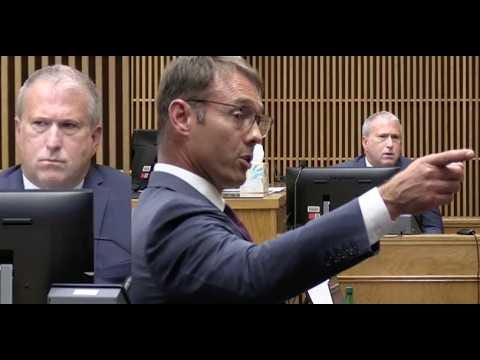
Testimony continues Tuesday, and I’ll have video on YouTube and Facebook. I’m also sharing highlight clips there and on TikTok and Instagram.
Thank you for supporting my independent legal affairs journalism. Your paid subscriptions make my work possible. If you’re not already a paid subscriber, please consider purchasing a subscription through Substack.
Meghann, can you share if us the courts archieves too? Motions, indictments and others?
Megan, can you share if us the courts archieves too? Motions, indictments and others?