
Judge in Young Thug trial transfers recusal motions and releases ex parte transcript
The decision from Judge Ural Glanville in Atlanta moots a pending emergency petition and indefinitely delays a trial that began with jury selection in January 2023.

The judge overseeing an unprecedented racketeering conspiracy case against rapper Jeffery “Young Thug” Williams said Monday that three recusal motions against him will be considered by another judge, indefinitely delaying the trial and surprising defense attorneys who’d already turned to another court.
Fulton County Superior Court Judge Ural Glanville also released an unredacted transcript of the June 10 meeting with prosecutors and key witness Kenneth “Lil Woody” Copeland that led to the recusal calls and resulted in the arrest of Williams’ attorney Brian Steel for contempt of court.
Steel’s contempt conviction still stands, though he is appealing and the appellate court already has stayed his two-week jail sentence. But Judge Glanville on Monday cancelled a hearing that could have resulted in contempt findings against the person he believes told Steel about the meeting, and he said he has no plans to reschedule it.
The 56-page court reporter’s transcript shows the judge and prosecutors discussed the meaning of immunity with Copeland during the meeting, who had been in jail for three nights on a contempt charge after defiantly trying to invoke his Fifth Amendment right against self incrimination when asked his age, after being granted immunity by prosecutors.
Glanville jailed Copeland to try to force his testimony. At the time, Chief Deputy District Attorney Adriane Love questioned whether Copeland’s attorney, Jonathan Melnick of Atlanta, was truly serving Copeland’s interests or if he was working with Steel and the other trial defense attorneys to help their clients by blocking Copeland’s testimony.
According to the transcript released Monday, Love told the judge at the beginning of the June 10 meeting that she asked Melnick in an email, “Whose interests are you protecting, yours or Mr. Steel’s? and Melnick replied, “You are going to get him killed. You have made him — you are making him a target. Fuck you.”
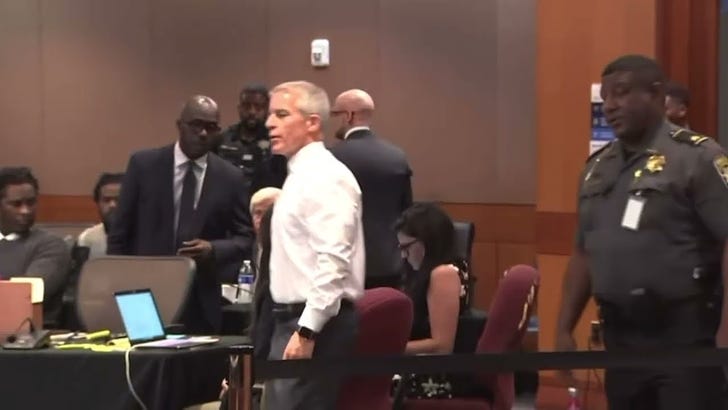
Glanville had not told defense attorneys about the meeting by the time Steel confronted him about it during a break in Copeland’s testimony on June 10. Steel refused to tell the judge how he learned of it, which led to Glanville declaring him in contempt of court.
Before Glanville cut him off, Steel said he was told that Copeland “made statements that he admitted to killing Donovan Thomas,” whose 2015 murder is part of the racketeering conspiracy charge and also a separate charge against five of Williams’ co-defendants. Steel said he heard Copeland said he wouldn’t testify and was willing to sit in jail for two years, and “If that’s true, what this is is coercion, witness intimidation.”
Attorneys for Williams’ co-defendant Deamonte “Yak Gotti” Kendrick also filed a recusal motion against Glanville that said they heard the judge told Copeland during the meeting that he “could keep Copeland incarcerated until additional defendants were tried — not just the six defendants currently on trial.”
The motion said Copeland “on information and belief” said he would lie on the stand, but Deputy District Attorney Simone Hylton “stated that she would not prosecute Copeland if he were to lie on the stand.” Additionally, the motion said Judge Glanville “should not have coerced sworn witness Copeland to testify.”
Glanville rejected the motion on June 12 and declined to allow immediate review by the appellate court.
“Aren’t you interested in removing the cloud that’s hanging over this case right now, Your Honor?” attorney Doug Weinstein asked.
Glanville warned Weinstein “to be very careful” about what he’s saying “as a matter of professional responsibility” and told him to “tread lightly.”
“Remember, we haven’t nugged out all of the issues involved in that affidavit,” Glanville said.
Transcript does not mention Donovan Thomas’ murder
The transcript released on Monday shows a more nuanced discussion than defense attorneys described, in which prosecutors and the judge repeatedly told Copeland he could be prosecuted for perjury if he lied on the stand but differentiated between perjury and inconsistent statements highlighted through the legal concept of impeachment during testimony.
“Well, I want to speak to you personally that I have never been truthful a day in my life until I just made this statement right now. I don’t comprehend none of this stuff that’s going on,” Copeland said early in the meeting.
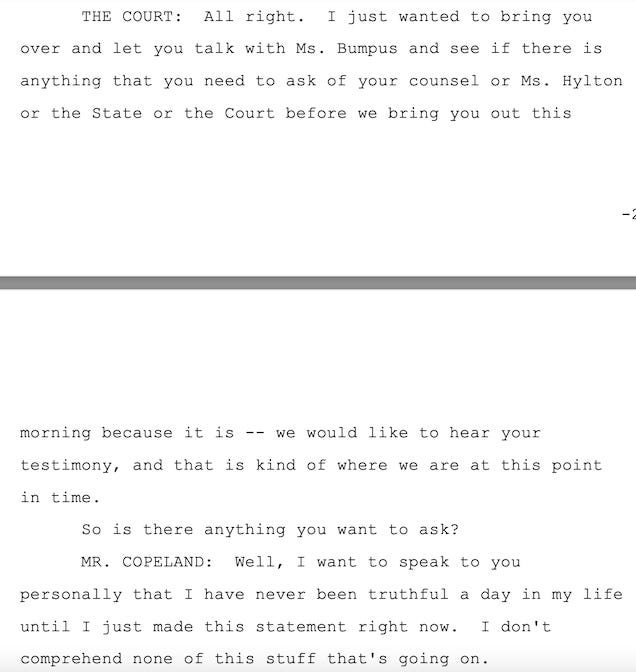
The transcript supports Steel’s and Weinstein’s statements about Copeland saying he’d sit in jail for two years and Hylton and Glanville saying it could be longer, but it never mentions Thomas or his murder. At one point Hylton told Copeland he was “immune from prosecution, any of it,” then said, “Literally — Judge, you might want to close your ears — if you confess to a murder on the stand, if we don’t have any other independent evidence outside of what you say on the stand, you are immune from prosecution from what you say in court.”
Copeland later asked, “Like, murder don’t have, like, no statute of limitations, right?”
Hylton answered, “But if you didn’t do it, I can’t charge you with something you didn’t do because I don’t have any other evidence but you saying it.”
Copeland also said at one point, seemingly unprompted, “I did these crimes. I’m telling you that.”
Hylton replied, “Okay. I don’t know what you are talking about but —” and his attorney Kayla Bumpus said, “I think — are you saying you want to get up there on the stand and say something,” and Copeland didn’t respond.
Glanville earlier told Copeland if he testified “about some aggravated assault or murder, they can’t prosecute on it” under the immunity order.
“Okay?” the judge said.” The only thing that will get you in trouble is this next little paragraph: ‘Kenneth Copeland shall be subject to prosecution or to penalty or forfeiture for any perjury, false swearing, or contempt committed in testifying or failing to testify in accordance with this order.’”
Atlanta police arrested Copeland for Thomas’ Jan. 10, 2015, murder, but Hylton said last week that prosecutors never indicted him because they didn’t believe evidence supported it.
Steel told the jury in his Nov. 28 opening statement that Copeland killed Thomas, and he and other defense attorneys want to cross-examine him about statements related to Thomas and his Inglewood Family or Atlanta Bloods gang, which Atlanta police investigators have testified was feuding with Williams’ Young Slime Life gang when Thomas was killed in a drive-by shooting outside two barbershops.
Copeland is no longer in custody, and he has no charges pending. He told Glanville during the June 10 meeting that he’d rather invoke his Fifth Amendment right than have immunity from prosecution, but Glanville said prosecutors can give him immunity against his will.
According to the transcript, Copeland was transported to Glanville’s chambers from jail after his attorney at the time, Bumpus, met for about 25 minutes with Love and the judge about his refusal to testify. Bumpus was substituting for Melnick, who was in court when Copeland was jailed for contempt on Friday, June 7 but said he had “nonrefundable plane tickets” and couldn’t be in court the following Monday.
According to the transcript, Bumpus on June 10 read aloud a June 8 email in which Melnick told her, “So at first Kenneth was going to testify but has now decided to take the Fifth. He may change his mind on Monday. If he does, then he’s agreed to discharge me as his attorney. This isn’t out of bad feelings, but I was not present when he met with the DA’s office so I can’t really help him with his testimony.”
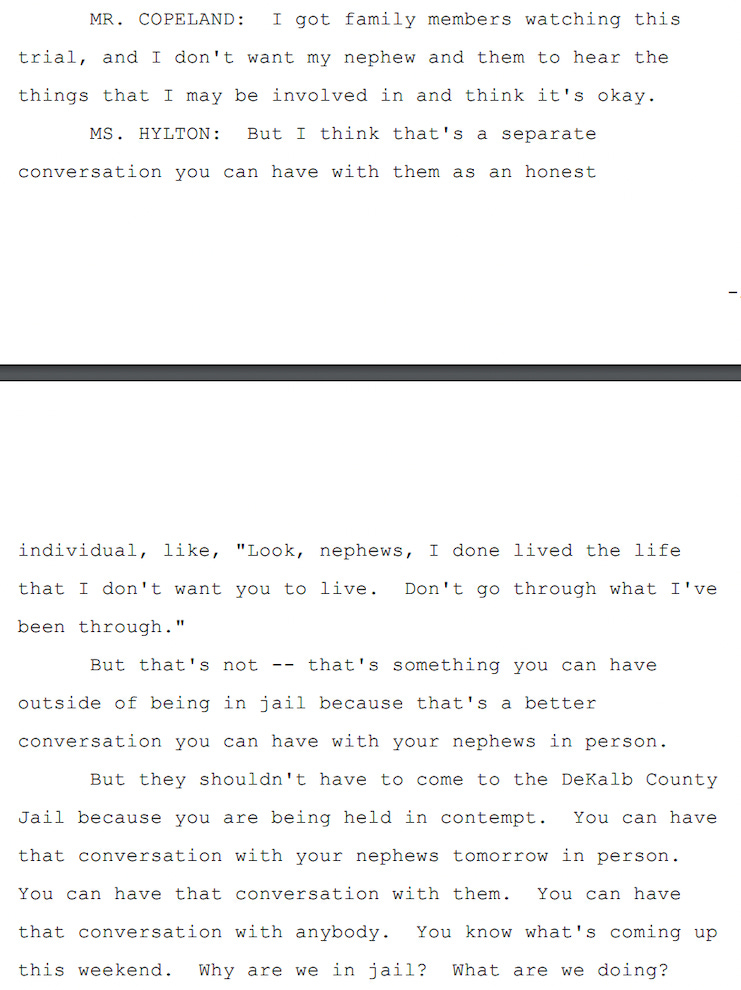
The transcript shows Copeland cited his young nephew when saying why he didn’t want to testify.
“I got family members watching this trial, and I don’t want my nephew and them to hear the things that I may be involved in and think it’s okay,” Copeland said.
I interviewed Weinstein in a YouTube live on Monday, and he discussed his surprise at Glanville’s decision to send the recusal motions to another judge.
The move, along with the release of the unredacted transcript, moots a motion Weinstein had pending with Fulton County Superior Court that asked for Glanville to be ordered to send the recusal motion to another judge and to release an unredacted transcript.
Weinstein and his co-counsel E. Jay Abt of The Abt Law Firm and Katie Hingerty of The Hingerty Law Firm (look for her cameo in my interview with Weinstein) initially filed a petition with the Georgia Supreme Court, but the court said they should have filed in Fulton County Superior Court first. The June 27 order assured them the motion would go to another judge and highlighted in a footnote the process for deciding Georgia judge recusals.


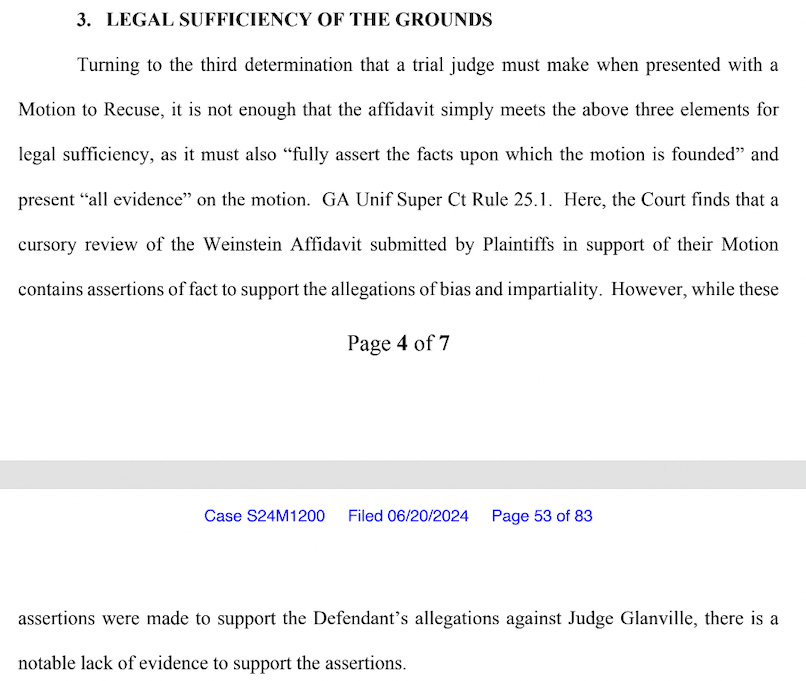
Under Georgia law, judges must send recusal motions against them to other judges if the facts as alleged are sufficient for recusal, and Glanville may have written himself into a corner when he said in his seven-page June 12 order, “Here, the Court finds that a cursory review of the Weinstein Affidavit submitted by Plaintiffs in support of their Motion contains assertions of fact to support the allegations of bias and impartiality. However, while these assertions were made to support the Defendant’s allegations against Judge Glanville, there is a notable lack of evidence to support the assertions.”
The petition from Weinstein’s team pointed out that the evidence is in the transcript that hadn’t yet been released, but also, Georgia state law says judges should assume the facts as alleged to be true when deciding whether to send a recusal motion to another judge. The new petition filed in Fulton County cited an order removing a probate judge from the bench for widespread misconduct that included lying in her disciplinary hearing and repeatedly holding ex parte communications.
The recusal motions that Glanville ordered to another judge could end up in another county’s superior court because Glanville’s Fulton County colleagues may declare a conflict of interest. Right now, the motions are assigned to Judge Rachel Krause, a judge since 2018 and a former a partner in Lewis Brisbois Bisgaard & Smith LLP’s Atlanta office.
On Monday, Glanville defended the ex parte hearing by citing several Georgia state appellate cases regarding ex parte hearings regarding issues such as witnesses feeling threatened and that did not get into the substance of testimony.
In Copeland’s situation, while the meeting resulted in his testimony, he certainly hasn’t testified the way prosecutors hoped. Instead, he testified that everything he told police in his 2015 interviews, on which much of the criminal case is based, was a lie. That led to an indefinite pause in his testimony so prosecutors and defense attorneys could sort through the approximately 17 hours of police interviews and 2 1/2 hours of jail calls.
The process is nearly finished, but it won’t resume until after another judge decides Glanville’s recusal motions. Hylton asked Monday if Glanville knew of a way to expedite the process, but he said he was staying out of it.
“While I understand your concern, I think the rules of transfer and recusal are pretty clear. I’m not going to comment on anything that is pending. … Hopefully it will get done fairly quickly in terms of somebody acting on it,” the judge said.
Glanville has been a Fulton County Superior Court judge since 2005 and the chief judge since 2022. He graduated University of Georgia School of Law in 1987 and has extensive military law experience, including as brigadier general and chief judge for U.S. Army Court of Criminal Appeals and commanding general for the NATO Rule of Law Support Mission/Rule of Law Field Force-Afghanistan. The judge has a black lab named Jack that joins him in court every day.
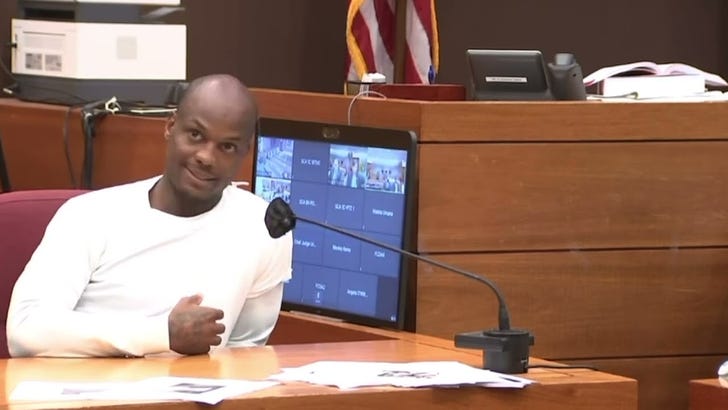
Last but not least, this is the best part of the transcript. Lil Woody staying true to his name.

Court documents:
June 10 ex parte hearing transcript
June 12 Weinstein team’s motion to recuse Judge Glanville
June 12 Glanville rejects Weinstein team’s recusal motion
June 14 Kayla Bumpus’ motion to quash and recuse
June 17 Steel’s motion to recuse Glanville
June 20 Georgia Supreme Court petition re: Glanville
June 28 Fulton County emergency petition re: Glanville
Previous articles:’

YouTube & TikTok
I’m still going strong on YouTube and TikTok, where I’m enjoying hosting live discussions and sharing clips of the proceedings with descriptive captions. I’m nearing 18,500 YouTube subscribers and 177,200 (!) TikTok followers.
You’ll find shorter clips on TikTok, whereas YouTube is where I share longer videos and organize everything into playlists.
You can find a playlist for Copeland’s testimony and a playlist for Steel’s contempt of court arrest. You also can find playlists of testimony about Thomas’ murder and the Lil Wayne tour bus shooting, a playlist of legal arguments that includes the recent discussions about Copeland’s 2015 interviews and playlists for police testimony, defense cross-examinations and surveillance videos & calls.
I also made a playlist for my favorite set of witnesses so far, the guys who were at the barbershops the night Thomas was gunned down, including Sammy from McDaniel Street and alleged attempted murder victim Reginald Hendricks.
Thank you all for your (paid 🙏) subscriptions and support!
Thank you for supporting my independent legal affairs journalism. Your paid subscriptions make my work possible. If you’re not already a paid subscriber, please consider purchasing a subscription through Substack. You also can support me through Venmo (MeghannCuniff), CashApp ($MeghannCuniff) and Zelle (meghanncuniff@gmail.com). Thank you!