
Corrupt LA politician José Huizar sentenced to 13 years in prison as judge cites 'little remorse'
The ex-city councilman is the first Los Angeles politician to be convicted under the Racketeer Influenced and Corrupt Organizations Act after pleading guilty in 2023.

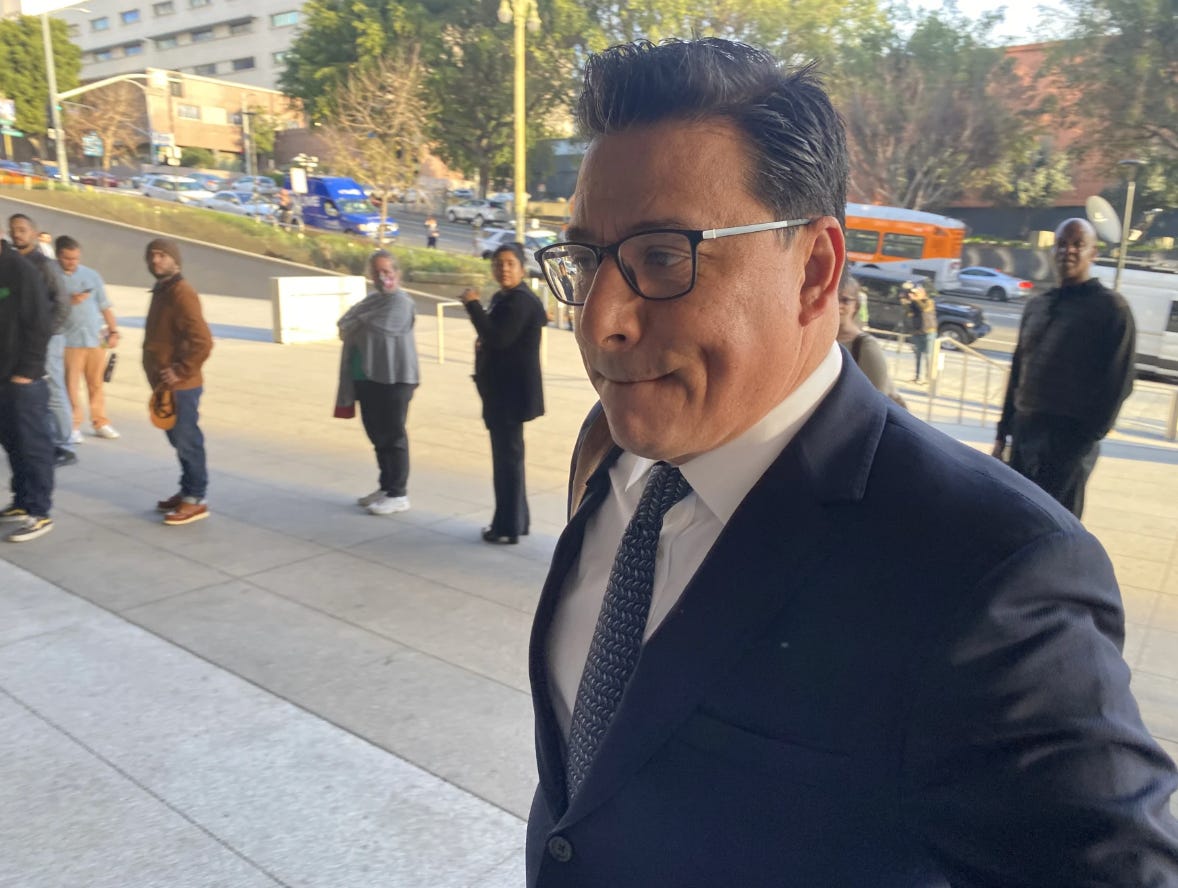
A federal judge on Friday ordered a Los Angeles politician to spend 13 years in prison for turning his City Council district into an organized crime syndicate that took bribes from developers, including frequent gambling trips to Las Vegas and visits with prostitutes.
José Huizar is to begin his 156-month sentence by April 30 after a two-hour hearing before U.S. District Judge John F. Walter in downtown Los Angeles, who cited a filing from Huizar that detailed conduct by his co-conspirators and “failed to include any meaningful discussion” of Huizar’s role “except to grudgingly acknowledge that he accepted the bribes.”
“The defendant attempts to downplay his outrageous criminal conduct by claiming that all the projects were good for the city,” Judge Walter said. “That Robin Hood-type of argument, in my view, utterly misses the point and shows the defendant has little remorse for his criminal conduct.”
The 13-year sentence matches federal prosecutors’ recommendation and is four years more than Huizar’s public defenders recommended. Walter noted Friday it was more than twice the six years he gave developer David Lee, a private citizen who paid Huizar a $500,000 bribe. The U.S. Attorney’s Office recommendation for Huizar “would strike the right balance, given the respective nature and circumstances of their misconduct.”
In a brief appearance at the lectern, Huizar apologized to “my family, my constituents and the city of Los Angeles, and I accept responsibility for my actions.”
Huizar referenced a letter he wrote the judge, which Walter said he’d read “several times.”


Walter said the letter shows Huizar “was in denial for a significant period of time and pointing the finger at others,” but he wouldn’t consider the length of time it took Huizar to plead guilty.
“As far as I’m concerned, he has fully accepted responsibility,” Walter said.
Walter gave Huizar until 2 p.m. on April 30 to report to a to-be-assigned prison, less than the six month-delay requested by the defense but longer than the 60 days prosecutors approved. The judge also unexpectedly ordered Huizar to immediately pay $50,000 toward his restitution, which is $443,905 to the city of Los Angeles and $38,792 to the Internal Revenue Service.
The $50,000 is to come from $140,000 Huizar liquidated from his retirement account related to the City Council seat he held for 15 years.
Huizar wanted the entirety of the $140,000 to pay for things related to Huizar’s youngest son, who has special needs and to whom Huizar has served as a caregiver since his public downfall.
Walter’s decision to allow only $90,000 appeared to fluster Huizar and his attorneys, who told the judge the costs “are both immediate and pressing.” They asked for a sidebar, but the judge declined.
Walter said information provided to him under seal indicates Huizar’s ex-wife can pay a portion of the cost because “in my view she received the benefit of an unequal division of community property” when Huizar gave her the family home.
“So there should be funds that are available,” Walter said.
Walter said he knows Huizar’s imprisonment “will have severe consequences” for his family “especially defendant’s youngest child” as described by Huizar and his daughters in letters that are redacted from public view. Walter said the effect on family “more than anything else” makes sentencing one of a judge’s most difficult tasks, “and this case is no exception.”
“But sympathy for a defendant’s family cannot be allowed to shield the defendant from the punishment that he deserves,” Walter said. He said Huizar “was undoubtedly aware of and obviously didn’t consider or care about the impact his crimes would have on his family.” The fact that he did so “in my view only aggravates his crimes,” Walter said.
Huizar left the courtroom with his attorneys and surrounded by supporters who tried to block reporters from approaching him. A courthouse security officer also forcibly removed a Los Angeles Times reporter from an elevator Huizar was in.
Huizar pleaded guilty on Jan. 20, 2023, to one count of conspiracy to violate the Racketeer Influenced and Corrupt Organizations (RICO) Act and one count of tax evasion. Walter at the time declined to officially accept Huizar’s plea agreement with the U.S. Attorney’s Office, which called for a sentence between nine years and 13 years. The judge said during Lee’s sentencing in July that he wasn’t sure prosecutors had justified giving Huizar such a big reduction from the standard range under U.S. Sentencing Guidelines, which was approximately 22 years to 27 years. The U.S. Probation Office recommended 20 years, but Walter said Friday that imposing a sentence within the guidelines, while justified, could appear “draconian.”
The judge elaborated on comments he made at a previous sentencing about public corruption being “a matter of public urgency throughout our nation’s history.” Fears of bribery in the early 1900s “are best exemplified in President Roosevelt's powerful comments to Congress in 1903.”
“There can be no crime more serious than bribery. Other offenses violate one law while corruption strikes at the foundation of all law. Under our form of government all authority is vested in the people and by them delegated to those who represent them in official capacity. There can be no offense heavier than that of him in whom such a sacred trust has been reposed, who sells it for his own gain and enrichment; and no less heavy is the offense of the bribe giver. He is worse than the thief, for the thief robs the individual, while the corrupt official plunders an entire city or state. He is as wicked as the murderer, for the murderer may only take one life against the law, while the corrupt official and the man who corrupts the official alike aim at the assassination of the commonwealth itself. Government of the people, by the people, for the people will perish from the face of the earth if bribery is tolerated.”
“Corruption requires a substantial sentence. Any other sentence would erode, if only by increments” the country’s intolerance for it as well as “the foundations of our democracy until it collapses under its own weight,” Walter said.
Walter also said Huizar deserves no “special credit” for good work he did while in public office “because that’s exactly what he was elected and paid to do.”
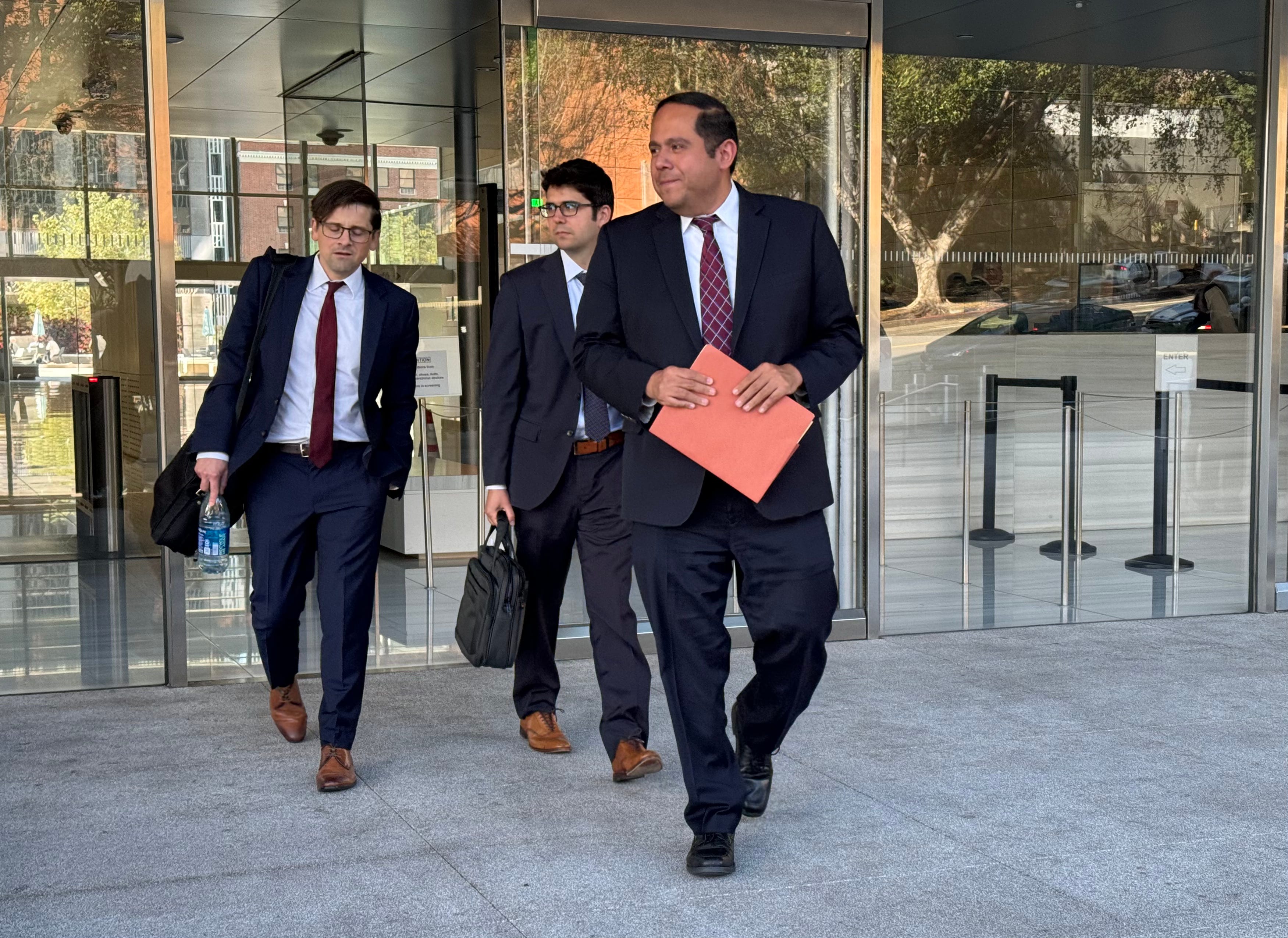
In arguing for a lesser sentence, Deputy Federal Public Defender Charles Snyder said nine years in prison would still “be the longest sentence ever imposed on a Los Angeles official.”
“I think everyone can agree that Mr. Huizar has been thoroughly dragged through the public square,” said Snyder, who was joined at the defense table by Deputy Federal Public Defender Adam Olin and Cuauhtemoc Ortega, federal defender for the Central District.
He cited other federal public corruption cases involving former Illinois Gov. Rod Blagojevich and Sheldon Silver, former speaker of the New York State Assembly, both who fought their cases at trial and received lesser sentences than the 13 years prosecutors sought for Huizar. He also described the good Huizar did while in office, saying he sought public office out of a genuine desire to help people, and he spearheaded a development renaissance in downtown that helped revitalize the area.
“Many of us in the courtroom have been in L.A. for a long time. I think it’s fairly undeniable that downtown transformed for the positive during Mr. Huizar’s time in office,” Snyder said.
Assistant U.S. Attorney Mack E. Jenkins compared Huizar to King Kong.
“It’s not just King Kong that comes crashing down. It’s the buildings he takes down with him. … It’s the innocent civilians that he falls on top of,” Jenkins said. “Jose Huizar was the King Kong of downtown LA. He was the King Kong of L.A. City Hall for many, many years. And with this fall, a lot of devastation was left in his wake.”
Jenkins prosecuted Huizar with Assistant U.S. Attorneys Cassie D. Palmer, Susan S. Har and Brian R. Faerstein.
After sentencing, Martin Estrada, U.S. attorney for the Central District of California, told reporters that Huizar’s conviction is the first for a Los Angeles public official under the federal RICO statute, and his 13-year sentence is “the most substantial sentence to date in our ongoing efforts to weed out public corruption.”
Estrada said Huizar used Los Angeles City Hall “like his personal ATM, and he treated the people who relied on City Hall like pawns in a chess game.”
“Instead of serving the constituents of Los Angeles with integrity, Mr. Huizar chose to line his own pockets,” Estrada said. “Instead of operating with honesty, he chose to act with greed. And instead of public service, he chose corruption on a massive scale.”
Huizar, 55, moved from rural Mexico to east Los Angeles with his family when he was a boy. He became the first in his family to go to college, then became a lawyer before launching a political career that began with the Los Angeles Unified School Board and eventually put him at the helm of influential development projects in downtown L.A. He has a bachelor’s degree from UC Berkeley, a master’s degree from Princeton University and a law degree from UCLA. He was elected to the Los Angeles City Council in 2005 and eventually turned his district into a criminal enterprise that extracted bribe payments from developers looking to build downtown.
Huizar’s flashiest bribery scheme was with Wei Huang, a billionaire Chinese developer who wanted to turn the 13-story L.A. Grand Hotel into a 77-story skyscraper.
Huizar’s longtime aide, George Esparza, has testified in detail about his boss’ corrupt relationship with Huang, which included extravagant trips to Las Vegas with high-end gambling, elaborate meals and expensive prostitutes. Huizar’s sentence includes mandatory gambling addiction counseling.
The trips are what led to Huizar’s downfall. After the councilman handed his identification to an employe at a blackjack table at The Venetian Resort’s Palazzo casino, a security officer told him he’d been identified as an elected official and asked him to sign a document confirming his casino chips were his and not a gift.
Esparza also testified that he hid $200,000 in cash for Huizar in two liquor boxes — Johnnie Walker Blue Label and Don Julio — stored in his bedroom at his grandparents’ home in Boyle Heights.
Esparza wasn’t yet cooperating with investigators, but he testified he was documenting his actions to protect himself.
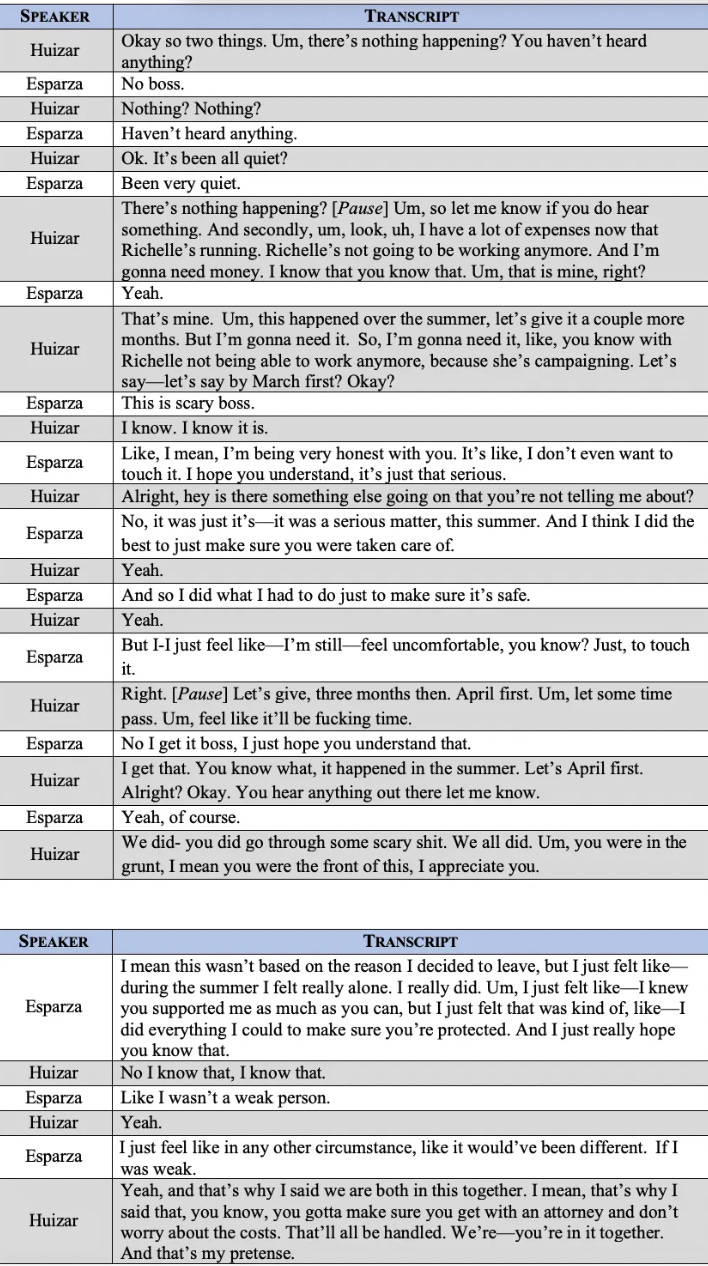
That included covertly recording a bathroom conversation he had with Huizar in December 2017 in which he told his boss he was quitting and said “This is scary, boss” as Huizar pressed him about the hidden money.
Here’s a copy of part of the recording:
Prosecutors also have a recording of Huizar at Esparaza’s front door in 2018. Esparza testified that he wasn’t home at the time, so Huizar told his grandfather he owed him money.
Several co-defendants in Huizar’s case are awaiting sentencing after taking cooperating plea deals, including Esparza, whose attorney watched Friday’s hearing from the gallery.
Judge Walter said Huizar’s sealed filing that details the actions of co-conspirators such as Esparza “was primarily motivated by defendants’ desire to seek revenge against those individuals and to make sure that they are also severely punished.”
“If that was the purpose, I can assure the defendant that each one of the co-defendants will be appropriately punished for their criminal conduct,” Walter said.
The other sentencings are awaiting the trial of former Los Angeles Deputy Mayor Raymond Chan, which is scheduled to begin in March.
Wei Huang is a fugitive whose charges include wire fraud and interstate and foreign travel in aid of racketeering. He lives in Shenzhen, China, and also maintains a residence in San Marino, California, but authorities believe he’s in China. A jury in November 2022 convicted his company Shen Zhen New World I LLC of eight crimes. Judge Walter fined the company $4 million at sentencing in May.
Salvador Huizar pleaded guilty on Oct. 19, 2022, to a false statements charge in a deal that requires his cooperation against other defendants. Prosecutors agreed to recommend no more than six months in prison.
Esparza pleaded guilty on July 22, 2020, to racketeering conspiracy. Prosecutors agreed to recommend no more than 87 months in prison, which is 7.25 years. The deal requires his cooperation against other defendants.
Real estate development consultant George Chiang pleaded guilty on June 26, 2020, to racketeering conspiracy. Prosecutors agreed to recommend no more than 70 months in prison, which is 5.83 years. The deal requires Chiang’s cooperation against other defendants. (Like Esparza, he was a witness in Chan’s trial.)
Justin Kim, Huizar’s political fundraiser who helped broker Lee’s $500,000 bribe, pleaded guilty to bribery on June 3, 2020. Prosecutors agreed to recommend no more than 57 months in prison. The deal requires Kim’s cooperation against other defendants..
Morris Roland Goldman, a former Los Angeles lobbyist who now works at a winery in northern California, pleaded guilty on Sept. 30, 2020, to honest services fraud and conspiracy to commit bribery. Prosecutors agreed to recommend no more than 30 months in prison. The deal requires Goldman’s cooperation against other defendants. (He testified in Chan’s trial.)
The San Francisco company CP Employer, Inc., formerly known as Carmel Partners, Inc., paid a $1.2 million fine in December 2020 as part of a non-prosecution agreement.
Another company, Jia Yuan USA Co., Inc. agreed to pay $1.05 million in another non-prosecution agreement. Jia Yuan is a subsidiary of the Chinese-based Shenzhen Hazens, which is owned by Fuer Yuan, who was hoping to redevelop the Luxe City Center Hotel in downtown Los Angeles.
Previous coverage, w/ sentencing memorandums. (Here’s prosecutors’ reply to the defense memo.)
Feds want corrupt LA politician Jose Huizar to do 13 years for RICO pay-to-play conspiracy

Prosecutors want a former Los Angeles politician to serve 13 years in federal prison for turning his downtown City Council district into a racketeering enterprise that included lavish Las Vegas gambling parties and trysts with prostitutes arranged by a billionaire developer who’s now a fugitive.
'This is scary, boss': Jurors hear ex-Los Angeles Councilman Huizar's covert bathroom meeting

A longtime assistant to ex-Los Angeles City Councilman Jose Huizar testified Friday of his former boss’ persistent efforts to collect $200,000 in cash bribes the you…
Thank you for supporting my independent legal affairs journalism. Your paid subscriptions make my work possible. If you’re not already a paid subscriber, please consider purchasing a subscription through Substack. You also can support me through Venmo (MeghannCuniff), CashApp ($MeghannCuniff) and Zelle (meghanncuniff@gmail.com). Thank you!