
Young Thug's RICO trial a 'quagmire' for Georgia courts as defense attorney tries to quit
From rap lyrics as evidence to an unrelated but relevant ruling out of the Jam Master Jay murder case in New York, there is a lot going on with this case. Let’s dive in.

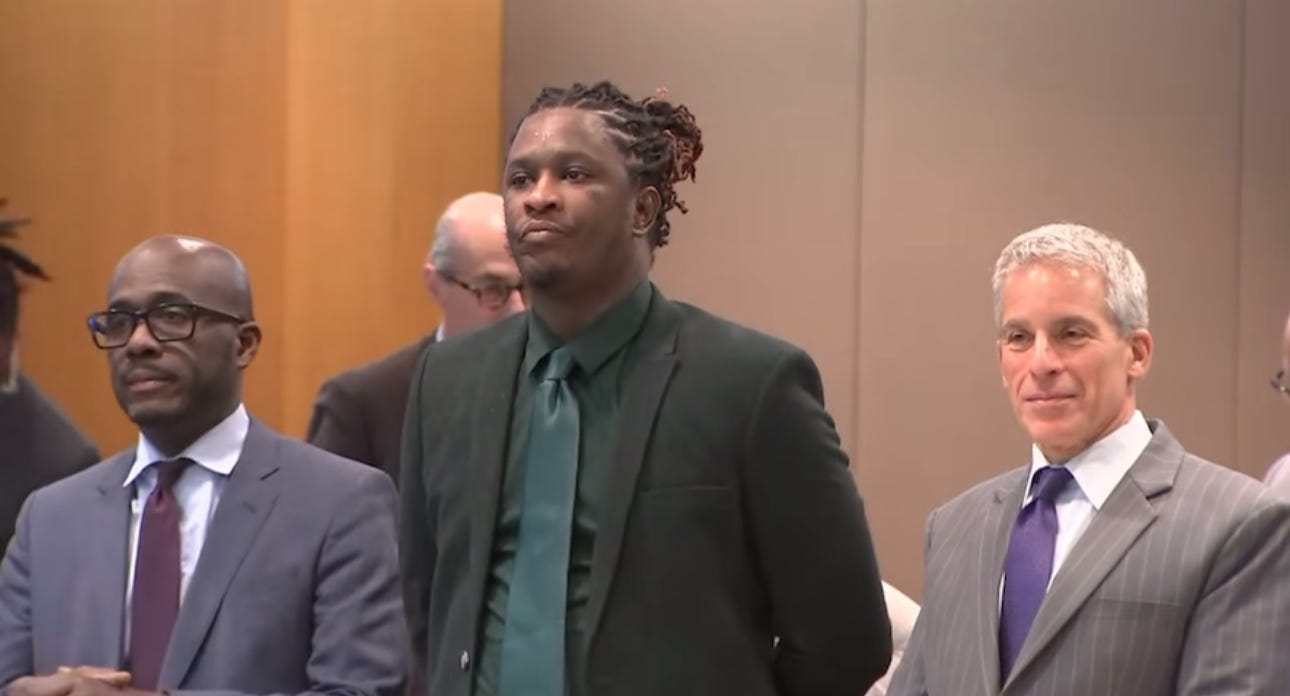
Nearly three months into an unprecedented organized crime trial, an attorney for rapper Young Thug warned the judge that jurors may still be hearing evidence when the Super Bowl arrives: Next year’s Super Bowl.
He may have underestimated.
Prosecutors in Atlanta, Georgia, have long said trial in their racketeering conspiracy indictment against the rap superstar and his alleged co-conspirators could last up to a year, but the court’s trial schedule so far has limited testimony to less than four hours a day, with frequent late starts and days off.
The case accuses Young Thug, legal name Jeffery Lamar Williams, of leading the criminal street gang Young Slime Life while operating under the guise of his record label, Young Stoner Life.
The indictment is the biggest in Fulton County’s history, with 28 total defendants, 65 alleged crimes and 191 so-called “overt acts” that prosecutors allege were done to further Young Slime Life’s status as a criminal organization. It includes two counts of murder and three counts of attempted murder, but Williams’ most serious charge is the racketeering conspiracy count, which carries up to 20 years in prison. Prosecutors are hoping his lyrics will help put there: Of the 191 overt acts, at least 60 relate to song lyrics or social media postings that prosecutors say were written to further the criminal conspiracy.
The case was filed 18 months before the same office secured another racketeering conspiracy indictment against former President Donald Trump and 18 others over their attempts to interfere in the certification of Georgia’s 2020 U.S. presidential election results.
Williams and his co-defendants currently are in jail with no bail allowed as their trial proceeds at a speed that’s on par with jury selection: The judge and attorneys took 10 months to select 12 jurors and six alternates, and 35 of 400 listed prosecution witnesses have testified since opening statements concluded on Nov. 28.
“I would say this case is exceptionally slow in the way that it’s going,” Leah Abbasi, an Atlanta criminal defense attorney and former public defender, told Legal Affairs and Trials. “It’s infuriatingly slow. I don’t know how the attorneys have dealt with it, both as far as financially being there but also just the sheer grind.”
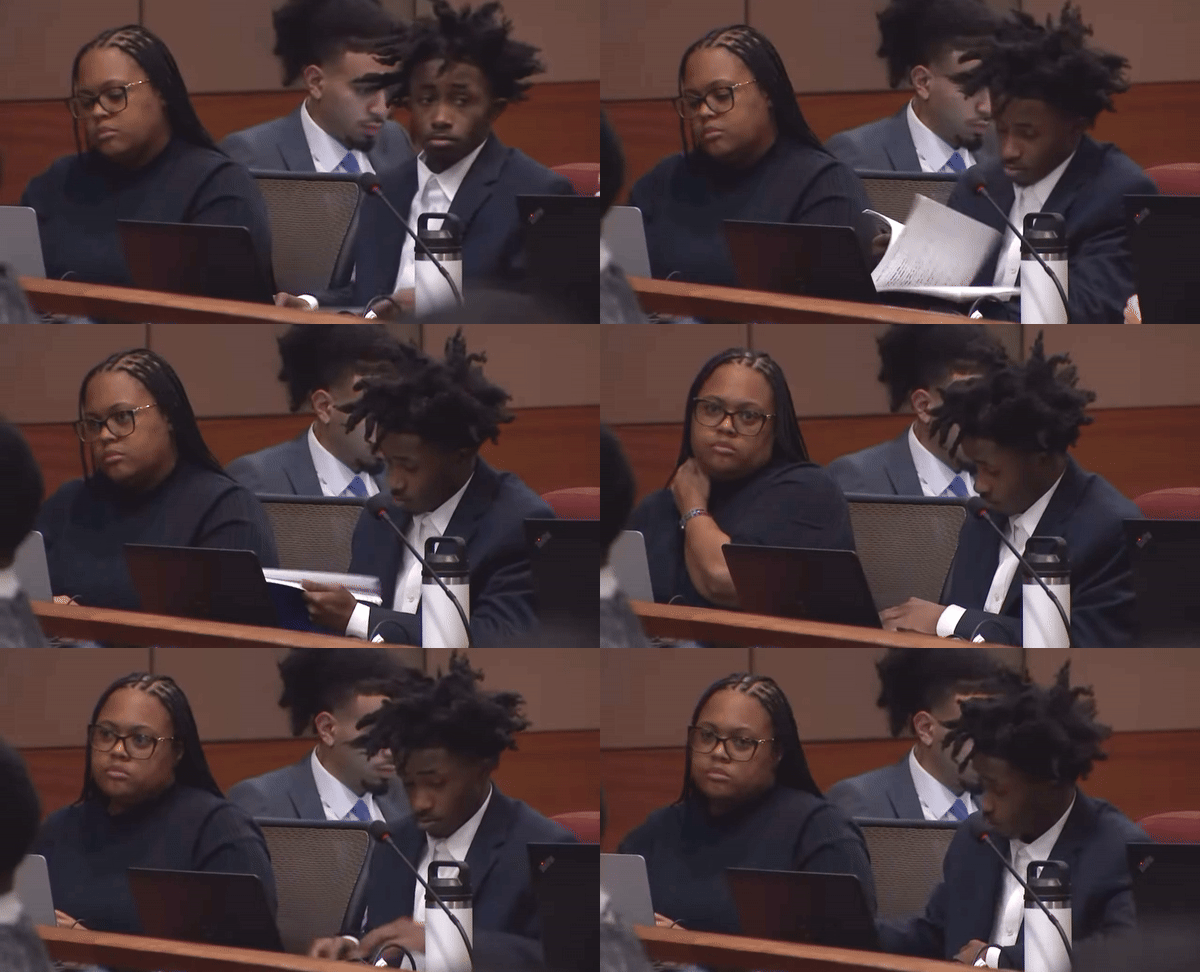
Angela D’Williams said in a withdrawal motion filed last Thursday, “Counsel has lost her physical office because of this trial and will likely continue to lose her livelihood.”
D’Williams, a licensed lawyer in Georgia since November 2019, represents 19-year-old Rodalius Ryan, who already is serving life in prison without the possibility of parole for a murder he committed when he was 15.
She’s the only lawyer in trial who’s an appointed public defender on contract, and she’s complained in the past about low pay: Last May, she told a reporter for the Atlanta station WSB-TV in jest that she was considering creating an account on the subscription website OnlyFans, which often is used for adult pornography, to supplement her income.
In a Feb. 5 letter, D’Williams told the Defenders Council she appreciates the increase approved in March 2023 of “$5,000 a month, with a cap of $55,000” but, “as the trial has progressed, I am the only appointed counsel left on this case. I am facing unforeseen challenges that necessitate a reconsideration of the budgetary allocation for extended trials in GA.”
“I am not able to take on new clients because I am either in court for this trial, or outside of court working on this case, the majority of my time. As such, I am not able to earn a livable wage, while representing Mr. Ryan in this trial,” D’Williams wrote. She said she’s “lost” her office but did not say if she was evicted for not paying rent or if she willingly left it.


Natalie Glaser, chief legal officer of the Georgia Public Defender Council, replied to D’Williams saying the council is “unable to accommodate a third increase in our contractual relationship with you that would exceed the new policy.”
“If you find yourself unable to continue the representation, please let me know as soon as possible so that I can arrange to have an attorney available to substitute into the case,” Glaser wrote.
In her withdrawal motion, D’Williams characterized Glaser’s statement as the Council “stating they will find another attorney to substitute counsel and continue this trial that is slated to continue well into 2025.”
But, “after talks with Mr. Rodalius Ryan, he is opposed to a Substitution of Counsel and will not waive his write [sic] to counsel whom has already been appointed.”
Fulton County Superior Court Judge Ural Glanville scheduled a hearing for this Friday. He told D’Williams last Thursday to get her payment records from the council so he can consider them when deciding whether she can quit the case.
Longtime Atlanta criminal defense attorney Bruce Harvey, who represents accused YSL member Quamarvious Nichols, told Legal Affairs and Trials the trial is the longest he knows of anywhere. It technically has been in progress since jury selection began in January 2023.
“I’ve never seen anything like it. And I get reactions from other courts, ‘Really, when can you give me a date? When can you be here?’ And I can’t tell him when I’m going to be there,” Harvey said. “It’s just very difficult to deal with.”
Harvey said some of his clients “are sitting in jail, waiting for me to finish this so that they can deal with their own cases.”
“Their families want resolution to their cases. Everybody wants resolution of their cases,” Harvey said. “It’s just a legal, personal and emotional quagmire.”
Jury hears detailed testimony about drug busts
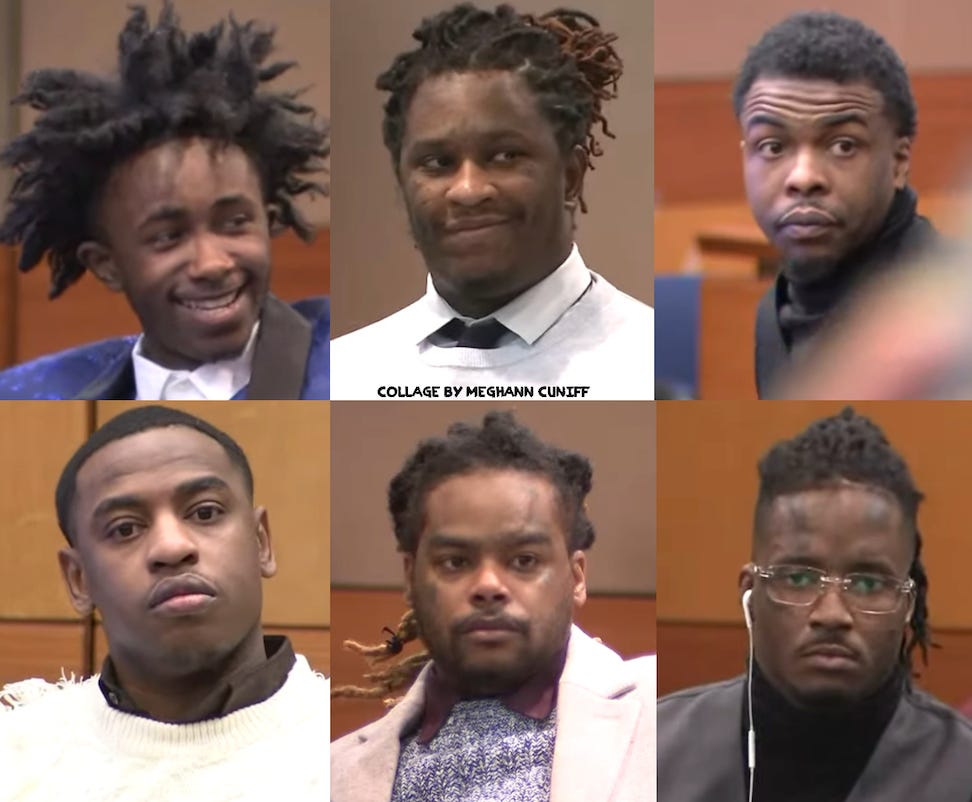
The indictment against Williams, Ryan, Nichols and their co-defendants, Shannon Stillwell, Marquavius Huey and rapper Yak Gotti, legal name Deamonte Kendrick, includes the murder and attempted murder charges as well as 15 counts of participation in criminal street gang activity in violation of Georgia’s anti-gang law.
The 191 alleged overt acts supporting the racketeering conspiracy charge include the two murders that also are charged separately, as well as the murder for which Ryan was convicted in 2019. One of the overt acts is the shooting of rap superstar Lil Wayne’s tour bus as it left a concert in Atlanta in April 2015.
Rapper Rayshawn “YFN Lucci” Bennett, who recently pleaded guilty to a felony gang charge in a separate murder case, also is the victim in an attempted murder charge after he was stabbed in the Fulton County Jail in February 2022; prosecutors say YSL members attacked him as part of a gang rivalry, then sought Williams’ permission to target him again.
But so far, trial testimony has focused on less serious acts such as drug possession and a 2016 carjacking prosecutors attribute to an alleged YSL member who’s to be tried separately. Prosecutors are relying on Mark Belknap, a detective in the Atlanta Police Department’s gang enforcement unit, to connect the acts to the greater Young Slime Life gang, and they plan to put him on the witness stand multiple times in what a defense attorney called “the Detective Belknap show.”
The 19-year police veteran is in the midst of his second witness stand appearance, and he’ll return at least one more time as the judge said he plans to address future requests to recall him as they arise. If Judge Glanville eventually decides Belknap can’t return to the stand, prosecutors would be stymied from using his expertise to buttress evidence of the indictment’s most violent crimes and overt acts.
The approximately 35 witnesses who’ve testified since Nov. 28 include four current or former employees of the Georgia State Crime Lab. Together, they testified for approximately three hours over four days about drug identification test results, including for $20 of marijuana.
Prosecutors also called five witnesses to testify about the 2016 carjacking, including the eyewitness, the victim, two police officers and a 911 dispatcher. None had information about the relevant aspect of the crime: Its connections to the Young Slime Life gang, beyond the fact that Christian Eppinger, who was 17 when he was arrested for the carjacking eight years ago, is a suspected member.
The approach by the Fulton County District Attorney’s Office differs greatly from how federal prosecutors handled a racketeering case against the Mongols Motorcycle Club.
The alleged biker gang went on trial in Santa Ana, California, in October 2019 for violation of the federal racketeering law and conspiracy to violate the racketeering law. The conspiracy charge was backed by 50 overt acts, while the racketeering charge was supported by 10 predicate acts that included three attempted murders and three murders.
Two acts were distribution of methamphetamine and conspiracy to distribute cocaine and meth, but the Mongols’ lawyer didn’t contest that the existence of the drugs, so prosecutors didn’t call witnesses to testify about the testing process. Doing so would be “a waste of time,” said Joe Yanny, a Los Angeles lawyer who defended the Mongols in trial.
The issue was not whether the drugs existed but whether “it had anything to do with the club,” Yanny told Legal Affairs and Trials.
The Mongols case was tried over 27 days between Oct. 31, 2018, and Jan. 11, 2019. Prosecutors called approximately 28 witnesses, and jurors ended up convicting the Mongols organization of both counts, then approving the forfeiture of its trademarked patches to the federal government. The presiding judge, U.S. District Judge David O. Carter, blocked the patch forfeiture but authorized the forfeiture of other items and fined the club $500,000. Along the way, he regularly kept the attorneys in court after trial to ensure no unexpected issues would delay the next day’s testimony.
“We were there sometimes till 7 in the morning to 1 at night,” Yanny said.
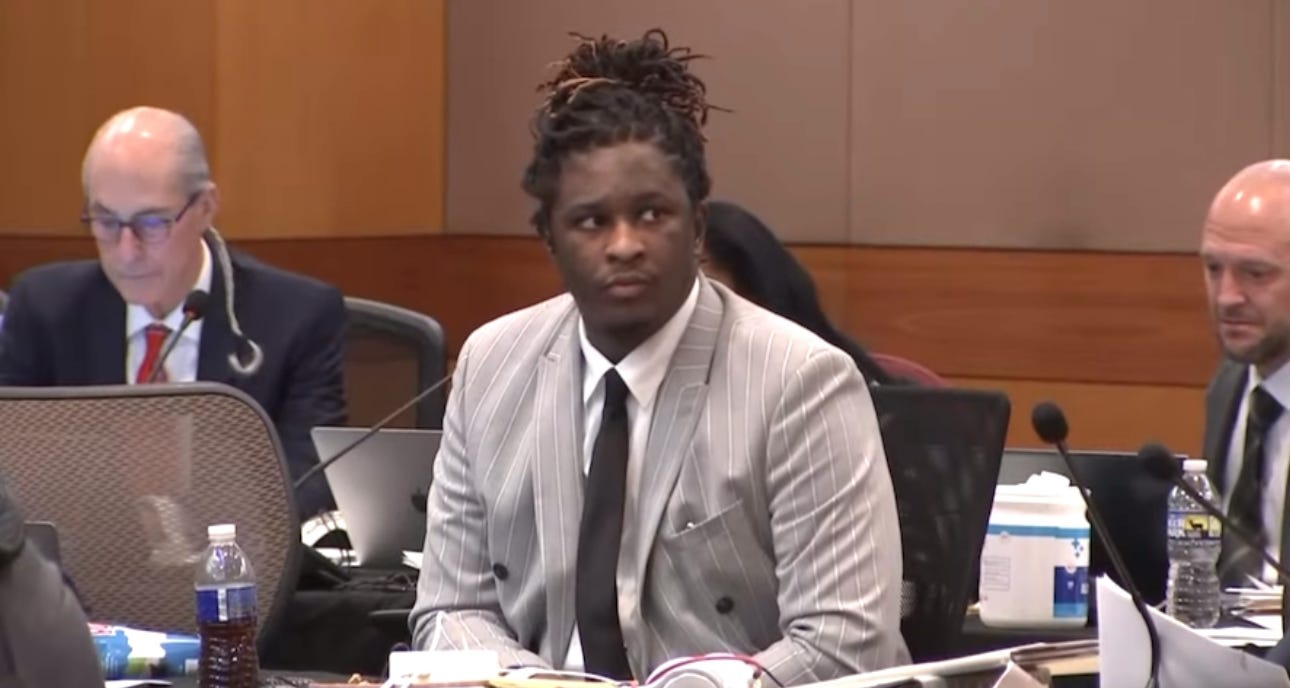
In Young Thug’s case, trial has been in session 28 days since Nov. 27, with an unexpected four-day break in December after Thug’s co-defendant Shannon Stillwell was stabbed in jail and a two-day unexpected break two weeks ago because Judge Glanville was ill.
Glanville also canceled trial one day in December after D’Williams called in sick, and trial usually isn’t in session Fridays or is only a half day because Glanville presides over Fulton County’s veterans court and also sometimes hears other cases. When trial is in session, lunch breaks sometimes last upwards of two hours and recesses that Glanville calls “comfort breaks” sometimes extend 30 to 40 minutes longer than advertised.
“The time management theories on why this case is being tried the way that it is, it make no sense to me,” said Abbasi, adding that she and many other defense attorneys in the Atlanta area “wanted nothing to do with the case.”
“It would take a lot, a lot, a lot to get a mistrial in this case, simply because of the ‘We don’t want to start over,’” Abbasi said.
Yanny said the trial likely will end in a mistrial because jurors can’t stay on. Glanville and the attorneys looked for people in jury selection who could commit to a year-long trial, but, already, one alternate juror has been dismissed, and two jurors on Thursday indicated new problems are amiss. One asked about money owed to them from Fulton County Superior Court’s $25 per day juror compensation.
In response, Glanville mentioned “a little incident,” apparently referring to a cyberattack that crippled Fulton County’s technology system two weeks ago. But, he told the jurors, “We are working on that … We are working to make sure that you get the handsome renumeration that you rightly are owed, alright?”
Another juror asked Glanville if the media could stop reporting which days the jury won’t be hearing testimony, to try to stop employers from calling the jurors into work. Glanville said no, but if any employers ask a juror to come into work on an unexpected day off from trial, he’ll call the employer and say the juror is still on duty.
“I think several employers have been giving our jurors a difficult time,” Glanville said.
The judge gave the jurors Monday off so at least one could tend to what he described as transitional life issues. Glanville planned to hear motions with the attorney instead, but he cancelled the hearing because one of the defendants is reportedly ill. Now attorneys are scheduled to convene Wednesday to argue motions, and the jury won’t return for testimony until Thursday.
Harvey told Legal Affairs and Trials he expects the trial will end by “maybe August or September.”
“I think at some point, we’re gonna start marching to a different tune,” he said. But, “if the state keeps doing it in this unnecessary, meticulous, bringing in the crime lab on a $20 marijuana sale,” jurors are in for a long haul.
“I’m gonna say, yeah, just smoke it, and we know. We know what the hell it is,” said Harvey, a licensed lawyer in Georgia since 1977. “I wanted to jump up and say, ‘I’ve done 100,000 controlled burns. I can tell you.’”
Prosecutor’s recitation of rap lyrics leads to unusual argument over recorded statements
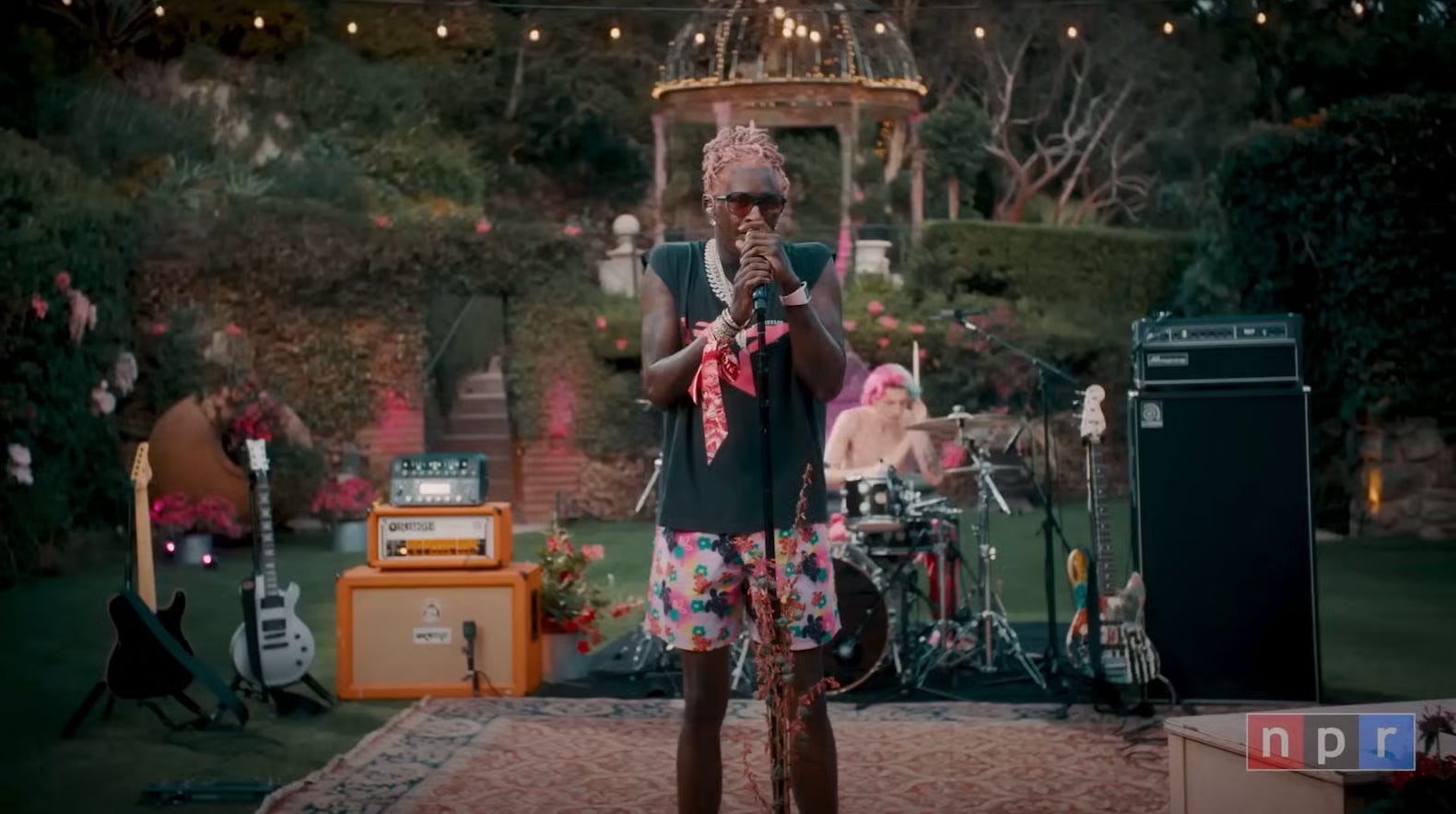
The trial so far has included standard unexpectancies but also legal issues that have little precedent, such as the admissibility of a YouTube video from Law & Crime Network showing a key prosecution witness’ plea hearing and the admissibility of a video of Young Thug performing his song “Droppin Jewels” for National Public Radio’s Tiny Desk Concert series.
Judge Glanville allowed the Law & Crime video in part, but he wouldn’t allow Williams’ lawyer to to play the NPR performance to try to cross Stephens’ testimony about the meaning of the lyrics.
Williams’ lawyer Brian Steel nearly begged him to reconsider and said the issue reaches the heart of the case: “They are trying to paint Mr. Williams as a person he is not. This is a good man. And I get to show the truth about that song.”
Steel said the lead prosecutor, Fulton County Chief Deputy District Attorney Adriane Love, read the lyrics with a tone and inflection that doesn’t match Williams’ rendition of “Droppin Jewels.” Love recited some of the song lyrics when she questioned confessed Young Slime Life gang co-founder Trontavious “Tick” Stephens about his testimony that Williams refers to God when he sings, “tell me why am I remaining, why am I living here.”
When questioning Stephens, Love also recited the lyrics, “I told my daughter, Keep one in the head, she ain’t gotta cock it / I told my son if he wanted to live, he might catch a body / I told my son he ain’t a cheerleader but he might gotta catch a body / His driver named Joe, but he still can’t do it sloppy.”
“Do either one of those lines refer to defendant being truly humble under God?” Love asked, referring to Steel’s definition of thug.
Judge Glanville overruled a speculation objection, and Stephens answered, “No.”
In response, Steel told Glanville needed to show the jury that “Droppin Jewels” is “about coming from nothing.”
“It’s about telling kids, if you live under the circumstances that gentlemen like Mr. Williams lived, you may have to kill someone because they’re going to kill you. It’s self defense,” Steel told Glanville.
But the judge said the “rule of completeness” in Georgia state court doesn’t allow for Steel to play the recording in his cross of Stephens because Love didn’t play a recording of the song when she questioned Stephens about the meaning of the lyrics.
“Had Ms. Love played the song, I would let you play the song,” Glanville said. The judge also wouldn’t allow Steel to play the video to Young Thug’s and Rich Homie Quan’s 2014 hit “Lifestyle” in front of the jury.
Steel still can introduce Young Thug songs as evidence in his own case, including by calling Williams as a witness. But he told Judge Glanville he needed to get the “Droppin Jewels” recording before the jury sooner to counter Love’s reading of the lyrics to Stephens.
“This trial may go on until the Super Bowl next year,” Steel said on Jan. 29. “I don’t want to do it in seven months. It is ripe now.”
He added, “At some point, the confrontation clause has to speak in this courtroom.”
Steel issued a similar warning when arguing against prosecutors’ attempts to bring in testimony about Thug drag racing in a McDonald’s parking lot and, a police officer alleges, tossing a gun from his car window.
“The story has 191 acts already. The state is just consistently making this too big for a jury to understand,” Steel said.
So far, the only music played for the jury has come from the defense. First Steel played the video to Young Thug’s and Gunna’s 2021 hit “Pushin P” in his cross of Stephens, then Glanville last week allowed Steel to play part of Ola Playa’s song “S.L.I.M.E.” with Thug. Steel did so while questioning Detective Belknap about his testimony that, to Thug and other YSL gang members, “Slime is a term meaning, ‘To do something reprehensible or wrong.’” “S.L.I.M.E.” lyrics define the word as “Slug Love I Me Everyone.”
Steel also referenced Williams’ lyrics unprompted when he asked if Stephens was aware he’s mentioned his name in songs. (Steel appears to have been referring to Young Thug’s song “Oh Okay” with Gunna and Lil Baby, in which Thug sings, “My lawyer Brian Steel.”)
The “Droppin Jewels” argument embodies the defense’s decision to fight prosecutors’ focus on Thug’s lyrics and social media postings by picking other songs, videos and posts to try to refute arguments that his music and musings relate to his gang membership.
The approach by Fulton County District Attorney’s Office is controversial: Two weeks ago, a federal judge in New York City prohibited prosecutors from using lyrics written by a rapper accused of murdering rap pioneer Jam Master Jay of the legendary group Run DMC.
The Second Circuit Court of Appeals, which includes New York’s federal courts, ruled in 2015 that rap lyrics can be used as evidence, but U.S. District Judge LaShann Dearcy Hall said in her new ruling that the lyrics Eastern District of New York prosecutors sought to use against Karl Jordan Jr. don’t have the evidentiary value needed to justify allowing them in trial.
“At bottom, none of the lyrics the Government seeks to admit as evidence of Jordan’s guilt bear any nexus to the criminal conduct alleged in this case,” wrote Hall, a 2014 Barack Obama appointee.
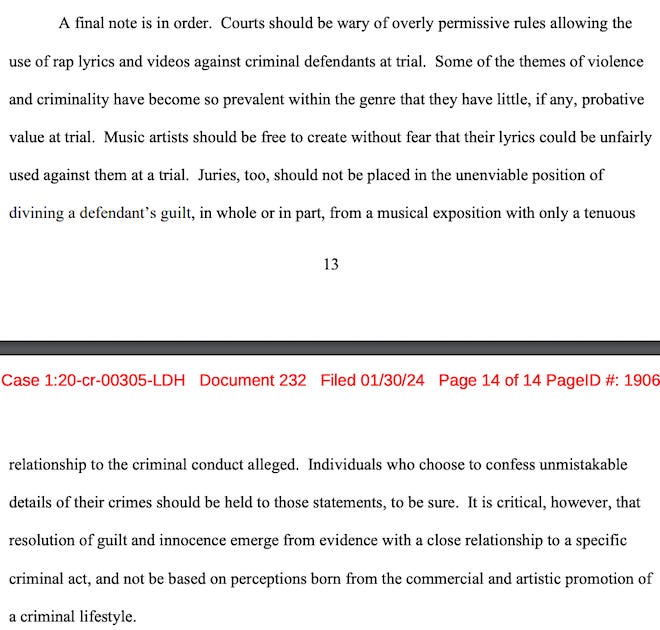
Judge Hall ended her 14-page order with a warning: “Music artists should be free to create without fear that their lyrics could be unfairly used against them at a trial. Juries, too, should not be placed in the unenviable position of divining a defendant’s guilt, in whole or in part, from a musical exposition with only a tenuous relationship to the criminal conduct alleged.”
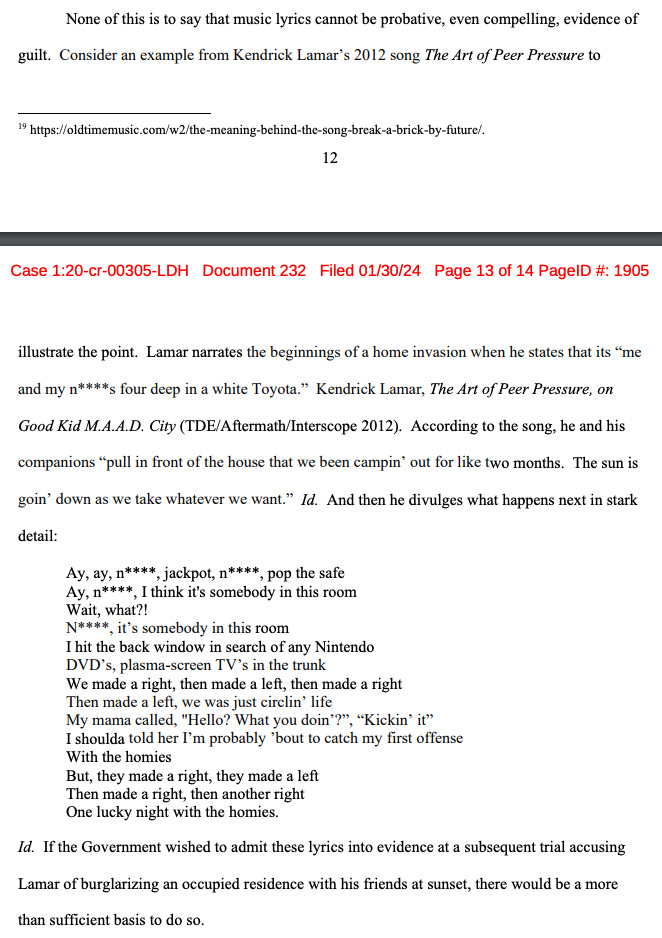
But the judge also made clear that some lyrics can be fair game for trial, even going so far as to identify rapper Kendrick Lamar’s 2012 song “The Art of Peer Pressure” and its “stark detail” about a home-invasion robbery.
“If the Government wished to admit these lyrics into evidence at a subsequent trial accusing Lamar of burglarizing an occupied residence with his friends at sunset, there would be a more than sufficient basis to do so,” the judge wrote.
If Fulton County prosecutors are to be believed, Thug’s lyrics meet Hall’s standard.
Lyrics in the song “Slime Shit” by Thug and Yak Gotti include “hundred rounds in a Tahoe,” and Love said rival gang leader Donovan Thomas’ Chevrolet Tahoe had bullet damage all over it after YSL members shot him to death in 2015. (Yak Gotti is one of three defendants charged with Thomas’ murder, in addition to Thomas’ murder being an overt act for the racketeering conspiracy.)
Then in the 2019 song “Just How It Is,” Thug raps, “we know to kill the biggest cats of all kittens.”
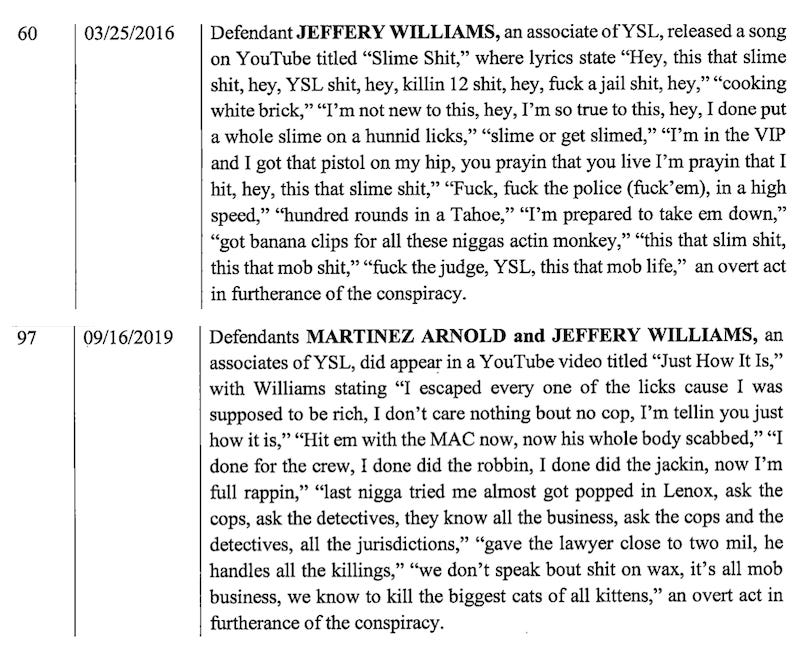
“How coincidental that Donovan Thomas was gunned down and these were the words later spoken by the members of YSL,” Love said in her opening statement. “The evidence will show it’s not coincidental at all.”
Judge blocks prosecutors from introducing evidence of overt act linked to song lyrics
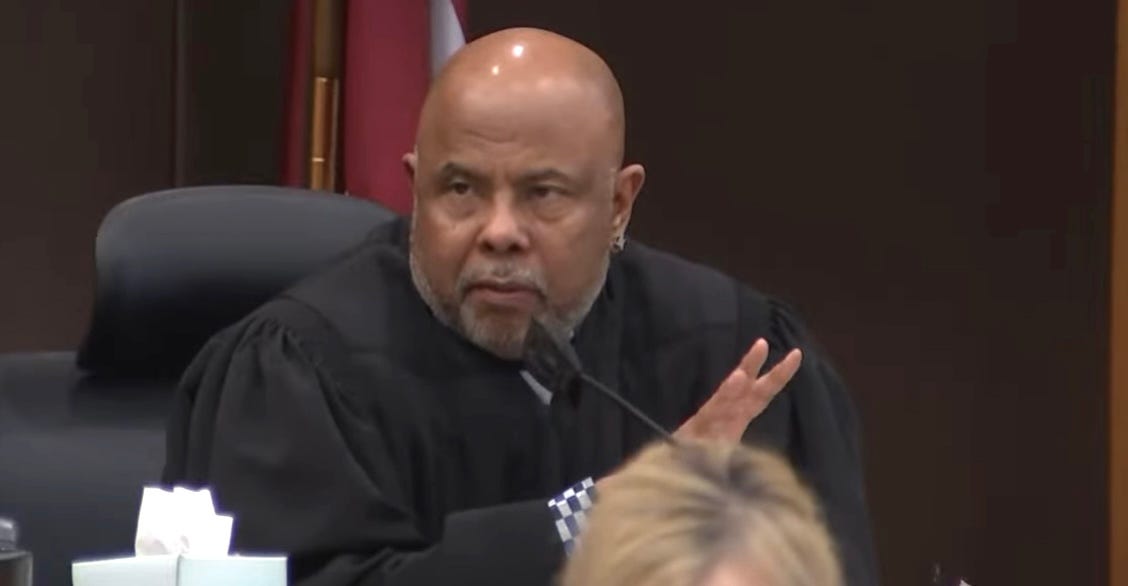
Judge Glanville said before trial that certain lyrics could be admissible but he’d decide for sure in trial if prosecutors had laid the foundation needed to introduce them. Already, he’s made a ruling that could greatly affect the evidentiary value of one.
Two weeks ago, the judge blocked prosecutors from eliciting testimony from a police officer about a 2018 traffic stop involving Young Thug that is the basis for an overt act supporting the racketeering conspiracy charge. Thug received only a speeding ticket, but a Dodge Charger that a prosecutor described as a “trail vehicle” was stopped in tandem with Thug’s Porsche, and police found a cache of guns with the four men inside, including an AK-47.
Deputy District Attorney Christian Adkins cited Thug’s lyrics when arguing the second vehicle related to Thug.
“The state has lyrics from Jeffery Williams saying he has snipers behind him,” Adkins said.
The judge wasn’t persuaded.
“Just because two cars are traveling down the road at the same time doesn’t necessarily make them tied to one another,” said Glanville, a 28-year jurist who has been chief judge of the 20-judge Fulton County Superior Court since 2022.
Adkins said that’s a question for the jury, and “the state should be wholeheartedly allowed to present evidence of for an overt act in this very indictment that we’re in trial for,” but Glanville didn’t budge.
“It doesn’t have a nexus. Stop trying to get into it. I’m still not convinced,” the judge snapped.
The decision affects not just one but two overt acts for the racketeering conspiracy charge because, along with the incident being its own overt act, another overt act focuses on Thug’s song “Ewww” and cites the lyric Adkins referenced, which is, “In the Bentley on West Lee gettin’ trailed by sniper.”
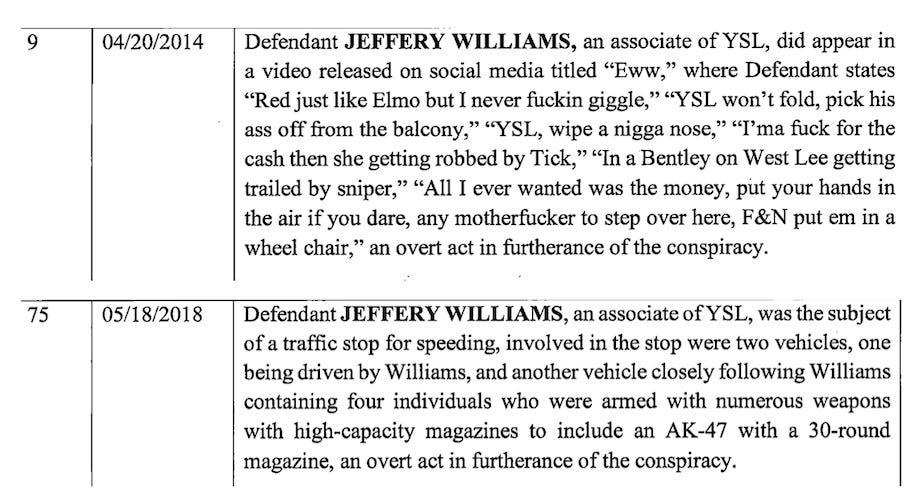
Another “Eww” lyric is supported by prosecutors’ plea deal with Stephens, the confessed YSL co-founder who recently testified. The written agreement Stephens signed in December 2022 acknowledges he is the Tick in the “Ewww” lyric, “I’ma — for the cash then she gettin’ robbed by Tick.”
But in cross with Steel, Stephens pushed back on the inference that Thug was celebrating his robberies and testified that he was upset by the lyric because he knew Thug was “teasing me.” He said he was angry with Thug “for even putting that in the song, knowing it was false.”
Much of the defense’s questioning of Stephens tried to show jurors he had reasons to plead guilty that had nothing to do with guilt. Steel asked about life inside the Fulton County Jail, Stephens’ three children with three women and him missing Christmas while in jail to try to show the pressures he faced when he decided to strike a deal with prosecutors.
Steel also questioned Stephens about his switch in lawyers. Stephens testified that his grandmother paid $50,000 to an Atlanta lawyer who ended up backing out of the case because his wife had cancer. The attorney returned $25,000, and Stephens and his grandmother hired Kristi Gladden, an Atlanta lawyer who negotiated Stephens a deal that got him out of jail on an eight-year probation sentence. Stephens pleaded guilty to racketeering conspiracy and acknowledged in a signed document he is one of three co-founders of the Young Slime Life street gang. The deal required his testimony in trial.
Max Schardt, an Atlanta solo practitioner who represents Stillwell, expanded on Steel’s questions by asking Stephens who prepared the documents involved in his plea, and asking if he thought it was “OK to refuse to initial certain acknowledgments.”
“You had to initial all the acknowledgments, right? For the plea to go through? For you to go home?” Schardt asked as Stephens said yes.
To try to counter questions, D.A. Love got Judge Glanville’s approval to bring in an unusual piece of evidence: A YouTube video of Stephens’ plea hearing from Law & Crime Network. Prosecutors removed the network logo and edited out a private conversation between Stephens and Gladden before Love played it in her redirect-exam.
“This is part of the new millennium of new technology in the courtroom. It’s another tool for a court or, in this case, for a prosecutor to establish the voluntariness of the statement,” Arturo Corso, an attorney in Gainesville, Georgia, who is following the trial told Legal Affairs and Trials.
The video of Stephens’ plea hearing barely shows him on camera. His witness stand appearance, however, put him feet from the jury on seven days over three weeks, and it didn’t give prosecutors much of the incriminating testimony they tried to elicit.
A key YSL member testified as part of plea deal, but did he gave prosecutors what they needed?
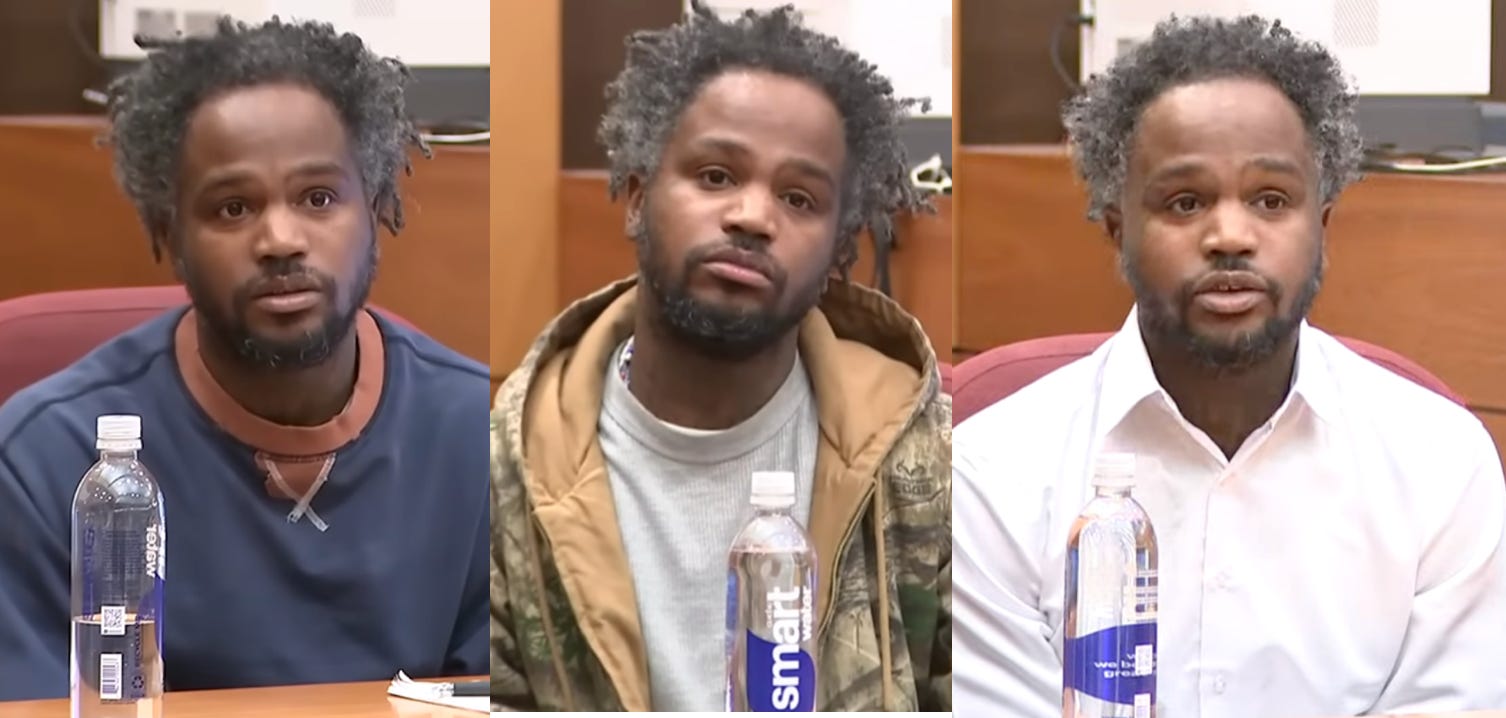
Now 30, Stephens was celebrating his 22nd birthday when he and other YSL members went to the Compound nightclub in Atlanta the night Lil Wayne was performing in April 2015.
Accused YSL member Jimmy “Peewee Roscoe” Winfrey fired shots at Wayne’s tour bus as it drove away, leading to Winfrey’s arrest and eventual convictions for two counts of violating Georgia’s anti-gang law. Winfrey is charged in YSL indictment but is not currently on trial, and he’s not expected to testify given his pending charges.
That makes Stephens a key witness regarding the bus shooting, but Stephens had little to say about it on the witness stand, instead testifying that he’d gone to the Compound because Lil Wayne is his “idol” and he was drinking liquor and smoking weed to celebrate his birthday.
“Basically, I was vibing, listening to music, smoking weed and drinking liquor. So I don’t recall any, like, exact conversations,” Stephens testified.
Stephens testified on both cross and direct that he committed crimes to further the notoriety of YSL as a gang, but he also testified that he believed himself committing crimes constituted gang activity simply because he was a member of a gang when he did so. And in one particularly memorable exchange, Stephens testified he believed he could be considered three people when Love asked him the name the other two co-founders of YSL.
“I really thought that I was use myself — that I counted as the three. I had a friend who passed, and he was a member. … We often sold drugs together and we had the same goals,” Stephens testified.
“Mr. Stephens, do you contend at this point that somehow you thought you constituted three or more members of Young Slime Life?” Love asked.
Yes I really thought that I could be, yeah,” Stephens answered.
Stephens also denied any gang connections to his tattoos, instead testifying that the B tattoo that Detective Belknap says connotes the national Bloods gang means Boo or Boss, and that the BFL throat tattoo Belknap said means Blood For Life actually means Bank First and Last.
Prosecutors also have a photograph of a tattoo on the back of Stephens’ neck that says Kant Fight Fight, but he didn’t say he spelled Kant with a K to disrespect the Bloods’ rival gang the Crips. Instead, when Love asked why he spelled it that way, he answered, “Because it was my body and I wanted to do what I wanted to do with my body.”
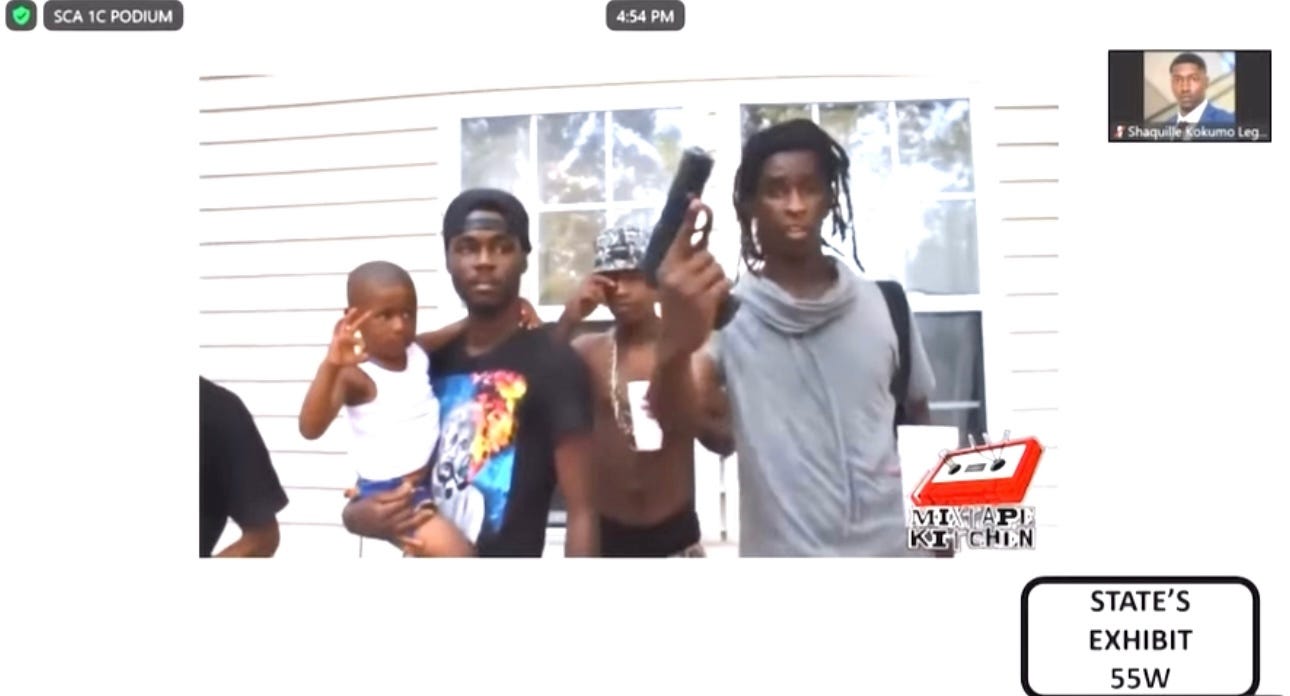
Part of the defense narrative is that Williams is a “studio gangster” who embraces gang imagery as part of his artistry. Last week, Steel said in his cross of Belknap that a toddler flashing gang signs while Thug brandished a gun was a “marketing tool.”
So in his cross-exam of Stephens, Steel worked to distance him from Williams by asking about Stephens’ criminal history and his lack of involvement in Williams’ career, including the years of work Williams put into teaching himself how to rap.
Stephens and Williams have known each other since Williams moved to Stephens’ impoverished Cleveland Avenue neighborhood from the nearby Jonesboro Housing Project. Prosecutors say Williams’ YSL gang evolved from a gang Stephens co-founded called ROC Crew, or Raised on Cleveland.
But Stephens testified no one in the courtroom could have been in ROC Crew with him because they weren’t raised on Cleveland with him, and he answered yes when Steel asked about Williams not actually spending much time on Cleveland Avenue.
“You really didn’t co-find anything with Jeffery, isn’t it true? He went one direction, you stayed in another. Isn’t that true?” Steel asked.
“We went separate ways,” Stephens answered.
“But Jeffery never turned his back to you. He always made himself available to you if you needed something, isn’t that true?” Steel asked.
“Yeah,” Stephens answered.
The questions led prosecutors to bring in Instagram messages, some as late as February 2021, in which Williams, Stephens and other YSL members discuss “The Webb,” a home in Atlanta that Williams rented and prosecutors say Stephens and others ran as a “trap house,” or a headquarters for drug sales.
Prosecutors already planned to introduce some as evidence and had listed them as overt acts for the racketeering conspiracy, but D.A. Love persuaded Judge Glanville to allow more messages based on Steel’s cross of Stephens, including one in which Stephens implores other YSL members to “find your purpose to da gang.”
“There were many questions that went into how his drug sales — Does anyone in here benefit from his drug sales? Does anyone in here get proceeds from his drug sales?” Love said. “Mr. Steel asked Mr. Stephens, didn’t he live with his grandmother all of his life, and in fact what is happening is The Webb is a trap. It’s a place where YSL members sell drugs. … You see them working in concert with one another. In this Instagram, you see them working together for the benefit of the enterprise that is YSL.”
Stephens’ cross also led to prosecutors bringing in tweets from Williams in 2011 that repeatedly reference ROC Crew and Sex Money Murder, a larger gang with which ROC Crew was affiliated. They did so during Belknap’s second witness stand appearance, which included testimony about gang symbolism in popular culture.
“I would disagree that pop music is full of gang references," Belknap testified during cross-exam by Schardt.
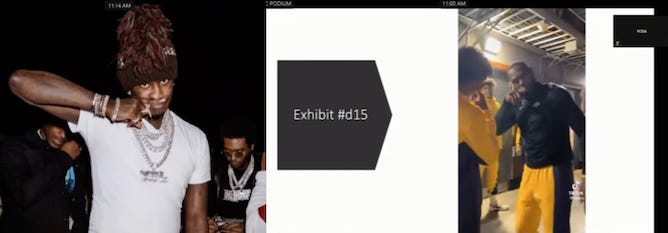
Part of the defense is that Williams is doing what other celebrities do when he displays hand signs and other symbols that Belknap and prosecutors say are gang related, such as wiping his finger under his nose. Belknap testified the nose wipe is YSL gang sign; Steel tried to counter the testimony by showing Stephens a video of professional basketball star LeBron James doing the same nose wipe sign as he shook hands with his Lakers teammates. James also says “slime” in the video.
“Is there something sinister to you with the use of the word ‘slime’?” Steel asked.
“No,” Stephens answered.
“Have you seen other basketball players do that same movement?” Steel asked.
“Yeah,” Stephens answered.
“Have you seen football, professional football players, do that?” Steel asked.
“Yeah,” Stephens answered.
“Is that something unique, the wiping of the nose and saying ‘slime’, to some gang member on Cleveland Avenue?” Steel asked.
“No,” Stephens answered.
Steel also asked Stephens about tennis star Serena Williams performing a “Crip Walk” at Wimbledon to signify the Crips gang, and he showed video of rappers Snoop Dogg and Dr. Dre performing at the Super Bowl in 2022, then asked Stephens about gang imagery.
“Do you recognize that dance?” Steel asked.
“Yeah,” Stephens answered.
“And tell the people what this dance signifies,” Steel said.
“A Crip Walk,” Stephens answered.
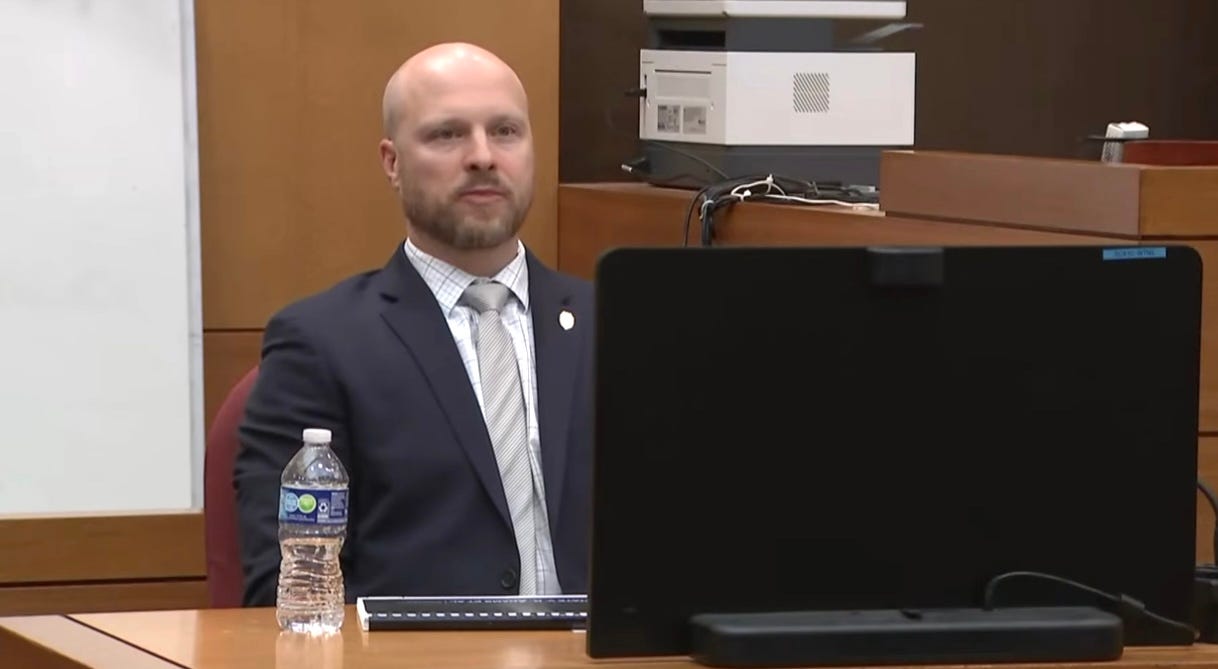
In cross last week, Belknap answered “unfortunately, yes, there were,” when Schardt asked if “there were explicit references to gang culture” during the Super Bowl show.
Steel followed up in his own cross-exam of Belknap.
“You said, and I think your word was ‘unfortunately,’” Steel said.
“I did say ‘unfortunately,’” Belknap answered. “And what I found through my experience, what a century of research has shown, what the community at large recognizes, is that criminal street gangs are bad. They’re bad for society. They’re bad for their victims. They’re bad for the communities that are plagued by them. They’re even bad for the members themselves. At some point in many gang members’ lives they realize this. Many of them step away from that life. Others aren’t given that opportunity.”
The detective continued, “So to the extent that the largest musical stage in the world provided an opportunity to present gang identifiers in a way that could be seen as positive, I see it as a net negative for society as a whole.”
“But there is absolutely nothing illegal about me going on the half-time Super Bowl show…and doing something like that; like a B, right?” Steel asked while demonstrating a Blood hand sign.
“There is nothing illegal in that act,” Belknap answered.
“The fact that you find it, and I’m not criticizing you at all, but the fact that you find it, my word is ‘repugnant’, that’s the difference between American and, like, let’s say, Russia, right?” Steel asked.
“No, sir, it isn’t. … You’re misrepresenting my testimony, and I do not believe that that’s the difference between American and Russia,” Belknap answered.
Belknap is to return to the witness stand on Thursday.
Trial notes
Co-conspirator theories: Some defendants have pleaded guilty like Stephens did, but others have had their cases severed and are to be tried separately. That means prosecutors theoretically are going to have to do this same trial many more times, which raises questions about how that’s close to being possible when they can’t seem to get through this trial in less than two years.
Having so many defendants in the same sprawling indictment also raises questions about how the decisions of one defense attorney could affect a defendant who is not their client. Harvey, the most seasoned criminal defense attorney in the courtroom, has raised that issue on several occasions, including over the Instagram messages about The Webb.
“Mr. Nichols has been dragged into this evidentiary quagmire — and with all due respect my co-counsel — by my co-counsels’ cross-examinations in which I did not participate,” Harvey said. “So what is happening now is that he is suffering a prejudicial spillover and it is akin to a prejudicial retroactive misjoinder, and therefore I’m asking for a severance.”
Young Thug’s Fear of God shirt: One thing I try to consider when I watch trials is which side is getting in exhibits that could be the most helpful during jury deliberations.
So far, prosecutors in this trial have gotten a lot of exhibits admitted that will seem pretty worthless in the jury room. The best exhibits for them so far have probably been the Instagram messages between Williams, Stephens and others. But they’ve also admitted exhibits such as seized drugs that no one on the defense is trying to say don’t exist and photos from arrests that no one is trying to say didn’t happen.
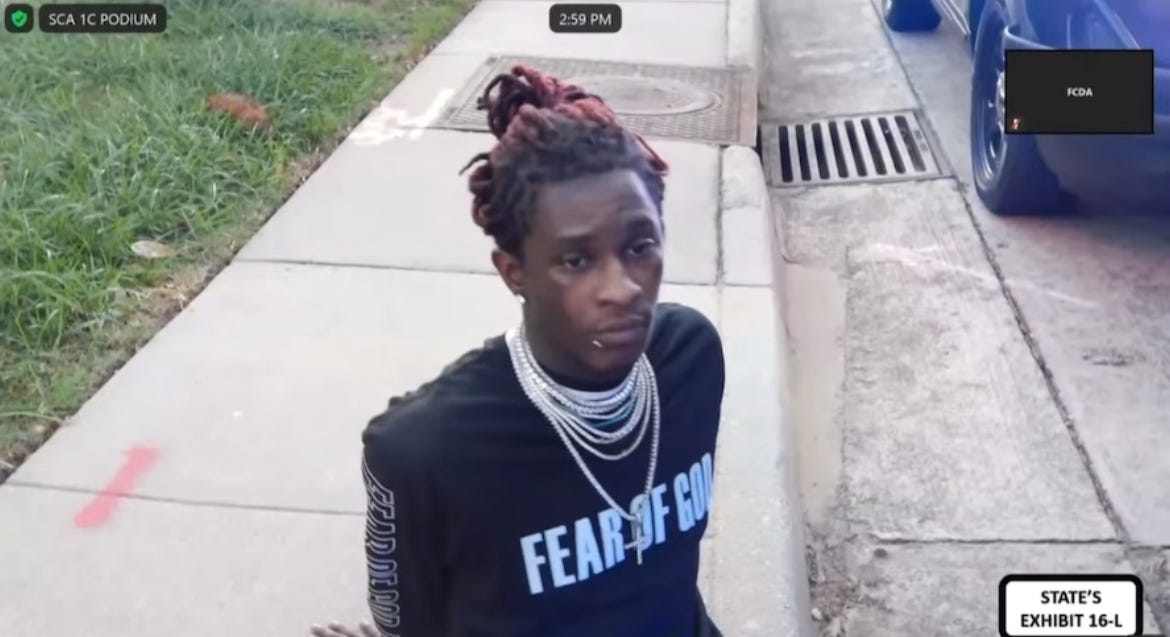
One photo, however, isn’t just worthless to prosecutors: It’s particularly helpful to the defense. It’s a photo of Williams during a 2017 traffic stop in which he was arrested along with Cedric Jones and Sergio Kitchens, who is the rapper Gunna. Police found marijuana, hydrocodone and Ecstasy that included meth in the men’s Mercedes Benz Maybach. The issue in trial is not the possession or possible distribution of drugs but whether either related to YSL’s status as a gang.
The photo of Williams doesn’t prove anything gang related, but it does show him in a shirt that says “Fear of God” on the front. The phrase might not be notable in trial were it not for the fact that prosecutors have been mocking the defense claim that Williams calls himself Young Thug because to him, thug means “truly humble under God,” including by questioning Stephens about the lack of God references in some of Thug’s music.
Williams’ lawyer Keith Adams (he and Steel are working the trial together) had a police officer point out the shirt during cross-examination. If the trial ever actually ends, I bet we’ll hear a lot about the shirt in Steel’s closing argument as he pushes a “rush to judgment” and “sloppy investigation hellbent on prosecution” defense.
Will Gunna testify? Gunna is the biggest star in the YSL indictment after Young Thug, and he entered an Alford plea to a gang crime in December 2022 that resulted in a five-year prison sentence with four years converted to probation. The one-year prison term was then reduced to time already served in jail along with 500 hours of community service, and Gunna left jail on Dec. 14, 2022.
Unlike Stephens, Gunna entered an Alford plea in which he didn’t not specifically admit guilt, and he didn’t agree to testify for prosecutors. His lawyer was Steve Sadow, who’s currently represented Trump in the election racketeering case, and Sadow has said Gunna will not testify.
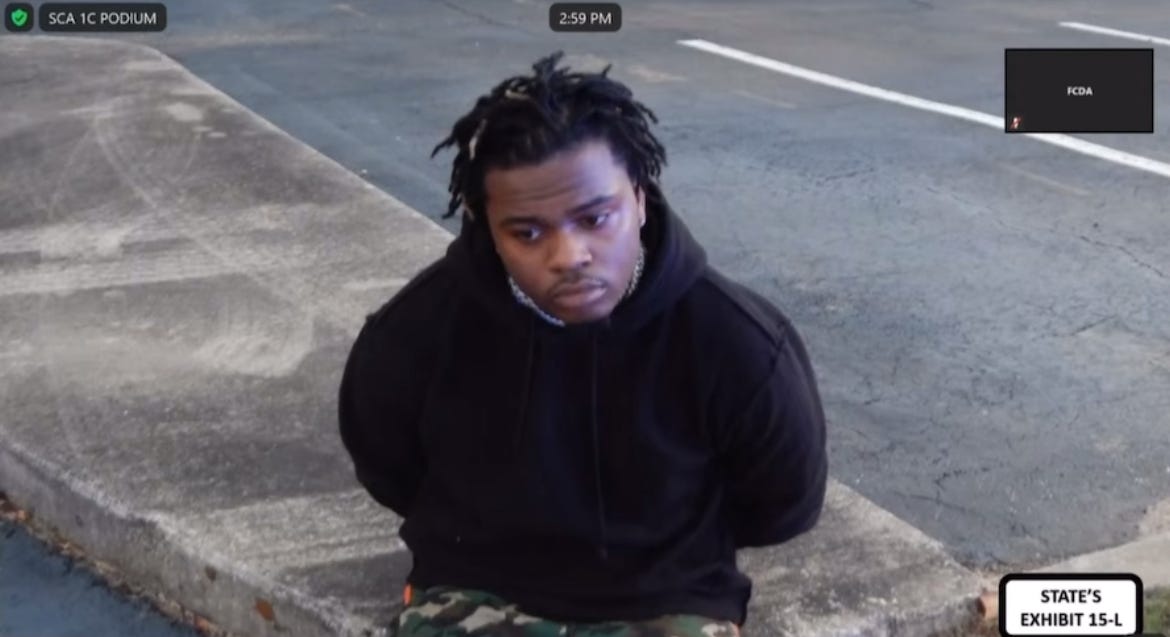
But given how things went with Stephens and all the questions about his plea deal, would it make strategic sense for the defense to call Gunna as a witness? Stephens fully admitted guilt and took a plea deal that included a list of damning factual admissions, and the defense still managed to put the credibility of his plea deal pretty well in question.
In addition to not admitting guilt, Gunna didn’t initial a list of factual admissions, though the document he signed stated he has “personal knowledge that members or associates of YSL have committed crimes in furtherance of the gang.”
“I recognize, accept and deeply regret that my talent and music indirectly furthered YSL the gang to the detriment of my community. YSL as a gang must end,” the statement continued.
Prosecutors surely will emphasize the statements should Gunna testify, and they’ll question him about his alleged illegal activity and that of his former YSL co-defendants.
Further, Gunna said in a statement after his plea that he hasn’t “agreed to testify or be a witness for or against any party in the case and have absolutely NO intention of being involved in the trial process in any way.” So if you’re a betting person, consider betting against seeing Gunna on the stand because the defense isn’t likely to call him unless he wants to help and even then, the risk of prosecution cross-examination probably outweighs the benefit of a defense direct-exam..
What about Lil Wayne and Birdman? Jurors have heard a lot about Lil Wayne through not only Stephens’ testimony about his tour bus shooting but testimony about his tattoos that Steel says Williams was emulating when he got tattoos prosecutors say are gang symbols.
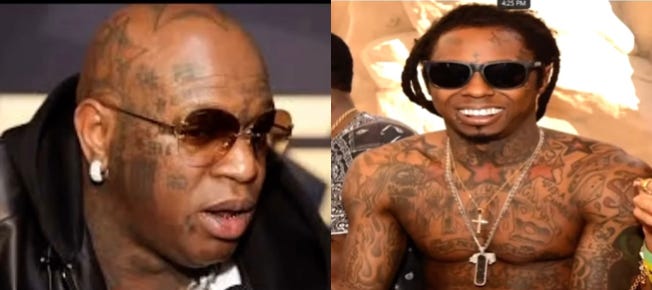
Steel also questioned Detective Belknap about Bryan “Birdman” Williams’ tattoos, and he’s repeatedly drawn attention to Wayne’s Rich Gang music and accompanying merchandise when trying to explain photos that prosecutors say are gang related. Both Wayne and Birdman are listed as prosecution witnesses, but so far I’ll be pretty surprised if either actually sets foot in Judge Glanville’s courtroom.
No Lucci? One potential witness we won’t likely hear from is YFN Lucci, the rapper stabbed in jail in what prosecutors say was part of a rivalry with the YSL gang.
Lucci is on the prosecution’s witness list, but his lawyer Drew Findling also recently told reporters “he will not be testifying in that case.” Should prosecutors subpoena Lucci, Findling said he’ll file a motion to quash.
“There is no cooperation in the YSL case. … He wants nothing to do with that case. He’s made that clear for 3 1/2 years. He’s said he knows nothing and he will not participate in that case, and he’s steadfast,” Findling said.
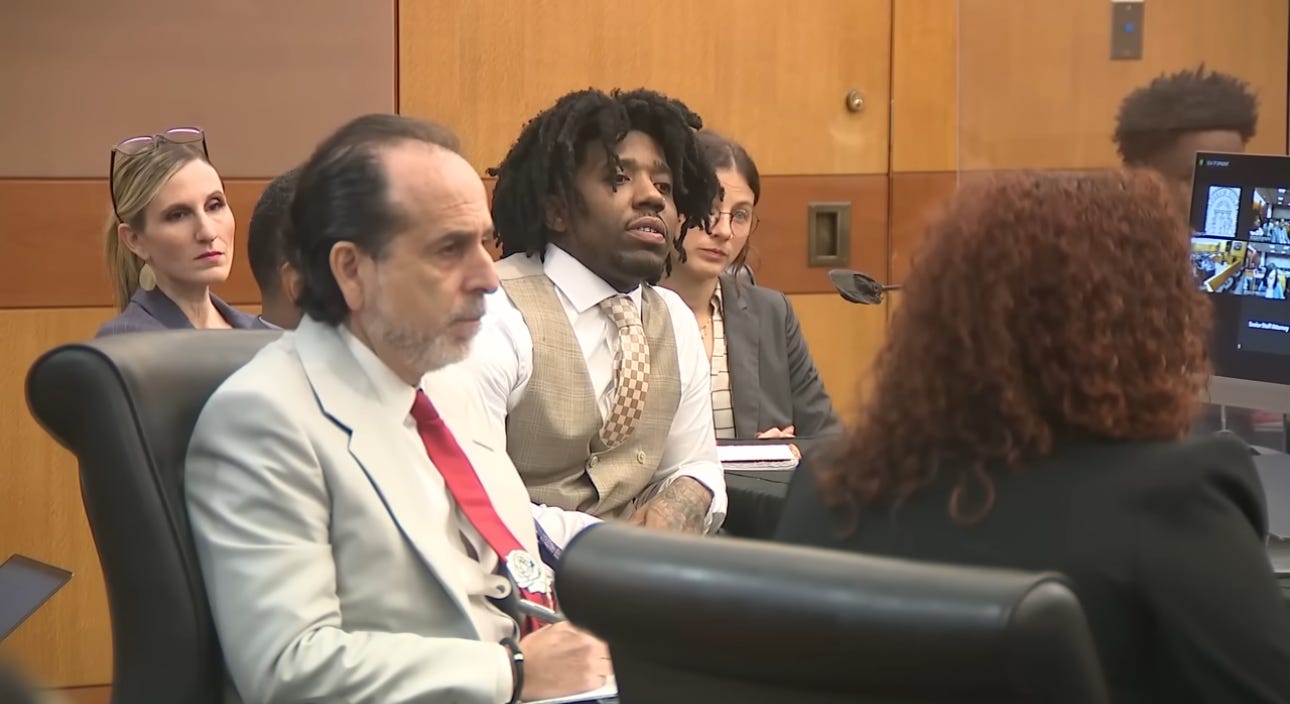
I’m not a lawyer and haven’t covered cases in Georgia, but given my experience in federal and California state courts, I think it’s likely Judge Glanville deems the testimony of a listed victim relevant to the case and doesn’t quash Lucci’s subpoena. But given Lucci’s unwillingness to cooperate, do prosecutors really want to put him on the stand? We will find out, assuming the trial doesn’t implode first.
Cameras in court: The various live streams of the trial get tens of thousands of views each day, at least, and video clips from the trial have been viewed tens of millions of times, at least, across all social media platforms.
Prosecutors tried to halt the video stream in an 11-page motion that cited menacing online comments directed at prosecution witnesses on Nov. 29 and Dec. 5. The motion complained that “additional images” of Belknap’s face were posted on news and other media outlets “along with the witness’ full name,” though Belknap’s photo and full name also are posted on the the Georgia Gang Investigators Association’s website.
“The escalating online menace faced by witnesses testifying in this trial is undeniable. Whether or to what extent the threats are credible is not something on which this Court can afford to gamble,” according to the motion.
Judge Glanville never ruled on the motion, which sought to end video streaming and limit some witness identification to initials only. Instead, the Fulton County District Attorney’s Office negotiated an agreement with lawyers for Atlanta media outlets that allows for the anonymity of witnesses to be considered on a witness-by-witness basis.
The live video stream will continue, though witnesses can opt to not be shown on camera, which several have done so far. Some witnesses may also be identified only by initials; prosecutors are to notify media lawyers by 5 p.m. each Friday of anonymity requests regarding the next week’s witnesses.
Follow my coverage on YouTube and TikTok
As I said in my previous email, I’m hooked on this trial. Many people depend on my TikTok and YouTube coverage , and I’m enjoying experimenting with new ways to utilize the incredible video access that’s available at my fingertips.
Many trials that get streamed online aren’t legally intriguing, but a racketeering conspiracy case is inherently subjective, and this trial is perfect for the audience I’ve been growing since my coverage of rapper Tory Lanez’s trial for shooting Megan Thee Stallion went viral.
My YouTube channel is organized into playlists, and my TikTok page is a collection of shorter clips that include captions and the same informative description you’ll find on YouTube.
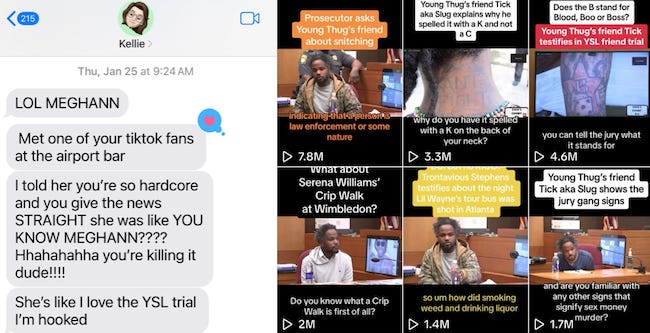
The fun began with a clip of Stephens answering questions about snitching. (Needless to say, all clips of Tick saying anything were wildly popular on social media.) It amassed 7.8 million views, 714,800 likes, 18,100 comments and 49,700 bookmarks, and it introduced people to the trial who enver would have known of if otherwise.
The viral clips have tapped me into a TikTok creator fund that allows me to continue prioritizing trial clips while amassing a larger audience of young people who quite possibly have never read a newspaper in their lives.
Trial usually is going by 7:30 a.m. my time, and I aim to post clips shortly after they happen to give people a way to follow along in near real-time without having to sit through the live stream and Judge Glanville’s comfort breaks.
As you can see from my dear friend Kellie’s texts, the TikTok clips are a big enough hit to be a topic of discussion in airport bars. Or at least one airport bar.
I plan to write more articles about the trial, but the best way to follow my daily coverage is to visit my YouTube channel. I’ll be live streaming the proceeding and sharing clips all through trial. If the case every actually goes to the jury, I plan to fly to Atlanta and be there in person during deliberations. But that feels like a total pipedream right now.
The attorneys are to be in Judge Glanville’s courtroom at 9:30 a.m. ET today (Wednesday) to argue motions, then jurors return on Thursday for more testimony from Detective Belknap. Stay tuned.
Read the indictment against Williams and the other accused YSL gang members here.
Thank you for supporting my independent legal affairs journalism. Your paid subscriptions make my work possible. If you’re not already a paid subscriber, please consider purchasing a subscription through Substack. You also can support me through Venmo (MeghannCuniff), CashApp ($MeghannCuniff) and Zelle (meghanncuniff@gmail.com). Thank you!