
State says Tory Lanez knew how his driver would testify but chose not to call him
The Attorney General's Office has responded to the rapper's habeas petition alleging his driver's statements are new evidence in the shooting of Megan Thee Stallion.

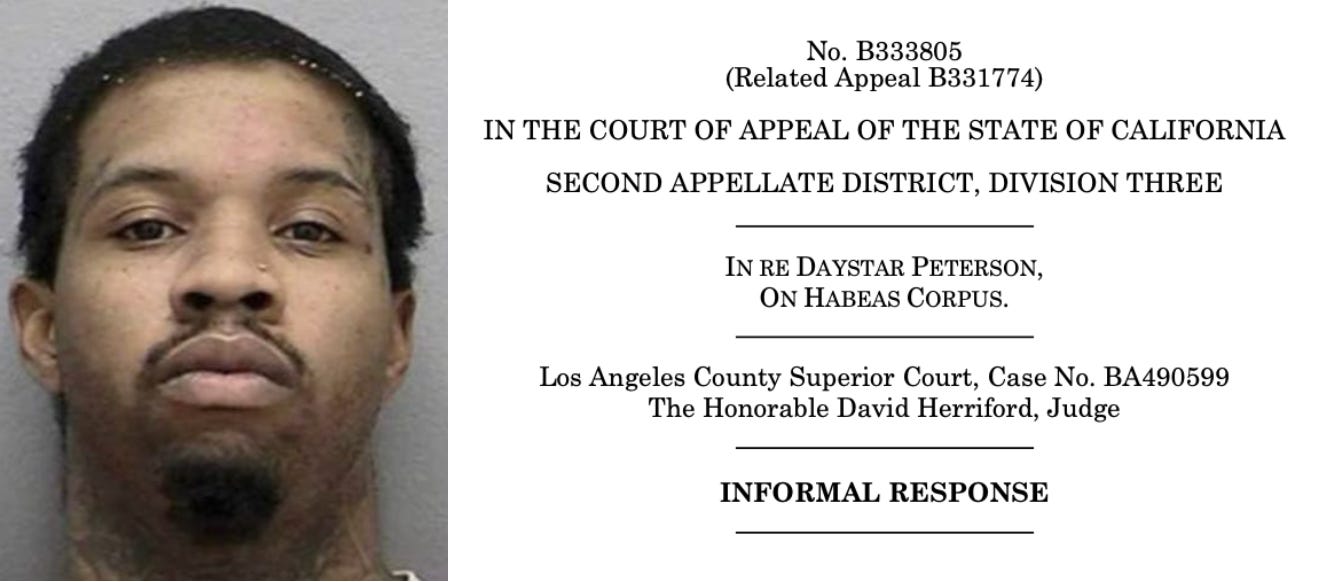
Rapper Daystar “Tory Lanez” Peterson knew how his driver would testify in his trial for shooting Megan Thee Stallion and chose not to call him as a witness after his lawyer told a judge the testimony wasn’t needed.
In a new filing, the California Attorney General’s Office cites previously undisclosed statements from Lanez’s trial lawyer, George Mgdesyan, when arguing Jauquan Smith’s statement about seeing Megan’s friend Kelsey Harris holding the gun doesn’t qualify as new evidence.
The filing responds to a habeas petition from Lanez’s appellate lawyers filed in December that said “it was unknown until this time what Smith had witnessed and what he would have stated,” about the July 2020 shooting. The transcript of Mgdesyan’s statements show that isn’t true, according to the 38-page brief from Deputy Attorney General Michael C. Keller.
“Defense counsel acknowledged that he had spoken with Smith regarding his observations and determined that Smith would not be a helpful witness,” Keller wrote. Smith also said he didn’t see who fired the gun, so he “does not directly contradict Pete’s testimony that petitioner [Lanez] was the person who shot her,” Keller wrote, referring to Megan’s legal name, Megan Pete.
Keller’s brief calls the evidence of Lanez’s guilt “compelling” and says Megan’s testimony that he shot her is supported “by a wealth of other evidence,” including Harris identifying him as the gunman in texts sent moments after the shooting and in a recorded interview with prosecutors before trial.
“Although Harris failed to confirm the identification at trial, she remained consistent with respect to her denial of being the shooter,” Keller wrote. “Moreover, within minutes of the shooting, responding police officers found the gun used to commit the shooting under the front passenger seat where petitioner had been seated when the SUV was stopped.”
Lanez also “implicated himself as the shooter twice in recorded admissions made within 24 hours of the shooting,” Keller wrote, referring to a text Lanez sent Megan and a recorded call he made to Harris from jail. Lanez did not specifically mention the shooting in either, and Mgdesyan said in trial Lanez was apologizing for having a romantic relationship with both Megan and Harris that led to Harris shooting Megan.
Filed Friday, Keller’s brief is an “informal response” to a habeas petition Lanez’s appellate lawyers filed on Dec. 12, 2023, that seeks to overturn his felony convictions and vacate his 10-year prison sentence in part because of alleged new evidence. Keller wants California’s 2nd District Court of Appeal in Los Angeles to determine the petition states no case for relief on first impression or “prima facie” and summarily deny it.
Keller filed another brief on Monday opposing Lanez’s main appeal. A three-judge panel from the 2nd District will consider the habeas brief the same time as the appeal, as well as a “motion for relevant evidence” Lanez’s lawyers filed in June that seeks to have the state release statistics regarding the number of people charged with first-degree assault who did or did not receive a gun-related sentencing enhancement.
The motion also seeks information relating to “charges, conviction rates, and lengths of sentences, for celebrities of all races” without defining celebrities. Keller’s June 26 opposition said the evidence request is “premature” because the court must first issue an “order to show cause” before ordering discovery.
Lanez’s appellate lawyers are Crystal Morgan, an attorney with the nonprofit legal services organization Unite the People in Long Beach, California, and Jose Baez, the prominent Florida criminal defense attorney who represented Lanez during his motion for new trial and sentencing.
Morgan signed the petition, which Keller’s response says fails to state any initial case for relief and argues issues that should have been appealed in the trial court.
Alleged ‘new evidence’ was known during trial


Lanez’s petition argues Smith’s declaration about seeing Harris with the gun qualifies as new evidence warranting a new trial. But Keller says it lacks supporting documentation for the “conclusory allegation” that “it was unknown until this time what Smith had witnessed and what he would have stated.”
Smith did not testify in Lanez’s December 2022 trial. According to the petition, he appeared at the courthouse wanting to testify as a defense witness, but prosecutors asked for time to prepare for his unexpected testimony, and Mgdesyan “stipulated that Smith was not going to be summoned, as the holidays were approaching and they feared that delaying the trial could cause a mistrial.”
But Keller points out that Smith’s declaration “does not address whether Smith had any conversation with defense counsel regarding his expected testimony,” nor did Lanez or Mgdesyan submit declarations of their own explaining what happened.
“In any event, the sealed transcript of an ex-parte hearing the trial court held with defense counsel refutes the petition’s conclusory allegation that, prior to the posttrial habeas investigation, it had been unknown ‘what Smith had witnessed and what he would have stated,’” Keller wrote. “In that ex-parte hearing, defense counsel acknowledged that he had spoken with Smith regarding his observations and determined that Smith would not be a helpful witness.”
Keller quotes Mgdesyan telling Los Angeles County Superior Court Judge David Herriford that Smith’s testimony “is gonna be putting the gun in the hands of Kelsey” but “we came to the conclusion that we’re not gonna call him” because another witness, Sean Kelly, “already put the gun in Kelsey’s hand.”
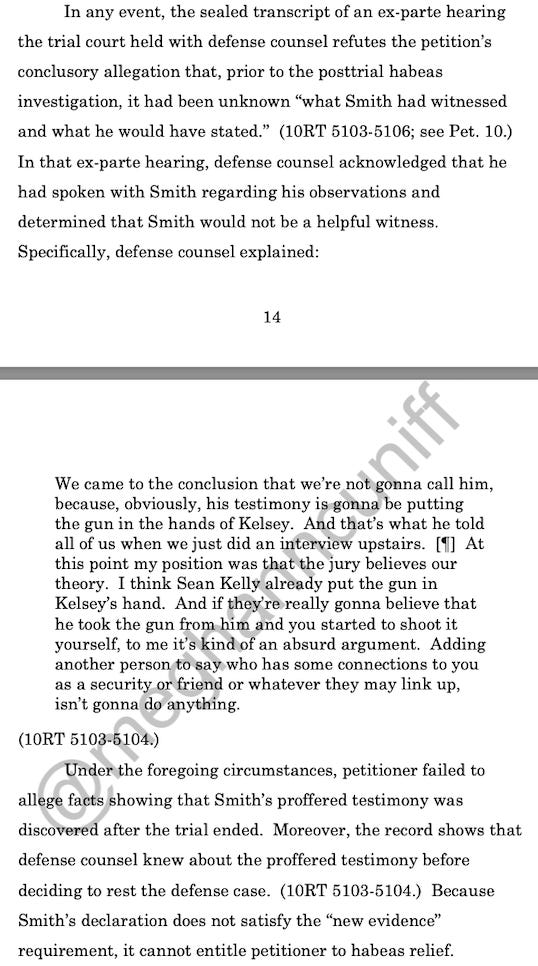
Keller says Mgdesyan’s statements show he knew about the alleged new evidence from Smith “before deciding to rest the defense case.”
“Because Smith’s declaration does not satisfy the ‘new evidence’ requirement, it cannot entitle petitioner to habeas relief,” according to Keller’s brief.
Keller says Lanez’s attorneys also haven’t shown he likely would have obtained a better result if Smith had testified, which is a key requirement for seeking habeas relief over alleged new evidence.
Not only does Smith not identify the shooter, his “value as a witness was limited given his acknowledgment of facts showing that he has a bias in favor of” Lanez, who was his “close personal friend” and employer.
“Given these circumstances, defense counsel conceded that Smith would not have been a helpful witness because of his bias and the cumulative nature of his proffered testimony,” Keller wrote. “Recognizing that an independent eyewitness had placed the gun in the hands of Harris prior to the shooting, defense counsel explained that it would not ‘do anything’ to have appellant’s friend say the same thing.”
Lanez’s ‘false evidence’ claims are false, AG says
Lanez’s petition also argues expert testimony about DNA results constitutes false evidence, but Keller says that isn’t true. In trial, criminalist Randy Zepeda testified that the DNA found on the firearm “contained a mixture of at least four individuals, with one unknown male providing 90 percent of the material and the other three people providing the remaining 10 percent.”
“Zepeda testified that appellant could not have been the person who was the 90 percent contributor,” Keller wrote. “But Zepeda explained that, for the other three contributors, petitioner could not be excluded or included. Zepeda characterized the result as ‘neutral’ and ‘inconclusive.’”
Lanez’s DNA expert, Marc Taylor, supported Zepeda’s testimony. And while Lanez has said the DNA evidence was key in his prosecution, Keller points out that prosecutors didn’t rely on it to establish guilt.
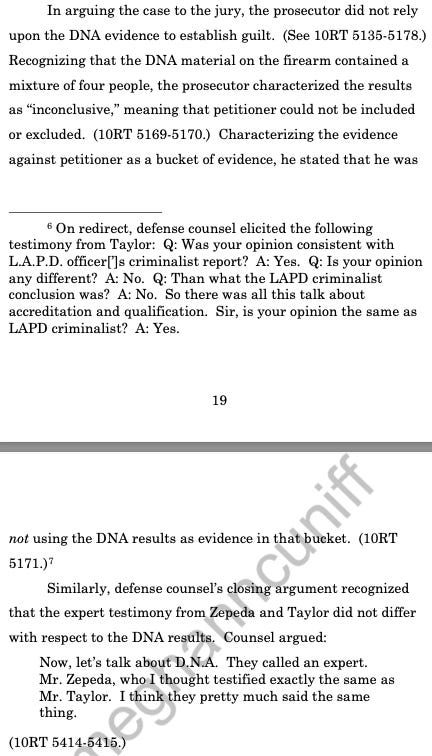
Deputy District Attorney Alexander Bott characterized the evidence against Lanez as “a bucket of evidence” and he specifically “stated that he was not using the DNA results as evidence in that bucket.”
Keller also notes that Mgdesyan acknowledged the DNA expert testimony “did not differ” when he said Zepeda “testified exactly the same as Mr. Taylor” and “I think they pretty much said the same thing.”
Lanez’s petition argues jurors should have heard that it was marginally more likely a random member of the black community contributed to the mixture than Petitioner contributed thereto,” but Keller says such information “still would have enabled an expert to characterize the results as ‘inconclusive.’”
“In short, the petition may allege that Zepeda and Taylor failed to testify fully regarding the DNA results, but the petition fails to allege facts showing that any testimony offered at trial was false,” Keller wrote. Further, “the evidence of petitioner’s guilt was compelling.”
“Under the circumstances, it is not reasonably probable that petitioner would have obtained a better result absent expert testimony that characterized the DNA results as inconclusive,” Keller wrote. “In fact, as Zepeda testified at trial that petitioner was excluded as the major contributor of the genetic material on the firearm, it is not reasonably probable that petitioner would have obtained a better result even if Zepeda had affirmatively testified that petitioner was also excluded from being one of the minor contributors.”
Judge knew of Lanez’s sentencing arguments
Lanez’s claims about the DNA testimony and Smith’s new declaration seek to overturn his three felony convictions, but he also has four claims that seek to have his case returned to Judge Herriford for a new sentencing.
One is based on Assembly Bill 518, which ended a requirement that a crime eligible for different punishments receive the longest possible. The law was effective prior to Lanez’s August 2023 sentencing, but his petition “suggests otherwise in asserting that the new provision applies retroactively to his case,” Keller wrote. Regardless, AB 518 still allows for a judge to sentence a defendant to the longer punishment; it just makes it no longer mandatory.
In Lanez’s case, Judge Herriford “did not express a belief that it was required to punish petitioner with the longer of the two terms,” Keller wrote.
Rather, the judge said Lanez’s assault with a firearm and negligent discharge of a firearm convictions “merge for sentencing purposes,” and stayed his two-year sentence for discharge while imposing a six-year sentence for the assault.
The additional four years was the gun enhancement on the assault charge. Herriford said Lanez’s harassment of Megan, which prosecutors described as a “campaign of misinformation” contributed to the 10-year sentence, which was three years less than the 13 years requested by prosecutors.
Lanez’s petition also cites Assembly Bill 124, which allows for a judge to impose the lowest prison sentence possible “if a person has experienced psychological, physical, or childhood trauma, including, but not limited to, abuse, neglect, exploitation, or sexual violence.”
The petition repeats his lawyers’ argument from sentencing that he has post-traumatic stress disorder from the death of his mother when he was 11. Keller’s response points out that the law took effect 19 months before sentencing, and his lawyers cited it at sentencing. Herriford also showed he was aware of it and “specifically asked defense counsel to address” whether any childhood trauma contributed to the shooting.
“After hearing argument on the issue in the context of a request for probation, the court found that petitioner did not suffer from Post Traumatic Stress Disorder and that any disorder or trauma was not a factor in the charged crimes,” Keller wrote. “The court thereafter imposed the middle term for the assault with a semiautomatic firearm.”
Lanez also cited Senate Bill 620, which in 2017 ended mandatory gun enhancements. But Keller says Herriford acknowledged he had the authority to dismiss Lanez’s gun enhancement.
“After giving counsel an opportunity to discuss the relevant factors, the court found that it would not be in the interest of justice to strike the firearm enhancement,” Keller wrote.
Lanez’s petition also argues his firearm enhancement should be reconsidered under the California Racial Justice Act, saying such enhancements are imposed on defendants who are “African American at a higher frequency” than their percentage of the Los Angeles population.
But Keller says the petition “makes no effort to compare the length of the sentence he received with ‘other similarly situated individuals convicted of the same offense’ in Los Angeles County.”
“Petitioner has not alleged facts necessary to state a claim under the RJA because he fails to provide even one example of a similarly situated defendant, and he fails to cite any statistical evidence,” Keller wrote.
Lanez’s petition also argues he should be resentenced because Herriford and prosecutors cited his Canadian citizenship and likely deportation when discussing why he should be sentenced to only probation. The petition says “it is just such considerations, which the RJA was enacted to prevent,” but Keller says it fails to show “that the RJA applies to such a decision, which does not involve either the securing of a conviction or the imposition of a sentence.”
“Moreover, petitioner fails to allege facts showing that the court improperly considered his race in refusing to grant him bail on appeal,” Keller wrote.
Keller also notes the petition “says absolutely nothing about the total length of his sentence, which is 10 years in this case where he repeatedly fired an unregistered semiautomatic handgun at an unarmed woman who suffered a gunshot wound to both of her feet.”
Keller wants the appellate court to summarily deny the petition with prejudice, which would bar Lanez from raising the claims again. But it also says the court “may deny the petition without prejudice” which would allow Lanez to file an appeal in the trial court.
Four years after shooting, prison and a world tour
Lanez was arrested on a gun charge shortly after the July 12, 2020, shooting in Los Angeles’ Hollywood Hills. He and Megan were leaving reality star Kylie Jenner’s home with Harris when an argument broke out and Megan exited the Escalade on Nichols Canyon Road barefoot and in her bikini. She testified in trial that she heard Lanez say “Dance, bitch!” before he opened fire.
Kelly, the Hollywood Hills homeowner, testified he saw two women fighting and believed the shots initially originated with one of the women, but he also said the muzzle flash occurred “about the same time that the smallest individual got out of the car.” It was a clear reference to Lanez, and Kelly went on to testify that he saw Lanez “firing everywhere” and spewing obscenities.
The jury deliberated seven hours after two days before convicting Lanez on Dec. 23, 2022, of first-degree assault with a firearm, negligent discharge of a firearm and possession of a concealed and unregistered firearm in a vehicle. He was remanded to jail after the verdict and has been in custody since.
Emails released during post-conviction proceedings show Lanez replaced his original trial counsel, Shawn Holley, with Mgdesyan after she told him she didn’t believe blaming Harris for the shooting was a viable strategy
Judge Herriford rejected a motion for new trial in May 2023, then the state appellate court rejected an unusual request to remove the judge from the case or order him to grant a new trial. Lanez was sentenced in August 2023, and he last appeared in court in September when Herriford rejected his motion for bail pending appeal.
He’s currently at the California Correctional Institution in Tehachapi, about 120 miles north of Los Angeles, and he’ll be eligible for his first parole hearing in September 2029. He turned 32 on Saturday, and he recently released music that he said his engineer helped him record through his phone calls from prison.
Megan, meanwhile, is touring the world and has a new album, “Megan” as well as endorsement deals with Nike, Planet Fitness, Frito-Lay and others.
I also started my own merchandise line in honor of Lanez calling me a “googly eyed bitch” during his bail hearing. You can check it out here.
I’ll write another article on Keller’s response to Lanez’s main appeal after I obtain a copy. Subscribe to get it in your inbox. Paid subscribers make my work possible.
Previous coverage:
Lanez cites driver's new statement in appellate petition as Megan says, 'Read a real journalist'

Citing new statements from his driver, rapper Tory Lanez’s lawyers are asking an appellate court to vacate his 10-year prison sentence for shooting Megan Thee Stallion in the feet and injuring her three years ago.
You can find PDFs of all my Twitter threads from the trial here.
I’ve got links to all my previous articles here. All post-conviction coverage on this website is paywalled, meaning it’s available to paid subscribers only, just like all other articles are paywalled after one month. Please consider purchasing a subscription to support my work.
Court documents:
Dec. 12 Lanez’s habeas petition
June 21 Motion for relevant evidence
June 26 Opposition to motion for relevant evidence
July 26 Response to habeas petition
Trial transcripts:
Here are the transcripts that have been posted online. The new trial hearing transcript was obtained as an exhibit in an appellate court file. At least one of the Harris transcripts was distributed by Jose Baez’s law firm.
Two-day hearing in May on Lanez’s motion for new trial
Megan Thee Stallion’s full trial testimony on Dec. 13, 2022
Day 1 of Kelsey Harris’ trial testimony on Dec. 14, 2022
Day 2 of Harris’ testimony on Dec. 15, 2022
Thank you for supporting my independent legal affairs journalism. Your paid subscriptions make my work possible. If you’re not already a paid subscriber, please consider purchasing a subscription through Substack. You also can support me through Venmo (MeghannCuniff), CashApp ($MeghannCuniff) and Zelle (meghanncuniff@gmail.com). Thank you!