
Sean 'Diddy' Combs' lawyers seek gag order on civil counsel as lawsuits mount
Combs' lawyers want a judge to prohibit statements from "prospective witnesses and their lawyers that substantially interfere with Mr. Combs’ right to a fair trial.”

Sean “Diddy” Combs has a May 5 trial date, but federal prosecutors say they may file a superseding indictment against him with new charges, which would push back the trial and probably give him co-defendants.
His lawyers, meanwhile, want a judge to bar “further extrajudicial statements from prospective witnesses and their lawyers that substantially interfere with Mr. Combs’s right to a fair trial.”
They filed a five-page motion on Sunday that said Combs “has been the target of an unending stream of allegations by prospective witnesses and their counsel in the press.”
“These lawyers are — by their own admission — in communication with the government about their clients acting as potential witnesses,” according to the motion.
They want prosecutors to respond by Oct. 30 because “this request is time sensitive.”
“Each day that passes brings a fresh wave of publicity, often at the direction of accusers and their counsel, further prejudicing Mr. Combs’ right to a fair trial,” according to the motion.
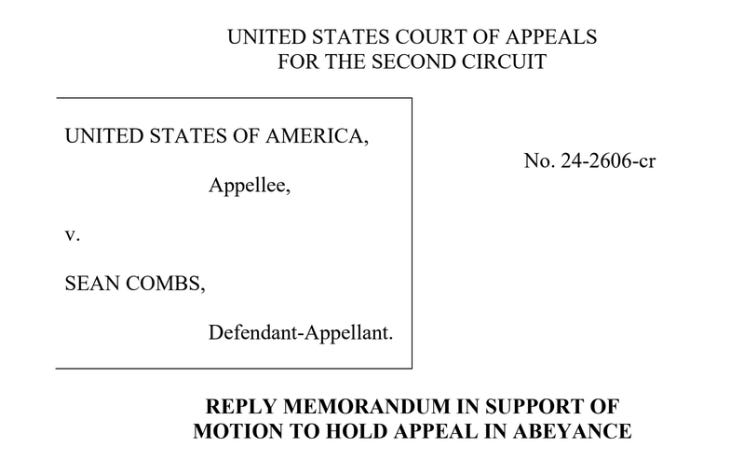
Combs’ lawyers also still are trying to get him out of federal custody. The 2nd Circuit U.S. Court of Appeals last week scheduled argument for Nov. 4 in Manhattan on his motion for bail.
Prosecutors filed their opposition to the bail request on Thursday.
“In arguing that Judge [Andrew] Carter erred, Combs entirely ignores the serious and violent nature of the charges against him, and the strength of the evidence against him,” according to the 25-page filing.
Combs’ lawyers. however, want the 2nd Circuit to hold their appeal in abeyance while they pursue another bail hearing in U.S. District Court.
“The renewed request is based on changed circumstances warranting a new bail hearing, which the district court is best suited to consider in the first instance,” according to a motion filed on Thursday.
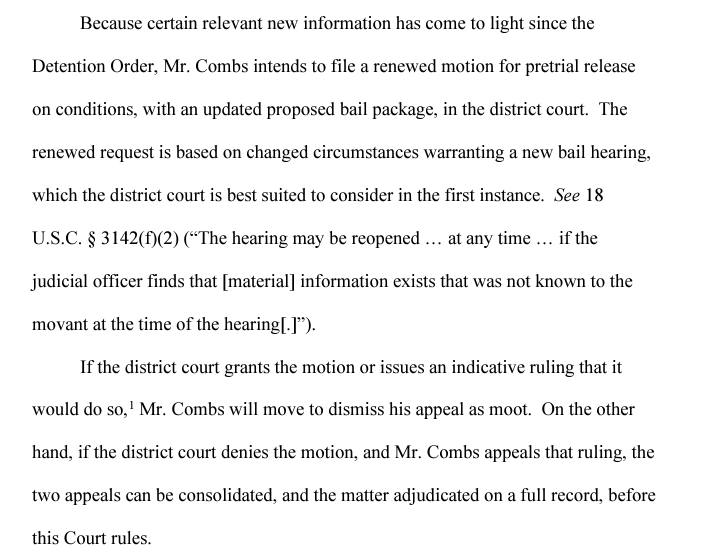
Prosecutors want the 2nd Circuit to reject the appeal without delay. Their filing on Saturday says Combs’ abeyance request “is a transparent attempt to forum shop based on the assignment of a new district judge.”
“Oral argument is now less than 16 days away. The Court should not delay its decision on this appeal based merely on the hypothetical possibility of future motion practice in the District Court,” prosecutors wrote.
Combs’ lawyers replied on Monday that his renewed request “will be based on significant changed circumstances that could not be presented to the district court at his initial bail hearing.”
“These circumstances include, inter alia, constitutional concerns stemming from his conditions of confinement and evidence contained in recently produced discovery,” according to the filing, which called prosecutors'’ opposition “remarkable.”
The public bail motion in the 2nd Circuit is 31 pages with a couple lines redacted that describe newly released information released to the defense by the prosecution that “completely undermines its claim that the timing of the contacts with the witness in September 2024 suggest obstruction,” which is what prosecutors stated when arguing against his bail request.
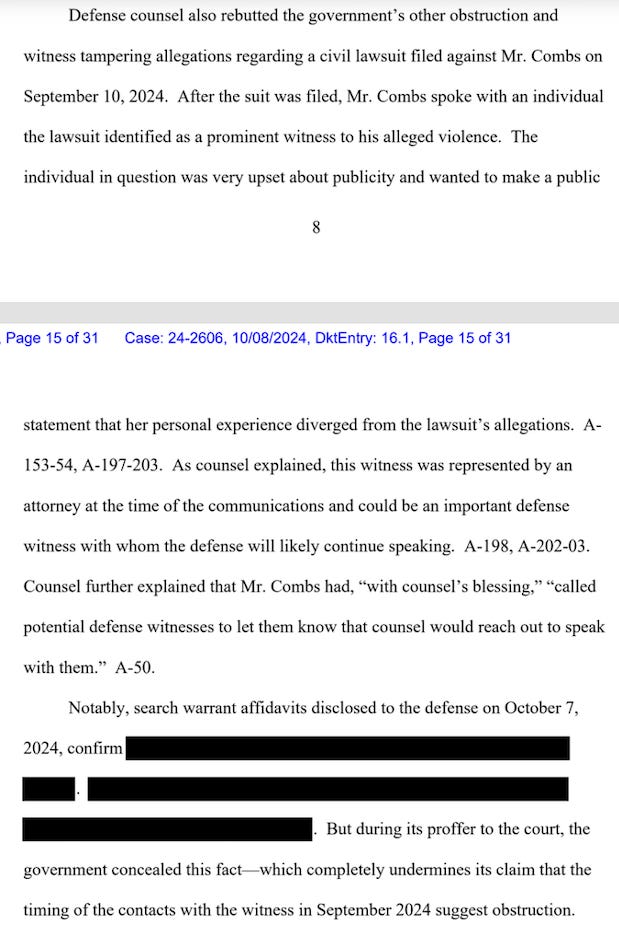
Combs’ lawyer Alexandra A.E. Shapiro said in her motion to seal that the bail motion “includes a reference to information that was produced by the government with an ‘Attorney’s Possession Only’ designation as described in the Protective Order.”
“The Protective Order provides that in the event either party wishes to include such material in a public filing, the party must file the material under seal absent agreement from the opposing party that such restriction may be lifted,” Shapiro wrote.
Shapiro filed a fully sealed bail motion on Oct. 11 after 2nd Circuit Judge William J. Nardini granted the motion to seal and referred the bail request to a three-judge panel.
U.S. District Judge Arun Subramanian approved the protective order on Oct. 7. The 2023 President Joe Biden appointee took over the case from U.S. District Judge Andrew L. Carter Jr. on Oct. 3 after Carter said during the Sept. 18 bail hearing, because Combs was not waiving his right to a speedy trial, he would send the case to a colleague who could accommodate an early trial date.
Subramanian held his first status conference on Oct. 10. One day earlier, prosecutors and Combs’ lawyers filed a letter that described the case discovery, which is possible evidence prosecutors release to the defense, as “voluminous” and “totaling several terabytes of electronic material.”
Defense lawyers said prosecutors are “only now beginning to review and copy” electronic devices seized during Combs’ Sept. 16 arrest and during the March raids of his Miami and Los Angeles mansions.
“The timely production of these materials is critical to Mr. Combs’ ability to prepare his defense. And because these devices belong to Mr. Combs, their production should not be delayed by the government’s initial review for responsiveness and privilege. The government has indicated they will be able to produce these devices in the next 30 days,” according to the letter.
Combs’ lawyers also accuse federal authorities of “a series of unlawful government leaks, which have led to damaging, highly prejudicial pretrial publicity that can only taint the jury pool and deprive Mr. Combs of his right to a fair trial.”
The 17-page motion asks for an evidentiary hearing, which could involve witness testimony. Assistant U.S. Attorneys Meredith Foster, Emily A. Johnson, Madison Reddick Smyser, M. Christy Slavik and Mitzi Steiner have not yet filed their opposition.
Prosecutors also need to respond to a motion from Combs’ lawyers that asks Judge Subramanian to “direct the government to identify its alleged victims so that Mr. Combs can prepare for trial and to allow defense counsel to ensure compliance with Local Rule 23.1.1.”
The rule is about what attorneys can and can’t say during a case, and it’s the same rule Combs’ lawyers cite in their gag order request filed Sunday. They want to know which plaintiffs are considered victims in the criminal case so they can speak publicly about those who aren’t.
The motion says Combs’ criminal case “is unique, in part because of the number of individuals levying allegations against Mr. Combs due to his celebrity status, wealth, and the publicity of his previously settled lawsuit and the grand jury leaks and false inflammatory statements by the DHS agents, as outlined in our previous motion.”
“This has had a pervasive ripple effect, resulting in a torrent of allegations by unidentified complainants, spanning from the false to outright absurd,” Combs’ lawyers wrote.
The motion includes an Oct. 7 letter to prosecutors that says the indictment “treats Mr. Combs’ sexual history over the past sixteen years, from 2008 through 2024, as part of an alleged vast criminal conspiracy.”
The motion says Combs “will be unable to tell which of his prior sexual partners now claim, years later, that they felt coerced.” It says prosecutors oppose disclosing the alleged victims’ identities “at this stage.”
“The government is thus forcing him, unfairly, to play a guessing game—one made all the more challenging by the slew of baseless allegations that desperate plaintiffs are lodging at him (for the most part anonymously) in opportunistic civil suits,” according to the motion from Marc Agnifilo and Teny Geragos of Agnifilo Intrater, Anna Estevao of Sher Tremonte LLP and Anthony Ricco, a prominent criminal defense attorney in New York.
The motion calls Houston-based attorney Tony Buzbee’s announcement of 120 potential lawsuits against Combs “a publicity stunt.”
“These swirling allegations have created a hysterical media circus that, if left unchecked, will irreparably deprive Mr. Combs of a fair trial, if they haven’t already,” the motion says.
You can watch Buzbee’s press conference on my YouTube channel.
Combs’ lawyers wanted prosecutors to respond to the motion by Oct. 21, but Judge Subramanian on Friday granted their request for an Oct. 30 deadline. Prosecutors said the request to identify the alleged victims “cannot meaningfully be evaluated at this stage, prior to the completion of discovery.”
I think we may see a superseding indictment filed before Oct. 30.
As demonstrated by my recent TV appearances, the media circus surrounding Combs is international.
In the last few weeks, I’ve appeared on Scripps News’ America On The Docket, Fox 2 Detroit’s The Noon, LiveNOW From Fox, CBS 2 Chicago, ABC News Live, ABC News Australia, Australia’s Today morning show, a Dutch TV news show, a show on a network started by Dr. Phil and maybe some I’m forgetting.
As I’ve explained in a few interviews, no civil case will go to depositions or the discovery phase while Combs’ criminal case is pending. His attorneys can get the cases stayed — put on hold — until his criminal case is resolved.
It’s a little embarrassing how some people assume I spend my days reading every sordid detail in every Diddy lawsuit that gets filed, because that’s not what I do. I am, however, tracking the litigation and will continue following the criminal case closely.
Right now, Combs has about 15 lawsuits pending against him, and his lawyers haven’t asked to stay any of them.
They’re pursuing dismissal motions based on the pleadings in some, including a Southern District of New York lawsuit in which the judge has ordered that the plaintiff cannot proceed anonymously. That’s the lawsuit Cassie Ventura’s lawyers filed about two weeks after they reached a settlement in her lawsuit that Combs’ lawyers described as “large” in 2nd Circuit bail motion.
“The Court recognizes that public disclosure of Doe’s identity could have a significant impact on her, particularly given the graphic and disturbing allegations in this case,” Clarke wrote in a 12-page order on Feb. 29. “While the Court does not take Plaintiff’s concerns lightly, the Court cannot rely on generalized, uncorroborated claims that disclosure would harm Plaintiff to justify her anonymity.”
The plaintiff won’t have to identify herself unless Clarke rejects a dismissal motion that calls her claim “entirely false and hideous.” Combs and his codefendants, including his company Bad Boy Entertainment Holdings, Inc., are represented by Jonathan D. Davis and Anthony C. LoMonaco in Manhattan, as well as Michael Tremonte and Erica Ashley Wolff of Sher Tremonte, who have a partner representing Combs in his criminal case.
In their June 7 opposition, plaintiff’s attorneys at Wigdor LLP called the dismissal motion “wholly unpersuasive” and said seeks “to completely distort the plain language of the relevant law and the binding precedential decisions governing that law.” Combs’ lawyers replied on June 21. They also filed a sur-reply on Sept. 26, but Judge Clarke struck it from the record at the request of Combs’ attorneys, who said it was filed without advance permission and in violation of this Court’s rules.”
Clarke has not said when she’ll issue her ruling.
Combs’ lawyers may cite her ruling when arguing against anonymity for other plaintiffs. Buzbee recently filed five complaints in the Southern District of New York that do not name the plaintiffs. He says in his requests to proceed anonymously that for many of his clients, “Mr. Combs’ threats of violence were a primary reason why they did not speak out or file lawsuits earlier.”
“Most of our clients still fear retribution and have conditioned moving forward on anonymity,” Buzbee wrote.
The judge in one case last week permitted the complaint to be filed anonymously. U.S. District Judge Lewis J. Liman gave the plaintiff 30 days to file a renewed motion to proceed anonymously.
“In the absence of a timely filed motion, the Court shall order the name of the Plaintiff be disclosed,” Liman wrote in a three-paragraph order.
Liman’s colleague U.S. District Judge Jennifer L. Rochon issued a similar order on Friday in which she allowed plaintiff anonymity in Buzbee’s lawsuit on behalf of a man who says Combs raped him when he was 16 but said she may revisit the order “including to consider whether to order Plaintiff to provide his identity to counsel for Defendant.”
Rochon, a 2021 Biden appointee, noted that Buzbee “contemplated” such an arrangement in his declaration supporting his motion for anonymity. Before Buzbee filed his anonymity request, Rochon ordered him to do so and quoted a 2015 trial court order affirmed by 2nd Circuit U.S. Court of Appeals, “‘The use of pseudonyms runs afoul of the public's common law right of access to judicial proceedings, a right that is supported by the First Amendment,’ although there are a limited number of exceptions to the general requirement of disclosure of the names of parties, which permit plaintiffs to proceed anonymously.”
Combs’ attorneys also have a dismissal motion pending in a New York state court lawsuit from Joi Dickerson-Neal, who says he raped her when she was a student at Syracuse University in 1991.
The lawsuit alleges Combs filmed the assault and distributed the video as “revenge porn.” His motion argues “the recording and sharing of a videotape is not part and parcel of the alleged sexual offense,” but Dickerson-Neal’s lawyers say in their opposition that “the filming of a revenge porn tape inherently arises out of the sexual offense.” Combs’ lawyers replied on Aug. 2. The case is assigned to Judge Lyle E. Frank of the New York Supreme Court 1st Judicial District.
Another lawsuit in U.S. District Court in New Jersey is from a woman who accuses Combs of raping her in 1990. Combs’ lawyers are to file a dismissal motion in that case by Nov. 22, and the plaintiff’s lawyers have until Jan. 8 to respond.
The plaintiff is represented by Tyrone Blackburn, who also is suing Combs in the Southern District of New York on behalf of producer Rodney “Lil Rod” Jones. Combs’ lawyers have a motion to dismiss pending in that case, too. Blacburn filed his opposition on Sept. 30, and Combs’ lawyers replied on Friday.
“Because Jones is unable to refute any of the Combs Defendants’ arguments for dismissal of the incoherent Second Amended Complaint, his Opposition focuses heavily on ad hominem attacks,” according to the filing. “For the most part, Jones does not even attempt to argue that he has pled the elements of his purported claims. Instead, he points to a recent federal criminal indictment of Mr. Combs and other unrelated civil actions against him as ‘proof’ of Mr. Combs’ alleged bad character. “
Combs’ lawyers are expected to file dismissal motions in other lawsuits, including one in the SDNY from Crystal McKinney, who alleges Combs raped her in 2003. A dismissal motion is due by Nov. 8, with opposition due by Dec. 6 and McKinney’s reply by Jan. 7.
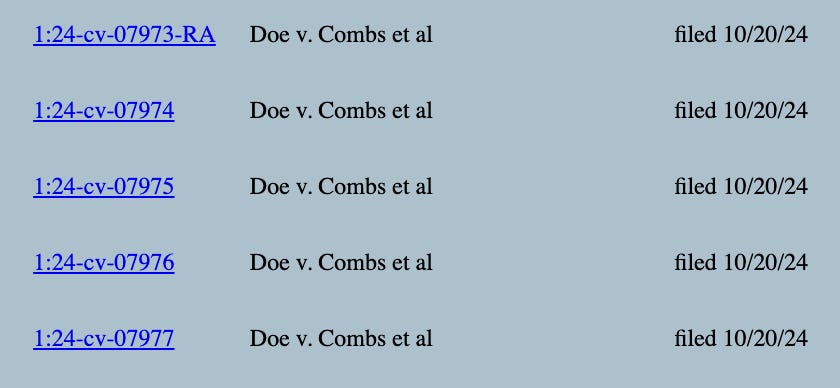
Update: Five additional lawsuits were filed against Combs in the SDNY on Sunday.
Thank you for supporting my independent legal affairs journalism. Your paid subscriptions make my work possible. If you’re not already a paid subscriber, please consider purchasing a subscription through Substack. You also can support me through Venmo (MeghannCuniff), CashApp ($MeghannCuniff) and Zelle (meghanncuniff@gmail.com). Thank you!