
'Quarterback' attorney of massive LA public corruption scandal gets 33 months in prison
Paul Paradis is assisting the California State Bar in an investigation involving prominent LA lawyers. The judge said he believes 'too few people have been held to account.'

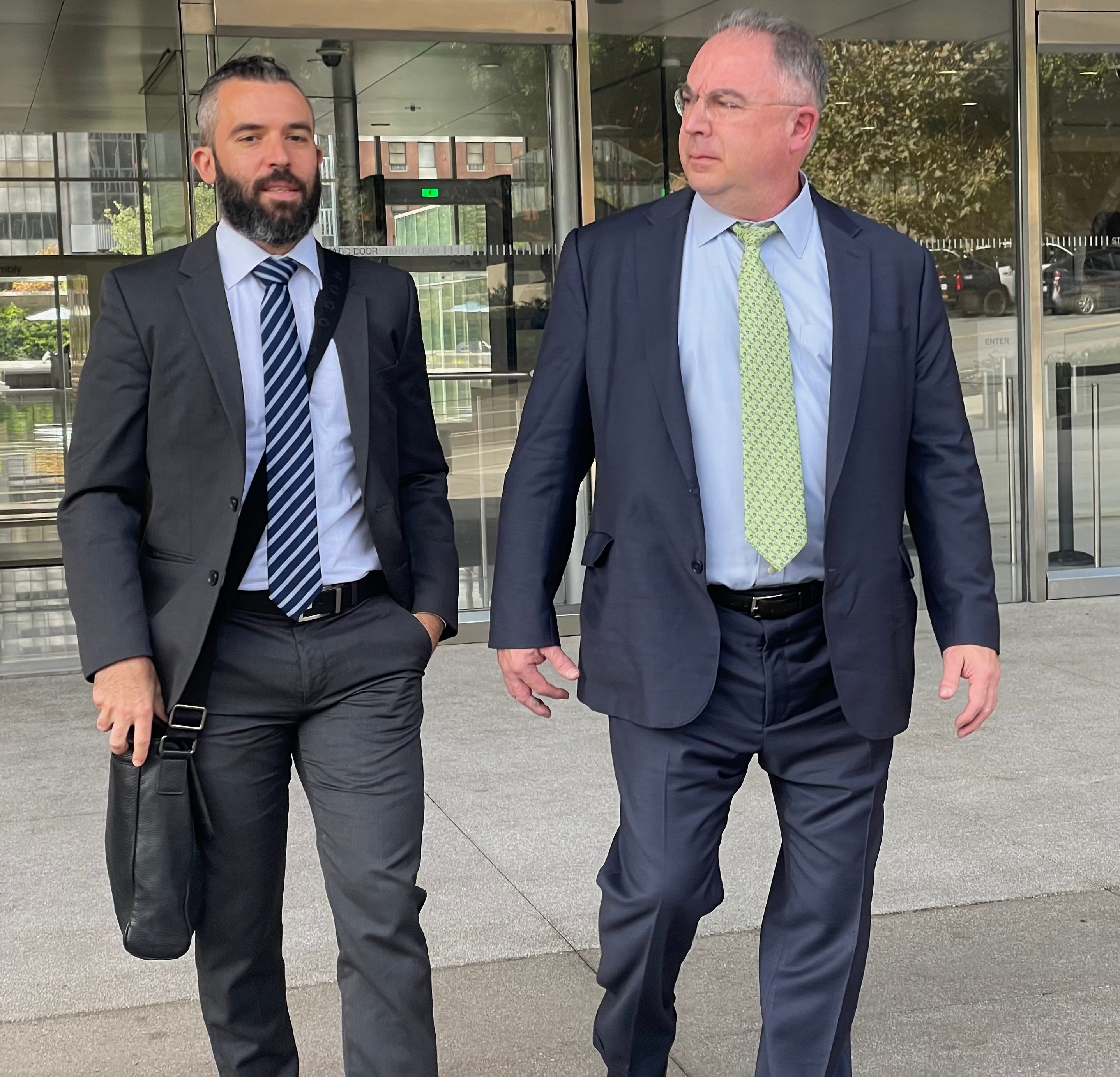
A federal judge on Tuesday ordered a disbarred lawyer to serve 33 months in prison for a “mind-boggling” bribery scandal involving a collusive lawsuit, sham lawyering, fake adversaries and secret deals inside the Los Angeles City Attorney’s Office that “shattered public confidence in government and in the legal profession.”
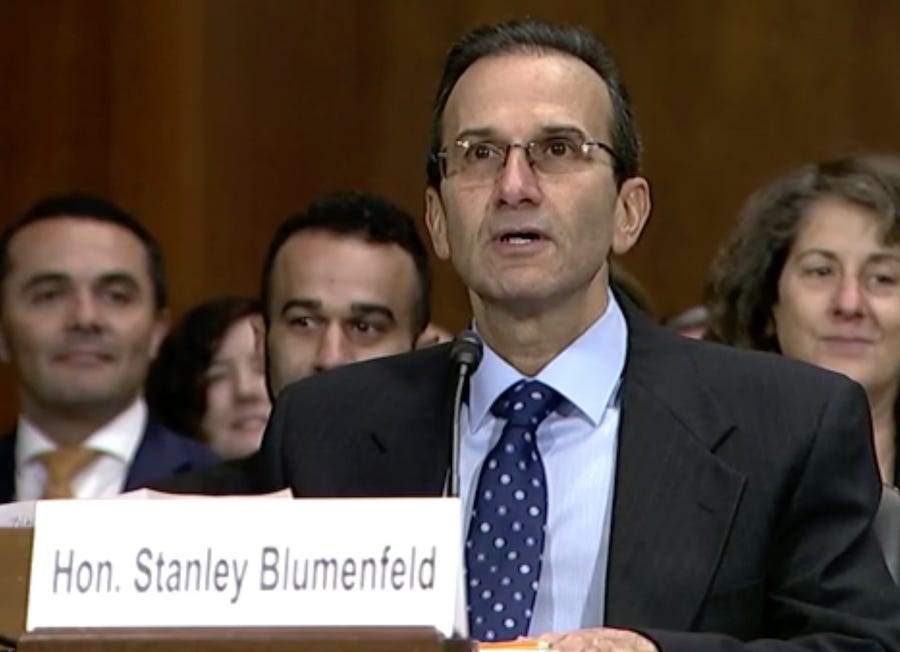
“This case has given this court some pause about the level of corruption within the legal profession, which is very troubling,” said U.S. District Judge Stanley Blumenfeld Jr.
Paul Oliva Paradis, 60, said in his allocution that an FBI agent has testified that former Los Angeles City Attorney Mike Feuer, who’s currently running for U.S. Congress, lied to a federal grand jury. Paradis also said Feuer lied to the FBI and in a civil deposition related to the sprawling conspiracy that sent two top officials with the Los Angeles Department of Water and Power to federal prison last year.
Blumenfeld cut Paradis off by telling him everything he was saying was “amply covered in the papers,” referring to Paradis’ sentencing memorandum, some of which is redacted from public view. The judge later said he believes “too few people have been held to account.”
“But that’s just the reality, unfortunately, of how the system operates. It doesn’t always succeed in sweeping up all of the dirt that needs to be swept up. And here, the level of corruption and the extent of it is mind-boggling,” Blumenfeld said.
Paradis was allowed to stay out custody until Jan. 8, when he’s to surrender at the same courthouse where Blumenfeld sentenced him on Tuesday. He repeated his allegations about Feuer reporters after the hearing in the courthouse hallway but declined to say what Feuer had been asked and how he answered.
“It involved extortion and it also involves when Feuer knew about the collusive scheme. He lied about both repeatedly,” Paradis said. He said he’s “devastated” by his prison sentence.
Blumenfeld in September issued a protective order prohibiting Paradis from distributing discovery obtained through the case. Prosecutors requested the order after Paradis wrote the Los Angeles City Controller’s Office requesting an audit of the City Attorney’s Office related to the scandal. The letter also requested the city suspended payments to two law firms Paradis said are involved in the scandal. Paradis included a trove of documents as exhibits, including an email exchange related to the scandal that includes a high-ranking City Attorney’s Office official writing simply, “Quo,” an apparent reference to quid-pro-quo.
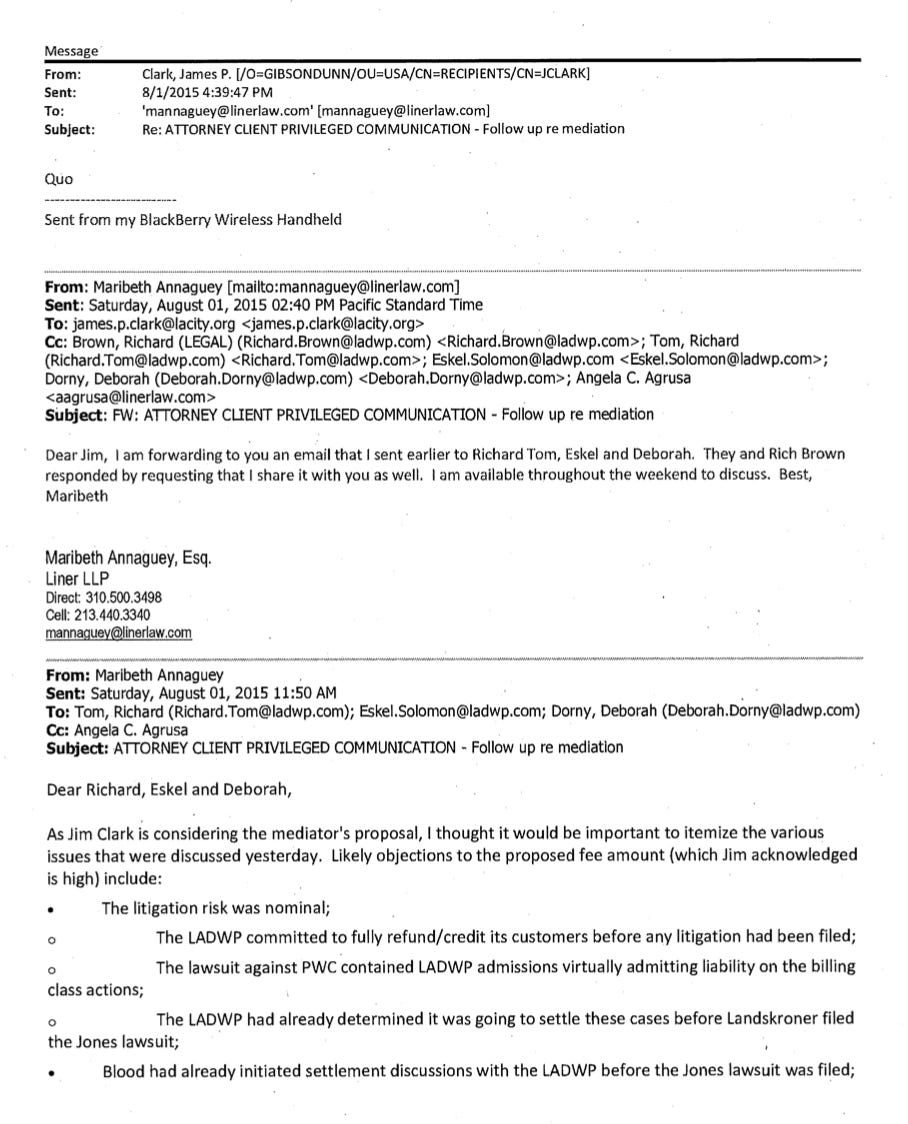


Click here for the letter and all exhibits.
Blumenfeld in June delayed Paradis’ sentencing to give more time for him to help California State Bar investigators pursuing potential misconduct charges against powerful Los Angeles attorneys connected to the scandal, including Feuer. One said the investigation is the largest ever and that Paradis’ cooperation is “extraordinary.”
Blumenfeld, a 2020 Donald Trump appointee, said in June that he may give Paradis more prison time than the 18 months prosecutors recommended, and he did just that on Tuesday by sentencing Paradis to nearly double time. Paradis’ attorneys, David Scheper and Jeffrey Steinfeld of Winston & Strawn LLP, recommended probation, while the U.S. Probation Office recommended nine years.
Paradis’ 33-month sentence is driven by his outsized role in the scheme, the judge said.
“The culpability that Mr. Paradis bears is extraordinary. And in this Court’s view, a maximum sentence would be warranted. And his motive was pure greed. There’s just nothing else that could explain Mr. Paradis’ motivation here,” Blumenfeld said.
Blumenfeld agreed with prosecutors’ calculation regarding an offense level, but he chose to implement a three-level variance, then impose the high-end of the sentencing range to get Paradis to 33 months.
The judge said “there’s a certain level of irony” to Paradis positioning himself “at the center of all of this corruption,” then using his knowledge to try to “extricate himself from full responsibility through extraordinary cooperation.” He agreed Paradis’ cooperation with both State Bar and federal investigators was “quite substantial” but said sentencing Paradis to only probation as his lawyers recommended would “send the absolute wrong message.”
“He has the innate abilities to be a leader both in the legal community as well as in society more broadly,” Blumenfeld said. “And yet, that’s not the path he elected to go down. Instead, he elected to go down the path of public corruption.”
Paradis pleaded guilty in January 2022 to a federal bribery charge related to $2.175 million in kickbacks he accepted as attorney fees in a class action over water rates at the Department of Water and Power. His role in the lawsuit put him in secret conflict with his own client: He was suing the city on behalf of a ratepayer when the city hired him to file a separate lawsuit on behalf of the city.
To try to avoid public problems, at least one senior official in the City Attorney’s Office told Paradis to find a lawyer who could be the face of the ratepayer’s lawsuit but still friendly to the city’s cause, according to Paradis’ plea deal. Paradis found Jack Landskroner, a now-deceased personal injury attorney in Cleveland, Ohio, cut a deal in which Paradis secretly did most of the work in the case in exchange for 20 percent of Landskroner’s attorney fees.
Landskroner netted $10.3 million from the $67 million settlement, $2.175 million of which he secretly sent to Paradis in accordance with their bribery deal. The money was funneled through shell companies Paradis and Landskroner created specifically for the scheme, according to Paradis’ plea deal.
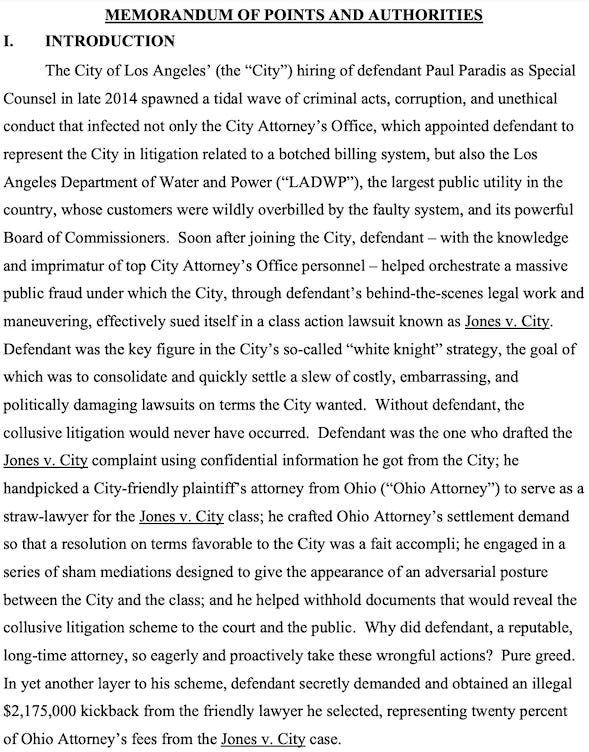
Here’s how prosecutors began their July 13 sentencing memorandum:
Overall, Paradis’ crimes involved three bribes,”the collection of which is staggering,” Blumenfeld said on Tuesday.
There was the $2.175 million kickback bribe for the sham lawsuit that was created to squelch potential public scrutiny about a scandal over DWP’s over-billing practices. Then there was a bribe that involved Paradis ghostwriting reports for a special monitor that positioned his cyber-services company, Aventador Utility Solutions, for a three-year, $30 million contract with DWP, and there was Paradis’ bribe of a DWP board member with free legal services in exchange for the member supporting his contract. Paradis also promised to make the DWP general manager Aventador’s future CEO and give him a $1 million annual salary and luxury car.
“These schemes were clearly sophisticated,” Blumenfeld said. “Mr. Paradis used his legal talents and his charisma, and he used them not for public good, which he had every capacity to use those talents for.”
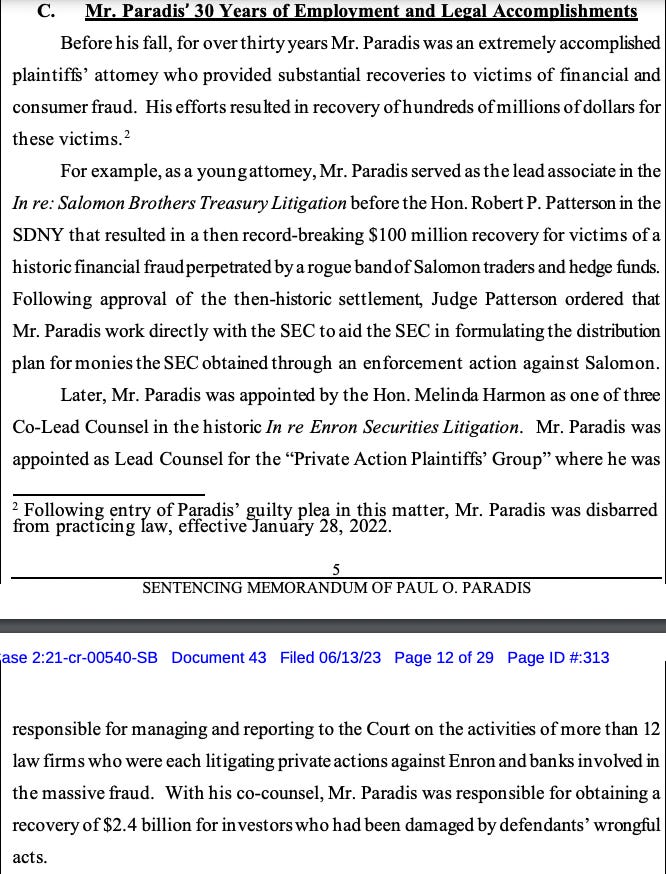
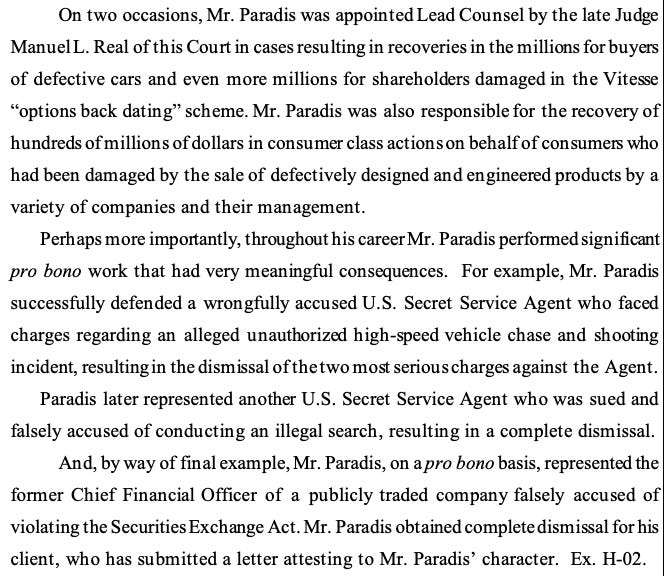
A graduate of New York Law School, Paradis owned the Paradis Law Group in Manhattan, but the U.S. Attorney’s Office says he lives in Scottsdale, Arizona. According to his sentencing memo, he worked on the New York Law School Law Review while attending night school and working days on Wall Street as a portfolio manager.
“Based on academic achievement and work experience, Mr. Paradis was recruited by multiple Wall Street law firms, but chose to become a plaintiffs’ attorney because he wanted to protect those incapable of protecting themselves,” according to the memo.
The federal investigation into the DWP scandal included FBI raids in July 2019 at the office of Feuer, who was at the time Los Angeles’ elected city attorney. Now a candidate for the U.S. House of Representatives, Feuer has acknowledged he’s under investigation by the State Bar.
Paradis implicated Feuer in a letter to Blumenfeld in June.
“Unwilling to bear the consequences that were likely to end his campaign for Mayor of Los Angeles before his campaign had even officially begun, during a meeting that began in his office at 4:45 pm on December 1, 2017, City Attorney Feuer participated in a meeting with his subordinates, including Thomas Peters, to discuss the extortion threat. During this meeting, Peters was directed to instruct Kiesel to pay the extortionist to buy her silence - else Kiesel risked being terminated as Special Counsel to the City in another litigation brought on behalf of the City.”


Paradis was the first person to be charged with a crime, striking a deal that prosecutors announced in November 2021. When former senior city attorney Thomas H. Peters’ plea deal was announced in January 2022, Paradis “saw that Mr. Peters was essentially the fall guy” for his supervisors and decided to contact the State Bar, Scheper told Blumenfeld in June.
Blumenfeld sentenced David H. Wright, the former DWP general manager, in April 2022 to six years in prison for bribery and David F. Alexander, DWP’s former senior cyber official, in June 2022 to four years in prison for lying to the FBI.
Peters avoided prison and was instead sentenced by Blumenfeld in May to nine months home confinement and three years of probation.
Peters admitted plotting to pay a former employee of prominent Los Angeles attorney Paul Kiesel to stay quiet about the collusive lawsuit, which also involved Kiesel, after the woman confronted him in a courtroom. Kiesel ended up paying the woman $800,000 over dinner on Dec. 4, 2017, but he’s never been charged with a crime. Judge Blumenfeld didn’t name him on Tuesday, but the judge mentioned that Peters’ victim was a lawyer who “himself was concealing the activity” and had a duty to disclose the scandal to the State Bar but didn’t.
Peters didn’t profit from his crimes, which Blumenfeld cited in May when declining to sentence hm to prison. Peters is married to Los Angeles County Superior Court Judge Elaine Mandel, who is Kiesel’s former law partner.
Paradis not only profited, he was at the center of the scheme.
“There is no individual in this entire sordid affair who bears more responsibility even remotely compared to Mr. Paradis,” Blumenfeld said.
Assistant U.S. Attorney J. Jamari Buxton cited Scheper’s statement that Paradis was appointed “the quarterback” by his coaches.
“I think that’s actually a good metaphor because the quarterback is the most important and impactful player on the field. They’re involved in virtually every play,” Buxton said. (Note: This is updated from the email version that misattributed this to Judge Blumenfeld.)
Scheper focused on Paradis’ cooperation when trying to persuade Blumenfeld to change his mind after Blumenfeld announced his tentative sentence of 33 months. He said Paradis “went undercover 184 times,” and the FBI served 33 search warrants that would never have existed if Paradis hadn’t cooperated.
“He wasn’t just willing to speak truth to and about the powerful. He made it his life’s work,” Scheper said.
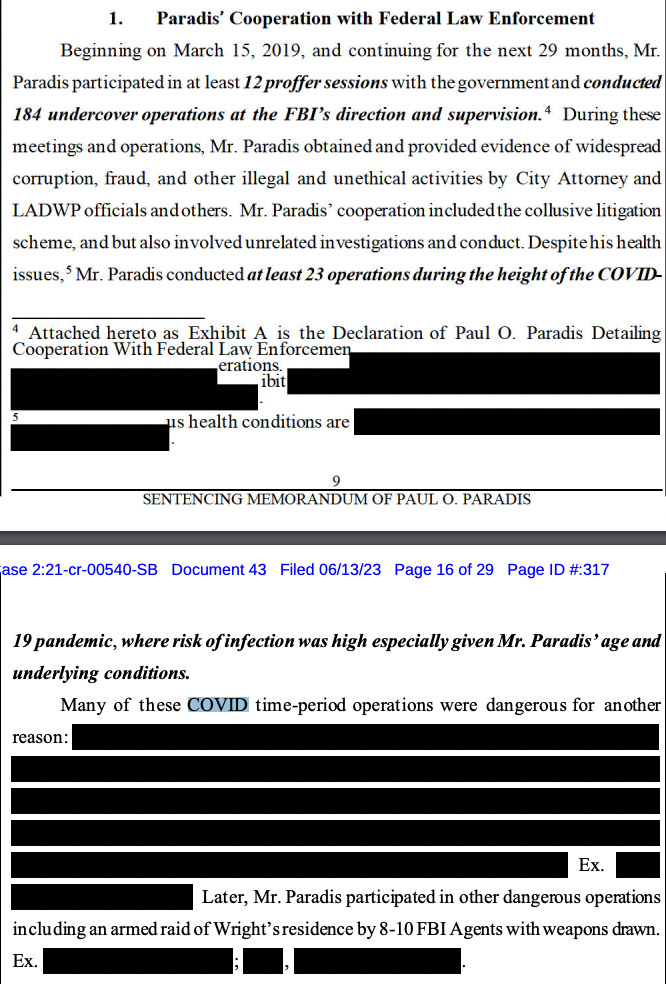
Paradis’ assistance was so substantial “it literally was life threatening at times,” Scheper told Blumenfeld. He said Paradis’ cooperation “is the biggest the court has ever seen. I bet by a lot.”
Paradis began his allocution by apologizing then saying, “I’ve ruined my life.”
“There’s no excuse or any excuses. What I did was wrong. And I accept responsibility,” Paradis said. He explained plea negotiations with the U.S. Department of Justice that he said promised him a charge with less prison time than he actually got. He also told Blumenfeld of being appointed lead counsel by the now-late U.S. District Judge Manny Real on a group of cases, and being approached by opposing counsel seeking mercy for his clients.
“Never in a million years would I have imagined myself needing to ask the judge for the same mercy,” Paradis said. But, he said, “I would ask you, judge,” for the same mercy.
“I’m sincerely sorry for my misdeeds. I am a broken man in a lot of ways,” Paradis said. He told the judge he has “a very serious brain tumor.”
Buxton told Judge Blumenfeld the prosecution recommendation of 18 months was “extraordinary” but emphasized Paradis doesn’t deserve less.
“By no means does Mr. Paradis deserve or warrant a non-custodial sentence,” said Buxton, who prosecuted Paradis with Assistant U.S. Attorney Susan S. Har.
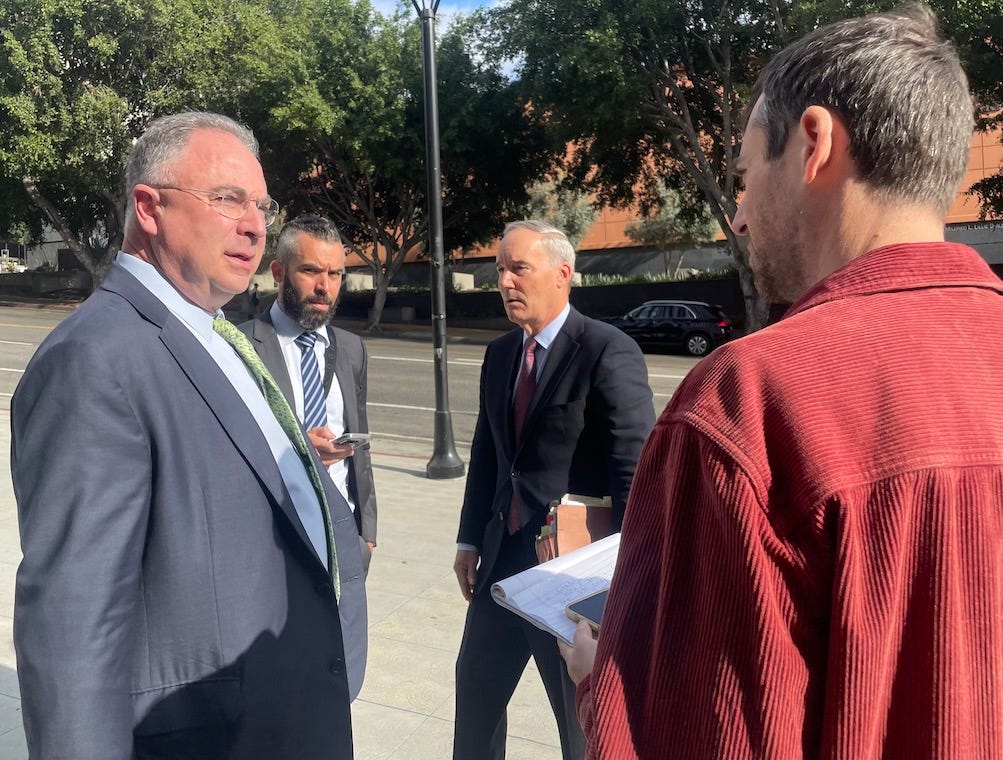
My friend and former Los Angles Daily Journal colleague Justin Kloczko attended the sentencing, too. Afterward, he asked Jim Ham, a lawyer who has represented Mike Feuer before the State Bar, if Feuer lied to a grand jury and about Paradis’ allegations.
“That’s interesting,” said Ham, before declining to comment and hanging up. Read Justin’s story here.
Previous coverage:
State bar probe into Los Angeles lawyers delays final sentencing in scandal over sham lawsuit

A massive California State Bar investigation into powerful attorneys in Los Angeles prompted a judge on Tuesday to delay the final sentencing in a bribery scandal involving a collusive lawsuit, secret deals, sham lawyering and fake adversaries hatched within the City Attorney’s Office.

Thank you for supporting my independent legal affairs journalism. Your paid subscriptions make my work possible. If you’re not already a paid subscriber, please consider purchasing a subscription through Substack. You can also support me through Venmo (MeghannCuniff), CashApp ($MeghannCuniff) and Zelle (meghanncuniff@gmail.com). Thank you!