
Pras Michel accuses David Kenner of ignorance, greed and an AI-generated closing argument
The Fugees rapper hired 82-year-old Kenner, known for getting Snoop Dogg acquitted of murder in 1996, for a complex white-collar crime trial in Washington, D.C.

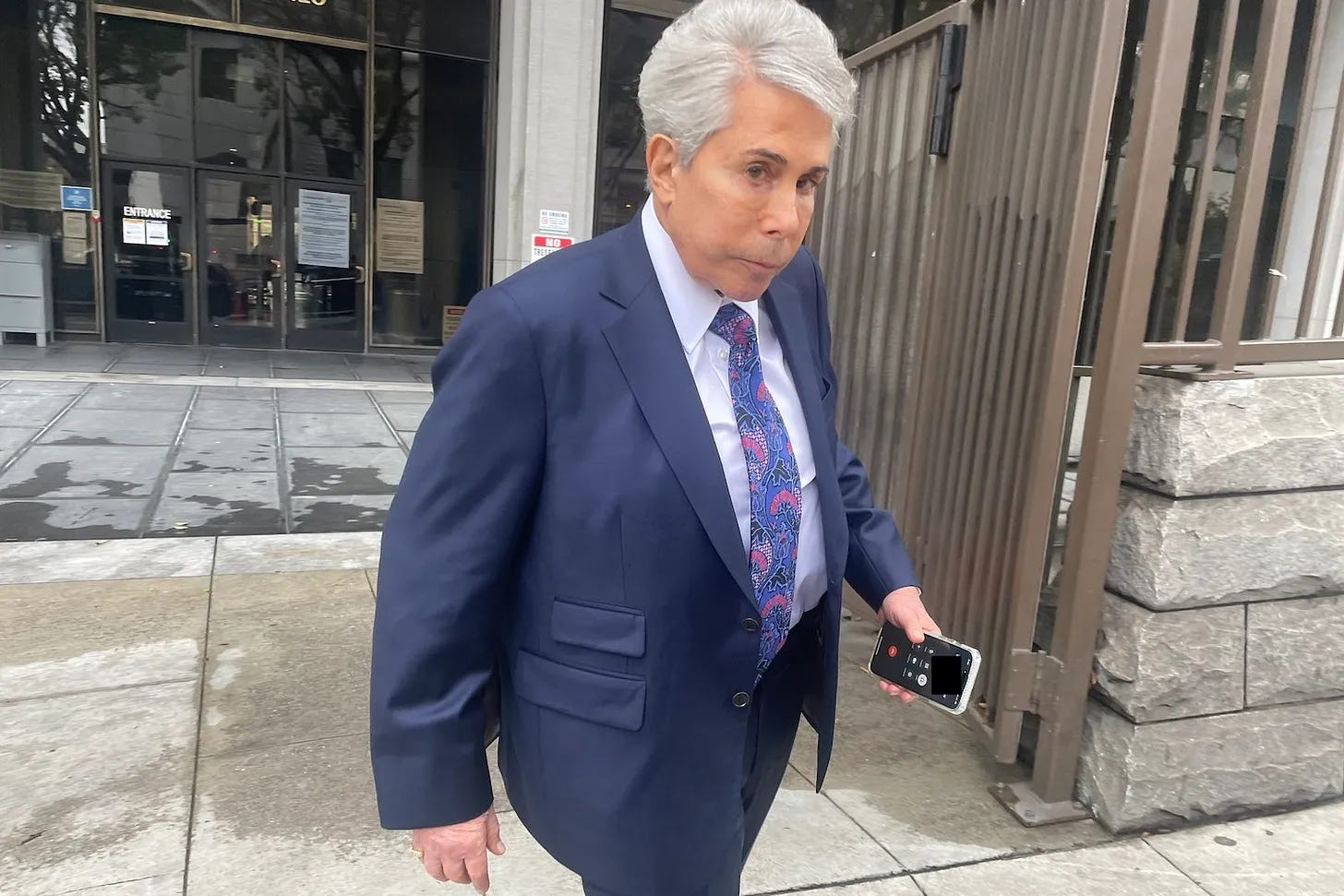
Rapper Prakazrel “Pras” Michel of the Fugees is accusing longtime Southern California lawyer David Kenner of ineffective assistance of counsel as he seeks a new trial in his federal money laundering and foreign lobbying case in Washington, D.C., in part because Kenner used an artificial intelligence program to draft his closing argument.
A licensed California attorney since 1968, Kenner touted his use of the program in a press release after a jury in April convicted Michel of all 10 counts. Kenner said it “turned hours or days of legal work into seconds” while a representative of the company behind the program said Kenner’s use was the first use of “generative AI in a federal trial.”
“It showed. Kenner’s closing argument made frivolous arguments, misapprehended the required elements, conflated the schemes, and ignored critical weaknesses in the Government’s case. The closing was damaging to the defense,” according to Michel’s 59-page motion for new trial filed this week.


Michel, who is out of custody awaiting sentencing, faces up to 20 years in federal prison for his convictions for conspiracy, concealment of material facts, making false entries in records, witness tampering and serving as an unregistered agent of a foreign power, which stem from a money laundering, foreign lobbying and illegal campaign donations scheme involving the 2012 U.S. presidential election as well as now-former President Donald Trump’s administration.
Prosecutors say the scheme involved 51-year-old Michel conspiring with fugitive Malaysian businessman Jho Low and others, including a former U.S. Department of Justice employee, on behalf of China to get the Trump administration to end an embezzlement investigation and forfeiture proceedings involving Low and to have a Chinese national sent back to China.
Witnesses at trial included actor Leonardo DiCaprio, who testified about Low’s efforts to woo him and other actors with huge donations to their charities and lavish, star-studded parties that once included Britney Spears jumping out of a cake to wish Low a happy birthday.
After his convictions, Michel replaced Kenner with attorneys from ArentFox Schiff LLP, a D.C.-based firm experienced in complex white-collar criminal cases similar to the case against Michel.
Their motion for new trial alleges Kenner had a “financial interest” in the artificial intelligence program that he elevated “over Michel’s interest in a competent and vigorous defense,” and he enlisted attorneys from an e-discovery vendor who had no experience in white-collar criminal law or jury trials. But they don’t merely allege Kenner went to trial ill prepared. They allege he had a personal stake in seeing Michel convicted to “curry favor” with prosecutors, who were accusing him of contempt of court for providing Bloomberg News reporters confidential case materials before trial.
“Indeed, if Michel were convicted, Kenner could seek to rebut the allegations that he attempted to intimidate witnesses and taint the jury pool by pointing to the lack of harm arising from his conduct, since Michel would have been convicted anyway. On the other hand, a not-guilty verdict for Michel would have the opposite effect,” according to the motion, which will be considered by Senior U.S. District Judge Colleen Kollar-Kotelly, who presided over the trial in the District of Columbia.
Kenner and his lawyer did not return emails from Legal Affairs and Trials seeking comment. But Neil Katz, co-founder of EyeLevel.AI, which makes the AI program Kenner used in trial, said Kenner has no financial stake in his company. He also said his technology does not replace human decision-making and did not write Kenner’s closing argument, it only offered suggestions.
“In this case, we think it made lawyers faster better and smarter, but it’s always a human lawyer who’s making human decision with this technology,” Katz told Legal Affairs and Trials.
The legal services industry continues to grapple with ethical issues surrounding the use of artificial intelligence, highlighted in June when Senior U.S. District Judge P. Kevin Castel in the Southern District of New York sanctioned two lawyers $5,000 each for submitting a brief written by the artificial intelligence tool ChatGPT. Castel also ordered the lawyers and their firm — Peter LoDuca, Steven Schwartz and Levidow, Levidow & Obermanto — to notify each judge who was falsely identified as authoring a fake case. But Judge Castel also wrote in his order, “there is nothing inherently improper about using a reliable artificial intelligence tool for assistance,” which Katz said matches what happened in Michel’s case.
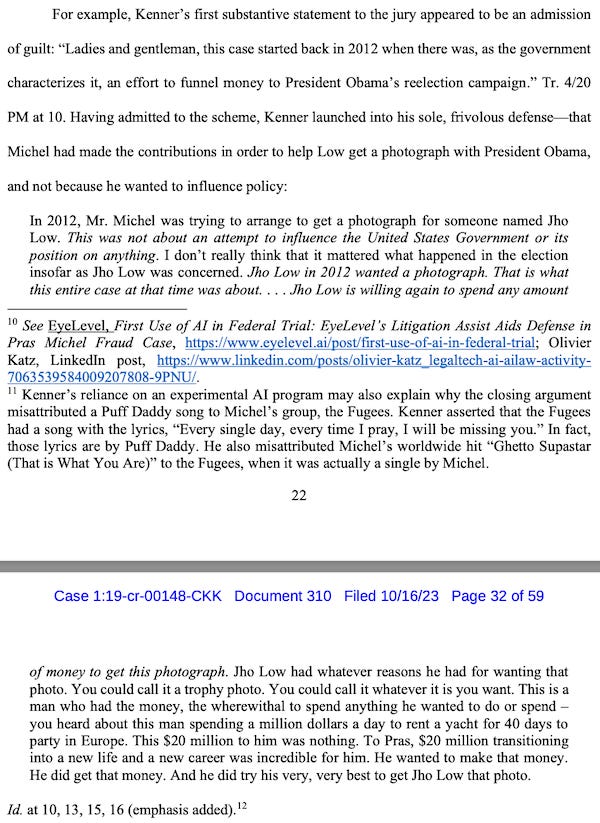
Michel’s new lawyers don’t allege Kenner used artificial intelligence outside his closing argument. Still, their motion and accompanying declarations lay out a brutal assessment of the 82-year-old’s fitness as an attorney and his reliance on the technology for a closing argument they say “was frivolous, missed nearly every colorable argument, and damaged the defense.” They also said the program could be why Kenner wrongly told the jury that the Fugees had a song with the lyrics, “Every single day, every time I pray, I will be missing you,” when “in fact, those lyrics are by Puff Daddy.”
“He also misattributed Michel’s worldwide hit “Ghetto Supastar (That is What You Are)” to the Fugees, when it was actually a single by Michel,” according to the motion from ArentFox partner Peter Zeidenberg.
“At bottom, the AI program failed Kenner, and Kenner failed Michel,” Zeidenberg wrote. “The closing argument was deficient, unhelpful, and a missed opportunity that prejudiced the defense.”
Michel said in a four-page declaration that Kenner “rarely took notes” when they discussed the case and “frequently confused the multiple schemes charged by the Government.”
“If he had shown me his closing, I would have corrected the portion of his closing where he misattributed lyrics from a popular Puff Daddy song to me. When I expressed concerns about Mr. Kenner’s state of preparedness prior to trial, Mr. Kenner would say that he had been a lawyer for over 50 years, and that the Government’s case was weak. Mr. Kenner’s co-counsel was Alon Israely, a family friend with no litigation experience of which I am aware. I later came to learn that Mr. Israely and Mr. Kenner shared a business interest in an AI company that they intended to market to incarcerated persons who needed legal services.”


Israely is a licensed lawyer in New York since 2001 who listed his law firm as Kenner’s Kenner Law APC when he appeared in Michel’s case in April 2022. He was trial counsel with Kenner along with Kriss Anne Carlstrom, a licensed attorney in Minnesota since 2019 who lists her resident state as North Carolina and is co-president of a high school booster club.
According to Michel’s motion, Israely and Carlstrom work for Business Intelligence Associates, Inc., a company offering services for electronic discovery to law firms and corporate legal counsel. It was bought by HaystackID in September 2022.
“That Kenner and the contract attorneys lacked white collar experience is evident from their strategy and work product,” Michel’s new lawyers wrote in a footnote. “For instance, the defense filed a motion to dismiss on the basis of an advice-of-counsel defense, ECF No. 132, even though any competent white-collar practitioner would know that the advice-of-counsel defense can only be raised at trial.”
Kenner was upfront about both his use of artificial intelligence and Israely’s involvement in the case, which he said in court “was primarily due to a company he then owned called BIA.” Kenner said BIA “was retained for the purpose of receiving 2.7 million pages of discovery that was sent out by the government,” according to a court reporter’s transcript.
Katz told Legal Affairs and Trials that’s also part of the purpose of the artificial intelligence program that Kenner used: It helps smaller firms manage huge amounts of testimony and evidence.
“Every night, the legal team was able to ask complex questions of the prior proceedings to help them get information and, hopefully, pursue a stronger case,” Katz said.
Kenner was a longtime lawyer for Death Row Records
Michel’s declaration doesn’t say how he met Kenner, but Michel gained fame in the 1990s as a member of the hip-hop group the Fugees with Wyclef Jean and Lauryn Hill, and Kenner is well-known in the hip-hop world as the lawyer who got Snoop Dogg acquitted of murder in 1996. Kenner was repeatedly pictured in the 1990s partying with Snoop, Tupac and Death Row Records co-founder Suge Knight, and he’s represented Knight and Death Row in various legal matters.


In 2002, Kenner was sentenced in U.S. District Court in Los Angeles to nine months of house arrest and three years of probation for failing to file a tax return in 1995. His misdemeanor conviction was part of a broader criminal investigation into Death Row Records.
Through the years, his friendship with Snoop endured: In 2021, the Doggfather performed at Kenner’s 80th birthday party.
Kenner again made headlines in the rap world earlier this year when rapper Tory Lanez hired him after a Los Angeles County jury convicted him of three felonies, including first-degree assault with a firearm, for shooting Megan Thee Stallion in the feet. Kenner left the case shortly before Michel’s trial after appearing at two hearings on Lanez’s behalf, both times accompanied to the courthouse by Michael “Harry-O” Harris, a former imprisoned drug kingpin who co-founded Death Row with Knight.
Michel’s motion for new trial mentions Kenner’s representation of Lanez when arguing he was unqualified to defend a complex federal criminal case.
“His general criminal practice, which involved defending charges of assault, robbery, homicide, false imprisonment, burglary, drug offenses, DUIs, and reckless driving, did not qualify him for this case. [He] also failed to take the necessary steps to competently represent Michel,” according to the motion.
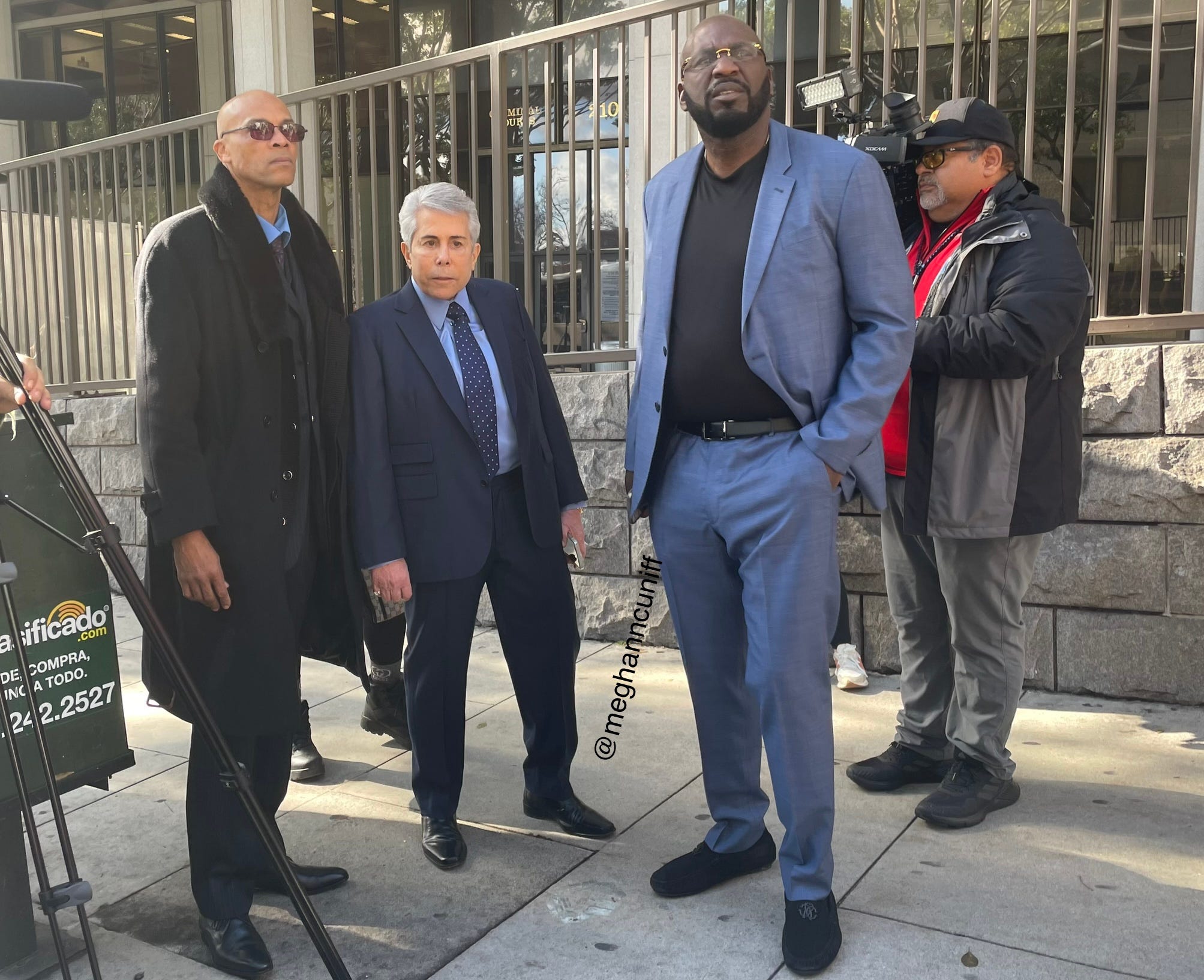
Defense opening ‘appeared to be an admission of guilt’
Kenner’s use of artificial intelligence for his closing argument is far from the biggest problem alleged in Michel’s motion for new trial.
Michel’s new lawyers say the FBI agent was wrongly allowed to testify as an overview witness and opine on Michel’s guilt, and that jurors were wrongly told that a judge had applied the crime-fraud exception to Michel’s communications with co-defendant George Higginbotham, a former U.S. Department of Justice lawyer who gave Michel legal advice.
“It is extremely prejudicial for a jury to learn of fact finding by a court or judge, particularly judicial fact finding of prior wrongdoing by the defendant,” according to the motion. “Courts have recognized that the danger of a jury’s exposure to a judge’s findings is due to the likelihood that the jury will give undue weight to a judge’s finding.”
The motion also details problems from the first words of Kenner’s opening statement, which they say “appeared to be an admission of guilt.”
The motion also says Kenner’s problems were apparent before trial began, including to Israely, who knows Kenner because he attended New York University Law School with Kenner’s daughter.
According to Michel’s declaration, Israely “became very concerned about the state of trial preparations” a few days before they were to travel from California to D.C. He called Joel Denaro, a lawyer in Miami who at Israely’s request traveled to Kenner’s office in the Encino neighborhood of Los Angeles’ San Fernando Valley.
“Mr. Denaro spent time vying to explain the money laundering statute to Mr. Kenner, who did not seem to understand it. Mr. Israely told me that he did not think that Mr. Kenner knew what he was doing,” according to Michel’s declaration.
Denaro wasn’t the only attorney alarmed at Kenner’s trial preparation.
Jasmine Zaki, a licensed attorney in D.C. since 2010, said in a declaration that she met with Kenner in his trial “war room” at the Hyatt Hotel on Capitol Hill the night of April 11 — the midst of trial — to discuss the Foreign Agents Registration Act and regulations, which were key to the case.
“I was taken aback when Mr. Kenner began asking me the most basic questions about FARA, such as who it covered and what type of activities it covered,” Zaki wrote. “I initially thought they were testing my knowledge, but it then became clear to me that Mr. Michel’s attorneys had very little understanding of FARA.”
At the time, Zaki was an attorney with ArentFox who advised companies on FARA regulations. She said Kenner wanted her to testify as an expert witness, but she told him that wasn’t part of her practice.


Michel’s motion for new trial also blames Kenner for failing to ask Judge Kollar-Kotelly to severe the charges related to foreign lobbying from the charges related to money laundering, which included witness tampering.
“As a result, the jury needlessly heard highly prejudicial evidence that Michel sought to corruptly tamper with alleged straw donors to dissuade them from testifying against him,” according to the motion.
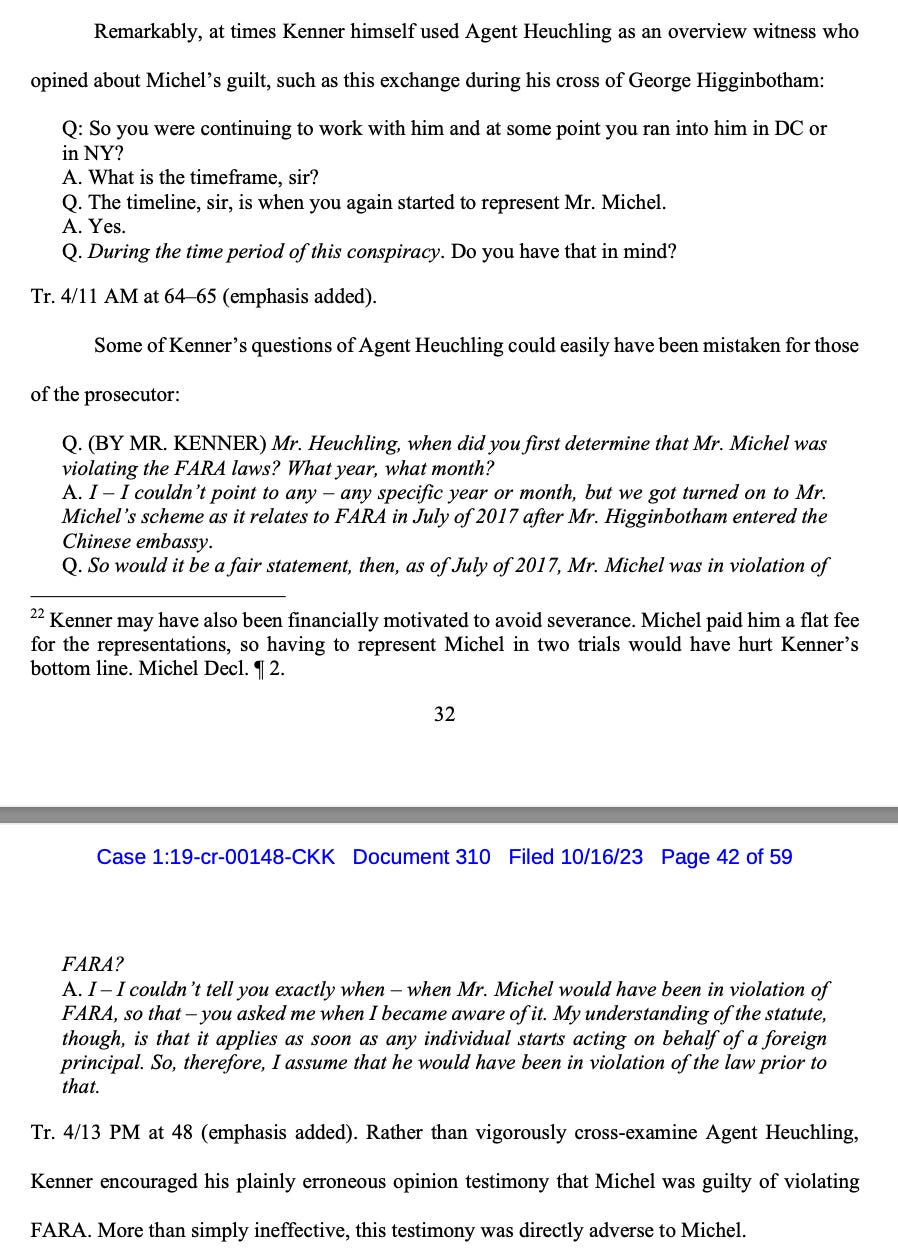
The ArentFox team offers two possible explanations for Kenner not asking to severe the charges: Ignorance and greed. He may confused the schemes as he often did in trial and didn’t realize they could be separated, or “Kenner may have also been financially motivated to avoid severance.”
“Michel paid him a flat fee for the representations, so having to represent Michel in two trials would have hurt Kenner’s bottom line,” according to the motion.
It may not be the most unethical act alleged in the motion. The allegations regarding Kenner’s use of artificial intelligence repeatedly accused him of having a financial stake in the company, which Katz steadfastly denied in a phone interview with Legal Affairs and Trials.
“David Kenner and Kenner Law was a client, and they do not have a financial stake in our company,” Katz said. “He was thrilled with the performance of the technology, and like any other client that’s very happy, he very kindly gave us a great quote about how effective that technology is.”
Michel’s new lawyers also allege shortcomings in Kenner’s witness examinations, including questions to an FBI agent that “could easily have been mistaken for those of the prosecutor.”
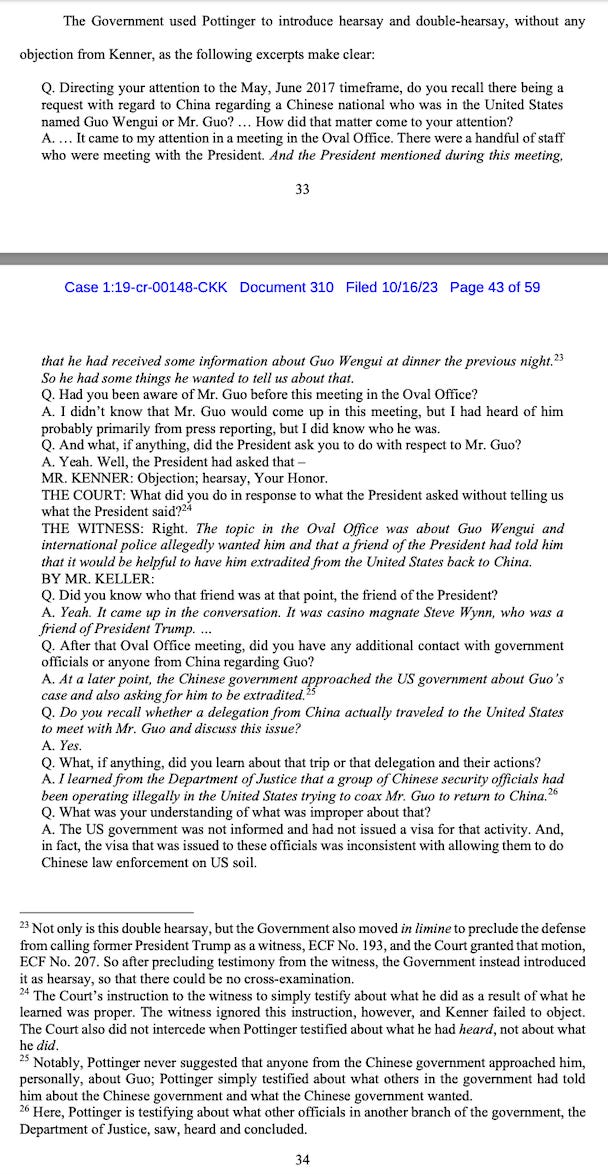
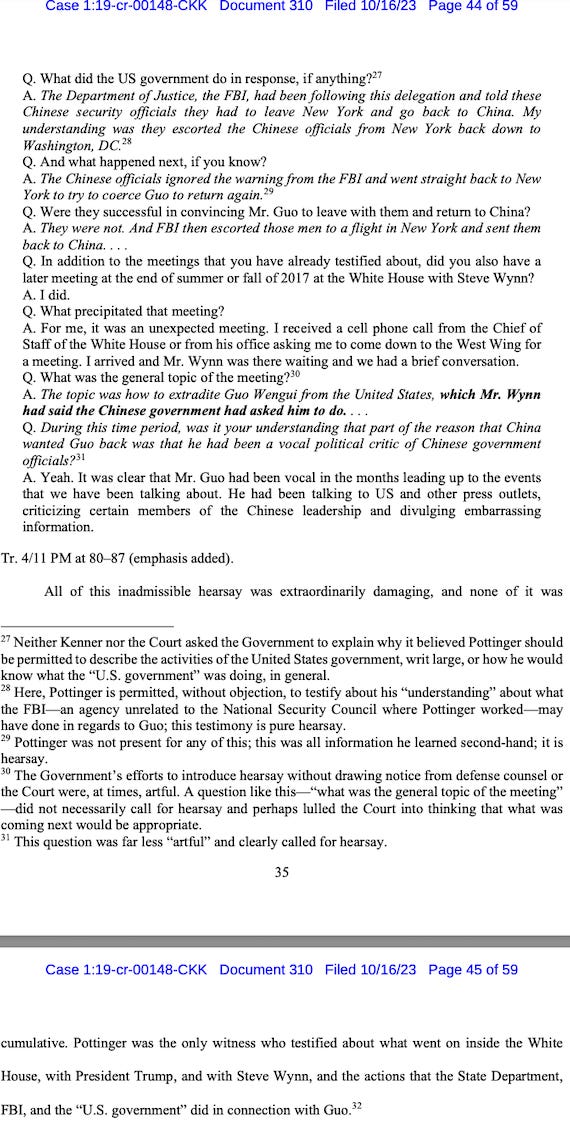
They also take issue with Kenner’s lack of objections for hearsay, which allowed a witness to testify “who provided evidence that the alleged lobbying scheme had reached inside the Trump administration, yet …. had virtually no first-hand knowledge of the information about which he testified.”
Kenner faces criminal contempt charges in D.C.
The motion comes as Kenner is fighting a contempt of court charge for giving case information to Bloomberg News reporters in violation of a protective order. Michel’s new lawyers say he “essentially admitted to the charges” after prosecutors filed a motion to show cause on March 3 charging with him criminal contempt.
“In a bizarre confession, he conceded that the defense shared materials with the Bloomberg reporters after the reporters ‘signed or acknowledged’ the protective order, and stated that the reporters ‘access[ed]’ defense information ‘as agents of the Defense as set forth in the Protective Order,’” according to the motion for new trial.
Michel said in his declaration that Kenner was “very disturbed and worried” when he learned of the contempt charge. Kenner said he told the prosecutors “that he really cannot defend [Michel] with this show-cause motion hanging over his head.”
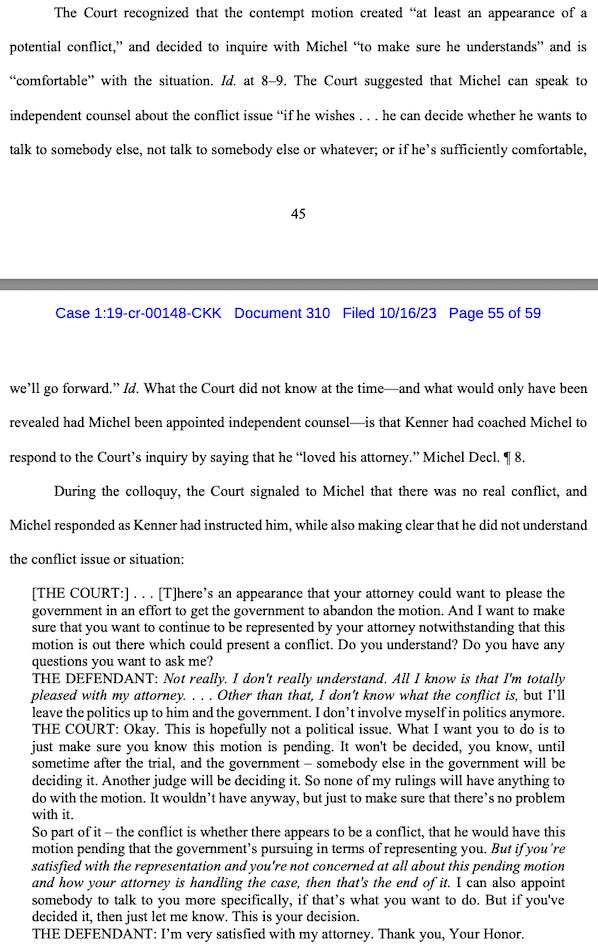
Michel said Kenner told him “that the judge may ask me questions about whether I want Mr. Kenner to still represent me, and that I should just say that I ‘love my lawyer’ when the judge questions me, which I did.”
“Mr. Kenner did not inform me that he had a possible conflict of interest that arose from the Government potentially prosecuting him, or explain to me what that means and how it could adversely affect his representation of me,” according to Michel’s declaration. “I also did not appreciate the seriousness of the allegations pending against Mr. Kenner.”
Judge Kollar-Kotelly held the charges in abeyance until after trial, but neither she nor prosecutors recused until three days into trial, and Michel’s new lawyers say Kenner was motivated to curry favor with them to try to protect himself. They also say Michel didn’t understand the significance of the situation, and they highlighted his discussion with Judge Kollar-Kotelly as evidence.
The contempt case is pending before U.S. District Judge Amit P. Mehta. A status conference is scheduled for Nov. 13.
Kenner is represented by L. Barrett “Barry” Boss, co-chair of Cozen O’Connor’s commercial litigation department and its white collar defense and investigations. Boss did not return an email seeking comment from Legal Affairs and Trials. Israely is represented by David Schertler of Schertler Onorato Mead & Sears in D.C.
Meanwhile, the U.S. Attorney’s Office in D.C. has until Nov. 6 to file its response to Michel’s motion for new trial, as well as his motion for acquittal that also was filed Monday. Michel’s new lawyers then have until Nov. 13 to reply.
Court documents:
Peter Zeidenberg’s declaration
Contempt motion for order to show cause
Transcript from May 11 contempt hearing
I’ll be live on YouTube Friday at 12 p.m. PST / 3 p.m. EST to discuss this article and everything else I’ve been up to. If you can’t watch/listen live, you can tune in later.
Thank you for supporting my independent legal affairs journalism. Your paid subscriptions enable me to go in-depth and unfiltered on major issues. If you’re not already a paid subscriber, please consider purchasing a subscription through Substack. You can also support me through Venmo (MeghannCuniff), CashApp ($MeghannCuniff) and Zelle (meghanncuniff@gmail.com). Thank you!