
On tap in the Masimo v. Apple trade secrets trial: Politeness, not pirate flags
Amid an onslaught of courtroom courtesy from Apple's WilmerHale team, jurors won't hear of the company's internal embrace of pirate imagery because of a judge's ruling.


The $3.1 billion trade secrets trial between Masimo Corp. and Apple, Inc., has a decisively upper-crust atmosphere.
There’s the standard high-brow feel that accompanies most intellectual property cases. But there’s also an extra feeling of prestige, and Apple’s lawyer Joseph Mueller leads the casting call by bringing an Eagle Scout vibe to the courtroom through his unwavering politeness.
One of Mueller’s most frequent phrases is a variation of “out of courtesy for the plaintiffs, I’ll ask for a sealing of the courtroom,” before he moves into questions about the specifics of trade secrets that he’s always sure to point out are merely alleged.
Masimo’s lawyer Joseph Re apparently sees it as a trial tactic: He complained last week that Mueller is trying to deflect attention from Apple’s own confidentiality requirements under the protective order.
“Again, the courtesy to the plaintiffs? It is the defendant who wants their information confidential. This has gone on about 35 times!” Re said.
Had Re and his partners at Knobbe Martens LLP gotten their way, jurors would be seeing another side of Apple in the form of pirate flags that have been seen at the company’s corporate events and on its buildings.
Re’s team wanted to tell jurors about Apple’s embrace of pirate imagery as a way of supporting their argument that the company targeted Masimo’s confidential information when it hired two key employees in 2013 and 2014 while working on the pulse oximetry function of the soon-to-be-released Apple Watch. They also wanted to tell the jury about two well-known quotes from Apple co-founder Steve Jobs they said could be seen as supporting “a culture of misappropriating ideas from others.”
“It’s better to be a pirate than join the Navy.”
“Good artists copy, great artists steal. We have always been shameless about stealing great ideas.”
Mueller and his team at Wilmer Cutler Pickering Hale and Dorr LLP went on the offense in a Feb. 13 motion that sought to prohibit in trial any mention of quotes or anecdotes “that could, when taken out of context, suggest that Apple has a corporate culture disrespectful of intellectual property protections.”
The motion also said the two quotes from Jobs “are irrelevant to the claims or defenses in this case.”
“The former was simply Mr. Jobs parroting a quote oft-attributed to Pablo Picasso; the latter a remark he made in the 1980s to the team developing the original Macintosh computer,” according to the motion. “Neither has any relation to the accused products or issues to be tried before the jury in this case (indeed, Mr. Jobs passed away years before the relevant events in this case).”
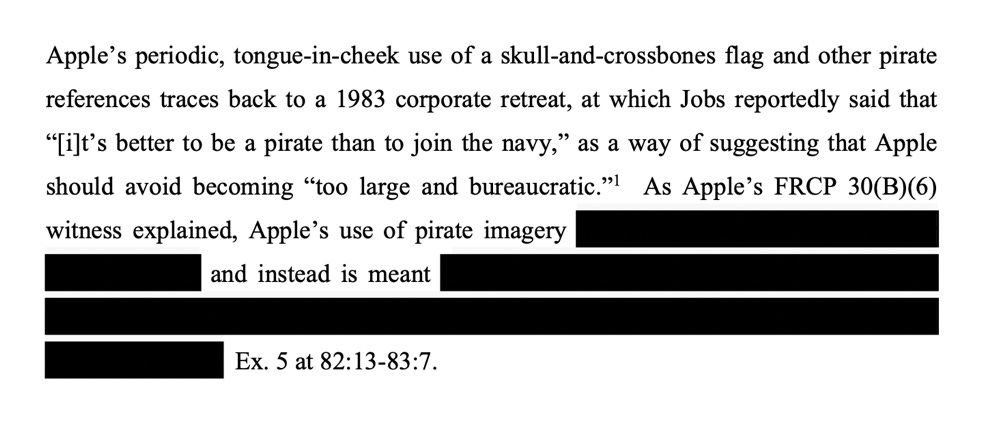
The WilmerHale lawyers described Apple’s use of pirate imagery as “periodic” and “tongue-in-cheek.” They cited the deposition of Apple in-house lawyer Jackie Harlow, but the public version of the motion redacted her apparent explanation of the true intent for Apple’s pirate imagery.
The WilmerHale team cited a case that, coincidentally, was tried down the hall from the Masimo v. Apple courtroom: Pinn, Inc.’s patent lawsuit against Apple, Inc., over the AirPods.
U.S. District Judge David O. Carter declared a mistrial in August 2022 after a juror brought modified headphones into the deliberation room, and the case ended up settling shortly before a second trial was to begin in November. But before the first trial, Carter adopted a recommendation from a special master to bar “argument, evidence, or questions regarding Steve Jobs and political positions taken by Apple or its leadership.”
That ruling and others were issued under Rule 402 of the Federal Rules of Evidence, which bars irrelevant evidence, but the WilmerHale team argued any relevance is outweighed by the potential to confuse the jury and be unduly prejudicial under Rule 403.
“Notably, in trials against Apple, courts routinely exclude under FRE 403 statements irrelevant to the claims at issue and attributed to Steve Jobs,” according to the motion, which cites four rulings in six years.
Masimo’s lawyers said the jury should decide the true intent of the pirate imagery and quotes from Jobs.
“The jury could reasonably conclude that embracing pirate imagery suggests that Jobs and Apple supported pirating the ideas of others, regardless of Apple’s formal policies,” according to the Feb. 21 opposition. “Such a conclusion is reasonable, particularly when combined with other evidence that Apple seeks to exclude, such as Jobs’ admiration of the saying that “good artists copy great artists steal” and his admission that: “we [Apple] have always been shameless about stealing great ideas[.]””
The filing continued, “Masimo has no intention of misrepresenting anything or taking anything out of context. But Apple cannot unilaterally dictate which representations are correct or how best to define the appropriate context for each statement. The jury, not Apple, should make those judgments.”
Senior U.S. District Judge James V. Selna sided with Apple in a March 15 order that said neither statements about infringement nor statements about copying are relevant to trade secrets misappropriation.
“Second, courts have routinely excluded the same, often-quoted statements by Steve Jobs, who died before the events at issue, as irrelevant or prejudicial,” according to the order, citing Pinn v. Apple and five other cases.
Photos of pirate flags as evidence certainly would have spiced up the trial, but it’s a great trial regardless, and I’m loaded with new material from the testimony I’ve heard this week. Apple may rest its case Thursday, and closing arguments will be next week. I’ll have more coverage soon, so please stay tuned.
Also, welcome to legalaffairsandtrials.com! I am taking this website to the next level through this custom url. Please update your bookmarks, though all previous Substack links are supposed to transfer.
Previous coverage:
April 18: Ex-Masimo execs deny divulging trade secrets as Apple's emails show ‘bad karma’ concerns
April 13: Masimo lawyer's promise dashes Apple's hopes for witness stand appearance by CEO Tim Cook
April 10: 'This is a mess': Masimo trade secrets trial reveals details of Apple Watch development
Thank you for supporting my independent legal affairs journalism. Your paid subscriptions enable me to go in-depth and unfiltered on major issues. If you’re not already a paid subscriber, please consider purchasing a subscription for yourself or a gift subscription for someone else. Your support is absolutely essential to my work.
Best of luck. I like your work.
Are you no longer affiliated with Law and Crime?