
‘Malice in my heart’: Witness recalls falsely IDing murderer before jury rejects claims against LAPD
A man wrongfully convicted of murder in 2002 lost his malicious prosecution and wrongful imprisonment lawsuit against the two police detectives who investigated him.

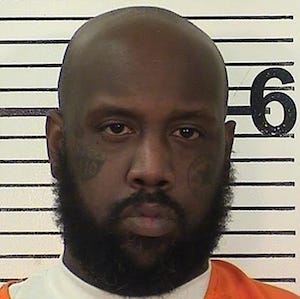
For Ramar Jenkins, testifying in a civil trial over a wrongful murder conviction was a chance to clear his conscience.
In 2002, he took the witness stand in a Los Angeles courtroom and identified Marco Milla as the gunman who shot him in the stomach and killed his close friend in an unprovoked attack a year earlier.
In the 21 years since, Milla was freed from prison and declared factually innocent, while Jenkins said he’s been haunted by his role in an investigation he described as “bullshit” to a federal jury in Santa Ana earlier this month.
“In my heart, I didn’t really know who the shooter was,” Jenkins testified. “I was never 100 percent. And that’s why I’m here now. I never felt 100 percent that the person I picked out was the person who shot me or killed my boy.”
Jenkins, who was released from prison two months ago for an unrelated burglary conviction, said he identified Milla only because of “malice in my heart.”
As he grew older, Jenkins learned more about police corruption and came to know of “a lot of cats that was in prison for crimes that they did not commit.”
He said his own stay in prison beginning in 2015 dramatically heightened his remorse.
“I committed my crime, and it was hard to do the prison time. So I can only imagine doing time for being innocent,” said Jenkins, who was released two months ago. “That was my change of heart.”
It wasn’t enough to salvage Milla’s lawsuit.
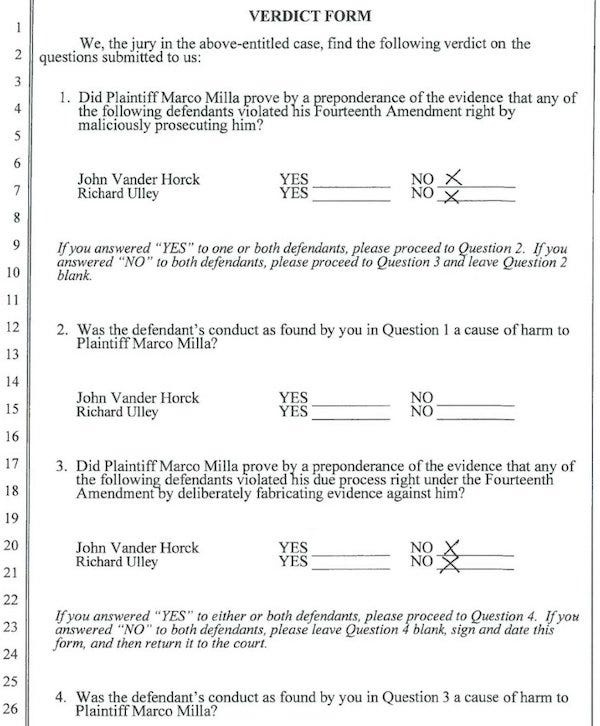
One week after Jenkins testified, the jury ruled in favor of the City of Los Angeles and the police detectives who investigated Milla, rejecting Milla’s claims of wrongful imprisonment and malicious prosecution.
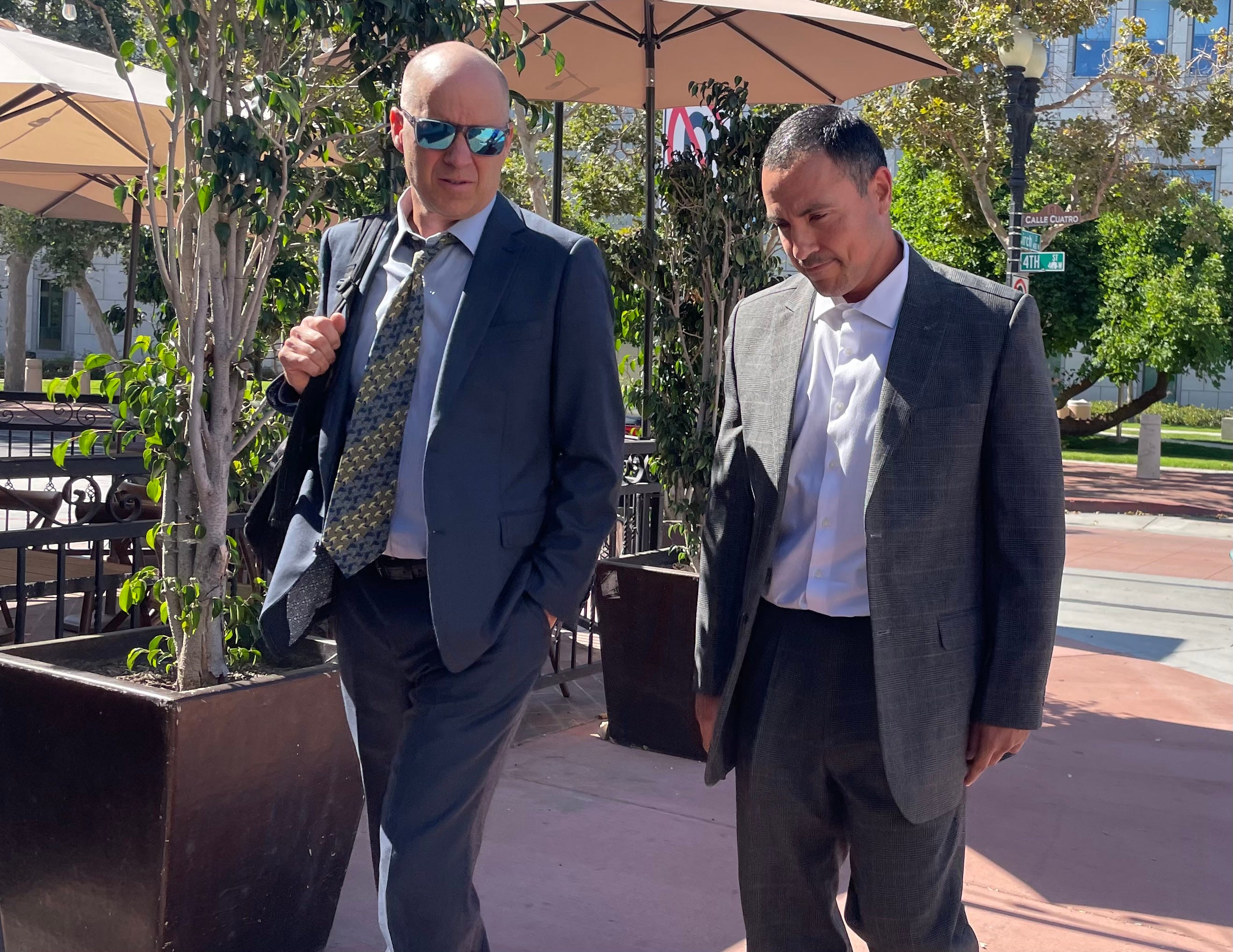
Milla, 39, collected $654,500 from the State of California in February 2016, but he’d hoped for millions of dollars more through his civil lawsuit. He left the Ronald Reagan Federal Building & Courthouse last Thursday with his head down and a mixed reaction of sadness and disbelief to a verdict that wrongful conviction experts say is not uncommon.
“Obviously, $654,500 pales in comparison to what he should be given,” Alissa Bjerkhoel, litigation coordinator for the California Innocence Project, told Legal Affairs and Trials with Meghann Cuniff in an email.
But Milla’s chances of a big win against police was unlikely, Bjerkhoel said.
“Civil suits against police are incredibly difficult to win, no matter how skilled the attorney because the cops have immunity to pretty much everything,” Bjerkhoel said. “It is also incredibly difficult to overturn a jury verdict, but he can always appeal if he has good issues.”
Milla’s lead lawyer, Santa Monica solo practitioner Martin Stanley, said he plans to seek a new trial. If he doesn’t get one, he said he’ll appeal the final judgment to the 9th Circuit U.S. Court of Appeals.
But Jenkins’ testimony highlighted problems with the crux of Stanley’s argument that the Los Angeles police detectives who investigated Milla did so maliciously and fabricated evidence to try to ensure his conviction.
Jenkins said he felt pressured by detectives to identify Milla as the shooter, and he said a detective placed his thumb near Milla’s photo as Jenkins looked at a six-photo lineup. But he also said detectives never hurried him, nor did they verbally suggest Milla was the gunman. He said he felt “the whole investigation was bullshit,” and he was angered because detectives told him the shootings were part of a larger race war that the 204th Street gang of Latino men was waging on Black people. Detectives told him the gangsters were attacking Black women and girls and showing no street “code,” Jenkins testified.
Jenkins was 17 at the time and “at that time, I didn’t know what to think of it.”
“There was a Mexican race war going on in LA,” Jenkins testified. “At that point, I just wanted to get them out of my house as fast as possible.”
Jenkins, however, also didn’t deny that he identified Milla as the gunman during the police investigation, a preliminary hearing and again during the jury trial that ended in Milla’s conviction.
“At the time I was like, ‘Fuck it. This will be the shooter,’” Jenkins testified. He recalled walking into the courtroom to testify in Milla’s December 2002 trial and seeing family members of his murdered friend, Robert “Bobby” Hightower.
“My heart wanted to be like, ‘Nah, I aint see nothing. Whoop-edy woo.’ But I didn’t want to let them down. I was all confused. You know what I’m saying?” Jenkins testified.
Jenkins blamed detectives and prosecutors for believing him.
“They should have never used my testimony, because they knew I had malice in my heart. I didn’t give a fuck who it was,” Jenkins said. “I was young. I was running the streets. I didn’t really want to be involved in telling and snitching and having that on my record. I was kind of pissed that they was there.”
He said his decision to identify Milla was not “because I felt that this man was the man who shot me and killed my best friend.”
“Because if that was the case, I can attack him now,” Jenkins said from the witness stand as Milla watched from the front row of the gallery.
The shootings that led to Milla’s incarceration occurred on Sept. 29, 2001, shortly after boxer Bernard Hopkins beat Felix Trinidad for the world middleweight championship in a pay-per-view match. The fight was widely watched in the Hispanic community because Trinidad is from Puerto Rico and Hopkins is Black, Stanley told the jury, and it came at a time of heightened tensions over attacks on Black people by the 204th Street gang.
At the time, police considered Milla to be a member of the gang and had spotted him in the area of the shootings on other occasions. They also had a report of him pointing a gun at a man in another incident. They found ammunitions and a gun when they searched his home, though it wasn’t the gun used in the shootings.
A Los Angeles County jury convicted Milla of one count of murder and five counts of attempted murder on Dec. 23, 2002, and he was sentenced to life in prison in August 2003. But in November 2010, the Los Angeles District Attorney’s Office notified Milla’s lawyer that a federal informant had identified another man as the gunman and said Milla was not in the area when the shootings occurred. A judge ended up granting Milla a new trial, but prosecutors dismissed all charges instead of trying him again. Milla was released from prison on Aug. 11, 2014, and he secured a finding of factual innocence in 2015.
He first sued in Los Angeles County Superior Court in 2015, but the case was moved to U.S. District Court. It appears to be the last case the 9th Circuit removed from U.S. District Judge Manuel Real before he died in June 2019 at the age of 95. Real in February 2017 granted summary judgment for the LAPD and the detectives, Richard Ulley and John Vander Horck, who died in 2020. But the 9th Circuit vacated the ruling and criticized Real for issuing it without a hearing.
“Milla was wrongfully imprisoned for over a decade, and his claims were, and are, serious enough to warrant meaningful consideration,” according to the order. “A decision at the summary judgement stage in a case such as this, without the benefit of a hearing or oral argument, raises real doubts as to the care with which Milla’s claims were examined.”
The case was reassigned to U.S. District Judge Stephen Wilson, who also granted summary judgment for the city and was reversed by the 9th Circuit. Wilson transferred the case to newly appointed U.S. District Judge Fred Slaughter in Santa Ana in 2022, as part of the Central District of California’s standard calendar-building procedure for new judges.
Trial began with jury selection on July 5. Stanley and his co-counsel Edmont Barrett planned to call Los Angeles County Superior Court Judge Olivia Rosales as a witness because she prosecuted Milla while a deputy district attorney, but she never testified because of scheduling issues.
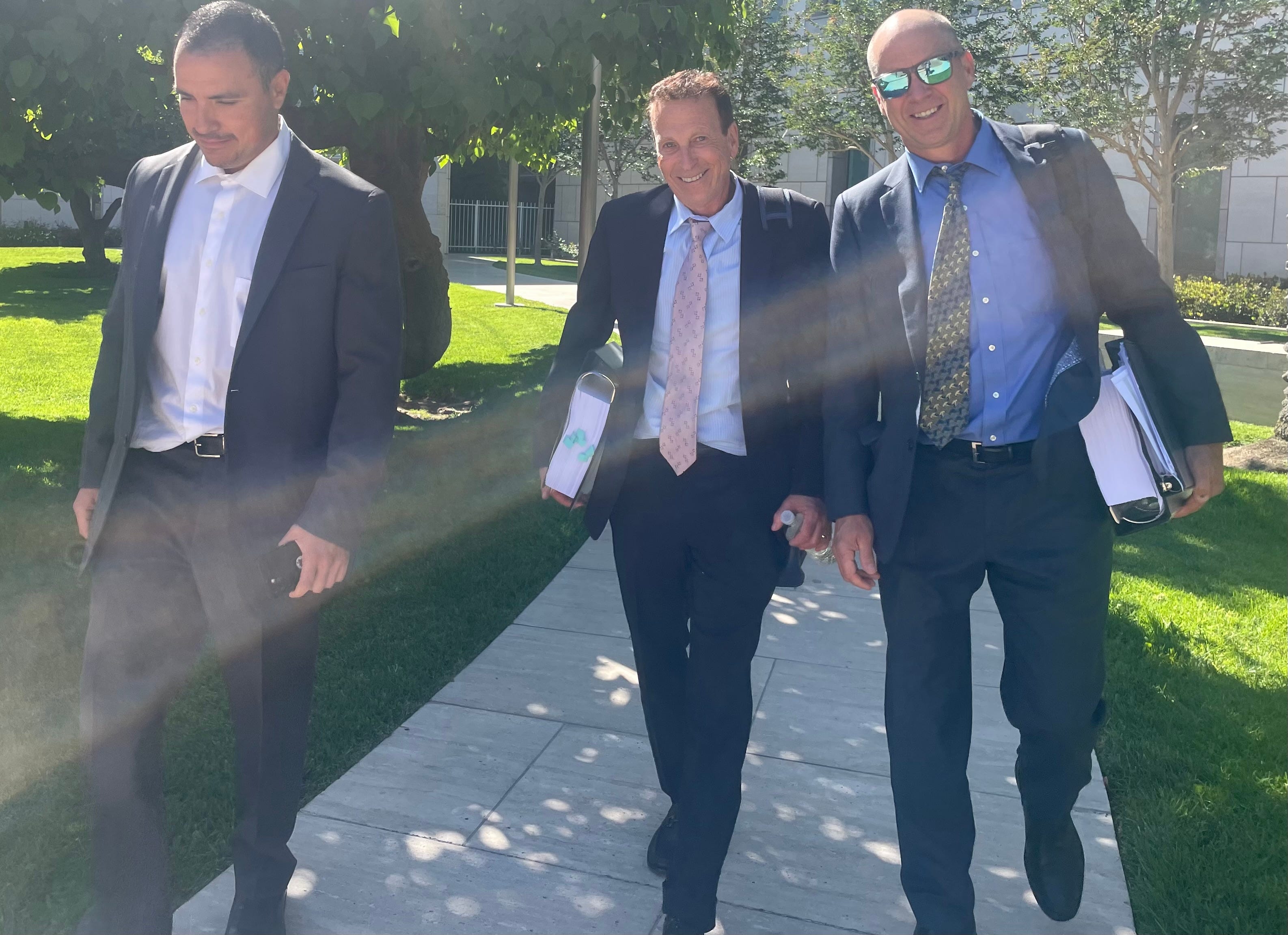
Kevin Gilbert of Orbach Huff & Henderson LLP in the Bay Area represented the City of Los Angeles as well as Vander Horck’s estate and Ulley, who’s now a lieutenant with the Los Angeles Police Department.
Gilbert said in his opening statement that Jenkins clearly identified Milla, and “no eyewitness ever ID’d another shooter.” He said the case isn’t about whether Milla is innocent or guilty but about “what the detectives knew at the time, what they looked at in real time, not in hindsight, not after the fact.”
In cross-examination, Gilbert pressed Jenkins about his repeated identification of Milla in 2001 and 2002. Jenkins told Stanley in direct-exam that he would have identified anyone as the shooter, but Gilbert said that’s not what happened.
“Instead, you identified characteristics that matched the shooter,” Gilbert told Jenkins, such as a scar, a goatee, green eyes, height of 5-foot-10 to 5-foot-11 and weight between 160 and 170 pounds. Gilbert asked Jenkins about him not identifying anyone in several photo lineups, then being shown a lineup with a recent photo of Milla and identifying him.
“You identified the person who jumped off the page, who you recognized as soon as that page was laid on the table,” Gilbert said.
“Right,” Jenkins replied, adding “the one he had his thumb on...that’s the one I chose.”
“You knew that testifying against a gang member could result in retribution to you?” Gilbert asked."
“For sure,” Jenkins answered.
“With that knowledge, you still testified at trial and preliminary, didn’t you?” Gilbert asked.
“Yes,” Jenkins answered.
Jenkins also circled Milla’s photo on the lineup during the October 2001 interview and wrote “the guy on Card E, Slot 2 is the shooter.”
“No detective told you what to write, did they?” Gilbert asked.
“No,” Jenkins answered.
“That was what you decided to write in your own words. … They never told you to focus on any one person?” Gilbert asked.
“No, no,” Jenkins answered.
Ulley and Vander Horck recorded a key Oct. 9, 2001, interview with Je kins, but they said the recorder malfunctioned so they returned with a new recorder and talked to Jenkins about the previous interview. Both recordings were played for jurors; the recording of the substantive interview is muffled and completely inaudible. Gilbert presented it as an innocent technical error to the jury, while Stanley implied the detectives intentionally disrupted the recording to mask misconduct when questioning Jenkins.
Stanley also argued that the detectives intentionally withheld information from prosecutors about the circumstances surrounding two tentative identifications of Milla by two witnesses. Ulley testified that they didn’t meet with prosecutors wanting to see Milla charged, they met with them “to present the case.”
“We wanted to present the case to the D.A. and he would say whether we had enough to actually file the case. ... He makes those decisions. I don’t make those decisions,” Ulley said. “My job is to collect facts and evidence.”
Some of Milla’s case focused on the lack of investigation into his alibi. At the time of the shootings, he had visited a liquor store near his girlfriend’s house in Downey, far from where Hightower was murdered.
“He mentioned a liquor store but didn’t give me any further details or information about the liquor store,” Ulley said.
“You never went to liquor store, true?” Stanley asked.
“I didn’t know what liquor store he was referring to. … He didn’t provide anything specific for me that could be followed up on other than just a mention of a liquor store,” Ulley answered.
But he also said he didn’t see a liquor store near the apartment, to which Stanley reacted with apparent shock and disbelief.
“Are you testifying under oath that you didn’t observe the Empire Liquor store right there?” Stanley asked.
“Not that I saw at the time,” Ulley answered.
Gilbert emphasized that police are not obligated to investigate a claimed alibi, nor are they required to continue investigating if they’ve established probable cause for someone’s arrest. He questioned Ulley about his lack of interest in the outcome of his completed investigations, and about police policies regarding evidence.
“If you fabricate evidence, what’s your understanding of what can happen?” Gilbert asked.
“Not only lose my job and get fired, but possibly be criminally charged and end up in prison,” Ulley answered.
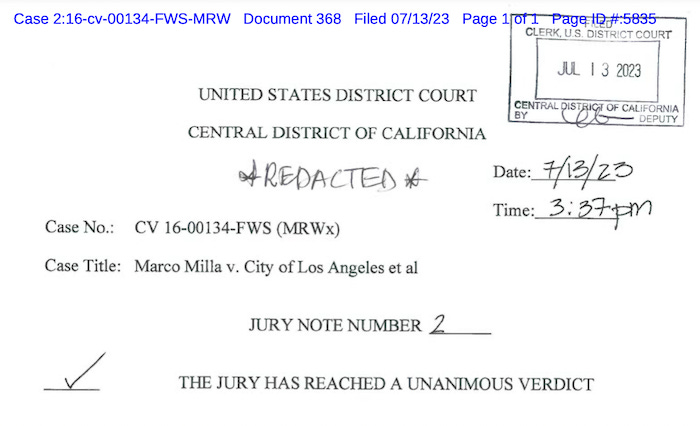
Jurors heard closing arguments Wednesday afternoon. They began deliberating about 8:30 a.m. on Thursday and reached their verdict at 3:37 p.m.
A closing thought: Vander Horck, the detective who died in 2020, is the father of current Los Angeles County Sheriff’s Capt. Matt Vander Horck. I know of the younger Vander Horck because he testified in the trial in Vanessa Bryant’s lawsuit against Los Angeles County over firefighters and sheriff’s deputies passing around photos of human remains from the helicopter crash that killed Kobe Bryant and their daughter, Gianna.
It’s a remarkable coincidence because the Bryant trial was the best trial I’ve ever watched in that the lawyering was absolutely excellent, and the Milla trial was by far the worst. Not a lot of Perry Mason moments in this one, and listening to it was excruciating. (Thankfully, Judge Slaughter allows me to use my laptop in court, unlike the federal judges in Los Angeles.) It was sad, because it’s an important topic. I didn’t cover everything: I hear Judge Slaughter granted a defense Rule 50 motion on Milla’s Monell claims; I don’t see anything in the case file yet, so you’re on your own for that one.
Other case documents are linked at the end of my previous article for paid subscribers:
LAPD argues man wrongfully convicted of murder isn’t due anything after 13 years in prison

No one denies that Marco Antonio Milla spent 13 years in prison for a murder he didn’t commit. The now 40-year-old Los Angeles man was freed in 2014 based on the testimony of a federal informant, and a judge declared him factually innocent in a signed order.
Thank you for supporting my independent legal affairs journalism. Your paid subscriptions enable me to go in-depth and unfiltered on major issues that regular news organizations don’t cover. If you’re not already a paid subscriber, please consider purchasing a subscription so I can stay housed. Any amount truly does help. Thank you. Venmo, CashApp, Zelle: MeghannCuniff, $MeghannCuniff, meghanncuniff@gmail.com.