
Judge in John Eastman's disbarment trial mulls attorney-client privilege, including Trump's
The former president's election lawyer faces 11 misconduct counts from the California State Bar for false election fraud claims that prosecutors say led to the Jan. 6 riots.

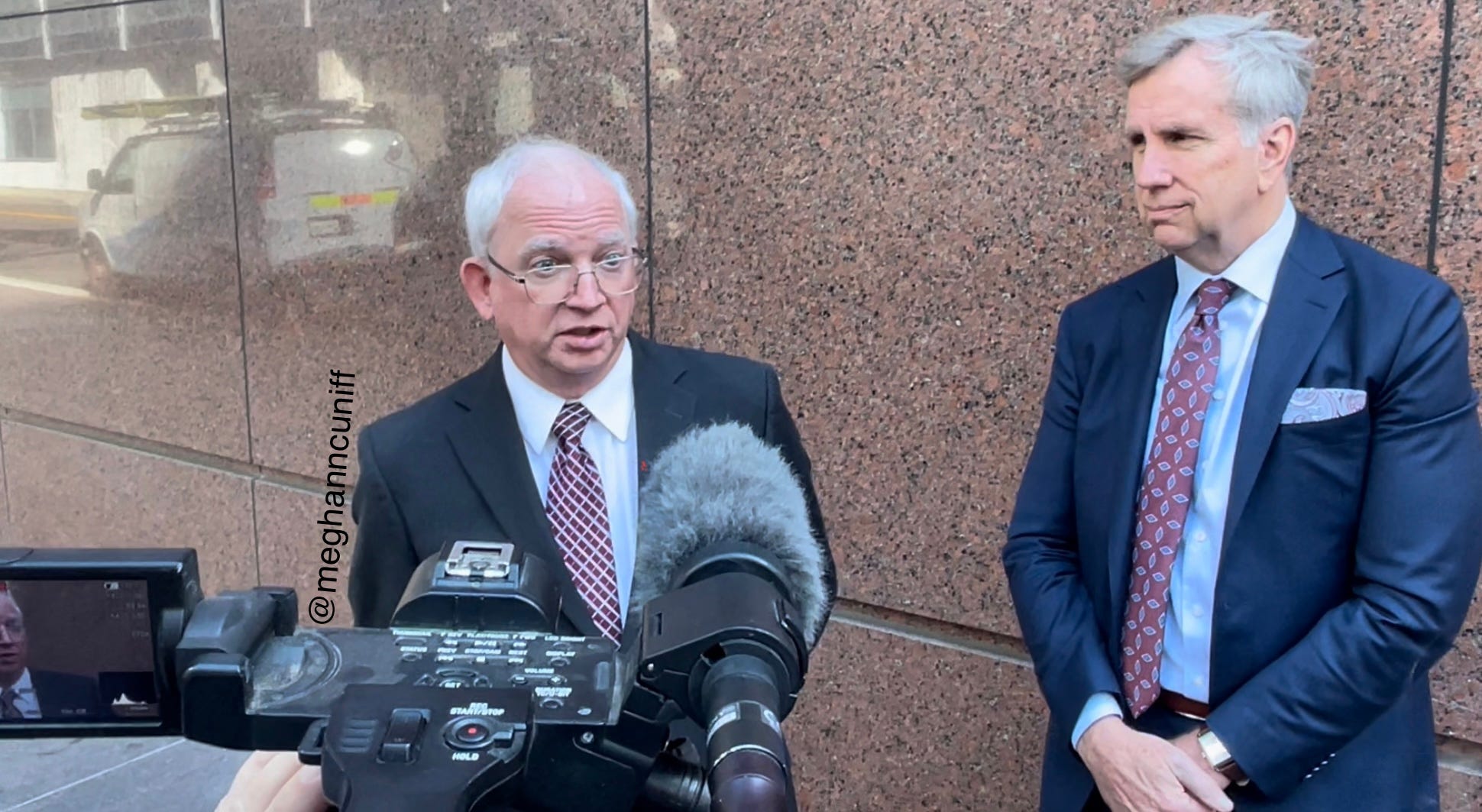
Two divergent views on attorney-client privilege have emerged in John Eastman’s California State Bar disciplinary trial: One from Eastman, and one from the judge who’s to determine if he should be disbarred.
The former election lawyer for Donald Trump cited Trump’s client relationship with him when refusing to identify people with whom he’d discussed the possibility of recruiting new electors to try to disrupt the certification of the 2020 presidential election.
State Bar prosecutors seeking Eastman’s disbarment say the discussions are part of a “course of conduct” that pushed false claims about non-existent election fraud and culminated with the Jan. 6, 2021, attacks on the U.S. Capitol by Trump supporters seeking to stop the certification of Joe Biden as the winner of the 2020 presidential election. Eastman spoke at Trump’s “Stop the Steal” rally before the riots began.
The crux of the defense presented by Eastman’s lawyer, Randy Miller, is that Eastman can’t be disciplined for advocating positions he as a lawyer was obligated to present for his client. Miller said in his June 20 opening statement that Eastman’s defense has four main tenants: Tenability, advocacy, protected speech and the right to petition.
“He was not there to steal the election or invent ways to make President Trump the winner,” Miller said. “The focus was on ensuring the election was properly, legally conducted and certified.”
But State Bar Counsel Duncan Carling said Eastman knew he was pushing false claims.
“All of Dr. Eastman’s conduct was fundamentally dishonest” and “completely unsupported by historical precedent or law, and contrary to our values as a nation,” Carling said. “He was fully aware in real time that his plan was damaging the nation.”
More than 1,000 people have been charged with crimes related to Jan. 6, with the lengthiest prison sentence so far the 18-year term handed to Stewart Rhodes, founder of the Oath Keepers militia group, for seditious conspiracy. Eastman is believed to be among the Trump allies facing possible criminal exposure in the investigation of U.S. Department of Justice Special Counsel Jack Smith. In June 2021, federal agents seized his cell phone as he walked out of a restaurant in Santa Fe, New Mexico.
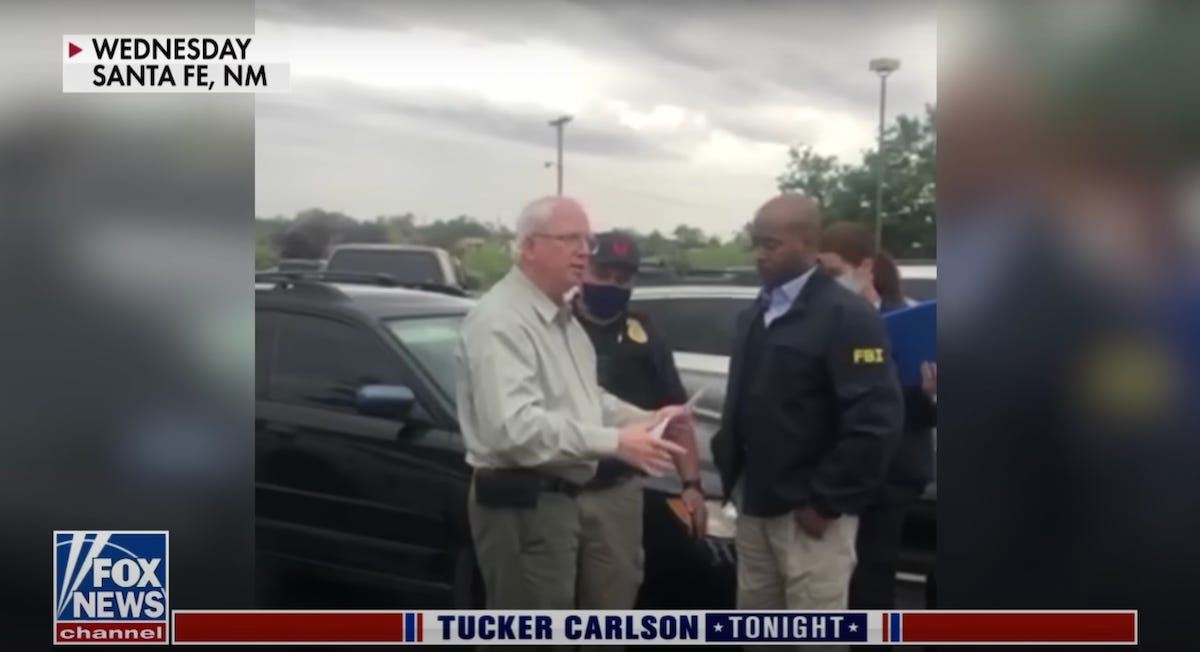
The search warrant was from the Department of Justice’s Office of the Inspector General, which investigates government employees. It was served on Eastman the same week that agents searched the Virginia home of Jeffrey Clark, Trump’s former acting attorney general and a key election conspiracy theorist.
So far, no charges have been filed. But law license proceedings are a different matter: Clark is facing possible discipline from the Washington, D.C., bar for his election-related work, and a D.C. bar panel has recommended New York City Mayor Rudy Giuliani be disbarred, also for pushing false election fraud claims. Giuliani’s New York law license was suspended in June 2021. Trump election lawyer Jenna Ellis was censured in March by the Colorado Supreme Court for her false claims of election fraud, and Sidney Powell also is facing possible discipline in Texas and Michigan.
In Los Angeles, Eastman is facing 11 counts from the California State Bar, including an all-encompassing charge that accuses him of failing to uphold the Constitution and laws of the United States.

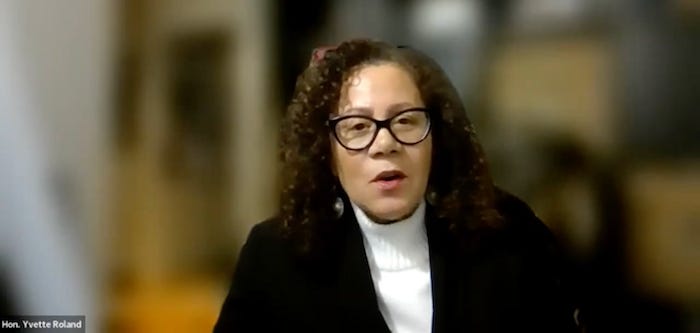
The fate of the 63-year-old’s law license, which he’s held since 1997, is in the hands of Judge Yvette Roland, a bar disciplinary judge since 2014 and a former partner at Duane Morris LLP. Her decision if and how Eastman should be disciplined could end up before the California Supreme Court, but it’s binding as soon as it’s issued.
As of Friday afternoon, that won’t be for at least several weeks: Eastman’s trial was originally scheduled to end June 30, but Roland determined more days are needed, and scheduling conflicts pushed the reconvention to Aug. 22 through Aug. 25.
The dispute over the extent of Eastman’s confidential work for the former president festered through last week. The Republican Party has waived the Trump presidential campaign’s attorney-client privilege, but Trump has not personally waived his own privilege. Eastman not only believes Trump’s privilege could apply to conversations with others, he believes other clients would have their privilege violated if he named them because doing so would reveal confidential communications.
“The fact that someone is a client is not covered unless that fact would reveal the substance of the discussion,” Eastman said from the witness stand last Tuesday.
“No, that is not the law,” Roland said, calling Eastman’s claim “an improper assertion of attorney-client privilege.” “The fact that someone is a client is not covered.”
Eastman looked at her.
“When the question, Your Honor, with all due respect, is ‘Who are the clients you would have provided this advice to?’ revealing the name of the client reveals the advice that I gave to them,” Eastman said.
Nearly a week later, the debate remains unresolved. It arose as Carling questioned Eastman about GOP Chairwoman Ronna McDaniel’s testimony to the U.S. House of Representatives’ now-defunct Jan. 6 Committee. McDaniel said Eastman told her it was important for the Trump campaign to enlist people to serve as alternate electors, and Carling said such discussions are part of a “course of conduct...ultimately culminating in his attempt to obstruct the Jan. 6 proceedings.”
Eastman said he didn’t recall his conversation with McDaniel but didn’t dispute the substance. Still, he said, “it was a very small part of what I was doing.”
“There were others on the Trump legal team that had greater responsibility for dealing with the elector issue,” Eastman told Carling.
“Did you talk to other people in early and mid-December about gathering electors?” Carling asked.
That’s when the trouble began. After Eastman cited attorney-client privilege, Roland told Carling to move to other questions and said she’d address the disagreement later. Eastman’s testimony was then interrupted for three days of testimony from other witnesses, and Roland revisited the debate once on Wednesday and twice on Friday Friday without offering a resolution.
“As we get into the examination, that will provide context for the assertion or the non-assertion,” Roland said.
“We’re happy to revisit it at anytime, Your Honor,” said Miller, Eastman’s lawyer. He appeared to be trying to underscore the need for the judge to act, but Roland didn’t take the bait. Miller had earlier told her he could answer any questions she might have, and the judge said, “I understand that you are valiantly trying to defend your client, however, you’re not the witness.”
As the issue festered, Carling worked to establish crucial context by questioning Eastman about a September 2021 interview with Harvard law professor Lawrence Lessig as well as constitutional law scholar Matthew Seligman, who was one of Eastman’s former professors at the University of Chicago Law School. In it, Eastman said, “Although I did have a client in this, the president has authorized me to talk about these things. I want to make that clear up front.”
According to the law, that lifts Trump’s attorney-client privilege with Eastman over those topics not just for that interview, but permanently. But Eastman said Trump’s waiver was limited to a few topics, none related to discussions about alternate electors. So the same disagreement over the extent of Trump’s attorney-client privilege with Eastman persisted: Does it cover discussions with people who were working with Trump and Eastman, and does it mean Eastman can decline to so much as say who those people are?
“Right now we’re speaking rather hypothetically,” Roland said on Friday as she declined to address the issue.
Attorney-client privilege with no crime-fraud exception
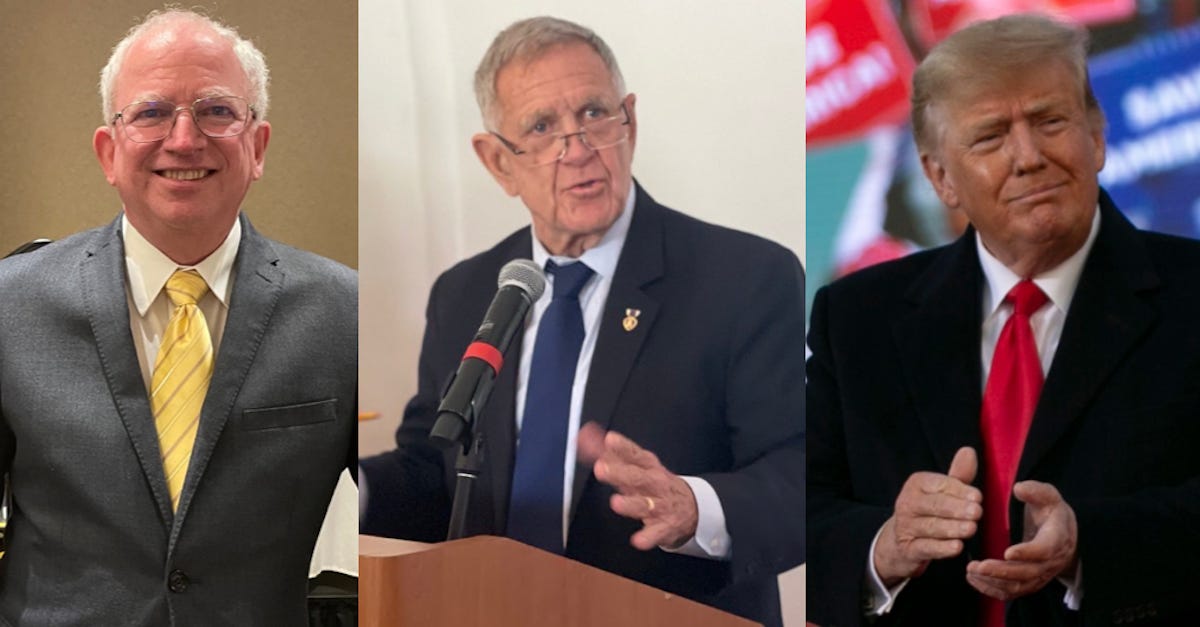
It’s not the first time a judge has considered the extent of Eastman’s confidential communications with Trump.
Last year, U.S. District Judge David O. Carter in Santa Ana, California, earned international attention when he declared on three occasions that the privilege didn’t protect some emails found in Eastman’s Chapman University account, the private Orange County college where Eastman was a law professor for 20 years until he retired amid outcry over his involvement in the attempted resurrection.
But while Roland has repeatedly put off addressing the debate in her courtroom, Carter took a bold approach to the attorney-client issues in the Chapman email case by first rejecting the university’s claims that Eastman had no privacy expectation to his email account, then being the one to first suggest the idea of applying the crime-fraud exception to Trump’s privilege with Eastman.
Of the approximately 283 emails and attached documents that Carter ordered released to the Jan. 6 Committee, he determined 10 were written in furtherance of crimes. That meant that while Eastman’s claimed attorney-client privilege did indeed apply, the emails still were releasable under the crime-fraud exception.
Carter’s initial March 28, 2022, order drew broad attention because of his findings that Eastman and Trump “more likely than not” attempted to obstruct an official proceeding and conspired to defraud the United States by trying to derail Congress’s Jan. 6, 2021, certification of the electoral vote that made Joe Biden the winner of the presidential election. It released 101 emails and documents from Eastman’s Chapman account, and it applied the crime-fraud exception to only one document: A draft memo that Carter said “may have been the first time members of President Trump’s team transformed a legal interpretation of the Electoral Count Act into a day-by-day plan of action.”
The judge’s June 7, 2022, order reiterated his crime-fraud finding and ordered an additional 159 emails and documents disclosed, though the number was later reduced to 149. But it again applied the exception to only one document, a Dec. 22, 2020, email in which another Trump attorney concluded that a loss in court would “tank the January 6 strategy” and encouraged avoiding the courts altogether.
Carter’s final Oct. 19 order went much further, ordering only 33 of 562 emails and documents to be disclosed but applying the crime-fraud exception to eight that the judge said were privileged and wouldn’t otherwise by released. That incudes two that the June 7 order said were a “close call” but ultimately didn’t need to be disclosed: Carter said he changed his mind after reading additional emails.
Eastman is trying to get the U.S. Supreme Court to vacate Carter’s findings, but they’ve already made a lasting impression: the Jan. 6 Committee cited them in its criminal referral to the U.S. Department of Justice. The State Bar charges against Eastman include one count of seeking to mislead a court related to a declaration from Trump in the Northern District of Georgia that Carter said Eastman knew contained false statements.
‘And thanks to your bullshit, we are now under siege’
Some of the emails Carter ordered Eastman to release to the committee are expected to come up in trial.
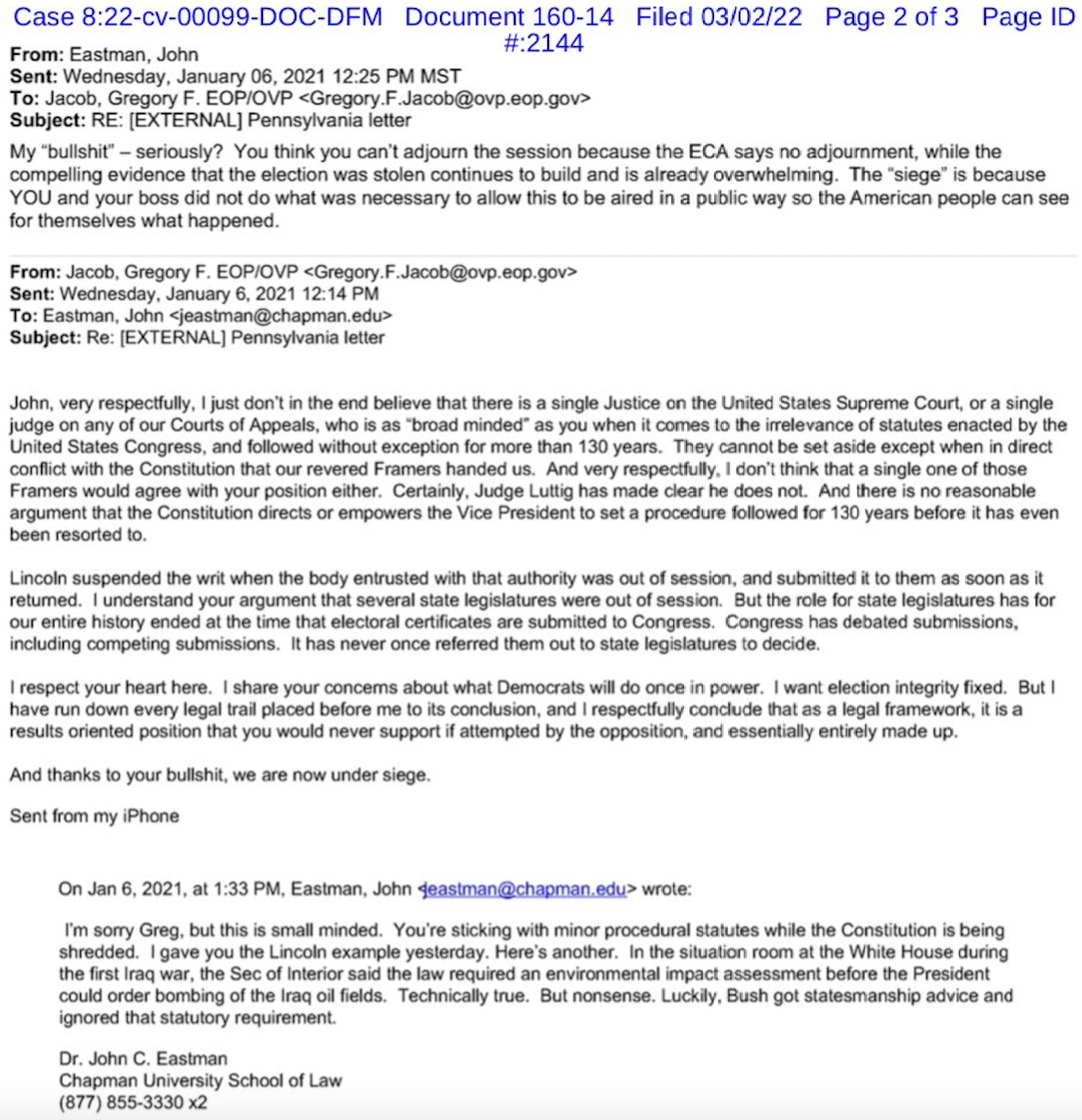
The testimony so far has brought to life a private exchange between Eastman and Vice President Mike Pence’s counsel Greg Jacob that was first revealed during Carter's case.
The Jan. 6 Committee publicly filed it on March 2, 2022, when trying to persuade Carter to apply the crime-fraud exception to the first batch of emails he reviewed, which were those sent and received by Eastman between Jan. 4 and Jan. 2021.
In the exchange, Eastman told Jacob, “You’re sticking with minor procedural statues while the Constitution is being shredded.” Jacob replied that he didn’t think there is a “a single Justice on the United States Supreme Court, or a single judge on any of our Courts of Appeals, who is as ‘broad minded’ as you when it comes to irrelevance of statutes enacted by the United States Congress, and followed without exception for more than 30 years.”
Jacob ended the email: “And thanks to your bullshit, we are now under siege.”
Eastman replied 11 minutes later, “My ‘bullshit’ - seriously?… The “siege” is because you and your boss did not do what was necessary to allow this to be aired in a public way.”
In his opening statement, Miller said the exchange was, “an honest debate held in good faith.”
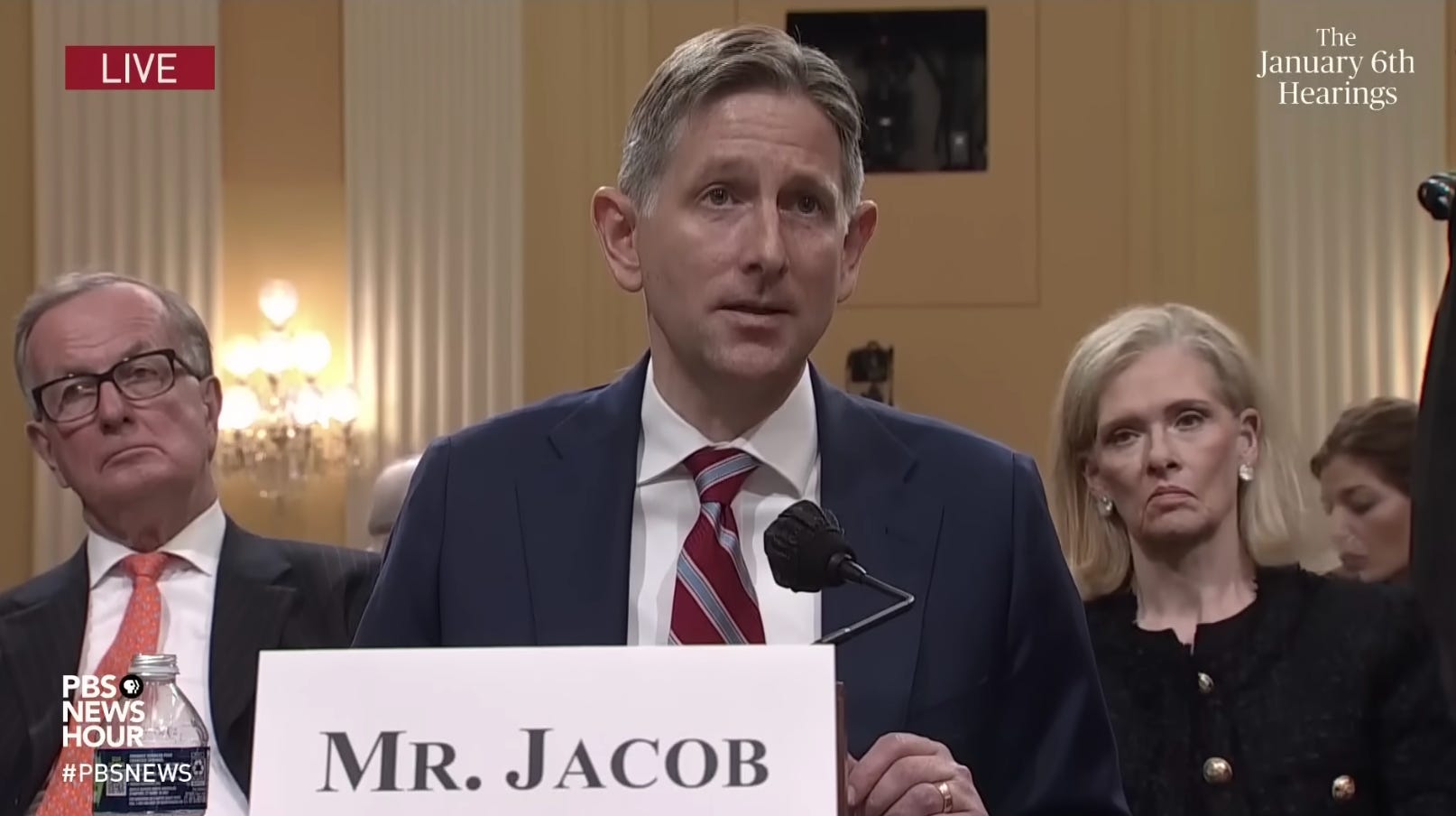
In video testimony on Wednesday, Jacob said he’d gone to a self-serve coffee kiosk on the bottom floor of the Senate side of the Capitol building when he heard “boom boom boom boom.” A glass window shattered about 35 to 40 feet from him, and “I immediately hot footed it upstairs to our staff office.” He later learned rioters smashed through the window with a stolen police shield.
Jacob finished his email to Eastman about four minutes later as he was being moved onto the Senate floor.
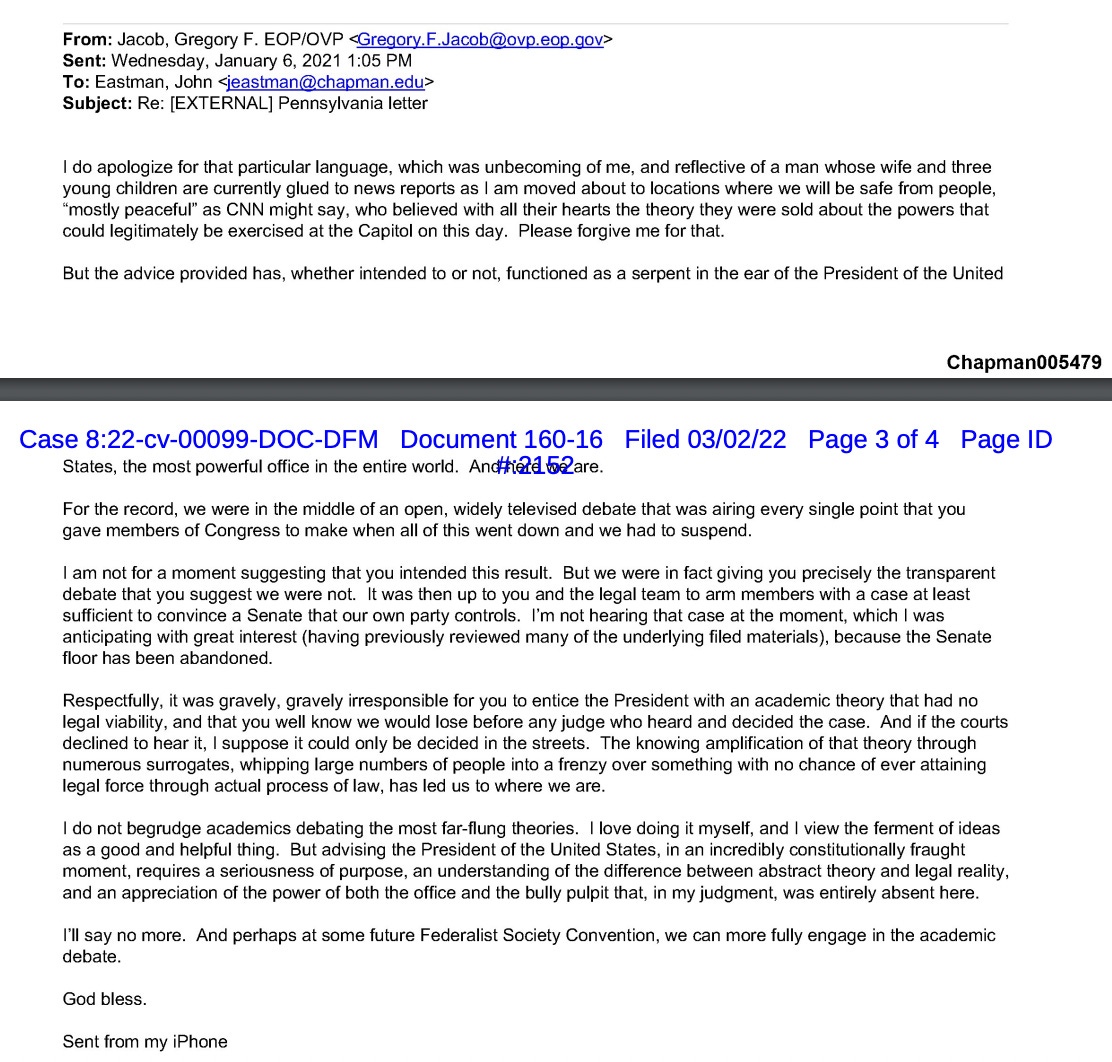
“I very quickly finished the email off with that last line, which doesn’t reflect the due consideration that I usually give when sending an email,” Jacob said. He didn’t mention that he’d apologized to Eastman in a later email in which he called his language “unbecoming of me, and reflective of a man whose wife and three young children are currently glued to news reports as I am moved about to locations where we will be safe from people, “mostly peaceful” as CNN might say, who believed with all their hearts the theory they were sold about the power that could legitimately be exercised at the Capitol on this day.”
“Please forgive me for that,” Jacob wrote to Eastman.
In testimony last week, Jacob said he followed the military aide who had the vice president’s “nuclear football,” meaning his nuclear controls, from the Senate floor to Pence’s office after he sent the ‘bullshit’ email.
Two days earlier, he and Pence met with Trump, Eastman and Pence’s chief of staff, Marc Short, discussed Eastman’s suggestions that Pence might be able to delay certification of the election or outright reject it.
Jacob later told Pence in a memo that the theories were “unworkable.” He testified Wednesday that Pence went into the meeting with Trump and Eastman not believing he had unilateral power to halt the certification of the election.
“The framers were smart about these things,” Jacob said. “They made a very specific decision as framers, not to have single building or person decide the outcome of the presidency.”
If not, “the result would be heats and ferments that would spread out to the people and result in essentially wha we say play out on Jan. 6,” Jacob continued.
Still, “It was apparent to me that the people who marched on the Capitol did so because they believed that there was a momentous decision that was going to decide who was going to be president of the United States, to be made in that building that day,” Jacob said. “The reason that they were there, the reason that they were angry and the reason they were demanding that action be taken is because they believed there was a decision to be made in the building that day.”
Carling asked Jacob about an op-ed he began writing while hiding in the Capitol on Jan. 6. He never published it himself, but the Washington Post eventually got a hold of it and did. It was entered as evidence during Jacob's testimony. He said he wrote it because, “I was offended for my profession by the advice I had seen given, and what had resulted in there from.”
On cross-examination, Miller asked Jacob about articles that support Eastman’s position, including one by UC Berkeley School of Law Professor John Yoo, to try to make the point that there was legit debate about the issues.
Jacob said he considers Yoo — who wrote the so-called “torture memos” for former President George W. Bush in 2002 — to be a constitutional scholar, but he added a big caveat: “Not everything that John writes is necessarily a piece of scholarship even though he himself is a constitutional scholar.”
Judge bars Eastman’s proposed expert witnesses
Along with Yoo, Eastman wanted to call as a witness John Valentine, who claims to have a database of U.S. election rolls that prosecutors say they’ve never seen. In a motion in limine, they said Valentine “was unprepared to testify to his opinions” in his deposition.
“During his deposition, Mr. Valentine testified that he did not know what specific opinions he might be asked to give at trial, and he had not yet begun collecting evidence to support those opinions, including by asking third parties about the findings from investigations conducted using his data,” according to the motion.
Prosecutors also said Valentine’s opinions are irrelevant and unreliable.
Roland agreed, just as she agreed that Joseph Fried, a certified public account, can’t testify as an elections expert for Eastman.
“According to what you provided the court, he has no experience in auditing election or voting procedures or voting practices or voting outcomes, which is even more important,” Roland told Miller on Tuesday, standing by her June 16 order.
Roland also barred Eastman from calling Janice Rogers Brown, a retired D.C. Circuit Court of Appeals judge, to testify about the unprecedented nature of the proceedings, though she is to still testify as a character witness. Roland also prevented Eastman from calling New York Law School Professor Rebecca Roiphe as a First Amendment expert, saying the testimony was unnecessary.
“The court will determine if Respondent’s statements warrant First Amendment Protection. Indeed, whether Respondent made false statements and if those statements were made knowingly or with reckless disregard of the truth, are issues that fall within the court’s purview,” Roland wrote in a May 23 order.
Prosecutors, meanwhile, are calling as witnesses election officials from battleground states who are testifying about the steps taken to ensure fraud-free elections. They want the harassment the officials experienced to be considered aggravating circumstances against Eastman, but Judge Roland said she’ll consider the issue in a separate phase of the proceeding. She’s given prosecutors until June 29 to respond to Eastman’s request for an offer of proof for what his motion calls “speculative” evidence of harassment.
Election officials detail work and refute fraud claims
Some of the testimony has already touched on harassment.
Mark Wlaschin, Nevada’s deputy secretary of state for elections, said the Secretary of State’s Office was inundated with bizarre questions about election integrity and voting machines owned by Dominion Voting Systems, the company that secured the $787 million defamation settlement against Fox News over the network’s false election fraud claims.
“Everything that they were owned by a Venezuelan dictator, to the fact that they had modems in their machines, to the Italian military satellites — I apologize, but I’m being genuinely serious — that they had somehow switched votes in the machines as well,” Wlaschin testified via video on Friday.
In cross, Miller asked Wlaschin about a new Nevada law that makes threatening election officials a felony and asked if it’s an improvement.
“In the same that friends who had limbs blown off in Iraq now have free college for their kids? That’s better, right?” Wlaschin replied.
Wlaschin said what other election officials said: The election he oversaw was conducted fairly and accurately. State Bar Counsel Samuel Beckerman walked him through the steps he took to safeguard the election, and he asked him about measures he took after the election to try to refute the false fraud claims.
His testimony followed testimony from Jonathan Marks, Pennsylvania’s deputy secretary for elections and commissions. Marks said the true triumphs of the 2020 election have been overshadowed by the false fraud claims.
“What I saw were state officials, federal officials, local officials — in both red counties, blue counties — doing everything they could to ensure there was free and fair elections and at the same time protecting the health and safety of their voters,” Marks said. “It’s tragic that that was recast as something other that and actually some grand conspiracy.”
Before Marks testified, Stephen Richer, the elected recorder in Maricopa County, Arizona, testified about his own experiences with the election. He managed to squeak out a victory, but Richer initially was losing his re-election.
“I poignantly remember especially the days after the election. I remember sweating a lot and sleeping a little,” he said. He detailed the quality checks his office conducted on Dominion voting systems and the need to counteract false information about “anything related to the bogeyman at the time, Dominion.”
Carling asks Richer if he put any weight into an audit from a group called the Cyber Ninjas that claimed election fraud. Richer said no.
“It was done by a bunch of imbeciles who we later learned had no clue what they’re doing” and probably fudged those numbers, Richer said.
Richer said he issued his own report because he hoped to help his fellow Republicans “have confidence in the process and they could move on from their conversations that were fanciful and fictitious about the 2020 election and could focus on future elections.” Richer also knew the Cyber Ninjas had another report coming and “we had every reason to believe it would contain numerous falsehoods, as indeed it did.”
When Carling asked Richer “do you believe” the election was secure, he answered, “I sort of hate the notion that it’s a belief.”
“I know just as I know that 9/11 happened even though I wasn’t in New York, just as I know that we landed on the moon even though I wasn’t born in 1969,” Richer said. (After he testified, Richer announced he was suing former Arizona GOP gubernatorial candidate Kari Lake for defamation over her false election claims against him.)
The trial continues Tuesday at 10 a.m. You can watch online via Zoom here.
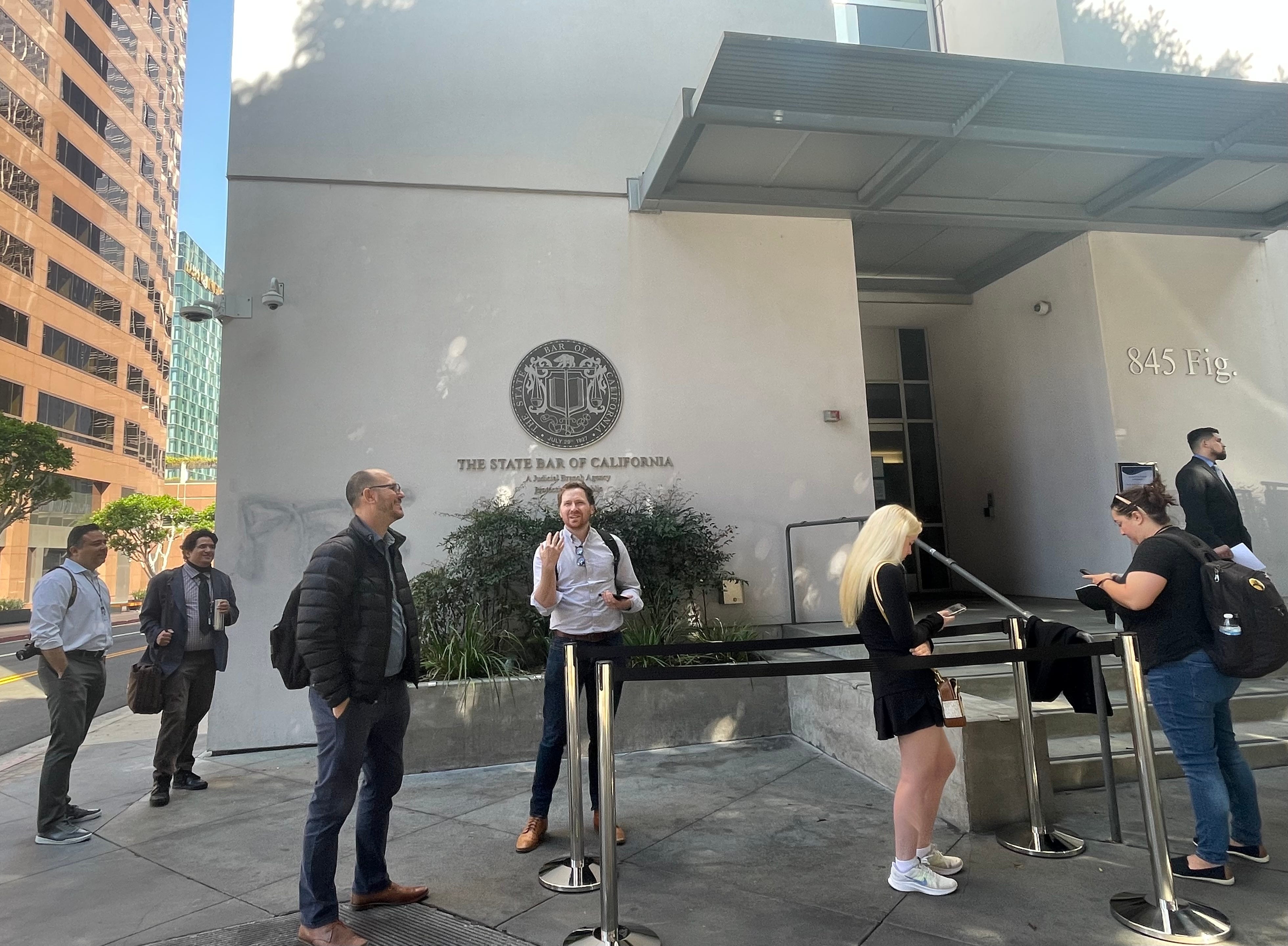
I attended in person on the first day. State Bar officials were prepared for a raucous scene, but the crowd was thin: Reporters showed up from Law360, The Associated Press, Los Angeles Daily Journal and National Public Radio, and there was a correspondent from Steve Bannon’s War Room seated with us in the folding chairs in the back of the courtroom. I watched online the other days, as did most other reporters.
Eastman is to continue testifying some time next week, which is when we should hear more about the attorney-client privilege debate. One highlight last week was when he said he “was a little bit under the weather with 104-degree temperature” in the weeks after the election, when answering why he didn’t see certain information that contradicted his fraud claims.
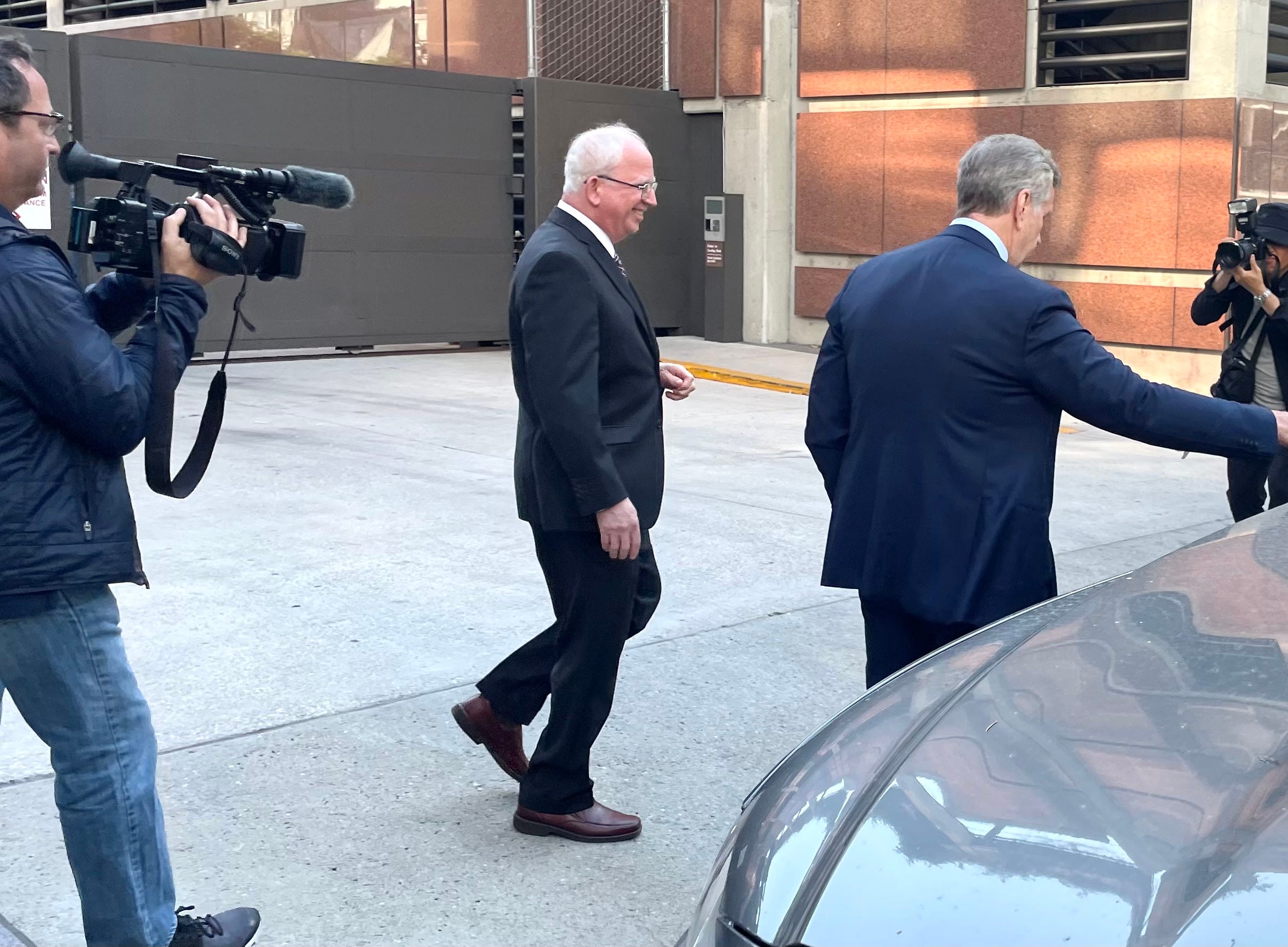
Eastman also is supposed to testify as a defense witness. Here’s a video of him speaking to reporters after the first day of the trial:
I appeared on the Daily Beans podcast by the great Allison Gill (a.k.a. Mueller, She Wrote) last week to discuss the trial. Check it out here:
I’ll be going live on YouTube at 3 p.m. Monday to discuss Eastman’s trial as well as a hearing I’m attending that morning involving a four-way fight for disgraced lawyer and federal prisoner Michael Avenatti’s seized jet.
I did my inaugural live last week. You can watch here:
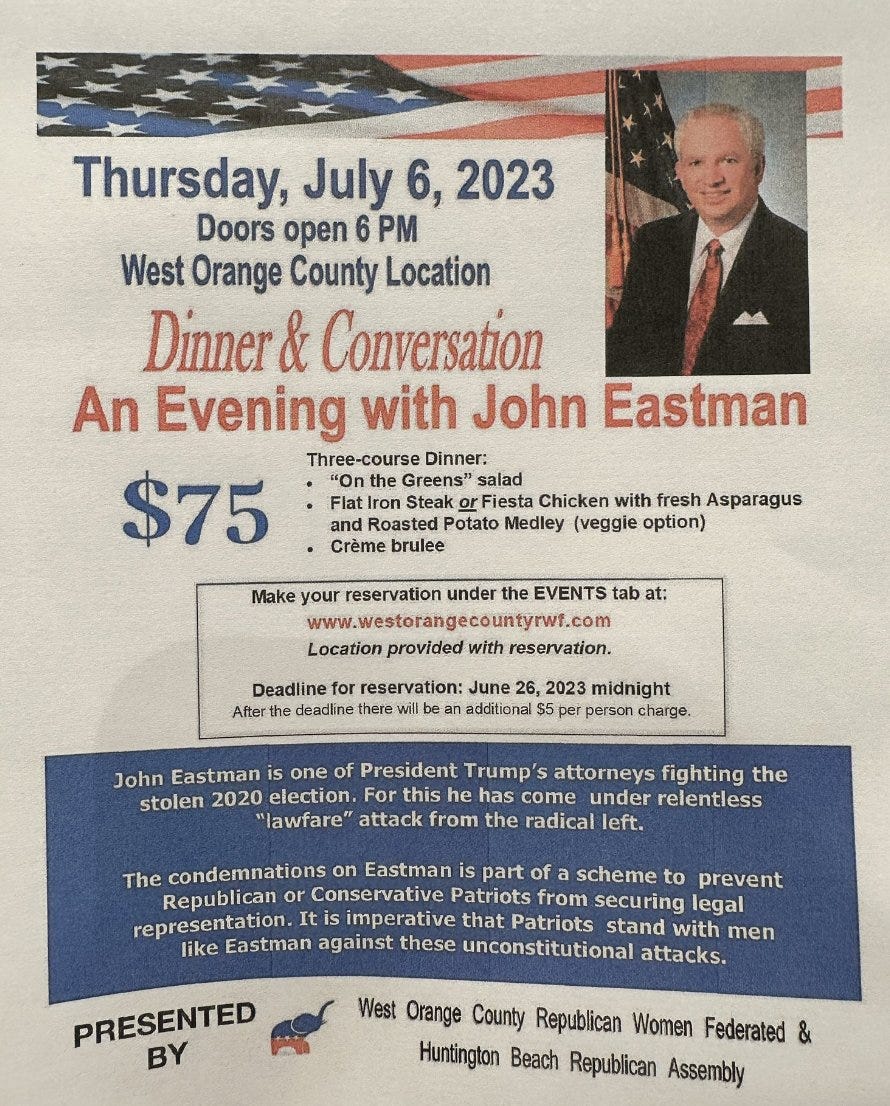
Eastman, meanwhile, has his own speaking schedule. He’ll be dining with the West Orange County Republican Women Federated and the Huntington Beach Republican Assembly on July 6.
“John Eastman is one of President Trump’s attorneys fighting the stolen 2020 election. For this he has come under relentless ‘lawfare’ attack from the radical left,” the flyer reads. “The condemnations on Eastman is part of a scheme to prevent Republican or Conservative Patriots from securing legal representation.”
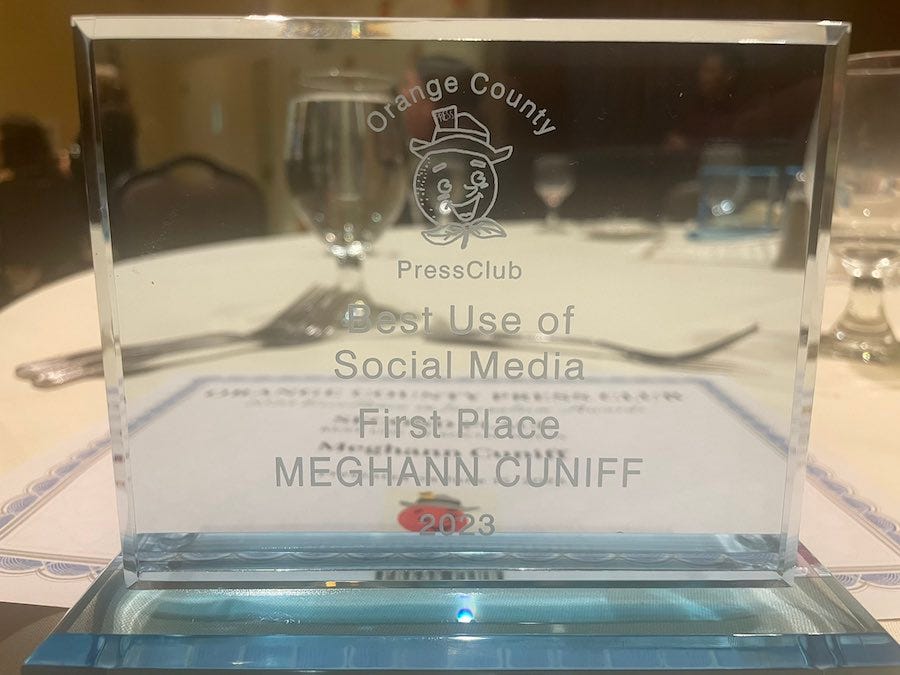
Speaking of speeches, my Twitter coverage of Eastman’s March 2022 speech to the California Republican Assembly recently earned 2nd place for “best use of social media” at the Orange County Press Club awards. The competition was stiff: 1st place went to my coverage of Cardi B’s civil trial. Congratulations to all winners!
Thank you for supporting my independent legal affairs journalism. Your paid subscriptions enable me to go in-depth and unfiltered on major issues. If you’re not already a paid subscriber, please consider purchasing a subscription for yourself or a gift subscription for someone else. Your support is absolutely essential to my work and will help build www.legalaffairsandtrials.com into a hub for quality journalism about our judiciary.