
Inside the jury deliberations that ended in seven felony convictions for Mark Ridley-Thomas
The forewoman confirmed prosecutors were correct: Jurors were misled by an instruction and believed an additional burden of proof existed for the bribery charge.


The forewoman of the jury that convicted Los Angeles politician Mark Ridley-Thomas of seven felonies last week confirmed that an instruction led jurors to mistakenly believe they needed to find an additional criminal element to bribery beyond bribery itself.
Kirsi Kilpelainen said the discussion in the jury room about Ridley-Thomas’ bribery charge was “a circular conversation amongst the jurors” because of an instruction that said the government must prove he “acted corruptly.”
The instruction went on to say, “that is, intending to be influenced or rewarded with any business...,” but jurors asked two questions on their third day of deliberations that indicated they were stuck on the same instruction’s definition of corruptly.
Both came in jury note 5.
What is the difference between method and means. Can we get an example relating to the case? (lines 6-7 pg 24)
Does unlawful equal illegal or is there another definition we should consider? Is it possible to provide examples of unlawful methods or means? (line 5 page 24)
The note is referencing this portion of the jury instructions:
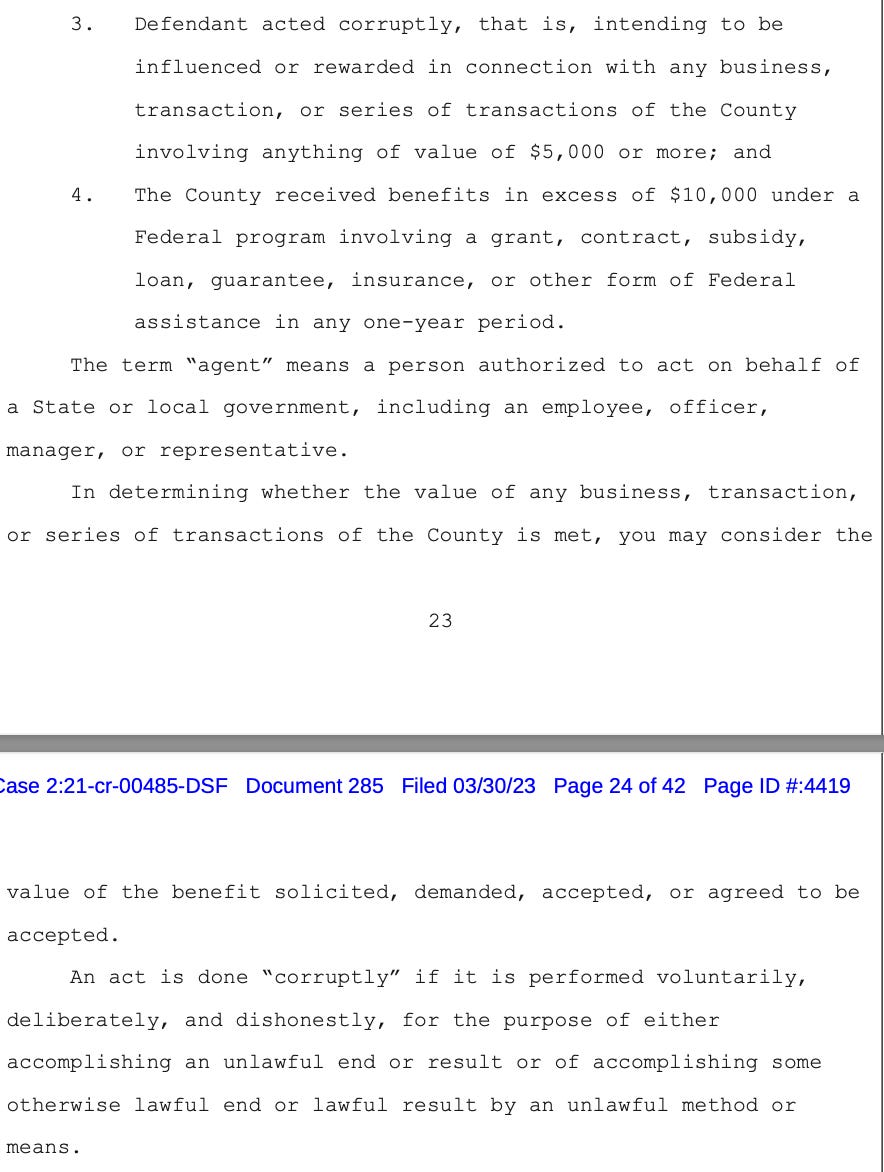
Jurors had already asked about jury instruction 20 in jury note #4, questioning whether they needed to find “all the elements in the definition of ‘corruptly’ or if it was merely there for reference.” They were told the government “must prove that the defendant acted corruptly.”
As I reported at the time, U.S. District Judge Dale S. Fischer mulled striking the instruction altogether after the jury sent note #5. But she didn’t, instead responding to the jury’s question this way:
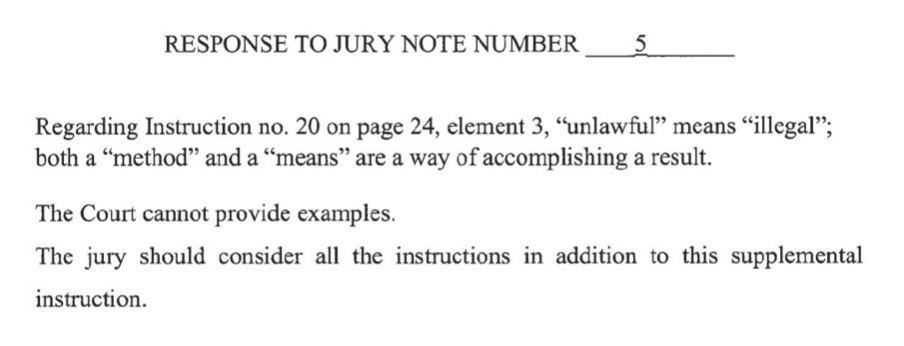
Jurors had already asked about jury instruction 20 in jury note #4, questioning whether they needed to find “all the elements in the definition of ‘corruptly’ or if it was merely there for reference.”
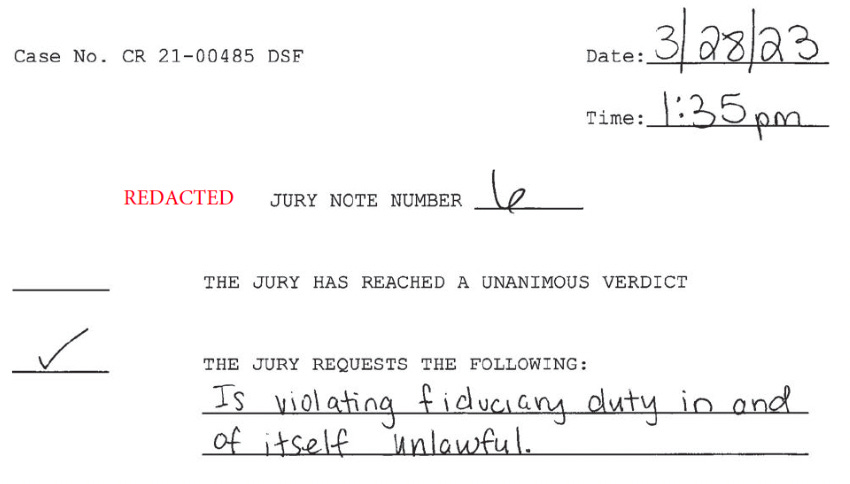
Jury note #6 likely didn’t make prosecutors feel better about the “corruptly” instruction.
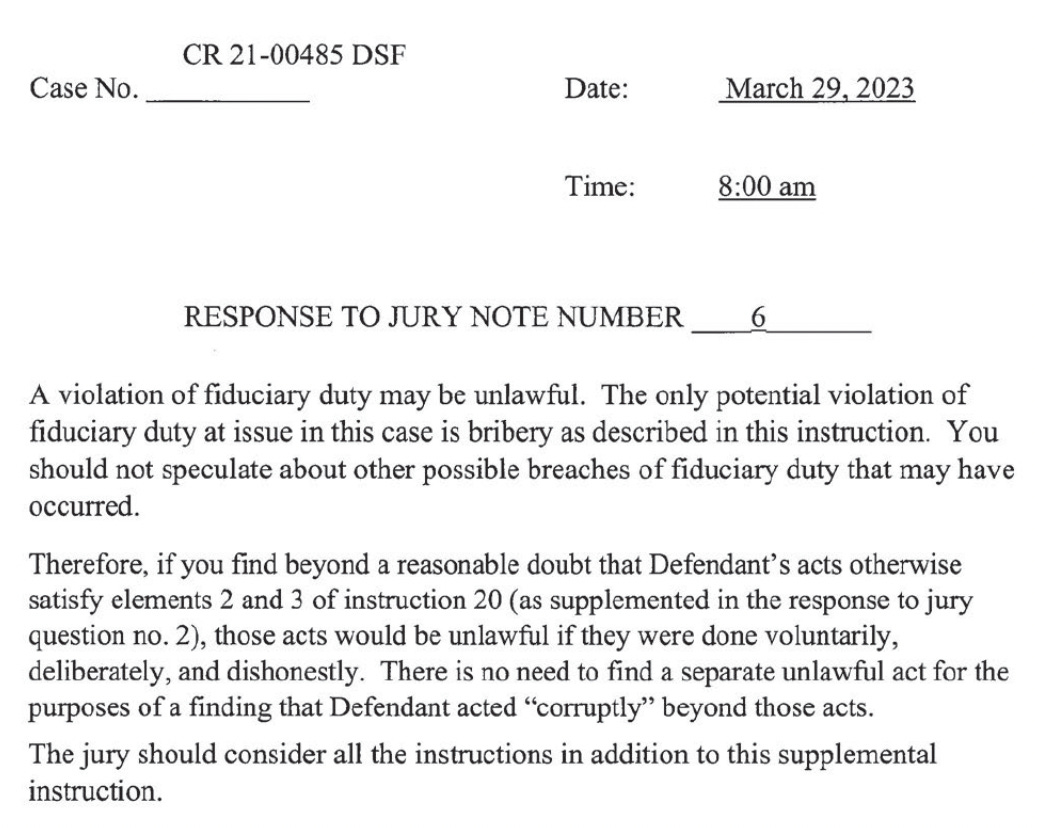
But Judge Fischer’s response may have alleviated some concern. It included the line, “There is no need to find a separate unlawful act for the purposes of a finding that Defendant acted “corruptly” beyond those acts.”
More than a day of deliberation and seven notes later, the jury convicted Ridley-Thomas, 68, of bribery and conspiracy, as well as four counts of honest services wire fraud and a single count of honest services mail fraud.
His sentencing was scheduled for Aug. 14, but Judge Fischer on Tuesday moved it to Aug. 21 after prosecutors agreed to the change with Ridley-Thomas’ lawyers because one had a scheduling conflict. (I’ll be writing an article later on Ridley-Thomas’ possible sentence.) Fischer also approved a post-trial briefing schedule that gives Ridley-Thomas’ lawyers until May 1 to file a motion for new trial. Prosecutors will have until May 22 to respond.
After the verdict, Kilpelainen told reporters in the hallway that jurors were unsure on the bribery charge until they realized they could convict on fraud charges related to the $100,000 in campaign money that Ridley-Thomas funneled to his son’s nonprofit initiative through the University of Southern California. At the time, Ridley-Thomas was an elected member of the Los Angeles County Board of Supervisors in 2018.
Ridley-Thomas’ agreement with Marilyn Flynn, the now-dean emeritus of the USC School of Social Work, regarding the money drove the convictions; Kilpelainen said jurors never agreed that Sebastian’s USC admission, scholarship and professorship were part of a conspiracy, which resulted in the not guilty verdicts for one count of honest services mail fraud and 11 counts of honest services wire fraud because those counts were related to the scholarship and job.
Kilpelainen spoke with reporters in the hallway after Judge Fischer read the verdictt. She also answered questions through Instagram on Friday.
A 36-year-old marketing specialist, Kilpelainen lives in San Luis Obispo, so U.S. District Court put her up in a hotel in downtown Los Angeles for trial, though she went home on the weekends.
She described her trial experience as “cool” in a Instagram stories question-and-answer session and encouraged everyone not to try to get out of jury service if they’re summonsed. She also offered insight into deliberations beyond what I reported from her hallway talk, including that jurors didn’t see much use for the testimony about Sebastian Ridley-Thomas’ health. The issue before them was whether Mark Ridley-Thomas had used his position as a public policymaker to get personal benefits — benefits that happened to be related to Sebastian Ridley-Thomas.
Sebastian’s health came into the trial because he cited it as the reason he resigned from the California State Assembly in December 2017. Prosecutors said he actually quit because of sexual harassment allegations against him, and his father’s actions were to secure him a respectable post-legislative landing position.
The defense called Sebastian’s doctor and Sebastian’s mother to testify about his health problems, but Kilpelainen said jurors didn’t focus on why Sebastian resigned when discussing his father’s 19 charges. Their focus was on the sequence and timing of events related to the alleged bribery conspiracy, and the detailed instructions that were to guide their decision. They created a timeline piecing through the email exhibits and their memories of the testimony, and they took turns reading the instructions aloud.
Kilpelainen answered several other questions through Instagram, mostly basics about the case such as the judge’s name, the type of case and how quickly the jury agreed. She said some jurors remarked that Ridley-Thomas was doing good things for the community, but they knew that wasn’t to be their focus as jurors. She said she researched Flynn after the verdict because everyone was curious what happened to her, and she wanted to know what Ridley-Thomas’ college degree was in because she’d heard the academic credentials of basically everyone in the trial except him. She appeared amused to have learned Ridley-Thomas’ degree is in ethics.
I spoke with Kilpelainen via private Instagram message and text message, which is how she confirmed the issues surrounding the “corruptly” instruction. Had that instruction not existed, “I don’t think the result would be different. If anything, removing that instruction would have made it faster for our jury to give a guilty verdict in bribery,” she said.
Kilpelainen doesn’t believe omitting that instruction would have changed the verdict regarding Sebastian’s scholarship and professorship, because jurors were too far apart on whether Ridley-Thomas’ actions with Flynn regarding them constituted a bribery conspiracy.
“We were close on the professorship,” she told me in a text message.
The $100,000 transaction had a tighter timeline, including a key email Ridley-Thomas sent Flynn on May 3, 2018, in which he told her it was “necessary to act with dispatch” and get the money to United Ways of California so a director could be hired for Sebastian’s nonprofit by the 15th. Jurors heard testimony about the unusual efforts Flynn took to expedite the transaction at work the next day.
The most depressing part about Kilpelainen’s Instagram question-and-answer session was hearing her say that Matt Hamilton’s Los Angeles Times article was the only article that didn’t take her after-verdict comments out of context. (She later included my article on her good list after I sent it to her. She hadn’t seen the paywalled Law360 article by Gina Kim, the only other reporter who actually covered the trial.) She also took issue with news reports describing the jury verdict as “confusing,” and I don’t blame her. The verdict may seem confusing to people who didn’t watch the trial or didn’t read the jury instructions or really make any minimal effort to understand what actually happened in that courtroom, but it’s unfair to say the jury verdict is confusing as a way to discredit it.
It is appalling how bad so many L.A. media outlets are at covering trials. Coverage of U.S. District Court is nearly nonexistent, despite the major prosecutions in the Central District of California. And the lack of literacy regarding legal issues when some of these people do show up at a courthouse is infuriating. I got so angry listening to a few people interrogate Kilpelainen about her verdict in the hallway that I forgot to ask her a question I’d had since the jury was impaneled on March 7. What is the dog’s name?

Thank goodness for social media. I submitted the question to Kilpelainen through Instagram, and she answered it in a video she’s allowing me to re-publish.
Matt scooped me on Homer’s name when the Times on Monday published his interview with Kilpelainen, but that’s OK. The video of her answering my question still is worth sharing. I also highly recommend reading Matt’s interview with Kilpelainen, which you can find here.
Lastly:
Here are the jury instructions.
I uploaded all the jury notes and responses here.
And you can watch my discussion about the verdict with Kate Cagle of Spectrum News 1 SoCal below.
Past coverage:
(One thing: The Central District U.S. Attorney’s Office press release about Ridley-Thomas’ conviction confirmed my fear that Flynn had indeed celebrated a birthday since her guilty plea in September. She’s now 84, not 83, so all the previous trial coverage that says she’s 83 should say 84. Sorry about that.)
March 30: Jury convicts Mark Ridley-Thomas of bribery, conspiracy in federal corruption trial
March 30: Jury asks about final 15 counts of Mark Ridley-Thomas' 19-count USC bribery indictment
Rebuttal: March 26: Jury hears prosecutor's final account of Mark Ridley-Thomas' evolving USC bribery scheme
Closing arguments: March 23: Defense says USC’s 'VIP' treatment made scholarship for Mark Ridley-Thomas' son 'business as usual'
Defense witnesses including Ann Ravel: March 22: Defense rests in suspended L.A. City Councilman Mark Ridley-Thomas' federal corruption trial
FBI Special Agent Brian Adkins: March 20: More from the FBI agent's testimony in L.A. City Councilman Mark Ridley-Thomas' criminal trial
MRT and Ralph Frammolino emails, USC whistleblower Michele Clark, USC employee Adriana Gonzalez: March 18: Prosecutors rest their public corruption case against L.A. City Councilman Mark Ridley-Thomas
Voir dire, evidentiary hearing: (I missed the first three trial days) March 8: primer on suspended Los Angeles City Councilman Mark Ridley-Thomas' bribery trial
Thank you for supporting my independent legal affairs journalism. Your paid subscriptions enable me to go in-depth and unfiltered on major issues. If you’re not already a paid subscriber, please consider purchasing a subscription for yourself or a gift subscription for someone else. Your support is absolutely essential to my work.
Thanks as always for fabulous coverage on LA scandals. MRT & his supporters seemed so confident that this would blow over for so long...maybe because wasn’t quite Huizar-level corruption? Still illegal, though & he should have known better. I wonder if/when the FBI will pounce on City Staffer B...