

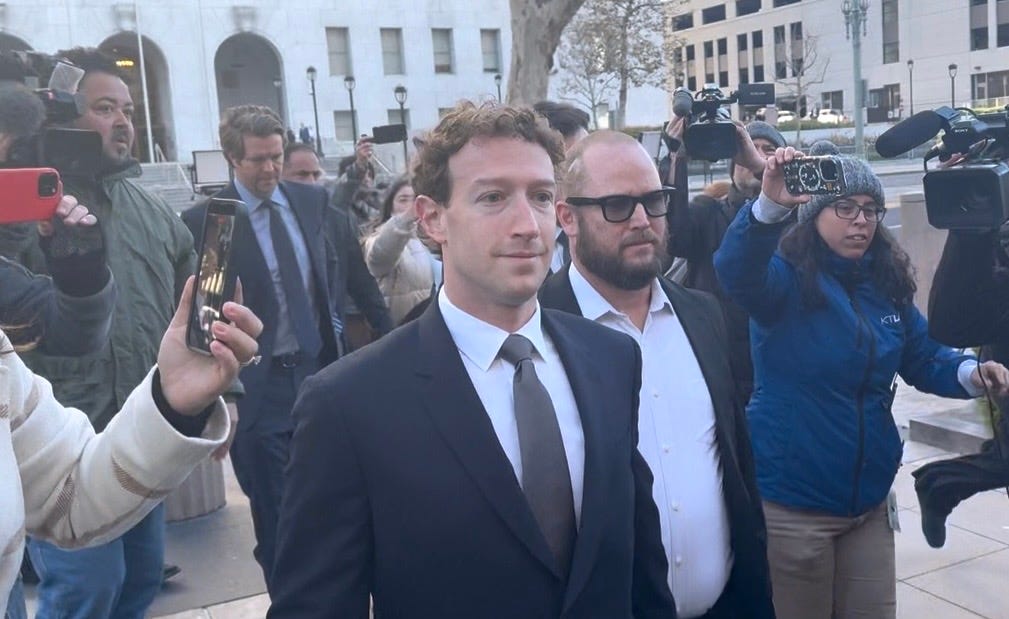
Mark Zuckerberg set the tone for his testimony in a landmark civil trial in Los Angeles last week with his first answer.
In a packed Los Angeles courtroom, the multibillionaire founder of Meta paused and said, “Uh, sure,” when plaintiff’s lawyer Mark Lanier asked, “You and I, and I think everybody, will readily agree that there are vulnerable in this world, fair?”
It began a multi-question point that culminated with Lanier saying if a company knows it does more harm than good, “than that company needs to reexamine its values.”
“Um, I think that’s probably right, yes,” Zuckerberg answered.
The exchange began Zuckerberg’s nearly three-hour direct-examination in a landmark lawsuit alleging Meta’s Instagram and Google’s YouTube substantially contributed to a now-20-year-old California woman’s mental health problems through the intentionally addictive nature of the platforms. The trial is a bellwether that could influence how attorneys approach approximately 1,900 other lawsuits in California state court that have been coordinated into a single case in Los Angeles County Superior Court.
Zuckerberg is the most prolific witness, and the 41-year-old Facebook co-founder made clear in his testimony on Wednesday that he finds the allegations driving the lawsuit, and Lanier’s courtroom approach, wrong and also, simplistic.
He also dismissed Lanier’s suggestion that he’s worried about media coverage of the trial by saying, “This is a court proceeding. This is, like, an important societal institution where we have jury debate and understand and come to judgment on an important question.”
“That has a much higher importance than how the media will report what I say,” he said.
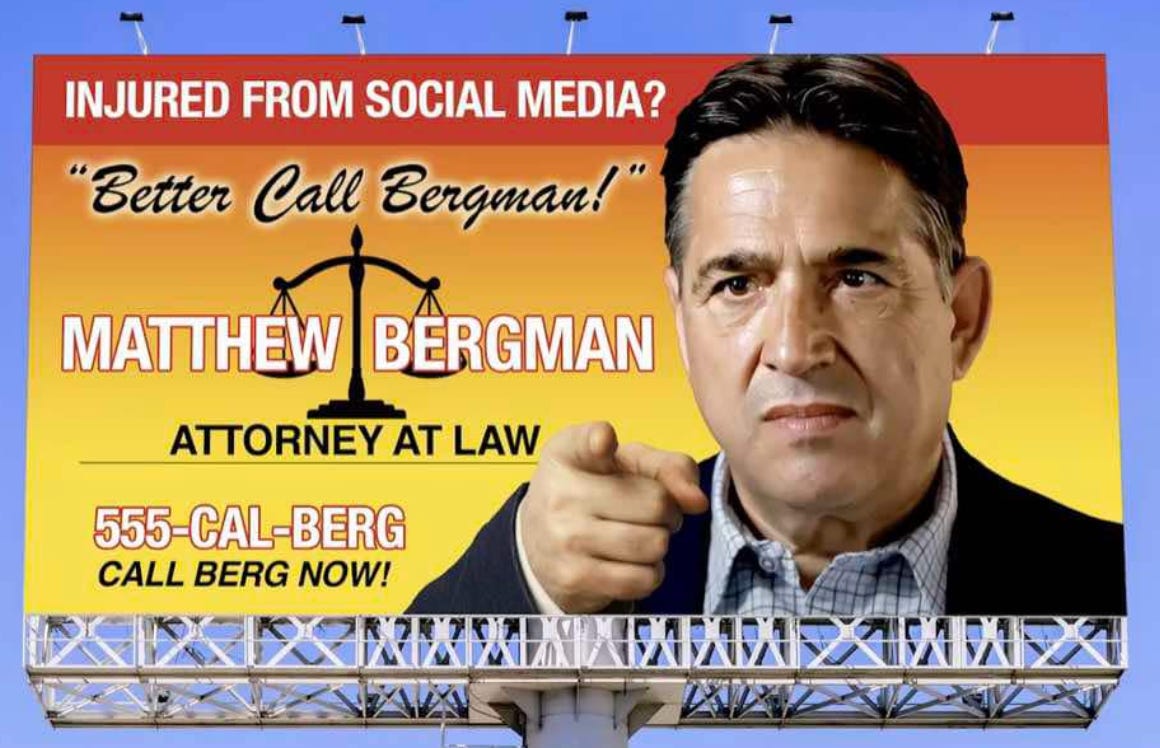
Several parents who are pursuing similar lawsuits watched Zuckerberg testify from the courtroom gallery. They were joined by Matthew Bergman, a Seattle-based lawyer who has hundreds of lawsuits against social media companies and is the original attorney on the case currently on trial.
Judge Carolyn B. Kuhl threatened to ban Bergman from the courthouse last week after he conducted an online interview with the BBC World News despite previously being admonished about electronics restrictions after he took a photo of himself inside the courtroom and posted it online.
During a hearing on Friday, Kuhl allowed Bergman to continue attending the trial but removed him from the steering committee for the coordinated lawsuits, which is a group of appointed attorneys who manage the cases and are entitled to money from verdicts and settlements.
“After I’ve counseled you about not taking photography, you video yourself inside the courthouse. So the problem is, I’m trying to focus on your claims case, and instead, I have to focus on this distraction,” Kuhl said.
The judge told Bergman he should apologize to his co-counsel.
“I feel most bad for your colleagues on the plaintiff’s side,” Kuhl said.
The judge scheduled a hearing on March 23 to determine if Bergman should be held in contempt of the court.
In the courtroom, the face of the case has been Lanier, a nationally prominent lawyer from Houston with a long record of big wins in mass torts.
But Bergman has for several years promoted himself nationally as the face of litigation against social media companies, including through a billboard that likened himself to Saul Goodman, the corrupt fictional lawyer on the television shows “Breaking Bad” and “Better Call Saul” who ends up disbarred and serving an 86-year prison sentence.
Bergman built his practice suing over asbestos-related claims and now operates the Social Media Victims Law Center in Seattle. He told Judge Kuhl in a four-minute mea culpa on Friday that he was so emotional over Zuckerberg’s testimony he wasn’t thinking clearly when he used his phone’s video camera to speak with BBC inside the courthouse.
“The events of Wednesday were so emotionally overcoming for me and those families that I have known for four years that I lost sight of my obligations as an officer of this court. That was inexcusable,” Bergman said.
He said he’s “absolutely appalled at my own conduct,” “deeply ashamed” and “profoundly embarrassed.”
“In a case about tech accountability, the fact that I was not accountable on tech issues in this court is humbling and I am deeply sorry,” Bergman said. He said he hopes the experience “can be a learning experience for me, and I hope that this will be an opportunity for me to reflect deeper how the situation arose and become a better lawyer and person in the future.”
He said he accepts his removal from the steering committed but asked if someone else from his firm can replace him. Kuhl said another attorney from his firm already is on the committee, and that won’t change.
“Your conduct does not implicate her,” Kuhl said.
Bergman spoke to reporters outside the courthouse.
“Wednesday was a very intense day,” Bergman said. Being in court with parents he’s cried and prayed with while Zuckerberg was on the stand “was emotionally overwhelming to me, and resulted in me lapsing from my obligations as an officer in the court.”
Bergman and others have held regular rallies and press conferences outside the courthouse with parents of children who died from drug overdoses or suicides or were harmed through their participation in online trends such as choking games.
Jonathan Haidt, a social psychologist and chair in ethical leadership at New York University, said at a rally outside Los Angeles City Hall last week that
“These trials are going to change the world,” Haidt said.
Haidt wrote on Instagram, “For the first time, tech executives are being forced to answer to the evidence that their social media platforms knowingly harm kids — even as lives are lost.”
Advocates hope the information released through the trial will lead to Congressional inquires and legislative changes, but much of Lanier’s questions to Zuckerberg regarded his testimony to Congress and information that has been public for years.
A direct-exam about credibility, truth and harm
First, I should say it’s an outright miracle I got in the courtroom for Zuckerberg’s testimony.
I have a badge that’s supposed to guarantee me a seat, but I didn’t get into the courthouse until just a few minutes before he got on the stand because there was a long line to go through security, including a jury pool for another case.
The demand for seating for Zuckerberg’s testimony obviously was ferocious, and there didn’t appear to be any space at all when I walked in. The guy in charge of media seating firmly told me there was no space.
Then it’s like a spell was cast over the courtroom because the media people began looking around for a place to fit me in, and they settled on a tiny nook in a back row already packed with reporters.
I squeezed in and realized I was sitting next to NBC Los Angeles reporter Alex Rozier, whom I’ve known since we were reporters in Spokane, Washington, together 15 years ago, and I knew I’d be okay.
Zuckerberg was sworn in just a couple minutes after I walked in. I was outside when he walked in, and I can confirm the moving media mob included the obligatory falling cameraman.
Lanier’s opening sequence included asking Zuckerberg if he agrees one option for vulnerable people is to “prey upon them,” to which Zuckerberg replied, “I guess. I don’t think we should.”
“Amen to that,” said Lanier, who’s also a Christian pastor.
Lanier told Zuckerberg the “road map” for his exam has three stops: “the stop of credibility, the stop of truth and the stop of harm.”
He approached the first by questioning Zuckerberg about his financial stake in Meta, which is roughly 13 percent of its stock shares worth about $200 billion. Zuckerberg said it’s true he makes more money when Meta’s stock value rises, but “it might be worth adding that I have pledged to give almost all of my money to charity.”
“I focus on giving billions of dollars to science, research, knowledge,” Zuckerberg said. “The better that Meta does, the more” he can donate to research.
Lanier referenced a motion in limine from Meta’s lawyers and asked, “Sir are you suggesting we examine your spending habits and what you own?” “I’m not suggesting anything. I’m answering your question about my economic motives” because the more money Meta makes “the more money I will be able to invest in science,” Zuckerberg said, adding that he’s pledged to donate “99 percent” of his wealth.
“Have you signed over your money, sir?” Lanier asked.
Zuckerberg said he believes most of his stock is going to his trust already.
“Now you have absolutely no income from that stock? You have no right to dictate where it goes?” Lanier asked.
“Oh, of course I determine where it goes,” Zuckerberg answered.
Lanier asked if the research Zuckerberg funds includes “the AI and the other things that are related to this,” and Zuckerberg said he doesn’t believe artificial intelligence “is related to this case.”
Judge Kuhl told Lanier to ask the question again “without the AI reference.”
Lanier asked Zuckerberg if it’s fair to say he and his wife determine where the money is invested.
“Yes, for the most part,” Zuckerberg said, though other people have input. He said the money “predominately goes towards scientific research” and another “large amount” goes to education.
“How much have you pledged towards helping with those people who have been hurt by social media?” Lanier asked.
“Uh, that’s not part of the focus of the foundation,” Zuckerberg said.
Lanier told him that wasn’t the question, and he again asked how much he’s pledged toward people harmed by social media.
“I disagree with the characterization of that,” Zuckerberg said.
Lanier asked if he remembered Sen. Josh Hawley asking if he’d give money to “help the victims of social media,” and Zuckerberg said, “I believe he would have asked something like that, but I don’t recall it myself.”
“Well, I’ll ask it of you. Have you?” Lanier said.
Zuckerberg said “no” and again said he disagrees “with the characterization.”
Lanier asked Zuckerberg about him telling podcast host Joe Rogan he has the benefit of “not having to convince the board” of directors not to fire him, and Zuckerberg said “that’s roughly true, although it’s a little more complicated.”
“I think what I told Joe Rogan was a simplified version,” he said. Lanier wanted to play Zuckerberg’s comments to Rogan for the jury, but Meta’s lawyer Paul Schmidt said there was no testimony to impeach and Judge Kuhl agreed.
Zuckerberg said that “being in court now” calls for a more technical explanation. He said it’s “roughly correct” that the board can’t fire him because he has a majority stake so if they tried to, he could elect a new board, “but in practice, the board is independent.”
“Your decisions ultimately determine corporate policy at Meta, true?” Lanier asked.
“Yes,” Zuckerberg answered.
Zuckerberg pushed back when Lanier said he has “extensive media training, true?”
“I’m not sure why you say that,” Zuckerberg answered. He said he’s “sort of well known to be very bad at this.”
Lanier said Zuckerberg works with communications teams who “give you pretty clear instructions on how to be good versus bad.”
Lanier moved into evidence and displayed for the jury a document called “MZ’s comms plan.”
The document instructs Zuckerberg to be “authentic, human, insightful and real” and “not to try hard, not to be fake, robotic, corporate or even cheesy.” Zuckerberg said that was the advice “in general” and said he consistently seeks advice on how to improve.
Lanier displayed an email in which a communications specialist tells Zuckerberg that he should address concerns about social media causing children a “fear of missing out” by mentioning that he “will have two teenage daughters someday, so this will be personal to me, too.”
Lanier said he’s not only trying to become a better person, he’s “trying to further the mission of Meta.”
Zuckerberg said he’s “trying to communicate more clearly.”
“That’s one thing that doesn’t come naturally to me,” he said. “Being able to communicate more clearly is certainly something I’ve had to work on over time.”
Legal Affairs and Trials with Meghann Cuniff is a reader-supported project that utilizes my 20 years of reporting experience in traditional media to bring you in-depth news about major legal issues. If you want to support my work, consider upgrading to a paid subscription.
Lanier asked if his preparation was for situations such as “what we’re doing today,” and Zuckerberg said “I don’t consider what we’re doing today to be media.”
That led into a topic that Lanier also pressed heavily with Instagram Head Adam Mosseri during his testimony on Feb. 11: The policy against children under 13 using Instagram and how it’s enforced, or not enforced, and Instagram’s focus, or non-focus, on the time people spend on the platform.
Zuckerberg said he doesn’t remember his “exact words” to Congress claiming a lack of connection between social media and worsening teen mental health, but he said “that is my understanding of the summary of scientific literature.”
Then, about 35 minutes into the exam, Lanier segued from the “credibility” stop on the “road map” he mentioned in the beginning to the “truth” stop by asking Zuckerberg about a 2018 document that said, “We can estimate there were 4 million people under 13 in 2015 on Instagram.”
Zuckerberg testified Wednesday he “generally” thinks there are young people who lie about their age to access Instagram “and we have a bunch of systems” to try to detect them.
“It’s often difficult to determine,” he said.
Lanier pointed out that Instagram didn’t always ask for a user’s birth date when creating an account, including when the plaintiff, who’s identified in court as Kaley G.M., created an account in 2015 when she was 9 years old.
Even with the verification system, “You expect a 9 year old to read all of that fine print? … That’s your basis for swearing under oath to children under the age of 13 not allowed?” Lanier asked.
Zuckerberg said there’s an “important question about enforcement” and again acknowledged “it’s very difficult” to enforce.
Lanier displayed an email chain from 2019 in which an employee said Instagram’s lack of “proactive action on detecting under 13 and detecting under 13 accounts undermines our credibility.”
Zuckerberg testified there was “some debate” about the “private sensitivity of asking users to disclose their birthdates.
“We build more tools and things over time. I always wish that we could have gotten there sooner,” he said. “I think we’re in the right place now, … and I think we’ll continue to add more over time.”
Lanier characterized the questions and answers as them looking “at the truth about whether or not under 13 were on Instagram.” He displayed an email in which a Meta employee attached a presentation with an objective to “unearth digital behavior of eight to 12” year olds “with the ultimate aim of creating opportunity areas that ignite Facebook creativity”, expansion and development.
Zuckerberg pointed out that the presentation wasn’t from Meta and said he didn’t receive the email and said he’s unsure “what the relevance is.”
“You may not see the relevance, but for some people it may be, so let me keep going with that,” Lanier said.
Lanier pointed out that the document quotes a 12-year-old girl as saying she spends a lot of time on instagram.
It “clearly seems to indicate that there’s at least one 12 year old on Instagram,” Lanier said.
Zuckerberg said the company acknowledges “there are people who get around the restrictions.”
Lanier again asked him about his testimony to Congress that no children under 13 see advertising on Instagram because they’re not allowed on Instagram. Zuckerberg said that’s true but told him, “I think you’re mischaracterizing what I said” and “I don’t think this is complicated.”
“It’s been our clear policy that people under the age of 13 are not allowed on our services. And I think I’ve also been consistent that there are people who get around the rules, and we try to take steps to identify them and remove them, and they’re not perfect,” he testified on Wednesday.
Lanier spent the final 20 minutes before the 90-minute noon recess questioning Zuckerberg about whether the company tries to increase the amount of time users spend on Instagram.
“Earlier on in the company, we had goals around this, and then at some point, I decided” not to focus on time but to focus on “utility and value instead.”
“There’s a basic assumption that if you build something valuable, then people will do it more because it’s useful to them,” Zuckerberg said.
“People do things more because they’re addictive, don’t they?” Lanier asked.
“I’m not sure what to say to that,” Zuckerberg answered. “I don’t think that that applies here.”
Lanier displayed a 2015 document that discussed goals for increasing the time spent on Instagram by 12 percent, and Zuckerberg again said that his approach changed over time. Lanier displayed another document from 2021 that celebrated increases in time spend on Instagram, and Zuckerberg differentiated between “goals” and “milestones.”
Lanier finished his exam after the noon recess by asking Zuckerberg about an internal Facebook document that discussed “known negative effects of Facebook and/or social media in general on teens.”
The report said “increased screen time, particularly before bed, is linked to sleep issues, which have long term negative effects on cognitive and physical development.”
“One out of five teens” report “checking social media in the middle of the night. Teens feel enormous pressure to portray their idealized self on social media,” the report said. “Teens take 20 selfies to get to the right one to post.”
Lanier ended his exam by having his co-counsel display a large banner with photos Kaley posted on her Instagram. it stretched about 50 feet across the well of the courtroom, and it stayed displayed for a couple minutes as Lanier questioned Zuckerberg.
“Did you look carefully and see how much time had been spent and how many pictures had been posted by Kaley G.M.?” Lanier asked.
“No,”’ Zuckerberg answered.
“Did you try to analyze whether or not there may have been social harm to her?” Lanier asked.
“Me personally?” Zuckerberg asked.
“Yes, sir,” Lanier answered.
“We have our team and the experts who were involved in this trial, and that was thoroughly done,” he said. He said he saw “some of the photos” but not all.
He also said he’s “not sure that’s accurate” when Lanier said Instagram owns Kaley’s photos.
“Once it’s posted on Instagram, you don’t think those terms and conditions that we were talking about earlier might say something
about that?” Lanier asked.
“I don’t think we own it,” Zuckerberg asked.
Lanier had no more questions.
A cross-exam about growth and change
In cross-exam, Schmidt asked Zuckerberg if it’s important to him that people don’t feel harmed by Instagram.
Zuckerberg said “yes” and again said he wants to build a product thats a good thing and creates value in people’s lives.
“I’m focused on building this company over a very long period of time,” he said. “If you feel like they’re not having a good experience, then why would they use our products over a long period of time?”
“I want to make sure that we can build out this platform and this community over a very long period of time,” Zuckerberg continued. He said he built Meta’s services because this was a thing that I wanted to exist and that I wanted to use.”
“It’s very important to me and I think a lot of people I work with that what we do is something that people get value out of and feel like it’s a positive force in their life,’ Zuckerberg testified.
Schmidt, a partner at Covington & Burling LLP in Los Angeles, asked if wanting people to use Instagram is equivalent to wanting them to use them too much, and Zuckerberg said “No. I mean, I’ve tried to explain a few times” that he wants to build a valuable product, not a harmful one.
“To me, the North Star is making sure that we’re delivering value and that people are having positive experiences,” Zuckerberg said. People will gravitate toward social media if other mediums aren’t improving as quickly, he said, and “TV hasn’t gotten that much better over time, but I think social media has improved quite a bit.”
Schmidt asked if it’s important to him to be “honest and truthful” and Zuckerberg answered, “Always.”
“Ae you aware that Mr. Lanier asked you to testify here in his case?” Schmidt asked.
“Yes,” Zuckerberg answered.
Schmidt then pointed out that Lanier spent the first 30 minutes of the exam questioning Zuckerberg’s credibility.
“Yeah, I guess so,” Zuckerberg answered.
Schmidt asked if he’s “done your best to be truthful” when testifying.
“Yes,” Zuckerberg answered.
I said on KNX News radio during the lunch break that I expected to hear something in Schmidt’s cross about Zuckerberg’s starting theFacebook.com in his Harvard University dorm room, but Schmidt’s wrecked my prediction by telling Zuckerberg, “As I understand it, you started Facebook in college. I’m not going to ask you about that.”
Zuckerberg said he became interested in computers when he was 11 and a friend had one “and I thought it was awesome.” He wasn’t expecting to stay in California when he moved to Silicon Valley to build Facebook, but its popularity grew so much, he never left.
“I didn’t really think that Facebook was going to be a big company. I thought maybe one day I would start a company,” he said.
Facebook’s principles of “helping people express what they care about, helping people stay connected, helping people learn about other people” “are really important things to people.”
Trying to express who we are and talk to people we care about is “a thing that we all spend time doing.”
“So if can you build a tool that helps people do that, that’s a very useful thing,” he said.
Schmidt asked Zuckerberg about Facebook’s early motto, “Move Fast and Break Things.” Zuckerberg said it reflected Facebook’s early development, when he asked engineers “to try to innovate quickly, and when there were errors, we would just fix them. … That actually stopped working as a strategy.”
“I think it’s worth noting that we had a lot of debate around that phrase,” Zuckerberg said.
Schmidt went over an internal document with Zuckerberg that discussed the need to “focus on long-term impact.”
“Put your energy into what you know will have the greatest impact. Do not waste time on minor issues and instead focus on truly big challenges,” the document said.
Schmidt asked how a long-term focus relates to focusing on wellbeing, and Zuckerberg said, “I think we’ve talked about this a few times.” Some people may want to get people to use products in the short term, but Zuckerberg wants to focus on long-term value because “that’s actually the thing that sets us up for success.”
“That’s what I care about it,” Zuckerberg said, calling it a “bad strategy” to do anything else.
“I think becoming too myopic and too focused on the near term is the downfall for a lot of companies,” he said.
Schmidt highlighted the document’s goals to “build awesome things” and “technology that inspires people and revolutionizes.”
“I think the world needs inspiration,” Zuckerberg testified. “there’s a difference between building something that’s good and building something that’s awesome.”
“Something could be both. It can be awesome and good. It can be awesome and not good,” he continued. “I just want our company to push towards building both of those things.”
Zuckerberg also said his company doesn’t make much money from teenage Instagram users.
“The most recent estimate that I saw is less than 1% of revenue is from teens, or something like that,” he said.
Still, Instagram wants teenagers to use the platform, and ensuring they stay means giving them positive experiences, he said.
Schmidt followed up on Zuckerberg’s distinction between “milestones” and “goals” regarding time spent on Instagram.
“There’s a very important difference, which is that we’re not doing these as goals for teams to work on,” he said. He said milestones are “sort of like this gut check at a high level for, like, is the plan for the company tracking in the way that we want.”
After a 15-minute recess, Schmidt questioned Zuckerberg about a written comment he submitted to Congress about the need for a clear age verification system. Zuckerberg testified that phone makers such as Apple could develop a way to inform apps if a user is under 13.
“I think that doing that kind of control at the phone level is a very wise and simple way to do it, rather than having many, many app companies have to go try to build this verification,” Zuckerberg said.
Schmidt also asked Zuckerberg about plastic surgery photo filters on Instagram.
Zuckerberg said he prohibited the filters as “a reasonable precaution” while the company decided how to approach them long term. The final policy allows people outside the company to create the filters for Instagram but does not allow the company to promote them. He said he viewed the debate as “very challenging” and important to people’s freedom to express themselves.
“If people want to express something, and there isn’t evidence that it’s harmful to others, i think we should generally allow it,” he said.
Schmidt displayed an email exchange between Zuckerberg and Apple CEO Tim Cook in February 2018 about working together and “making sure technology improves people’s wellbeing.” Zuckerberg told Cook he wanted to reduce the time people spend on our services and make the time that they do spend…a lot better.”
Schmidt asked what he meant when he told Cook they’re “working on ways to encourage healthier technologies.”
“I mean, I think it’s pretty descriptive,” Zuckerberg told his attorney. “I’m basically saying that I care about the wellbeing of communities and kids who are using the services. We are trying to make sure that what we do improves wellbeing.”
Schmidt ended his exam by asking Zuckerberg why he’s stayed with Facebook and Instagram for so long.
Um, I really care about the stuff that we’re building,” he said. He said he believes “giving people broadly the ability to express themselves” and “learn about the world around them” are “important things.”
Re-direct and re-cross
In re-direct, Lanier pressed Zuckerberg about Instagram having goals for the amount of time users spend on the platform.
“Yeah, I think I’ve been clear today that we used to have goals on this, and then we changed our view,” Zuckerberg testified.
Zuckerberg again differentiated between goals and “milestones” company executives discussed in 2022, which caused Lanier to say, “I’m trying to ask very direct questions and you caused me to deviate. So now we need to talk about the difference between milestones and goals.”
“All of your family of apps had milestones that were set down as something to be accomplished in the future, and that dates from 2022 doesn’t it?” Lanier asked.
“Yeah,” Zuckerberg answered.
Lanier questioned Zuckerberg about an email he also questioned Mosseri about last week, from an employee who opposed allowing plastic surgery filters and cited her own teen daughters’ experiences with body dysmorphia. Zuckerberg said the decisions are “complicated,” and he isn’t surprised people disagree. He said he feels the current policy is “more than moderate” by not allowing the filters to be created or promoted by Instagram but allowing third-party creators to create them.
Lanier continued to question him, and Zuckerberg said he didn’t feel as though the evidence about potential harm from the filters was “clear enough to support limiting people’s discretion.”
He said the issue was “clearly debated” heavily within the company.
In re-cross, he said that time spent on Instagram, while no longer a goal, still “is the easiest way to measure engagements.” The company looks at it when considering how to better people’s experiences.
“I think we’ve just gotten more mature on these issues,” Zuckerberg said.
Schmidt pointed out a line in the document that said, “Young people will quickly point out the positive role Instagram plays in their personal and social lives.”
Lanier got a final chance to question Zuckerberg about exhibits Schmidt entered as evidence in recross, and he had Zuckerberg read the percentages of teenage users who’ve incorporated the safety measures on Instagram such as night mode and take a break notifications. Most were in the low single digits.
Judge says no A.I. glasses in court
Arguably the most interesting moment on Wednesday did not occur during Zuckerberg’s testimony but when Judge Kuhl warned the courtroom not to wear glasses with facial recognition capabilities in the courtroom.
She said if anyone wore glasses with artificial intelligence that recorded jurors, they must delete it and if they don’t, they’ll be held in contempt of court.
She did not direct her comments to anyone specifically, but Lanier told me after court that his team alerted the judge after someone told them Zuckerberg’s bodyguards were wearing Meta facial recognition glasses.
Previous articles:
Feb. 13 Instagram head Adam Mosseri testifies in child social media addiction trial in Los Angeles
Feb. 10 Meta and Google begin trial in lawsuit over child addiction and mental health claims
Thank you for supporting my independent legal affairs journalism. Your paid subscriptions make my work possible. If you’re not already a paid subscriber, please consider purchasing a subscription through Substack. You also can support me through my merchandise store and by watching my YouTube channel. Also, please follow me on Facebook and Instagram as I grow my Meta presence. Thank you!