
Is Tom Girardi faking it? Prosecutors suggest ex-legal king pin may be feigning mental state
An attorney who evaluated Girardi at his public defenders' request isn't qualified to testify about 'malingering,' prosecutors say, 'which may be an issue in this case.'

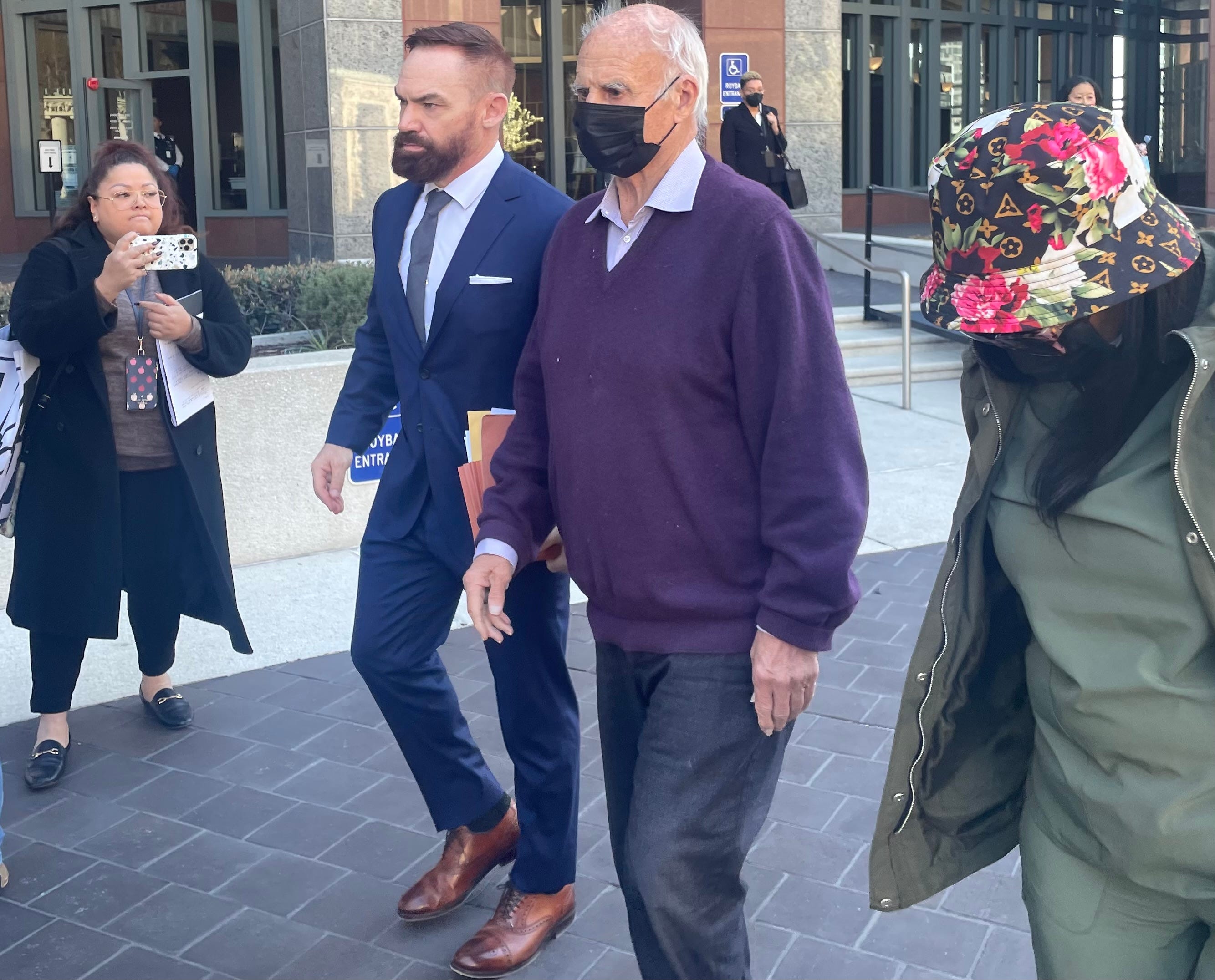
Federal prosecutors preparing for Tom Girardi’s competency hearing say “malingering” could be an issue in the case, the first indication that they may argue the disbarred power lawyer is exaggerating or feigning a deteriorated mental state.
The U.S. Attorney’s Office in Los Angeles mentioned the possible fakery in a new motion to exclude proposed expert testimony from a criminal defense lawyer who met with Girardi and believes he can’t assist in his defense.
The 11-page filing on Friday argues the proposed testimony from attorney Kate Corrigan “is unnecessary, irrelevant, and a waste of time.”
“Furthermore, her opinions are unreliable because she is not qualified to identify malingering, which may be an issue in this case,” Assistant U.S. Attorney Scott Paetty and Ali Moghaddas wrote.
While people have long speculated online that Girardi is at least exaggerating his condition, prosecutors have only previously said publicly that they believe he is competent to stand trial.
The new filing comes nearly two months before a scheduled Aug. 23 hearing with U.S. District Judge Josephine Staton in Los Angeles, who will determine 84-year-old Girardi’s competency and, ultimately, the fate of his criminal case.
The disbarred California power lawyer, whose work inspired the Oscar-winning film Erin Brockovich, is accused of stealing tens of millions of dollars from clients in a years-long Ponzi scheme that unraveled the same time as his marriage to Real Housewives of Beverly Hills star Erika Jayne in late 2021. The Pasadena mansion he shared with Erika has been sold and much of its contents auctioned, with the proceeds to help pay the more than $500 million he owes clients, former co-counsel and other creditors. He’s currently residing in an assisted living center.

Experts for the prosecution and defense have already evaluated Girardi’s competency to stand trial.
His lawyers got prosecutors’ report from neuropsychologist Diana Goldstein before prosecutors did so they could redact privileged information. But a dispute soon arose: Prosecutors said in a June 9 filing that the defense cited Girardi’s 5th Amendment right against self incrimination when redacting nearly 10 pages.
Paetty and Moghaddas acknowledge they can’t use incriminating statements Girardi made during Goldstein’s evaluation in their criminal case “unless he raises a mental status defense.” But they say the 5th Amendment doesn’t apply to his competency evaluation because it “does not involve a determination of guilt.”
That means everything in Goldstein’s report should be unredacted, they say, including statements Girardi made to Goldstein that his attorneys apparently believe could incriminate him.
“Defendant’s unilateral decision to redact what is arguably the most relevant sections of the report directly impedes the government and Court’s ability to fully assess the facts required for the Court’s ultimate decision,” prosecutors wrote.
Girardi’s lawyers say Goldstein told Girardi during her evaluation that nothing they discussed “about case details and/or potential defenses that might further the Government’s case could be provided to the U.S. Attorney’s Office.”
They said prosecutors want the following:
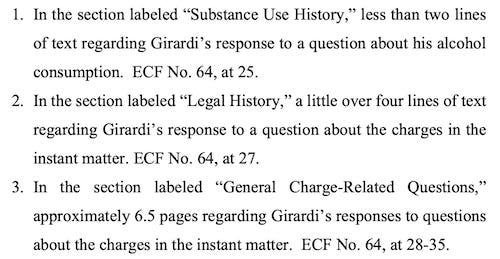
“The approximately 90 pages of unredacted information is sufficient to understand Goldstein’s conclusions. Goldstein does not say otherwise. And, most tellingly, the defense did not redact any of the approximately 20 pages of the report that provide Goldstein’s opinions, rather than the 80 pages that provide her summaries of medical records, collateral interviews, or other information,” according to the defense opposition.
Judge Staton on Friday ordered Girardi’s lawyers to provide her an unredacted copy of Goldstein’s report.
“After review, the Court shall issue such further orders as it deems appropriate,” the judge wrote.
Prosecutors have revealed nothing about Girardi’s evaluation beyond Goldstein’s name and the fact that she has, prosecutors wrote, “opined, among other things, that defendant is competent to stand trial.” Neurologist Ryan Darby, an assistant professor at Vanderbilt University Medical Center, is preparing a rebuttal report to the defense evaluation.
A psychiatrist in late 2020 said Girardi has dementia and Alzheimer’s disease, which Girardi’s brother cited when moved for a conservatorship shortly after Girardi was publicly accused of fraud.
But prosecutors said in a March filing that the conservatorship petition had “scant detail” and was approved by a judge based “in part, on an unchallenged declaration from a psychiatrist, opining that defendant has dementia that impairs his ability to understand.”
“Apparently relying on the findings made in the conservatorship proceeding, which was non-adversarial, defendant’s counsel in this criminal proceeding asserts that defendant is incompetent to stand trial,” prosecutors wrote.
Girardi was last seen publicly on Feb. 6 at his arraignment at the Roybal Federal Building and United States Courthouse. He said nothing during the hearing: U.S. Magistrate Judge Karen Stevenson instead entered not guilty pleas on his behalf and ordered the competency evaluation.
Girardi also said nothing as he walked to and from the courthouse accompanied by bother, caretaker and two deputy federal attorneys, Georgina Wakefield and Craig Harbaugh.
Wakefield and Harbaugh hired neuropsychologist Stacey Wood to evaluate Girardi. According to prosecutors’ new filing, they also enlisted two additional experts, Corrigan as well as Helena Chui, a neurology professor at the University of Southern California.
Thom Mrozek, spokesman for the U.S. Attorney’s Office in the Central District of California, declined comment on Friday’s filing, which says Corrigan “has no expertise in diagnosing or evaluating whether an individual is cognitively impaired; the potential presence of a mental disease or defect affecting the individual’s abilities receive, process and communicate information; and/or whether the individual’s presentation is the result of malingering or feigning impairment.”
“Thus, her medically uninformed opinions will only serve to distort the qualified opinions of the medically trained professionals who have submitted reports and opinions in this case,” according to the motion.
A licensed California lawyer since 1987, Corrigan is a partner with Corrigan Welbourn Stokke, APLC and a member of the Criminal Justice Act Panel of court-appointed criminal defense attorneys.
Prosecutors say they’ve been informed Corrigan will testify to “the responsibilities of defense counsel, her personal observations of defendant at several meetings of defendant and his counsel, and her opinion that defendant is unable to assist in his defense.” She also will opine that Girardi is incompetent to stand trial in the Northern District of Illinois, where he’s accused of embezzling millions of dollars in settlement money from the families of victims in a deadly 2018 plane crash.
Corrigan met with Girardi four times, but prosecutors say she has nothing to add to Staton’s assessment of his competency.
“The parties have already retained medical professionals who have examined defendant and are more qualified than a lay person such as Ms. Corrigan to opine as to his competency to proceed to trial. Testimony from a criminal defense attorney with no medical background or training, let alone experience in neuropsychiatry or neurology, would not assist the Court in its task of determining defendant’s mental competency.”
Prosecutors say Corrigan’s opinion that Girardi “appears unable to provide the type of assistance that is required of a criminal defendant” “usurps the role of the licensed psychiatrist or psychologist.”
“The government is unaware of any competency proceeding in this district that has involved testimony from a third-party criminal defense attorney on his or her perceived observations and opinion regarding a defendant’s ability to assist counsel. … And while Ms. Corrigan may be an experienced attorney, a review of her resume makes clear that she has no expertise in diagnosing or evaluating whether an individual is cognitively impaired; the potential presence of a mental disease or defect affecting the individual’s abilities receive, process and communicate information; and/or whether the individual’s presentation is the result of malingering or feigning impairment.”
Corrigan declined comment on Monday.
Prosecutors in Los Angeles and Chicago announced separate criminal cases against Girardi in February.
The L.A. indictment accuses him and his firm’s former chief financial officer, Christopher Kamon, of embezzling more than $15 million from five clients between 2010 and 2020. The California State Bar disclosed in November that it had received 136 complaints about Girardi between August 1982 and before the scandal erupted in December 2020, most involving client trust accounts. The statute of limitations for federal wire fraud charges is 10 years.
Kamon has been in federal custody since his arrest in Baltimore in November on wire fraud charges for allegedly stealing money from the law firm in a separate scheme that prosecutors say Girardi didn’t know about.
Kamon also is a co-defendant in the Illinois indictment, alongside Girardi and former Girardi Keese partner David Lira, who is Girardi’s son-in-law.
All documents cited in the article are available below for paid subscribers. If you haven’t already, please consider buying a subscription to support my independent legal affairs journalism. Your support makes my work possible. Thank you!

Thank you for purchasing a paid subscription. Your support makes my work possible.