
'I was a monster': Ex-cop gets two years in prison for steroid-fueled false imprisonment
The now-former Los Angeles County sheriff's deputy shot and killed a teenager two months after the April 2020 incident. He said steroids made him 'short tempered.'


A now-former Los Angeles County sheriff’s deputy who unlawfully imprisoned a man questioning his hassling of two young Black men was sentenced Monday to two years in federal prison.
Miguel Angel Vega, 33, was in a steroid rage when he trapped 23-year-old skateboarder Jesus Alegria in the back of his patrol SUV in April 2020 and took him on what a judge called an “unbuckled joyride” that injured him and led to an attempted coverup.
In a plea for leniency, Vega said he was in court Monday “to not only acknowledge the atrocious actions that I did” but also “take full responsibility.”
“I was a monster. And it took a lot of soul searching to understand that. I do not expect to ever be forgiven,” Vega told U.S. District Judge Percy Anderson.
“I will forever be a felon. I fear that my actions will throw me in a hole which I may never be able to climb my way out. Nobody realizes my failures more than myself,” Vega said.
Prosecutors said in court papers that Vega was using steroids “to compete with his peers” and, quoting Vega’s own words, have an “edge while on patrol.” The steroids “made him ‘angry and short tempered’ and likely clouded his judgement (though did not excuse his conduct).”
“It is no surprise that defendant committed the instance offense in the midst of his rampant steroid use,” prosecutors wrote.
Two months after Hernandez and Vega victimized Alegria while Vega was in a steroid rage, they were on patrol together again when Vega shot and killed 18-year-old Andres Guardado as he ran from them in an alley near Los Angeles’ Harbor Gateway area. It was the second deadly shooting by Los Angeles County sheriff’s deputies within two days, and it sparked large protests. The Los Angeles County District Attorney’s Office announced in April 2023 that no charges would be filed against Vega because of “insufficient evidence.”
Guardado’s killing was not mentioned in court on Monday or in documents related to Alegria’s case, but Alegria mentioned it in his victim impact statement.
“Rest in peace to Andres Guardado, for the same deputies that harassed me, fatally shot this young man on the back while on his knees with hands behind his head 7 times.. I simply say, what comes around goes around.. Always think twice before taking action to do something you'll end up regretting. For it is not just a particular individual that you're hurting.. But a community that cares as well..,” Alegria wrote.
Anderson, a 2002 George W. Bush appointee, said Monday that Vega’s actions “not only embarrassed the department, but they also embarrassed every man and woman that puts on the badge every day and puts their lives at risk.”
“What is so galling and disturbing about what you did is that you knew what you were doing was illegal. And it simply didn’t matter,” the judge said.
Anderson said it’s “important that people do not perceive that a law enforcement officer can come into court and simply apologize.”
“Law enforcement officials are held to a higher standard,” the judge said.
Identified in court documents as J.A., Alegria spoke to the Los Angeles Times about the crimes in a January 2021 article that preceded the federal charges.
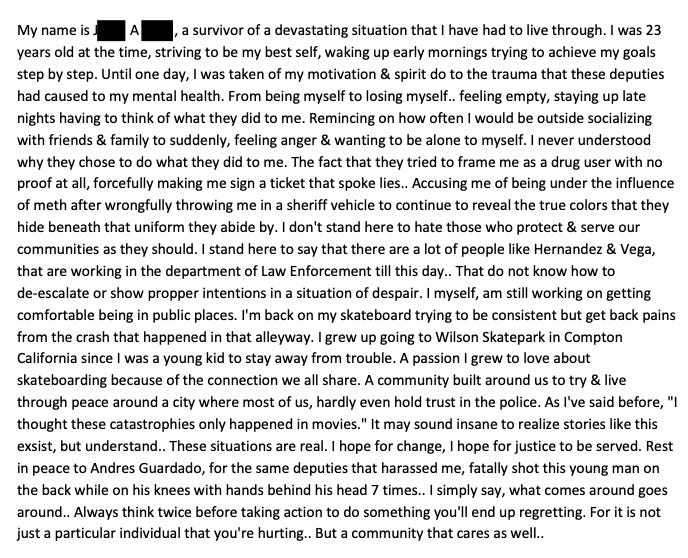
In his victim impact statement, Alegria said he believes Vega and his co-defendant, now-former sheriff’s Deputy Chris Hernandez, are not alone in law enforcement.
“I stand here to say that there are a lot of people like Hernandez & Vega, that are working in the department of Law Enforcement till this day.. That do not know how to de-escalate or show propper intentions in a situation of despair,” Alegria wrote. He said he has mental health issues related to the trauma and sometimes stays up “late nights having to think of what they did to me.”
“Remincing on how often I would be outside socializing with friends & family to suddenly, feeling anger & wanting to be alone to myself. I never understood why they chose to do what they did to me. The fact that they tried to frame me as a drug user with no proof at all, forcefully making me sign a ticket that spoke lies.. Accusing me of being under the influence of meth after wrongfully throwing me in a sheriff vehicle to continue to reveal the true colors that they hide beneath that uniform they abide by.”
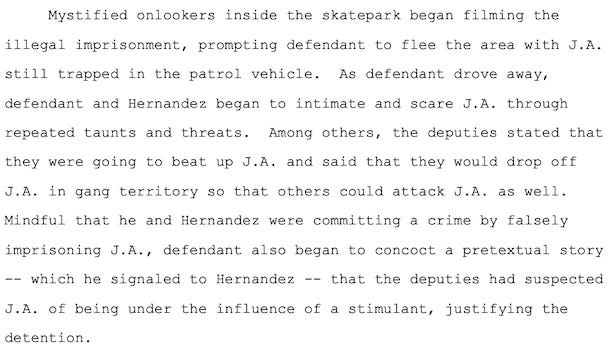
Vega admitted telling Alegria he was going assault him and to take him to gang territory so others could assault him. He also falsely told his supervisor he arrested Alegria because he was high on drugs, which caused another deputy to cite the Alegria at the hospital for being under the influence of methamphetamine. The citation was eventually dismissed.
Alegria’s lawyer, Christian Contreras, told reporters after the hearing that Alegria fears retribution from current sheriff’s deputies who are associated with the same deputy gang as Vega and Hernandez.
“They retaliate and they harass people, and they continue to violate their rights even after they step forward,” Contreras said.
Sometimes referred to as “cliques” by law enforcement officials, deputy gangs were investigated by a public oversight commission that concluded they currently exist and are engaging in illegal activity within the Los Angeles County Sheriff’s Department. The gangs exist within at least six sheriff’s substations and include matching tattoos and names such as the Banditos and the Regulators.
Another deputy who is considered a whistleblower on deputy gangs testified in a separate proceeding in August 2020 that Vega and Hernandez were prospective members of the Executioners gang within the Compton sheriff’s station.
Contreras said Vega and Hernandez “essentially wanted to set him up, they wanted to take him to a gang territory … to make sure that you’re in harm’s way,” and Alegria remains haunted by the attack.
“That type of violent situation, that type of dangerous situation is not something someone could forget so easily,” Contreras said.
Two months after Hernandez and Vega victimized Alegria while Vega was in a steroid rage, they were on patrol together again when Vega shot and killed 18-year-old Andres Guardado. It was the second deadly shooting by Los Angeles County sheriff’s deputies within two days, and it sparked large protests.
“Jesus Alegria was subjected to these violations two months before Andres Guardado was shot and killed. If the county were to take these deputies out then and there, put them on admin leave or take them off the streets, Andres Guardado never would have been shot and killed,” said Contreras, who also represented Guardado’s family in a wrongful death lawsuit against Los Angeles County that settled for $8 million.
Contreras said the county’s enabling of Hernandez and Vega is “indicative of how the county operates, of how the Sheriff’s Department operates in terms of essentially giving these deputies carte blanche to violate people’s rights and then continue with this lawlessness and these acts of impunity.”
A U.S. Attorney’s Office press release about Vega’s sentence quotes Los Angeles County Sheriff Robert Luna saying his department “assisted federal agencies during the criminal investigation, contributing to their indictment.”
“The Sheriff’s Department is committed to holding employees accountable for their actions and expects them to exhibit the highest moral and ethical standards when serving our communities,” said Luna, who has been sheriff since December 2022.
A federal grand jury indicted Vega and Hernandez in March. Vega pleaded guilty in September to one felony count of deprivation of rights under color of law. Hernandez pleaded guilty in July to a felony charge of conspiring to violate the civil rights. He’s out of custody awaiting sentencing, which is currently scheduled for January.
Vega’s plea agreement is publicly available, but his defense sentencing memorandum is sealed. Assistant U.S. Attorney J. Jamari Buxton said Monday it contains information that contributed to prosecutors’ decision to recommend 24 months in prison, the low end of Vega’s U.S. Sentencing Guideline range, instead of the high end of 30 months.
The sentencing memorandum from Buxton and Assistant U.S. Attorney Brian Faerstein described traumatic childhood circumstances that weigh in Vega’s favor such as his parents’ divorce and his mother’s homelessness. They also said he’s worked to address his mental health and substance abuse issues, and he’s learned to code: He earned an associate’s degree in computer science and is working on his bachelor’s degree.
“With these degrees, defendant apparently intends to pursue a career in coding or information technology, and he also appears to have the stability and support of his immediate and extended family,” according to the 21-page memo.
Still, Faerstein and Buxton said Vega’s actions erode “the public’s trust in law enforcement and in government more broadly.” They said Vega is “one of the small but increasingly prevalent group of law enforcement officers who have abused their powers to harm others” and described his victimization of Alegria as a “nightmarish episode out of a movie.”
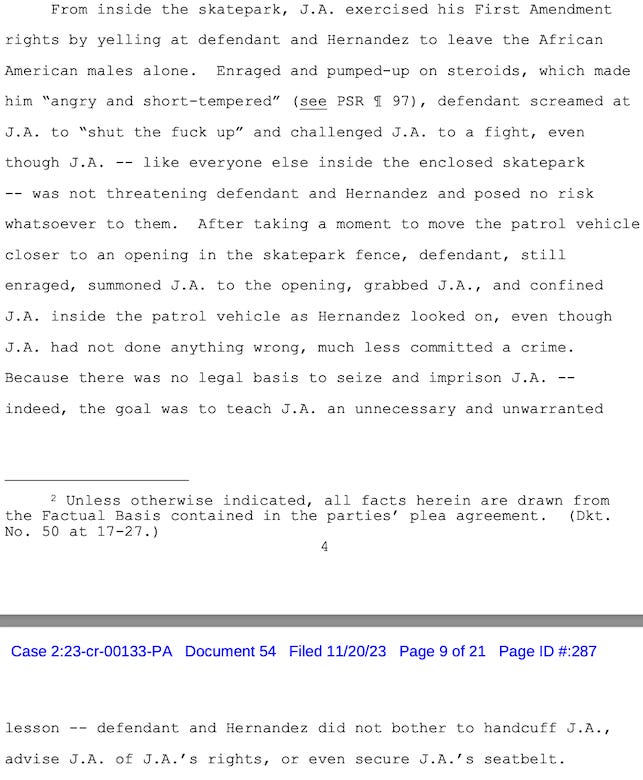
Alegria was “exercising his First Amendment rights” when he yelled at Vega and Hernandez to leave two young African-American men alone after the deputies approached them and asked them to lift their shirts. Buxton said Vega wanted to send a message to Alegria and everyone else at the Compton skatepark “that there are consequences for questioning and challenging law enforcement.”
Here’s how prosecutors’ memo describes what happened:
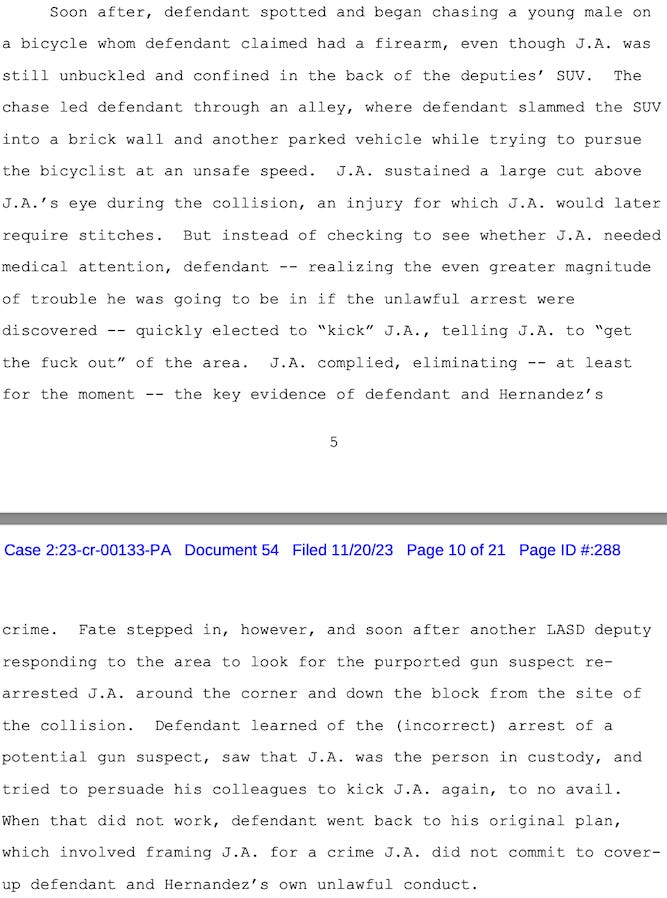
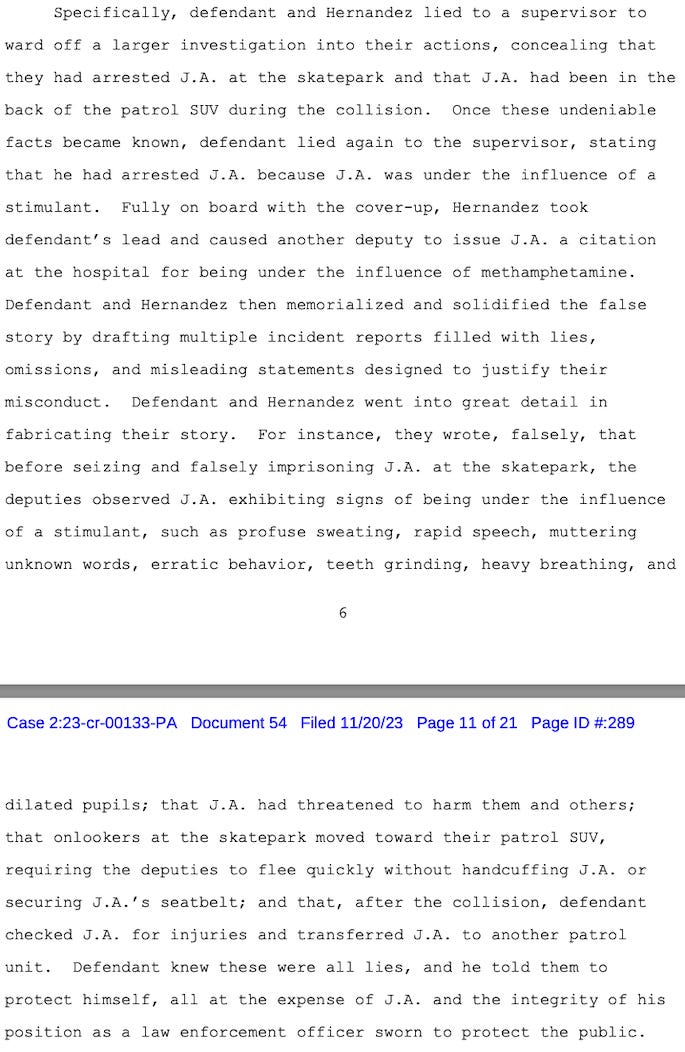
In court on Monday, defense attorney Brian Gurwitz said Vega was only charged with a felony because Alegria was injured, which was inadvertent. But Buxton said it doesn’t matter if Vega didn’t intend to hurt Alegria, and he emphasized that Vega knew Alegria had a bad cut above his eye but kicked him out his patrol SUV without asking him if he needed medical attention.
“The defendant didn’t pause to say, ‘Hey, are you OK? You need medical attention? How can I help?’” Buxton said. “He simply said, ‘Get the fuck out.’”
Martin Estrada, the U.S. attorney for the Los Angeles-based Central District of California, told reporters his prosecutors thoroughly investigated all conduct by Hernandez and Vega and was “very aggressive in getting to the bottom of this misconduct and all this misconduct associated with these two defendants.”
“We dug deep with these two defendants to get as much information as possible, so I’ll leave it at that,” Estrada said.
Estrada said the two-year sentence is a “good sentence” that “sends a message.”
“We want to send a strong message that violations of civil rights by any public official, much less a law enforcement officer need to be harshly addressed,” Estrada said. “This type of sentence is really important to send a message that this type of conduct won’t be tolerated.”
In court, Buxton emphasized the need for Vega’s sentence to deter other law enforcement officers from committing crimes, telling Judge Anderson it’s “symbolic” that the judge can send a message to Vega “and other officers like him” when Vega had been trying to send a message to Alegria.
“And that message in particular is that no one, not even law enforcement officers, is above the law,” Buxton said, adding that prosecutions such as Vega’s “are relatively rare.”
In his allocution, Vega said he knows “saying ‘I’m sorry’ will never be enough to right my wrongs, but I do want to apologize to Mr. Alegria. I will never understand the extent of the pain and trauma I inflicted on him.”
Vega referenced his ongoing education, telling the judge he stood before him as “an honor student” and “a man of faith.”
“I stand before you as someone who has dedicated to help lift the spirits of people in need. I stand before you as someone who’s working on developing a free application for infants with disabilities,” Vega said.
He finished by asking the judge “to continue letting me contribute to society, rather than becoming a burden upon it.”
Judge Anderson cited the need to deter corruption in law enforcement when he explained Vega’s 24-month sentence.
“It’s important that the sentence imposed today send a clear message that there are serious consequences for law enforcement officers who abuse their power and violate their sworn oath to uphold the law,” Anderson said.
The judge cited Vega’s “unrelated health issues,” his fast plea deal and his solid employment history and said, “but for those factors I would have imposed a far grater sentence.”
Vega also will be on three years of supervised released when he leaves prison, and he must pay a $5,000 fine.
Thank you for supporting my independent legal affairs journalism. Your paid subscriptions make my work possible. If you’re not already a paid subscriber, please consider purchasing a subscription through Substack. You can also support me through Venmo (MeghannCuniff), CashApp ($MeghannCuniff) and Zelle (meghanncuniff@gmail.com). Thank you!