

A jury in Honolulu, Hawaii, on Wednesday convicted a man of attempted manslaughter for an altercation with his wife on a cliffside hiking trail after jurors determined he acted under extreme mental or emotional disturbance.
Prosecutors sought a second-degree attempted murder conviction against Gerhardt Konig, but the jury’s emotional disturbance finding made his crime attempted manslaughter under Hawaii law.
Attempted murder carried a potential life sentence, but attempted manslaughter in Hawaii has a maximum sentence of 20 years in prison. There is no mandatory minimum sentence. Judge Paul B.K. Wong scheduled sentencing for Aug. 13 at 8:30 a.m.
Mr. Konig has been in jail with no bail allowed since his arrest on March 24, 2025, after an eight-hour manhunt near the Pali Puka Trail on O’ahu. He and his wife, Arielle Konig, moved to Maui from Pittsburgh, Pennsylvania, in 2023 with their sons and had flown to O’ahu to celebrate her birthday.
Mr. Konig, 47, worked on Maui as an anesthesiologist before his arrest, and Ms. Konig, 43, works for a nuclear engineering company. They were in counseling after he found flirtatious texts between her and a coworker, which Mr. Konig deemed an “emotional affair.”
Mr. Konig researched their finances and the cost of his first divorce in the months prior to the trip, and the prosecutor pointed to that evidence when arguing he wanted to leave her but was worried about the cost of divorce and child support. Mr. Konig also researched “dangerous hikes” online and selected the Pali Puka Trail himself.
After the verdict, Mr. Konig’s lawyer Thomas Otake told reporters they “plan on appealing, but that doesn’t take away from our respect of the jury, their service, their dedication and their verdict, and we look forward to to appealing.”
“I mean, we are thankful that they did not convict them of attempted murder, which would have been life in prison, and so we just thank them for their service, and we look forward to an appeal related to some of the judge's rulings throughout the case and before the trial,” Otake said.
Deputy Prosecutor Joel Garner appeared a bit shaken as he spoke to reporters. He said he’ll recommend Judge Wong sentence Mr. Konig to prison and said he didn’t know if he could be be released with credit for time already served in jail.
“We respect the verdict. We respect that the jury did their job, considered the evidence and came to a verdict that they thought fit evidence and proof on all sides in this case. So that’s all I can say about that. Thank you,” Garner said.
The trial was the first attempted murder or murder trial Garner has prosecuted as a first chair. Deputy Prosecutor Franklin “Donald” Pacarro, a long time prosecutor in Honolulu, was next to him at the prosecutioon table but did not question witnesses.
In his closing argument, he told jurors their instruction about emotional disturbance is “a long instruction” so “we’ll keep it simple.”
“There’s no evidence that the defendant was acting under extreme mental or emotional disturbance when he tried to kill Arielle. Don’t be confused by his testimony. He did say he was under severe emotional distress, but he said that after he tried to kill Arielle,” Garner said.
Garner said Mr. Konig only said he “was under severe emotional distress after he began to think about the consequences of his actions and how his actions would affect himself.”
“That’s what that is. The defendant was not under extreme mental or emotional disturbance when he tried to kill her. He only became that way when he began to think about the consequences,” Garner said.
The instruction Judge Wong read jurors said, “The question of defendant's self control or lack of it at the time of the offense is a significant factor in deciding whether he was under the influence of extreme mental or emotional disturbance.”
In his closing, Garner said the evidence demonstrates Mr. Konig used “logical thinking” when trying to kill Ms. Konig in three ways: “Plan A” was to push her off the cliff; “Plan B” was to “inject her with the syringe, knock her out, push her off the cliff” “Plan C” was to “beat her with the rock, knock her out, drag her over, or just simply kill her outright.”
“The intent behind every single plan was to kill Arielle,” Garner said.
Garner’s cross-exam of Mr. Konig focused not on what exactly happened on the trail but on the details of the couple’s troubled relationship and Mr. Konig’s actions to plan the hike and research his own prior divorce and financial situation.
But while they presented evidence of premeditation, Garner and his colleagues at Honolulu County’s Office of the Prosecuting Attorney didn’t charge Mr. Konig with premeditating his wife’s attempted murder. His top charge was attempted second-degree murder followed by lesser included offenses of attempted first-degree assault, attempted second-degree assault and third-degree assault.
Jurors never had the option of considering if Mr. Konig’s premeditated the crime, and the second-degree charge required them to consider the emotional disturbance affirmative defense if they agreed prosecutors had proven it beyond a reasonable doubt. Mr. Konig had the burden of proof to establish he acted under mental or emotional disturbance, but the standard was preponderance of the evidence, not beyond a reasonable a doubt.
Jury forewoman Makalapua Atkins told reporters said they closely followed the instructions and “the pushing part was not really anything that we were determining on, because they both said they pushed each other.”
“So we did determine that there was definitely a scuffle on top of the Pali Puka Trail that resulted in an injury to the head that could be bodily injury and serious,” Atkins said. “They both had showed that there was relationship issues that there had begun prior to this situation on Pali Puka Trail.”
Atkins said she’s “not necessarily sure” if the “emotional affair” Ms. Konig admitted to “was the root, but I do commonly believe that somebody that’s been married to someone for eight years, in a relationship for that long, and having some kind of affair happen after having two young kids under the age of two, might have some kind of emotional disturbance.”
Emile Konig, Mr. Konig’s son from a previous marriage testified that his father called him from the trail twice on FaceTime and told him he’d tried to kill his wife.
Mr. Konig wept on the stand as he testified about the calls and said his son must’ve misunderstood him when he mentioned that Ms. Konig had accused him of trying to kill her. He said he called his son because he was suicidal and wanted to say goodbye.
Otake didn’t address the emotional disturbance instruction in his closing, but he emphasized that Mr. Konig was emotional in “the FaceTime with Emile that they call a confession.”
“There’s no assurances of reliability. He explained to you what happened in that call. We need to consider it in the context in which it took place, and ask ourselves, ‘Is this a reliable, you know, thing that happened? That we can rely on two highly emotional participants in the phone call?” Otake said.
Mr. Konig testified his wife attacked him first by trying to push him off the trail. He wept as he testified he felt “terrible” that he’d struck her with a rock and continued to cry as he testified about feeling suicidal and calling his son to say goodbye.
Judge won’t suppress evidence found in metadata search
The trial included an unusual argument over whether investigators violated the scope of a search warrant when they located a Walmart receipt in Mr. Konig’s email for an 800-hour Knight 64GB hidden voice recorder because the search term “separate” appeared in hidden metadata.
Otake wanted Judge Wong to prohibit the receipt as evidence because he said investigators violated the “spirit” of the search warrant. In a hearing on March 30, Otake’s associate Manta Dircks said allowing Detective Thomas Iinuma of the Honolulu Police Department to testify about the receipt creates “a dangerous world moving forward for search warrants and digital forensics.”
Dircks said an investigator “with any knowledge of coding” could select keywords that open “the door to all emails containing that source code, whether or not it’s relevant in the actual body of the email to the case. So it’s very scary precedent.”
Judge Wong concluded investigators located the email by lawfully using the keyword separate.
“These parameters in this search warrant in this case prevented law enforcement from conducting a discretionary and indiscriminate search of the defendant’s laptop. The Constitution does not prohibit all searches, but only unreasonable searches," said Wong, a graduate of University of Southern California and Boston College Law School who’s been a judge in Hawaii’s 1st Circuit Court in Honolulu since 2017.
You can read the defense memo here.
People around the world followed the trial
The trial was video recorded and streamed online, and Ms. Konig’s testimony and the testimony of two women who rescued her captivated people across the country.
Many of my newest Substack subscribers found me through my YouTube channel, which is approaching 100,000 subscribers almost three years after I started it from scratch with no goal other than surviving as a journalist after two decades working for dying newspapers. I also surpassed 115,000 followers on Facebook last night.
I’m enjoying covering trials across the country through my social media platforms, which include testimony videos and detailed descriptions that essentially are short news articles about the testimony, with quotes.
The editor of the South Maui News included my videos of Mr. Konig’s trial in his online coverage, and the attention my channel is receiving will help me continue to bring a newsier approach to the social media platforms that have been dominated by so-called content creators who are thriving on the advertising revenue that once sustained newspaper journalism.
My goal is to better incorporate this Substack into my trial coverage by writing regular reports about the testimony that organize the videos and summarizes them for the subscribers who rely on my social media platforms for accurate, no frills trial coverage.
The trials I’m covering now aren’t the complex, Big Law-saturated cases I wrote about for the Los Angeles Daily Journal and ALM / Law.com. They are state court criminal trials that attract huge audiences online and provide opportunities to not only educate people about the legal system but also showcase the humanity that happens in our courtrooms every day.
In Mr. Konig’s trial, my clips of Ms. Konig’s testimony and the testimony of the women who helped her drew millions of views on TikTok and Instagram, including one that was shared by the page “Hiking Girls,” which says it is “empowering women who travel & hike worldwide.”
Ms. Konig testified her husband hiked to the top of the trail alone after she said she didn’t want to continue. He met her on the way down and they took photos of each other that they shared with family on Snapchat. Jurors saw one of Mr. Konig at the edge of the trail with the caption, “Don’t look down.”
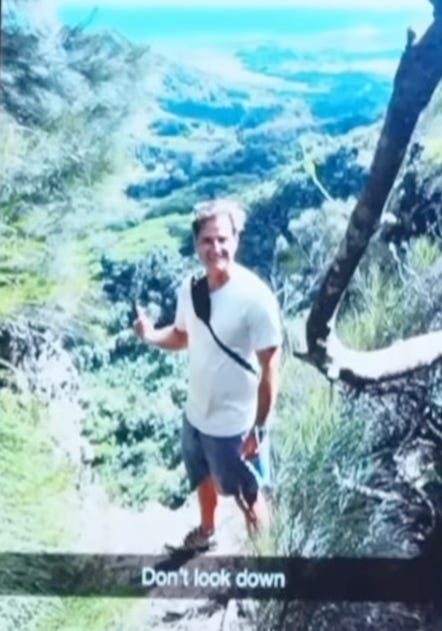
She testified she was surprised when he grabbed her “forcefully by my upper arms, and he said, ‘I’m so fucking sick of this shit. Get back over there.’ And he starts pushing me back towards the cliff.”
“It felt almost like he was kidding at first. And I was like, ‘What are you doing?’” Ms. Konig testified. “But he, he had grabbed me really hard and was moving me, so we kind of wrestled a little bit, and I threw myself onto the ground because there’s a lot of trees and shrubs there so that I could hold on.”
She said her husband had a syringe he’d apparently retreviewd from his backpack.
“And he says, ‘Hold still.’ And I see the syringe, and I just kind of batted it away from from us both,” she testified.
The syringe “fell on the ground, sort of near us,” she said.
Mr. Konig was digging into his backpack “with his left hand, and then kind of holding me down with his right hand,” Ms. Konig testified.
“I’m screaming, and I’m saying, ‘What the fuck are you doing? Get off me.’ And he’s saying, like, ‘Fuck you. You’re done. So, so sick of your shit, so done with you,’” Konig testified. “And I'm trying to kind of protect myself and get out of there, but also, he’s gripping his hand closed really hard, and ... there’s a vial in his hand, so I was trying to pry his hand open so I could grab that vial out.”
She said she pleaded with him to stop and told him, “Everyone knows we’re on a hike. They’ll know this wasn’t an accident, and our kids will be orphans. You’re, you’ll go to jail, and I’ll, I’ll be dead. Like, you have to stop.”
“Did telling the defendant any of these things that you told him, did that get him to stop?” Garner asked.
“No, not really. And I had said, like, ‘Your mom just sent me a really beautiful text for my birthday. Like, your family will be upset if I die.’ He can’t face our kids after this, you know?” Ms. Konig said.
She said he seemed to calm but “then he just starts hitting me with a rock.”
“I just started screaming. Because in my mind, he was trying to knock me unconscious to get to be able to drag me over the edge,” Ms. Konig testified.
She then heard a woman say “We’re here. We’re calling 911.”
“Gerhardt just kind of froze and knelt back away from me, and I just crawled away really slowly. And again, he seemed just frozen,” Ms. Konig testified.
Jurors had already heard what happened after that. Hiker Amanda Norris was the first witness to testify after opening statements on March 19.
Morris, a nurse at Kapi‘olani Medical Center for Women & Children in Honolulu, testified that she was hiking with a friend vacationing from Canada and “thought somebody had fallen” when they heard a woman screaming for help because “it’s not uncommon for someone to fall because of the ridge being so steep and narrow.”
Morris said she saw a man on top of a woman, hitting her with a rock it “looked like in the head.” The woman screamed, “Help me! Help me! He’s trying to kill me,” Morris testified. She identified the man in the courtroom as Konig and said he and the woman “saw us, and he stopped and stood up.”
“Did the defendant say anything?” Garner asked.
“No,” Morris answered.
Morris said she and her friend Sarah Buchsbaum, a nurse in Vancouver, B.C., “were a little afraid for our own safety, since we were kind of close to the edge” so they backed down the trail and “kind of turned a little bit of a corner, and that’s when Sarah started to call 911.”
Buschsbaum said when she first saw Ms. Konig “she was on her stomach, crawling towards us.”
“Her face was covered in blood, her head was covered and she was just fully covered in blood,” she testified.
“Did the woman say anything?” Garner asked.
“She screamed, ‘Help. He’s trying to kill me. Call 911,’” Buschsbaum answered.
She and Morris “initially backed up a bit because we were right on the edge and we didn’t want to get attacked,” Buschsbaum said.
“And as we were backing up, I was calling 911 and Amanda was yelling at her, saying that we were calling for help,” Buschsbaum testified.
Jurors heard Buschsbaum’s two-minute 911 call during her testimony. She told the dispatcher, “Someone’s currently being attacked on the top of Pali Puka, where there’s a man trying to kill her. She has blood all over her face.”
Garner asked Buschsbaum about making eye contact with Konig when she first saw him.
“How long did you make eye contact with the defendant?” Garner asked.
“For approximately 30 seconds,” Buschsbaum answered.
“You describe seeing the defendant’s eyes?” Garner asked.
“It’s like a cold, emotionless stare,” Buschsbaum answered.
“How did you feel as you made eye contact with the defendant?” Garner asked.
“I felt very uneasy,” Buschsbaum answered.
Ms. Konig testified she didn’t see the women until after she broke away from her husband.
“One of them went behind me and was kind of sweeping to make sure he wasn’t coming after us, visually scanning to make sure he wasn’t coming after us,” she testified on March 24.
“One of the women had, like, a large metal water bottle, and she had that in her hand, and she was like, ‘This is the only weapon I have,’” she continued.
Garner told jurors in his closing argument that Morris and Buschsbaum are the reason Mr. Konig stopped attacking her.
“Arielle screaming for help didn’t stop the defendant. Arielle fighting back for her life didn’t stop the defendant. The only thing that stopped the defendant, the only thing that was enough for him to stop, is two eyewitnesses coming up on the scene and seeing him beat her with that rock. The only thing that got him to stop was being caught redhanded,” Garner said.
Garner reminded jurors that Buschsbaum testified she looked into Mr. Konig’s eyes and “it made Sarah feel so unsafe that she and Amanda went back down the trail before they called 911.”
Otake, however, reminded jurors that Buschbaum initially identified the wrong person when police showed her a lineup of photos that included Konig and several other men.
“The eyewitness picks the wrong person out of the photo lineup, and still she stared at him, looked into his cold, dark eyes, saw him very clearly?” Otake said.
Otake said what happened between the Konigs “before the hikers got there, it is essentially she said, he said.”
“The witnesses told you they didn’t see much. One witness only saw one hit. The other didn’t see a hit at all. One of them picks up the wrong person in the photo lineup. Okay? Everything before that — they told you they can’t say what happened. They don’t know how it started. She said, he said,” Otake said.
Garner argued Mr. Konig got rid of the syringe and vial during the more than eight hours he spent hiding, but Otake emphasized that not only did police never find a syringe, neither Morris nor Buschbaum saw one when they saw the Konigs on the trail.
“Why in the world, if you bring a syringe to incapacitate someone, to make it easier, to throw them off the cliff, why would the syringe be Plan B? It would be Plan A. You would use the syringe first, and then you would be thrown off,” said Otake, co-founder of Alapa & Otake, LLC, in Honolulu.
Ms. Konig’s lawyer contacted police about a bag of medical supplies, including syringes, that she found in the couple’s Maui home after she returned there following her discharge from the hospital. Garner used the bag and its contents as evidence against Mr. Konig.


Jurors saw the bag and its contents during the testimony of Tracy Spacek, a detective with the Honolulu Police Department who also testified about the lava rock Mr. Konig used to strike Ms. Konig.
Scott Henderson and Michelle Amorin, criminalists with the Honolulu Police Department, testified about DNA and blood test results for the rock, which Otake argued in his closing show Ms. Konig touched the rock on the portion that wasn’t stained with her blood.
“The rock was in her hand. The DNA shows that. That blows away her whole story that she didn't have the rock. The rock was in her hand. Her DNA is all over that,” Otake said. “This idea, ‘Well, maybe when she was blocking and it hit her.’ That’s not going to lead to that much of her DNA on it more than him.”
Garner objected for speculation, but Judge Wong overruled because Otake was arguing what he believes the evidence shows, which is what closing arguments are for.
“If he’s holding the rock the whole time and she’s just blocking, there’s going to be more of his DNA than hers,” Otake told the jury.
Defense argues police chase didn’t happen
The police search for Mr. Konig resulted in the trial’s most viral moment. A trio of Honolulu Police Department officers testified about seeing him emerge from a forested area near the trail after they’d seen looking for him for about eight hours.
Officer Chauncey Nicola said he got out of the unmarked police van and yelled, “Police! Stop!” but “he turns and he runs away from my vehicle to this brushy, like the grassy area, because we’re still in the roadway.”
“So as I got closer, I reached out and I grabbed his right arm,” Nicola testified. “I’m still yelling, ‘Police! Stop! Police! Stop!’ And I was able to grab onto his right ar’m.”
“So as I got closer, I reached out and I grabbed his right arm,” Nicola testified. “I’m still yelling, ‘Police! Stop! Police! Stop!’ And I was able to grab onto his right arm.”
Mr. Konig “tries to pull — like, break my grip. So he tries to pull on and continue running away from me, to get away from me,” Nicola testified.
“We both fell down, and I fall on top of him,” he continued.
“Who falls on top of who?” Garner asked.
“I fell on top of him,” Nicola answered.
Nicola said Mr. Konig reached for his black bag so “I’m trying to use my physical strength to pull the bag away from him, which I was able to, and I’m able to pull it out off of him and get it away from him.”
Nicola got the bag, but he said Konig continued “to push and fight, and he’s trying to, like, grab all over.”
“So I don’t know what he's going for. He’s looking for his waist. He’s going for his pants. So I don’t know if he has a weapon or not. So I try to — I continue to try to gain control of him. So I give him some distractionary strikes to his large muscle group area,” Nicola said.
Garner had each officer demonstrate for jurors the tone they used when they yelled at Mr. Konig to stop, but the big viral moment came when Otake had Officer Asten Koki stand next to his client in the well of the courtroom to demonstrate their size difference. Mr. Konig denies fleeing from police, and his lawyer’s point apparently was that Koki and the other officers are far too big and slow to catch him if he had.
That scene was probably enough to delight the online masses, but Garner heightened the interest by asking Koki in re-direct about his athleticism.
“I would consider myself pretty fast,” Koki testified.
“Do you play sports?” Garner asked.
“I played sports,” Koki answered.
“What sport?” Garner asked.
“I played multiple sports, but my main sport was football at the time,” Koki answered.
“What level of football did you get up to?” Garner asked.
“Division 1,” Koki answered.
“Who’d you play for?” Garner asked.
“I played for UNLV,” Koki answered, referring to the University of Nevada, Las Vegas.
“And what position did you play?” Garner asked.
“I play defensive line,” Koki answered.
“How important is d-line? Or how important for a d-lineman is it to be quick?” Garner asked.
“Very important,” Koki answered.
“Thank you. No further questions,” Garner said.
Pathologist, restaurant owner testify as defense witnesses
In addition to himself, Mr. Konig’s defense witnesses were pathologist Jonathan Arden and John Charles “Chuck” Bussler, who owns Fête, a restaurant in Honolulu where Mr. Konig had a dinner reservation the night of March 24, 2025. Otake said the reservation shows Mr. Konig didn’t plan to harm his wife. In many trials I’ve covered, much of Bussler’s testimony would have been shut down as irrelevant, but we saw very few objections in Mr. Konig’s trial.
Arden testified that Ms. Konig’s injuries weren’t as bad as the bleeding indicated and aren’t consistent with being struck multiple times at full force with a lava rock. Garner took an aggressive tone in cross-examination and seemed to be much more effective with Arden than he was with Mr. Konig.
Arden said he doesn’t shape his analysis and opinions to fit someone’s case.
“I tell lots of lawyers that their clients are screwed, and, you know, that’s what happens. Sometimes the truth hurts, but that’s what they get from me,” Arden testified on April 1.
“Dr. Arden, your interest in future business encourages you to ignore the facts that are bad for your conclusion. Isn’t that right?” Garner asked.
“No, not right,” Arden answered.
In re-direct, Otake tried to emphasize that Arden doesn’t need new business.
“I apologize for asking this question, but how old are you, Doctor?” Otake asked.
“No embarrassment," Arden said. “Seventy — well, this month I'll be 72.”
“And you mentioned that you're trying to retire, trying to slow down, right?” Otake asked.
“Trying. Not succeeding so well, but I’m trying,” Arden answered.
“But do you need more work, Doctor?” Otake asked.
“No, I’m turning down plenty of work right now,” Arden answered.
“You’re in a position where you pick and choose the cases you want to work on and the attorneys you want to work with, right?” Otake asked.
“Yes,” Arden answered.
“Are you concerned about getting future business?” Otake asked.
“No, I’m not,” Arden answered.
“As I said, I am currently turning down substantial number of cases that come to me,” Arden answered.
Otake asked, “Is it a goal of your wife and yourself to slow down and enjoy yourself a little more?”
“Yes,” Arden answered.
“Spend time with family, correct?” Otake asked.
“Correct,” Arden answered.
In redirect, Garner displayed his obvious edge over attorneys in mainland states who similarly try to discredit experts.
“Doctor, Hawaii is a good place to slow down with your wife, right?” Garner asked.
“You’re talking about living here?” Arden said.
“Visiting,” Garner said.
“Visiting Hawaii is wonderful,” Arden said.
Thank you for supporting my independent legal affairs journalism. Your paid subscriptions make my work possible. If you’re not already a paid subscriber, please consider purchasing a subscription through Substack.