
The history of Tory Lanez's false DNA claims, from DJ Akademiks to Casey Anthony's expert
The rapper is to be sentenced on Monday for shooting Megan Thee Stallion in 2020. The DNA evidence in his case continues to be a source of intense online debate.


The tweet began like so many others claiming to have urgent news. “BREAKING,” it screamed in capital letters, “it was revealed in court few moments ago that Tory Lanez DNA WAS NOT found on the weapon in the Meg Thee Stallion case.”
It was an explosive claim from the prominent Internet commenter DJ Akademiks, and his more than 1 million Twitter followers embraced it with the excitement of a crowd thirsty for news about a criminal case engulfed in online gossip.
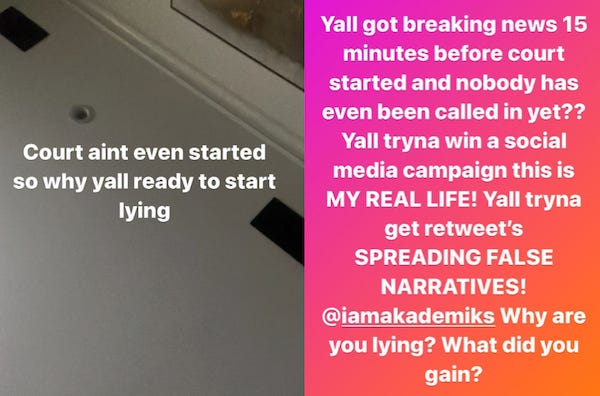
As the tweet spread, Megan took to Instagram to point out an obvious fallacy.
“Court ain’t even started so why yall ready to start lying,” she wrote.
A judge later determined that Lanez violated a protection order related to the prosecution expert’s DNA analysis report and posts on social media. The order prohibited the public distribution of information related to the case, according to a filing from Lanez’s lawyers.


The report, in fact, didn’t say Lanez’s DNA wasn’t on the gun that fired five rounds at Megan on July 12, 2020, injuring her feet. Rather, the results were more open-ended: It said Lanez couldn’t be included or excluded as a contributor to DNA on the gun, though it did say he was excluded as a contributor to DNA on the gun’s magazine. Lanez’s own expert testified to that in trial, though he added he would expect anyone who fired a gun five times to leave clearly identifiable DNA behind.
Nearly 18 months later, the DNA evidence remains one of the fiercest points of contention in the feverish online debate over Lanez’s convictions.
Akademiks replaced his original tweet with one that read, “UPDATE: Tory Lanez trial adjourned til April with Tory’s lawyer telling the court they have completed DNA results from the prosecution which is very pleasing to [her] client. (I saw this doc myself.. it literally says it was inconclusive in finding TORY DNA on the gun or magazine)”
But his original tweet, deleted shortly after it was posted, lives on through screenshots and Internet comments from people who continue to falsely claim that DNA tests establish Lanez never touched the gun used to shoot Megan.
Lanez himself fanned the falsehood in a voice recording from jail posted to his Instagram page in April, saying prosecutors “completely manipulated my DNA results and lied to the world, the media, and most importantly, my jury by constantly saying my DNA on the gun was inconclusive.”
“My new attorney Jose Baez hired one of the best DNA experts in the nation to carefully analyze the same DNA test, the fair and correct way. The results came back exactly as I knew the whole time. My DNA is 100% excluded and 100% eliminated from the gun. In other words, it’s physically and scientifically impossible for me to ever have touched or shot this gun,” Lanez continued.
The expert’s own words, however, don’t go that far. He instead said the DNA profile from the gun “is not reliable” and “exhibits a disbalance” that likely led to a wrong conclusion, and that Lanez should have been excluded, something prosecutors strongly dispute.
On Monday, the judge who’s had a front-row seat to the DNA saga is to sentence 31-year-old Lanez for his three felony convictions, including first-degree assault with a firearm. Prosecutors have pointed to the rapper’s false post-conviction DNA claims as an example of his refusal to accept responsibility for his crimes, and they’re urging Los Angeles County Superior Court Judge David Herriford to remember Lanez’s “campaign of misinformation” against Megan when he imposes a sentence.
Lanez’s lawyers, meanwhile, are asking for probation as Lanez maintains his innocence. They said in their sentencing recommendation that investigators “inexplicably” only took a DNA sample from Lanez, but they don’t repeat the previous claims about manipulated DNA evidence that have fueled so many online arguments
Legal Affairs and Trials with Meghann Cuniff researched the history of the DNA claims in hopes of providing clarity for the masses. Here’s what I found.
The leaked report
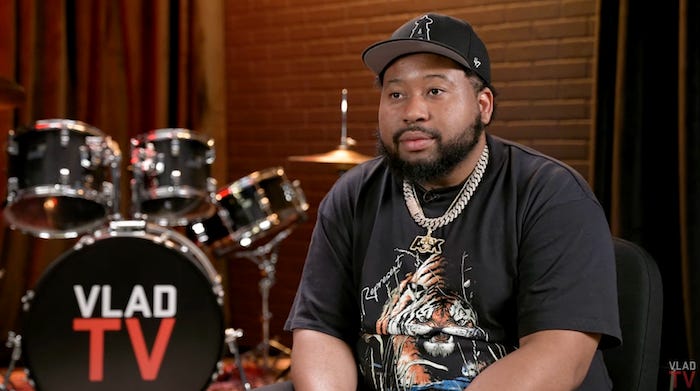
By Feb. 23, 2022, DJ Akademiks had established himself as an influential voice on Lanez’s case. Legal name Livingston Allen, the Rutgers University-educated hip-hop news commentator had devoted thousands of hours to the case for his millions of subscribers across multiple platforms, and his tweet about the courtroom DNA revelation had all the makings of another blockbuster.
But it was, as Megan said, posted before the status conference in Lanez’s case had actually gotten underway.
Megan unloaded in her Instagram stories, writing, “Yall got breaking news 15 minutes before court started and nobody has even been called in yet?? Yall tryna win a social media campaign this is MY REAL LIFE!"
She also called out Akademiks directly.
“Yall tryna get retweet’s SPREADING FALSE NARRATIVES! @iamakademiks Why are you lying? What did you gain?” she wrote.
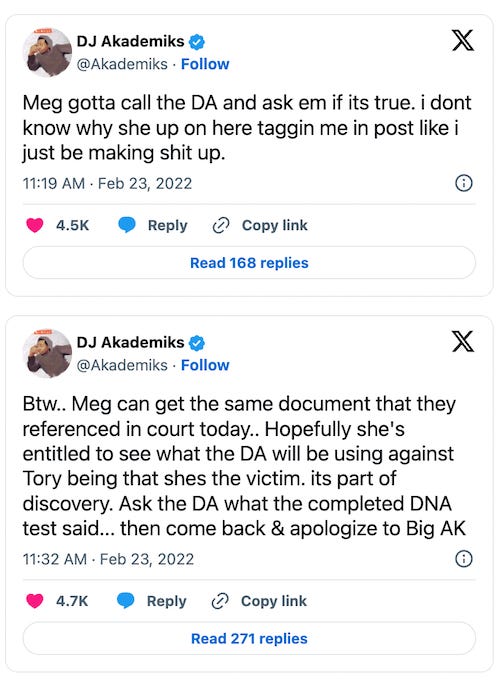
Akademiks, for his part, deleted the first tweet, and his new tweet was largely accurate: The results were inconclusive regarding Lanez’s DNA being on the gun. Demonstrating the confusion engulfing the issue, he missed the even more positive news for Lanez that his DNA had been excluded from the magazine. Instead, Akademiks wrongly stated that the results for the magazine were inconclusive, too.
After court was in session, Lanez’s lawyer at the time, Shawn Holley, addressed the DNA evidence only briefly, telling Judge Herriford she was “in the process of actually retaining an expert with respect to DNA.”
“It is our hope that we will be able to review and confirm the LAPD’s analysis, which from our standpoint was favorable,” Holley said.
Akademiks, meanwhile, defended himself on Twitter: “Ask the DA what the completed DNA test said... then come back & apologize to Big AK.”
Akademiks’ original claim that Lanez’s DNA was excluded caused such uproarious confusion that the Poynter Institute’s PoltiFact.com has a page dedicated to explaining its falsity.
The viral tweet apparently reached the courtroom: Deputy District Attorney Kathy Ta “advised Ms. Holley to remind her client about the discovery protective order that was in place,” according to a filing from Lanez’s post-conviction lawyers.
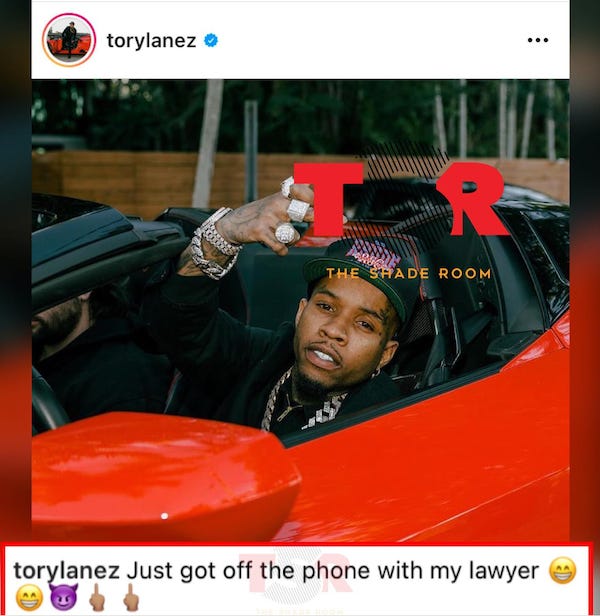
Holley said she didn’t know of a violation. But prosecutors pointed to a Feb. 2 photo Lanez posted to Instagram of himself sitting in a red Lamborghini and extending his middle finger to the camera with the caption “Just got off the phone with my lawyer 😁😁😈 🖕🏾🖕🏾”
Prosecutors also referenced an earlier request from Holley that Judge Herriford lift the protective order and allow Lanez to speak publicly after Megan engaged in a “social media tirade” in which she called him “the shooter” and an “abuser” and declared, “He’s a bitch.”
In an April 5 hearing, Herriford concluded Lanez had violated the discovery protective order by leaking information to Akademiks. Lanez’s bail was increased from $250,000 to $350,000, and he was briefly jailed before posting it.
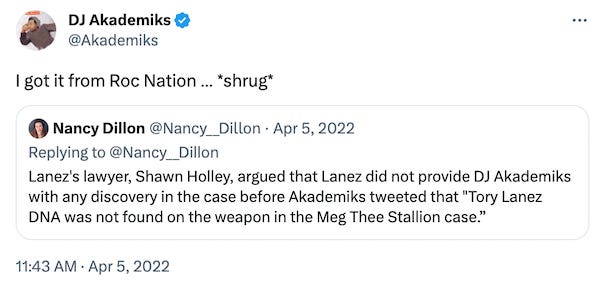
Akademiks appeared to make light of the situation by quoting a tweet from Rolling Stone reporter Nancy Dillon about the hearing and adding, “I got it from Roc Nation … *shrug*”.
Roc Nation, owned by billionaire hip-hop mogul Jay-Z, is Megan’s management company.
The trial testimony
The details of the DNA analysis stayed out of the public realm until Lanez’s trial in December 2022.
Los Angeles County Deputy District Attorney Alex Bott mentioned the findings in his opening statement, and they were introduced as evidence through the testimony of Los Angeles Police Department Criminalist Randy Zepeda.
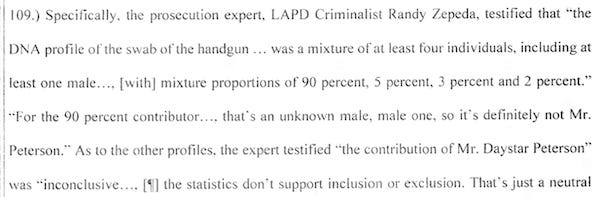
Zepeda said Lanez’s DNA was not found on the magazine, and he could neither be included or excluded as a contributor to the DNA collected from the gun. Zepeda said the DNA he analyzed from the gun had DNA from “at least four individuals.”
One person contributed 90 percent of the sample, which provided enough for Zepeda to determine the person must be a male. It also was enough for Zepeda to compare it with Lanez’s DNA sample and exclude him as the male who contributed that specific DNA.
But the three other discernible types of DNA accounted for just 5 percent, 3 percent and 2 percent of the sample, so Zepeda said he couldn’t determine the gender of the contributors, nor was there enough to compare with Lanez’s DNA sample. Thus, Zepeda said he couldn’t say if Lanez was or wasn’t a contributor to either of the three.
“The statistics don’t support inclusion or exclusion. That’s just a neutral result,” Zepeda said.
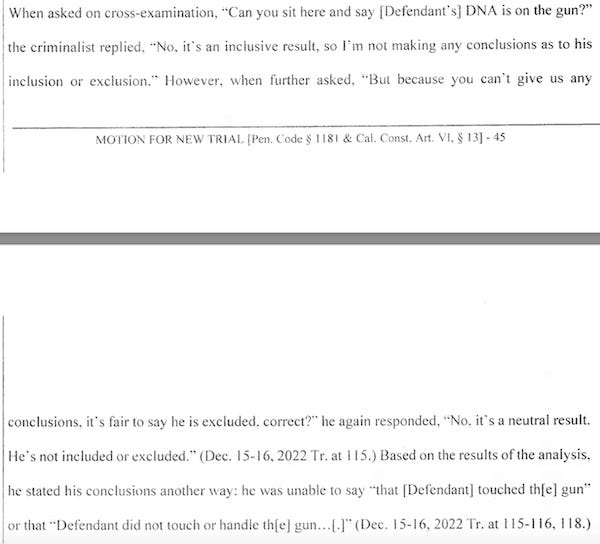
In cross-examination, Lanez’s lawyer George Mgdesyan asked, “Can you sit here and say my client’s DNA is on the gun?” and Zepeda answered no.
“I’m not making any conclusions as to his inclusion or exclusion,” Zepeda said.
Forensic science consultant Marc Scott Taylor testified for the defense, and he said the same thing Zepeda did: Lanez could neither be included or excluded as a contributor to the three small DNA amounts on the gun.
But Taylor, who owns Technical Associates Inc. in Ventura, California, also offered a stronger opinion on whether Lanez fired the gun, answering, “Not that we can tell, no,” because if someone fired a gun five times as Lanez is alleged to have done, he’d expect them to leave traceable DNA behind.
Taylor also testified that one of the three contributors appears to be a female, which Zepeda disputed when he testified again as a rebuttal witness. Zepeda also rebutted Taylor’s assertion that one of the three smaller amounts of DNA was from a female.
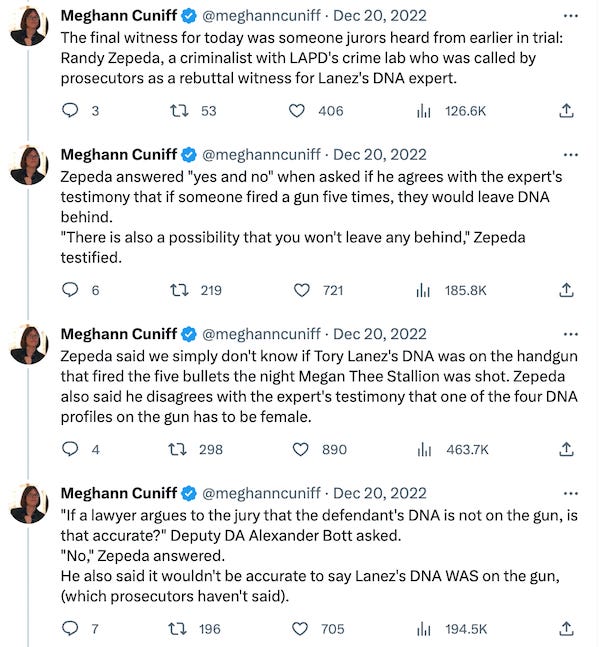
D.A. Bott addressed the DNA issue in his closing argument, telling jurors, “Don’t be fooled by an argument that the defendant’s DNA was not on the gun, because that’s just not accurate. … He can’t be included or excluded. His DNA very well may be on that gun. We just don’t know. But he cannot say that it wasn’t, OK?” He also told jurors Lanez could have wiped the gun before police pulled over the Escalade on Hollywood Boulevard.
The post-conviction claims
Lanez replaced Mgdesyan after he was convicted, and his new lawyers argued in an 84-page motion for new trial that the DNA evidence shouldn’t have been admitted.
The motion alleged the testing method didn’t comply with “industry-accepted reporting standards,” and that the evidence “was processed and manipulated in a way to specifically allow for the conclusion the State desired - that it could not be said that Defendant’s DNA was not on the gun.”
“The State’s expert testified in overly simplistic, non-quantative terms which failed to accurately portray the meaning behind the evidence to the jury, in a manner that permitted the People to present the evidence as being heavily inculpatory as to Defendant,” according to the motion. The motion said prosecutors didn’t disclose a worksheet used in the analysis until shortly before trial when Taylor (the defense expert) requested it.
Prosecutors called the DNA claim “baseless and perplexing, given that the defendant himself sought the admission of this exact same evidence at trial,”
“The defendant called Mr. Taylor to largely parrot the testimony of the People’s expert, indicating that he wanted the jury to hear this testimony,” prosecutors wrote in their April 11 opposition to the new trial motion. “However, the defendant now attempts to claim that the evidence was inadmissible and should not have been presented to the jury.”
I talked to Orange County criminal defense attorney Lee Stonum, who is not involved in the case, about the DNA claims for my April 1 article about the new trial motion. After reading the motion, Stonum told me the DNA argument “isn’t even really worth addressing” and that “if anything, the fact that Lanez could not be connected to the gun via DNA was good for him and likely evidence he wanted before the jury.”
That goes back to the what attorney Shawn Holley said in court shortly after DJ Akademiks claimed Lanez’s DNA couldn’t be found on the gun. Holley said she believed the prosecution’s DNA analysis was favorable to Lanez. She didn’t explain why, but her reasoning had to have been exactly what Stonum said: The fact that prosecutors couldn’t tell the jury that Lanez’s DNA was definitely on the gun is a good thing for Lanez. However, and this is an absolutely crucial fact: It doesn’t prove he never touched the gun, and it doesn’t mean he can’t still be convicted of shooting Megan.
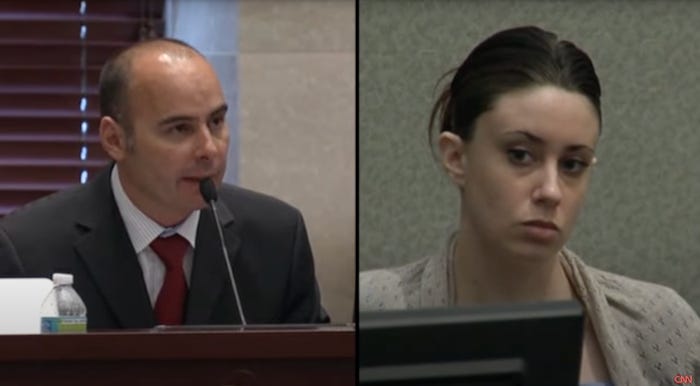
Lanez’s lawyers supplemented their new trial motion with a declaration from Richard Eikelenboom, who owns Independent Forensic Service in Colorado. He knows Lanez’s lead lawyer, Jose Baez, well: He was a defense expert witness in the high-profile 2011 trial in Orlando, Florida, of Baez’s client Casey Anthony, who was acquitted of murder charges in the death of her daughter, Caylee. Eikelenboom also was an expert for Baez in the double-murder case of NFL player Aaron Hernandez.
In a short declaration, Eikelenboom said the DNA profile from the gun “is not reliable.”


During the hearing on the new trial motion in May, D.A. Bott said Eikelenboom is “self-trained in DNA testing” and was prohibited from testifying in a 2016 trial in Denver, Colorado, after a judge found him unqualified. (Baez pointed out that an appellate court reversed the decision.)
“The idea that this expert would move the needle when two highly qualified experts — one called by the defense and one called by the people — is a ridiculous argument, Your Honor,” Bott said. He said Zepeda, the LAPD criminalist, said Eikelenboom “relied on antiquated methodology and could categorically go through each line of his declaration and show why it is incorrect.”
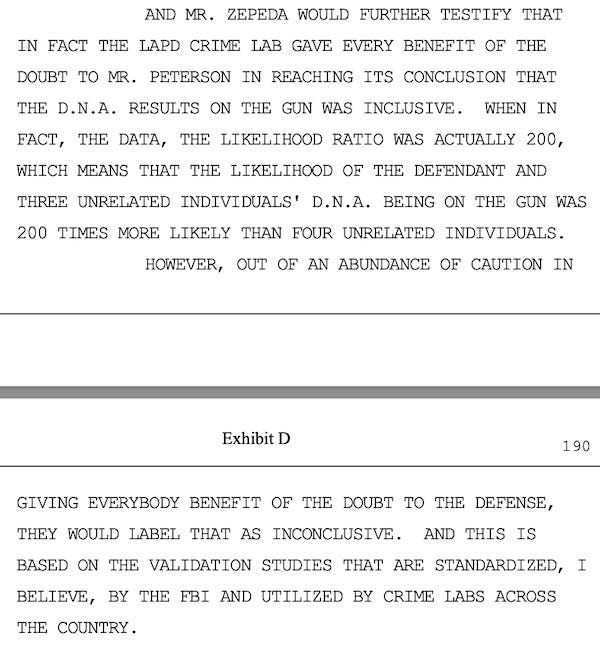
Bott also said something that’s gone totally overlooked in all coverage of this case: The DNA results actually “gave every benefit of the doubt to Mr. Peterson in reaching its conclusion that the DNA results on the gun was inclusive.”
“When in fact, the data, the likelihood ratio was actually 200, which means that the likelihood of the defendant and three unrelated individuals’ DNA being on the gun was 200 times more likely than four unrelated individuals,” Bott said.
Judge Herriford agreed with prosecutors that the DNA evidence wasn’t a problem in the case. He also said it was a minor piece of evidence in trial.
“The DNA evidence in this case is in some ways a very small piece of a larger puzzle, because whatever way you want to talk about it, it basically comes down to one thing: The DNA, you can’t say that Mr. Peterson did handle these items. You can’t say that he didn’t,” Herriford said. “And that’s what both of your experts said. That’s basically what would be the results if Mr. Eikelenboom had testified as well.”
Lanez’s lawyers don’t repeat the claims about the DNA analysis in the probation sentencing request they filed last week. They do question why investigators took a DNA sample from Lanez and no one else at the scene of the shooting. The only two who were with Megan and Lanez when Megan was shot were Megan’s friend and assistant, Kelsey Nicole Harris, and Lanez’s driver, Jaquan Smith.
However, Lanez’s trial defense clearly argued Harris was the shooter, not Smith, who never testified. Based on the DNA sample on the gun, Harris would be excluded from the male DNA that accounted for 90 percent of the profile and likely would be in the same situation as Lanez regarding the other three profiles of 5 percent, 3 percent and 2 percent: Neither included or excluded. (Emails show Lanez replaced Holley with Mgdesyan as his trial counsel after she told him she didn’t believe blaming Harris for the shooting was a viable strategy.)
Four months after they appeared, Lanez’s false claims that his expert determined prosectors manipulated the DNA evidence remain on his Instagram. Prosecutors cited them in their recommendation for a 13-year prison sentence, pointing out that Lanez said in his Instagram post that his newly retained expert determined the Los Angeles police lab had to have deliberately stopped the testing before it was complete for the result to be inconclusive.
“Defense Expert Eikelenboom provided a declaration to this Court in support of Defendant’s motion for new trial and made no such claims,” prosecutors wrote in their June 6 memo. “Defense Expert Eikelenboom, in his declaration, essentially reviewed the same DNA reports previously reviewed by both the defense and prosecution’s DNA experts, who testified at trial, and rendered a different opinion as to the results.”
Megan, meanwhile, hasn’t publicly addressed any of the post-trial litigation. She’ll have a chance to speak in person at Lanez’s sentencing on Monday, but it’s unknown if she will. She did, however, have a lot to say back in February 2022 when the DNA issue first arose. She included in her Instagram stories a call for facts.
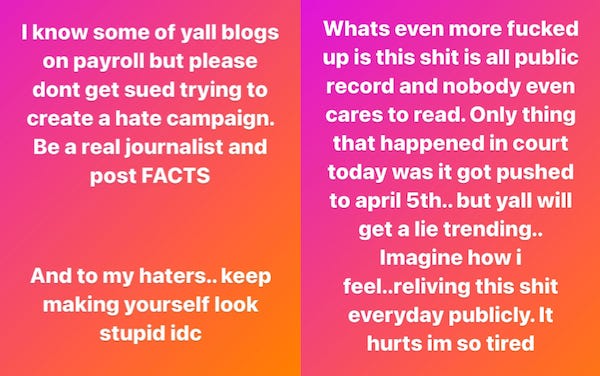
“I know some of yall blogs on payroll but please dont get sued trying to create a hate campaign. Be a real journalist and post FACTS And to my haters..keep making yourself look stupid idc,” she wrote.
I’ll be on live on YouTube today (Sunday) at 5 p.m. PST to discuss this article and preview Monday’s sentencing. I hope you can tune in!
Lanez is scheduled to be sentenced Monday at 10:30 a.m. in Los Angeles. I’ll post updates from the courthouse on Twitter or whatever it’s now called, and I’ll email an in-depth article to subscribers after the sentencing ends. I’ll also go live on YouTube about 12:30 p.m., and again after the hearing ends. If it’s within your budget, please consider purchasing a subscription to support my work. I am working independently, and I depend on subscriptions and tips to make ends meet. You can pay below through Substack or you can pay through Venmo (MeghannCuniff), CashApp ($MeghannCuniff) and Zelle: (meghanncuniff [at] gmail [dot] com). Thank you for your support!
So well written. Thank you 😊