
Ex-MLB shortstop testifies in wrongful death trial over SUV crash that killed boys in crosswalk
Closing arguments also begin Monday in another wrongful death trial over a Los Angeles police shooting in a clothing store that killed a teenage girl. I have video coverage of both.

A retired Major League Baseball player testified on Friday that he sought his cousin’s advice before telling police his friend and former baseball competitor was the driver of a second SUV investigators were trying to identify after a speeding driver killed two boys in a crosswalk in 2020.
“At that time, there was no knowledge of what that vehicle was, who was involved, the other driver of the car. And I knew this information,” Royce Clayton said.
Clayton said his cousin, a former sheriff’s deputy, told him, “You have to tell your story to a detective, because the most important part, Royce, is you don’t know what’s going to happen.”
“In some instances, people that are involved in certain situations, as he’s explained to me, are culpable or actually blamed for something that happened, and you don’t want this,” Clayton testified. His cousin said, “I guarantee you that they know who the other person is, and you will be withholding information.”
Clayton is a key witness in a trial over a wrongful death lawsuit brought against retired MLB pitcher Scott Erickson, his ex-girlfriend Rebecca Grossman and Grossman’s husband, Peter Grossman, by Nancy and Karim Iskander, whose sons Mark, 11, and Jacob, 8, died after Grossman struck them with her 2018 Mercedes-Benz AMG GLE43 at 7:10 p.m. on Sept. 29, 2020, in Westlake Village, California.
Grossman, 62, is serving 15 years to life in prison after a jury in February 2024 convicted her of two counts of second-degree murder, two counts of vehicular manslaughter with gross negligence and one count of hit and run driving resulting in death or serious injury. An appellate panel affirmed her convictions in a 143-page opinion published on March 17.
Erickson, 58, was charged with misdemeanor reckless driving, but the charge was dismissed after he recorded a public service announcement about the dangers of it. [This article has been updated to correct a previous statement that Erickson was not charged with a crime.] He testified in Grossman’s criminal trial, and his lawyers said he’ll testify in the civil trial, which began on Friday, April 24. Peter Grossman is a defendant because his wife’s SUV was registered in his name. He’s a prominent plastic surgeon whose father founded the Grossman Burn Foundation.
The trial is in Los Angeles County Superior Court Judge Huey Cotton’s courtroom in Van Nuys. It’s expected to last two months, and it’s being video recorded and streamed live online. I am streaming live on YouTube and Facebook and sharing videos of all testimony, as well as short clips of big trial moments there and on TikTok and Instagram.
Clayton testified on the trial’s sixth day.
He played shortstop for 11 teams from 1991 to 2007, and Erickson pitched for six teams from 2004 to 2019. They became friends early in their careers and after retirement sometimes met at bars and restaurants in Westlake Village in west Los Angeles County, where Clayton coached baseball at Oaks Christian School.
They saw each other at the Stonehaus Winery, then met Grossman at Julio’s Agave Grill. She’d been drinking earlier with friends at their home, and the Iskanders’ lawyer Brian Panish told jurors in his April 24 opening statement how she told them in a text message not to tell police she’d been drinking.
Clayton testified he planned to join Erickson and Grossman at a new home Grossman purchased on Westlake to eat tacos and watch the U.S. presidential debate. They left the restaurant together, and Clayton stopped at a grocery store and Grossman and Erickson were going to drive their Mercedes-Benz SUVs to her home.
Clayton was apparently in the store when Nancy Iskander and her three sons were crossing Triunfo Canyon Road at the intersection of Saddle Mountain Drive and Erickson and Grossman approached in their speeding SUVs.
Panish told jurors in his opening that Iskander heard “revving noise” and saw the vehicle approaching.
She grabbed her youngest son and “dives out of the way, but because Mr. Erickson is racing and he’s in the first lane, he blocks off the boys’ ability to escape, and they’re both hit at 73 miles an hour by Mrs. Grossman. 73 miles an hour,” said Panish, a founding partner of Panish | Shea | Ravipudi LLP in Los Angeles and one of the most successful plaintiff’s trial attorneys in the United States.
Clayton testified on Friday that he spoke with Erickson on the phone as Erickson hid in bushes and watched the crash scene, and Erickson told him and Grossman were “I don’t know if you use the word ‘racing’ — but they’re traveling a high rate of speed,” Clayton testified.
“She was directly behind him, and he said as he came up to this crosswalk, he saw the children,” Clayton began to cry and could not continue.
After a brief recess, Panish continued his exam by asking Clayton about his conversation with Erickson regarding attorney James Silverstein and prominent sports agent and attorney Jeff Borris.
“Did you have any discussions that night from the scene where you told Mr. Erickson that he should contact a representative?” Panish asked.
“Yes,” Clayton answered.
“And you felt that Mr. Erickson should contact the lawyer, and you told him that, right?” Panish asked.
“Yes,” Clayton answered.
“And you actually texted him the contact information of Mr. James Silverstein, a local lawyer that you knew?” Panish asked.
“He was recommended to me. I didn’t know Mr. Silverstein until a friend recommended him,” Clayton answered.
Panish confirmed Clayton got Silverstein’s name and contact information that night and texted it to Erickson.
Clayton testified his conversation with his cousin addressed “the legal part,” but “the conscience part of me” also emphasized “just the devastation these people must be going through in not knowing who was involved and what happened.”
He said he knows that “in certain situations, you’re considered telling information about something that you know legally, that can get somebody in trouble, or whatever, it’s called snitching” and his cousin told him, “You’re not snitching on anybody. When it comes to kids, this is something that’s going to come out.”
“And you don’t want to have your situation where you can lose time with your children, your family, if they try to blame you and be culpable for what happened. So you have to tell what you know,” Clayton said his cousin told him.
Panish followed up on his earlier testimony about his call with Erickson.
“And when Mr. Erickson talked to he told you he swerved to avoid the boys in the crosswalk. Is that right?” Panish asked.
“Yes,” Erickson answered.
“He also told you they looked at his rear view mirror and saw Rebecca Grossman hit both boys, didn’t he?” Panish asked
“Yeah,” Erickson answered.
Panish questioned Clayton about texts Erickson sent him about talking to police.
“No big story dude, I just know that you’re gonna have to tell the police that you met us for one drink and you went home. It’s that simple and she only had 1 drink the bill will prove it, but you have to account for that 4th drink because I had 2,” Erickon wrote two days after the boys were killed.
Erickson texted Clayton again the next day, “Did you speak to the detectives I assume everything went smoothly.”
He didn’t know that Clayton had already told police he’d been with Erickson and Grossman that night and knew Erickson was driving the other Mercedes-Benz.
“Were you worried about blowback or reactions of Mr. Erickson?” Panish asked.
“No,” Clayton answered.
“Were you worried about being labeled a snitch?” Panish asked.
“Yes,” Clayton answered.
Panish said he where he grew up — Inglewood — “Somebody that goes to the police and reports someone else is a snitch, right?”
“Yes,” Clayton answered.
“So you put that on one side, and you weighed out those factors and the other side that you told us, and you decided ... that you needed to do that. You needed to do right thing to do,” Panish said.
“It was the only thing to do,” Clayton testified.
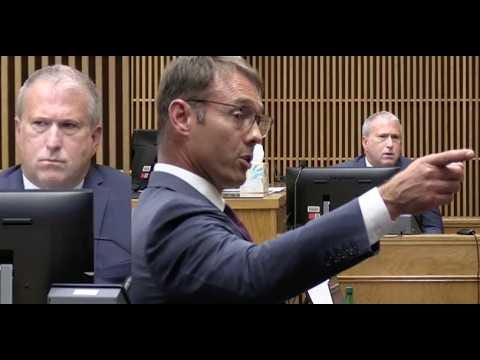
Erickson’s lawyer Jeff I. Braun tried to discredit Clayton in cross-exam and ended up eliciting testimony that Erickson said he and Grossman were “f***ing flying down the street.”
Braun pressed Clayton about whether Erickson used the word “racing,” and he asked if Erickson said “the miles per hour estimate that they were driving at.”
“No. I can clarify this in a very simple explanation, sir,” Clayton said. “So if I’m talking to you and we’re friends, or, you know, we know each other ... you don’t use the word ‘racing’ because nobody’s going to say that.”
“‘We were f***ing flying down the street.’ How about that?” Clayton continued.
“Did he say, ‘We were f***ing flying down the street,’?” asked Braun, a partner at McNeil Tropp & Braun LLP in Newport Beach.
“Yes,” Clayton answered.
Braun asked if Clayton in the last six years “ever told anybody that Mr. Erickson told you we were ‘f***ing flying down the street’?”
Clayton said Braun “and the law officers are very specific.”
“Did he tell you he was racing? The word racing? No, maybe not. I don’t recall. ... I’ve known him for 30 years. How is Scott Erickson going to describe him driving? ‘Oh, we’re driving down the street at a high rate of speed.’ Nobody talks like that,” Clayton testified.
“He was talking in the way Scott Erickson talked to me to explain that he was in front of Ms. Grossman, driving at a high rate of speed, racing or flying down the f***ing street, however you want to describe it, and that’s what happened,” he continued.
Braun represents Erickson with Deborah S. Tropp-Thompson, who acknowledged in her opening statement that Erickson sped up, but she said he’ll testify he did so to avoid striking the boys.
Erickson “believes he is going 50 to 55 miles per hour when he is 20 to 30 yards from that crosswalk when he first sees, and is surprised to see, two kids in the road, two children in the road, and he describes them as being near that center divider,” she told jurors.
Erickson feared that even if he slammed his brakes “he very likely would not have been able to stop in time, and was very concerned he might hit the kids,” Tropp-Thompson said.
“And in this crucial moment, he will tell you that he made the decision to speed up a bit more because from where he was and where the children were, he knew he could clear the intersection safely and not harm the children,” she said. “The evidence will show that he was right and that that is exactly what he did, and that’s exactly what happened.”
Tropp-Thompson told jurors Erickson lives in Nevada and “does the golf circuit for charities.”
“He is going to be here as much as he can. This trial is important to him, and taking the stand is important to him. If he is not here every day, it is because he is in Nevada. He will be here as often as he can,” she told the jury.
The Grossmans’ lawyer Esther P. Holm told jurors in her opening that Grossman “did have a margarita, but we believe the evidence will show she was not impaired.”
"She did not mention that tests placed Grossman’s blood-alcohol content at .08 — the legal limit for driving in California — three hours after the crash when her bood was drawn. Other tests put it at .73/./74. Jurors also have seen tests showing she had Benzodiazepines and Valium in her system.
Holm said Grossman “never saw the children in the crosswalk” and “did not try to flee the scene.”
“You heard a bunch of witnesses that Mr. Panish brought up. All these people are going to say this and that. But not one of those people, not one of those persons, can come in here and tell you they knew what she was thinking,” Holm said. “There’s not going to be a psychic or a psychiatrist or psychologist that comes in here and says, ‘Ms. Grossman meant to do this,’ or … ‘She was clearly doing that.’”
“The only person who knows what Ms. Grossman had in her head is Ms. Grossman. So while well, people can say, ‘Oh, I believe this is what happened,’ it’s speculation,” said Holm, a partner at Lewis Brisbois Bisgaard & Smith LLP who is working with partner Matthew P. Harrison.
Panish showed jurors photos of the Iskander family during his opening and said they’ll see may more “not because we’re trying to get sympathy” but because they “have the burden of proving what we’ve lost.”
“And the only way that you can determine what someone has lost is to see the evidence of what they had,” Panish said. “So what you’re going to see is what this family had and what was taken from them, and worst of all, what they’ve been left with.”
Panish spoke about each boy as their school photos were displayed on a courtroom monitor.
“These are the kind of kids that you want to have in your community. They were respectful, kind, loving, smart and funny,” Panish said.
Mark “was the big brother. He was gifted in math and science. He dreamed of being a neurosurgeon or a comedian.”
Jacob “was a disciplined kid that at this age would wake up five or six in the morning and go for a run before he goes to school.”
Jurors saw video of the boys doing push ups together while slapping hands.
“This kind of sums up the relationship. Just take a look,” Panish said.
The video played for about 35 seconds.
When it stopped, Panish said, “Their mom was filming that with great pride and joy. That will never happen again.”
Testimony continues on Monday morning. You can find a playlist of all witness testimony on my YouTube channel.
They include:
Michael Hale, an investigator with the Orange County District Attorney's Office in the vehicular homicide unit who analyzed the crash for Los Angeles County criminal investigators. He testified Grossman reached 81 mph three seconds before the crash, and she applied her brakes 1.5 seconds before but not at the moment of impact. Her SUV was traveling 73 mph when it struck the boys, Hale said.
Rafael Mejia, a detective with the Los Angeles County Sheriff’s Department who responded to the crash scene and spoke with Grossman.
Scott Shean, a Los Angeles County sheriff's detective who investigated the crash and interviewed witnesses, including about the speeds of the SUVs and alcohol consumed by Erickson and Grossman.
John Denton, a now retired Los Angeles County firefighter and paramedic who responded to the crash scene.
Chris Morgeson, who testified he was bicycling when he saw two dark-colored sedans and a white SUV later identified as Grossman’s speeding, then saw the SUV parked near a police car on Triunfo Canyon Road.
Alexis Grossman, via deposition. Jurors watched a video of Grossman’s daughter testifying in a deposition in February.
Ariana Adeva, the assistant director of the Orange County Crime Lab’s Identification Bureau. She said Grossman’s blood samples showed a blood-alcohol level of .074 and .073, and her blood had levels of caffeine, fluoxetine, norfluoxetine and nordazepam.
David Matero, an emergency room physician at Los Robles Regional Medical Center in Thousand Oaks who saw Jacob and Grossman after the crash. He said Grossman was “was relatively dismissive from the beginning” and “annoyed at the whole process.”
Donald Prijatel, who was driving in the area shorlty ebfore the crash and saw two Mercedes SUVs at a red light and heard both rev their engines before speeding away. Prijatel minutes later came upon an accident scene and heard a woman screaming at him not to run over her child.
Jake Sands, a passenger in a white Infiniti QX driven by his friend when he saw two Mercedes SUVs racing and saw the black SUV narrowly miss a family in the crosswalk, then saw the white SUV strike a boy.
Yasamin Eftekhari, who said she was driving when two Mercedes SUVs sped by her and saw two people struck in the intersection. “They like, tapped their brakes for a split second and just kept driving,” she said.
Blake Byfuglin, a criminalist with the Los Angeles County Sheriff's Department who tested Grossman’s blood samples and testified she had benzodiazepines in her system.
Christopher Lopez, a Los Angeles sheriff’s criminalist who confirmed Byfuglin’s results through separate tests.
Sylors Chem, a Los Angeles sheriff’s criminalist who testifeid Grossman’s blood samples for alcohol and testified her blood-alcohol content was .08 at the time her blood was drawn, three hours after the crash.
Teryl Grasso, an emergency medical technician at Los Robles who tried to save Jacob’s life and also saw Grossman when she was at the hospital. She testified about the boy’s “angelic” face and cried as she described his parents’ devastation. She said Grossman “looked intoxicated,” “was very loud” and at times uncooperative. Hospital staff moved her to another area after she repeatedly yelled for a doctor she knew, who was treating Jacob at that time.
Garrett Smith, a 27-year veteran of the California Highway Patrol who examined Grossman’s Mercedes-Benz and testified there were no mechanical issues.
The judge presiding has been a judge since 2009.
Cotton was an attorney at Cozen O’Connor from 1988 to 2009 and was a senior trial attorney for the Defenders Association of Philadelphia and a staff attorney with the U.S. Commission on Civil Rights. He earned his law degree from Temple University.
Closing arguments are Monday in the LAPD shooting wrongful death trial
Attorneys will give closing arguments on Monday, May 4, in a civl wrongful death trial over a police shooting at a Burlington Coat Factory in North Hollywood that killed a teen girl who was hiding in a fitting room.
Officer William Dorsey Jones Jr. finished testifying on Thursday, April 23.
He said he believed a man assaulting a woman with a bike lock had a gun when he fired three rounds inside the store, killing the man as well as a 14-year-old Valentina Orellana-Peralta, who was hiding with her mother in a fitting room.
Jones said he didn’t realize the man was holding only a bike lock and “I thought it was a gun” and he’d shot a woman in her face.
“You have fractions of a second to react. This is, in my mind, a life-or-death situation. I've got to save this lady’s life while protecting my own life,” Jones testified.
He thought the man “was going to fire a shot,” “so I get a center body mass picture in my optic, basically the center body mass” as he’s been trained.
“In my mind, I think he’s trying to take cover to because he sees my gun. So anyway, I come up in my optic, I get a sense of body mass, and I try to track his movement. And as he's moving, I shoot, shoot, shoot, and then the movement stops,” Jones testified.
“So at that moment in time when you’re shooting, as you mentioned, you’re shooting based upon what you observe and the threat that you believe exists at that time?” asked Jones’ lawyer Christian Bojorquez of the Los Angeles City Attorney’s Office.
“Yes,” Jones answered.
“And at the moment that you believe the threat no longer exists. you do what?” Bojorquez asked.
“You stop firing,” Jones answered.
Attorney Nick Rowley, who represents the girls’ parents, followed up.
“You know that that statement that you’ve repeated over and over and over again during your testimony, ‘I thought she was shot in the head. I thought she was shot in the head,’ is essential to your defense of this case. True?” Rowley asked.
“No, that’s what I believed at the time, sir,” Jones answered.
“And you know that by saying, ‘He had a gun. I thought he had a gun. I thought he shot her in the head and he was going to shoot me,’ is what you need to say in order to preserve your career. True?” Rowley asked.
Los Angeles County Superior Court Judge Frank M. Tavelman overruled a defense objection.
“No, that’s what I believed at the time,” Jones answered.
“As an officer of the law, you know that if you fired upon someone who did not have a firearm and you did not have a reasonable belief that they had a firearm, that you lose your job and you go to jail, potentially. True?” Rowley asked.
Boroquez objected, saying Rowley’s question “calls for a legal conclusion.”
“Your Honor, this is completely inappropriate,” Boroquez said.
Judge Tavelman sustained the objection, so Rowley asked, “You understand there are consequences to shooting someone who is unarmed, who does not have a firearm, who does not pose an imminent threat, true?”
“True,” Jones answered.
“And those consequences could be pretty severe for you?” Rowley asked.
“Yes,” Jones answered.
I posted all of Jones’ testimony on my YouTube channel. I’ll have more coverage of closing arguments and the verdict.
Previous article:
Thank you for supporting my independent legal affairs journalism. Your paid subscriptions make my work possible. If you’re not already a paid subscriber, please consider purchasing a subscription through Substack.