
Amid outcry over Ashton Kutcher’s letter for Danny Masterson, other letters, including a child porn defendant’s, highlight judicial complexity
Criminal defendants' family and friends often write letters to judges prior to sentencing. What they say and how they factor into sentences is complicated.

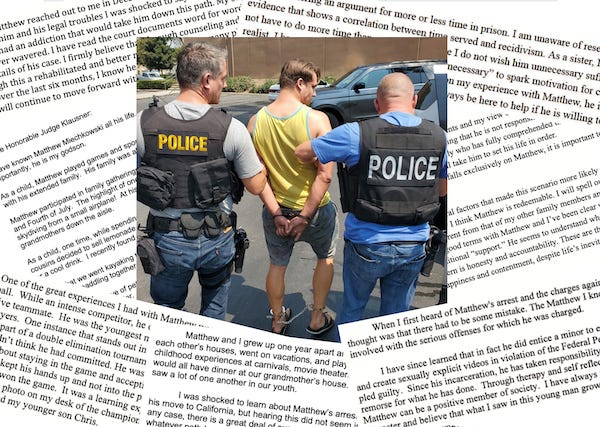
As far as sentencing letters go, Ashton Kutcher’s and Mila Kunis’ letters for their That ‘70s Show co-star Danny Masterson were similar to supportive letters written for a man who pleaded guilty to possessing child pornography and soliciting a 12-year-old girl for sex.
A childhood friend cited the man’s dedication to rescuing dogs before describing him as “a good person that made mistakes, mistakes that I very much believe he can overcome.” The man’s aunt offered to help him get a job at an Ivy League university, and the man’s uncle used his law firm’s letterhead to write about a positive experience coaching him in basketball when he was a boy.
But as the outcry over Kutcher and Kunis’ letters demonstrate, Matthew John Miechkowski’s supporters enjoyed an anonymity that’s difficult to find in a celebrity criminal case. Miechkowski’s arrest, guilty plea and 15-year federal prison sentence received no press attention, while Masterson’s two trials and 30-year to life sentence were covered by media organizations around the world.
Though publicly available online, Miechkowski’s supporters’ letters likely have been read by few others outside the chambers of the federal judge who sentenced Miechkowski on July 10 at a Los Angeles courthouse a few blocks from where a dozen journalists watched Masterson’s Sept. 7 sentencing.
Kutcher’s and Kunis’ letters, meanwhile, were read by thousands of people who shared them in a viral social media movement that dominated a weekend news cycle.
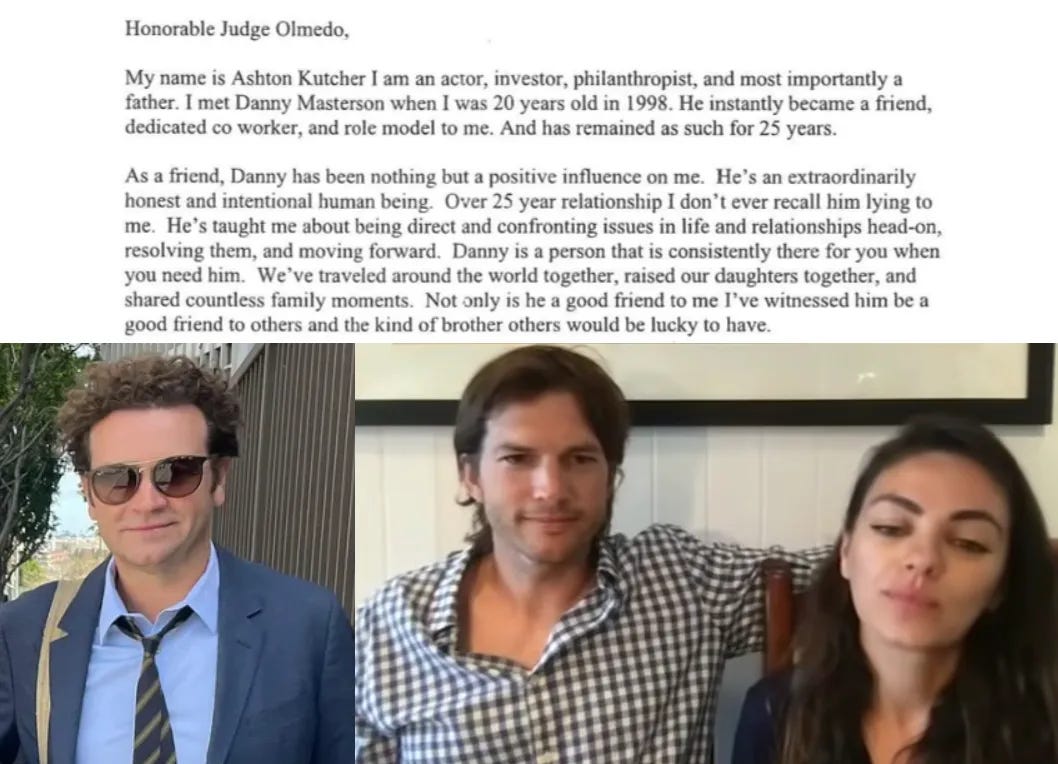
Nearly 50 other people wrote letters for Masterson, including actor Giovanni Ribisi, That ‘70s Show and The Ranch director David Trainer and Jim Patterson, creator of the Netflix show The Ranch, from which Masterson was fired after his indictment in 2020. None is as famous as Kunis and Kutcher, who both described Masterson’s positive influence on their lives.
Kutcher ended his letter, “While I’m aware that the judgement has been cast as guilty on two counts of rape by force and the victims have a great desire for justice. I hope that my testament to his character is taken into consideration in sentencing. I do not believe he is an ongoing harm to society and having his daughter raised without a present father would [be] a tertiary injustice in and of itself. Thank you for taking the time to read this.”
The public backlash extended beyond the Internet: On Sept. 15, Kutcher resigned as chairman of the board of the anti-child sex abuse organization Thorn, which he founded in 2009 with his then-wife, actress Demi Moore.
“After my wife and I spent several days of listening, personal reflection, learning, and conversations with survivors and the employees and leadership at Thorn, I have determined the responsible thing for me to do is resign as Chairman of the Board, effectively immediately,” Kutcher said in a written statement. “I cannot allow my error in judgment to distract from our efforts and the children we serve.”
It’s not a new concept. Similar conduct regularly brings vastly different media coverage based on the anonymity or fame of those involved. Kutcher’s involvement with Thorn also brought hypocrisy into the story. But some say the fallout from his and Kunis’ letters demonstrates a growing disconnect between the legal system and popular opinion, fueled in part by sparse coverage of criminal cases beyond those involving national celebrities.
“You’re allowed to voice support for your friends without it being some attack on victims,” Michael Freedman, a Los Angeles criminal defense attorney and former federal prosecutor, told Legal Affairs and Trials. “They’re not even standing up for him, really. They’re just being friends and sharing their view of his character, which they have experience with.”
Amber Powell, an assistant professor of sociology and criminology at the University of Iowa, said people are less outraged by the fact that Kutcher and Kunis wrote letters and “more outraged about the tone-deafness of the letters.”
Kutcher “was very tone deaf to the fact that [Masterson] had been convicted of a serious crime,” Powell said in an interview with Legal Affairs and Trials.
“Ashton was like, ‘He helped me not get into drugs,’ and it’s like, ‘You’re not mentioning the fact that this person was accused of some pretty heinous acts’” involving drugging women, Powell said.
Louis Shapiro, a Los Angeles criminal defense attorney and former prosecutor, said letters aren’t intended to address the facts of a case. Rather, they’re intended “to show the judge that this person has a lot more to their life than just this incident that they’ve been presiding over.”
“Just because you write a letter of support for the defendant doesn’t mean it’s your stamp of approval for what they’ve done,” Shapiro told Legal Affairs and Trials.
For Kutcher and Kunis “to be taken to task for writing a letter in support of the defendant is not fair,” Shapiro said. “You’re allowed to show support for a defendant and at the same time have sympathy for the victim. One doesn’t override the other and one isn’t to the exclusion of the other.”
‘This is an everyday occurrence’
Comedian Kathy Griffin denounced Kutcher’s and Kunis’ letters for Masterson and compared them to her own efforts to have her brother arrested for sexually assaulting people who lived in an apartment building he managed in Los Angeles.
“Blood was not thicker than water in my case,” she said. “It was a horrible, horrible thing, and I tried to get him caught. Now, this was my brother, so I don’t want to hear about Ashton and Mila and Giovanni Ribisi and people that feel like they had to stick up for Danny Masterson because he was their ‘bro,’ he was their buddy. This was my own brother.”
The relationship between criminal defendants and their friends and family generally is more complex.
Unabomber Ted Kaczynski’s brother, David Kaczynski, was instrumental in his 1996 arrest, but he famously became a staunch anti-death penalty advocate who worked with his brother’s lawyers to spare him from Death Row for the mail bombings that killed three people and injured 23 others between 1978 and 1995.
And every day across the country, family and friends of criminal defendants charged with everything from shoplifting to rape and murder write letters to judges about their own experiences and impressions of the person. Some are unabashed calls for leniency. Others are more circumspect and ask the judge only to consider the totality of the person, not just their crimes. Letters in sex crimes cases often evoke more complex emotions amid frequently overlapping relationships between victims, perpetrators and their friends and families.
“This is an everyday occurrence in a lot of sexual assault cases. People are writing letters on behalf of these folks, and it’s not getting a lot of attention,” said Powell, whose research areas include crime, law and social control. “In the cases I’ve seen, there’s a sense of loyalty that they want to show that person, or they feel that person was unfairly treated, or they don’t believe the victims.”
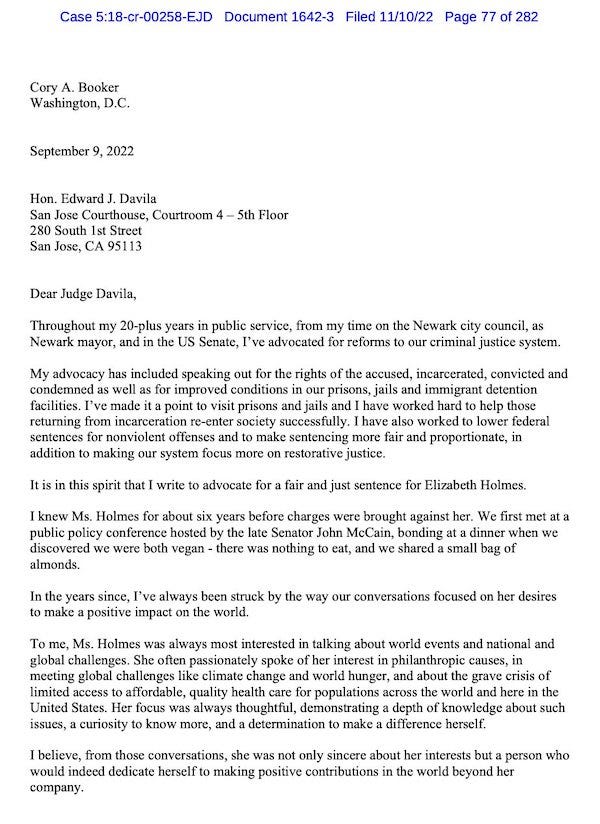
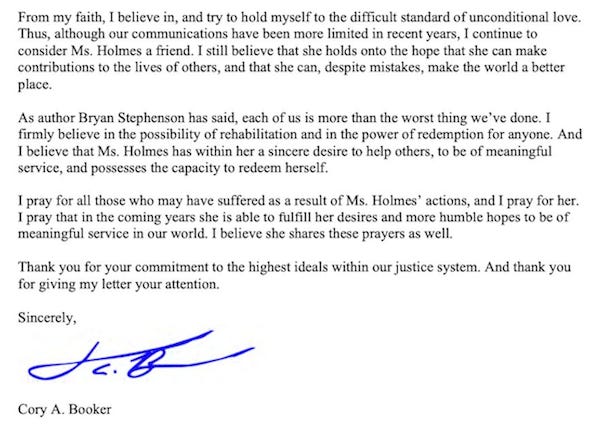
One of the most publicized sentencing letters in recent memory is a letter prominent U.S. Senator Cory Booker wrote to the judge who in November 2022 sentenced Theranos, Inc., founder Elizabeth Holmes to 11 years and three months in prison for defrauding investors. The New Jersey Democrat said he met Holmes at a public policy conference hosted by the late-Arizona Republican Senator John McCain, “bonding at a dinner when we discovered we were both vegan — there was nothing to eat, and we shared a small bag of almonds.”
“In the years since, I’ve always been struck by the way our conversations focused on her desires to make a positive impact on the world,” Booker wrote. “From my faith, I believe in, and try to hold myself to the difficult standard of unconditional love. Thus, although our communications have been more limited in recent years, I continue to consider Ms. Holmes a friend. I still believe that she holds onto the hope that she can make contributions to the lives of others, and that she can, despite mistakes, make the world a better place.”
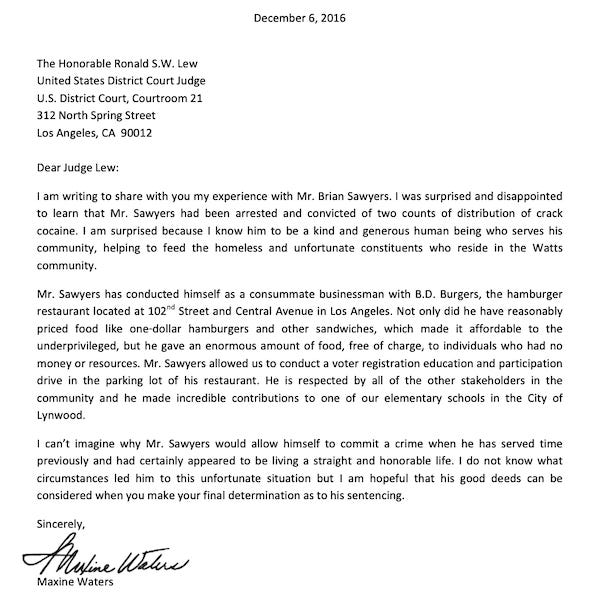
In 2016, U.S. Rep. Maxine Waters wrote a letter in support of Los Angeles hamburger restaurant owner Brian Sawyers after he was convicted of selling crack cocaine to an undercover informant, saying she was “surprised and disappointed” that a jury had convicted and writing of his generosity through his “reasonable priced food” and give aways.
“I do not know what circumstances led him to this unfortunate situation but I am hopeful that his good deeds can be considered,” according to the letter, which was first reported by the Los Angeles Times.
After a Los Angeles federal jury convicted U.S. Rep. Jeff Fortenberry, R-Nebraska, of lying to federal agents about illegal campaign contributions, U.S. Rep. Anna Eshoo, D-California, was among 64 people who wrote support letters for him at sentencing.
So was Nebraska Lt. Gov. Mike Foley, now the state auditor, who called Fortenberry “a man of the highest integrity” and asked U.S. District Judge Stanley Blumenfeld Jr., to show “leniency as you consider an appropriate sentence.”


At a hearing in June 2022, Blumenfeld said the support letters helped establish that Fortenberry “is a good and honest man.” The judge sentenced Fortenberry to two years probation instead of the six months in prison that prosecutors recommended.
Dan Wagner, a criminal defense attorney with Simmons Wagner, LLP in Irvine and former Orange County prosecutor, said defendants submit letters in “just about every contested sentencing, the defense is gong to want to bring mitigation in, and very commonly that’s going to be character evidence and letters of recommendation,” Wagner told Legal Affairs and Trials.
Do support letters matter to judges?
The letters are traditionally known not as support letters but character reference letters because they’re intended to give judges a full picture of a defendant’s character.
Judges aren’t required to place a specific amount of emphasis on them. But a defendant’s background is widely considered crucial to determining a fair sentence, exemplified by an oft-cited quote from Senior U.S. District Judge Jed Rakoff in the Southern District of New York in a 2006 sentencing decision: “But, surely, if ever a man is to receive credit for the good he has done, and his immediate misconduct assessed in the context of his overall life hitherto, it should be at the moment of his sentencing, when his very future hangs in the balance.”
The specifics of how judges factor good conduct can remain mysterious even after a purported explanation: In July, a real estate developer who bribed a Los Angeles city councilman submitted approximately 25 support letters that U.S. District Judge John F. Walter said provided “an extensive picture of his true nature and character.”
“I agree with his wife’s stated observation that defendant is a good man who made a huge mistake,” Judge Walter said at the July 21 sentencing, adding that “this factor weighs heavily in defendant’s favor.” But, calling public corruption “an insidious and infectious crime,” the judge then sentenced the developer, 58-year-old Dae “David” Yong Lee, to six years in prison, one year less than prosecutors recommended but nearly three times the defense’s 18-month recommendation.
When rapper Tory Lanez was sentenced in August for shooting Megan Thee Stallion, Los Angeles County Superior Court Judge David Herriford said it was “difficult to reconcile the talented, industrious, philanthropic individual described in the many letters of recommendation submitted and the testimonials presented on his behalf by his friends, family, co-workers and acquaintances with the individual convicted in this case whose conduct [prosecutors] just described.”
Herriford then sentenced Lanez to 10 years in prison, three short of prosecutors’ recommendation but far beyond Lanez’s request for probation or a three-year sentence.
“I think the short answer is they do matter,” Freedman, a licensed attorney in California since 2011, told Legal Affairs and Trials. “Even a judge who is tough or against you or is going to hammer you, they generally feel that sentencing is like the hardest part of their job or the most weighty. They take it very seriously. … I think it’s very important to have that holistic sense in there.”
Letters from friends, family and associates can be crucial to mitigating the criminal behavior that judges learn about in detail prior to sentencing.
“Some judges give more weight to them than others. Some judges don’t even reference them at sentencing. Some judges go all out and quote from them,” said Shapiro, a licensed California attorney since 2006.
Freedman has a letter-writing guide he sends clients and their families. He and Shapiro both said they don’t want letters that argue innocence or question the system, nor do they submit letters that discuss the facts of the case.
In Masterson’s case, the two women he was convicted of raping testified that he gave them a drink that made them feel strange before they were attacked. Kutcher’s and Kunis’ letters both described Masterson as vehemently anti-drug, but neither directly discussed the drugging allegations involved in the rapes.
Some equate that with denying the facts of the case. Shapiro disagrees, saying letters often describe personal experiences that may not support the facts of the case but, he believes, do not equate to discussing the actual case.
Scott Simmons, Wagner’s partner at Simmons Wagner, LLP and another former Orange County prosecutor, told Legal Affairs and Trials that a client convicted of assaulting his girlfriend may seek letters from previous girlfriends that say he never assaulted them, which he would consider good mitigating evidence at sentencing and want the judge to see.
Shapiro agreed.
“They are used to show that the defendant doesn’t have a pattern of this type of conduct, which make the instant offense appear to be a one-off one,” Shapiro said.
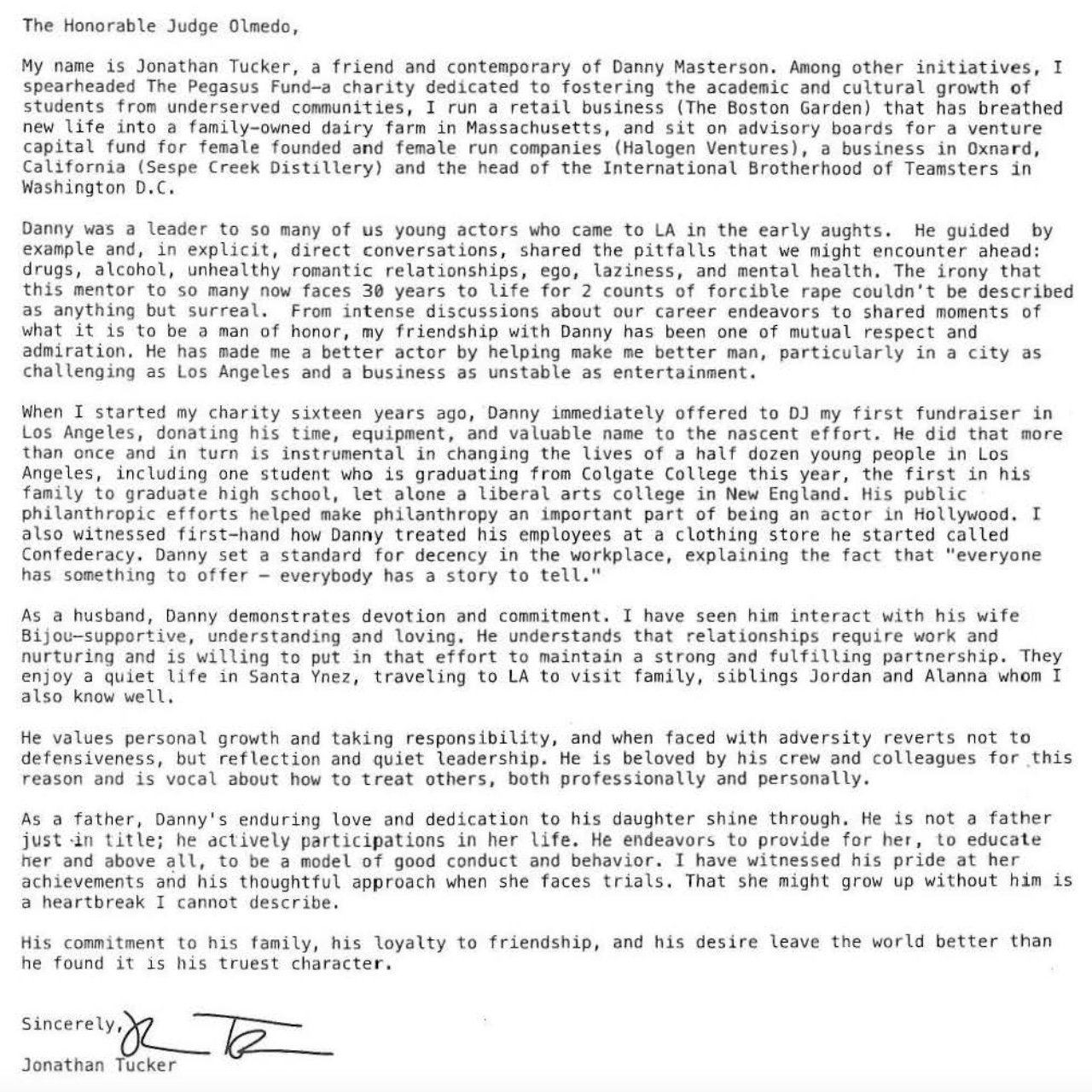
A support letter for Masterson from actor Jonathan Tucker highlighted that point.
“The irony that this mentor to so many now faces 30 years to life for 2 counts of forcible rape couldn’t be described as anything but surreal,” Tucker wrote.
The Los Angeles County probation officer who reviewed Masterson’s case said in a report that “all of the letters provide insight into the defendant’s good character, charity work and his love for his family and friends.”
But the letters didn’t change the officer’s recommendation that Masterson was not a good candidate for probation. They also didn’t appear to have much effect on Los Angeles County Superior Court Judge Charlaine F. Olmedo, who sentenced Masterson to 30 years to life in prison after telling him, “Mr. Masterson, you are not the victim here. Your actions 20 years ago took away another person’s voice and choice. Your actions 20 years ago were criminal, and that is why you are here.”
‘I was told this was for a judge only’
Though widely considered public record, character reference letters often are written with only the judge in mind, and some writers may not realize their words could be read by others.
After news spread of rapper Iggy Azalea’s letter to the judge who sentenced Lanez for shooting Megan Thee Stallion, Azalea wrote on social media that she didn’t believe her letter would be publicly available.
“I was told this was for a judge only, yet it’s being discussed in public? I never intended to publicly comment,” she said in a post on X, formerly known as Twitter.
She may not have realized the extent of the publicization.
At that point, Azalea’s letter had been referenced in court but not disseminated publicly. Her since-deleted X post appeared to minimize her support for Lanez, while her full letter showed a more adoring tone when it was released the next day.


Though Kutcher and Kunis didn’t outright say they thought their letters would be private, the couple said nearly as much in a video posted on Instagram as fury spread last month.
“The letters were not written to question the legitimacy of the judicial system or the validity of the jury’s ruling,” Kunis said.
Kutcher added: “They were intended for the judge to read and not to undermine the testimony of the victims or re-traumatize them in any way. We would never want to do that. And we’re sorry if that has taken place.”
Shapiro worries the intense backlash Kutcher and Kunis experienced will deter people from writing letters for other criminal defendants.
“It causes a chilling effect in other cases,” he said.
One of Masterson’s supporters already acknowledged his trepidation in his letter.
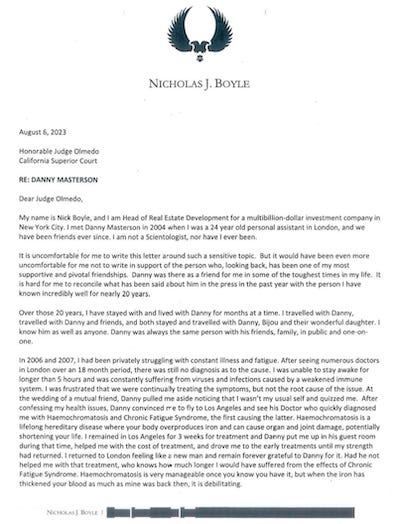
“It is uncomfortable for me to write this letter around such a sensitive topic,” wrote Nicholas J. Boyle, a real estate developer in New York City. “But it would have been even more uncomfortable for me not to write in support of the person who, looking back, has been one of my most supportive and pivotable friendships.”
Child porn convict’s letters show family rift
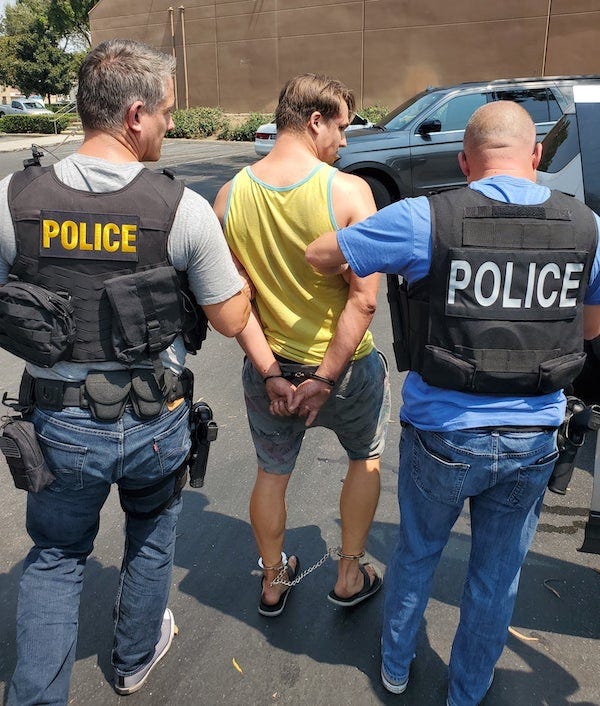
The complex dynamics of sentencing support letters also are exemplified in the case of Matthew Miechkowski, the man sentenced in July for possessing child pornography and using the Kik social media and TextFree instant messaging services to try to solicit a minor for sex.
Now 34, Miechkowski was arrested outside a Del Taco in Riverside, California, on Oct. 21, 2020, after arranging to meet a 12-year-old girl named Destiny for sex who turned out to be an undercover investigator with the Riverside County District Attorney’s Office. Miechkowski brought a bag of Skittles and a Cherry Coke with him to the Del Taco meeting place as the undercover investigator requested.
Detectives found 71 photos and 550 videos of children being sexually abused in Miechkowski’s Kik account that he’d downloaded from the Internet, according to his plea agreement. He admitted that one video found on his phone was of a 15-year-old girl he’d conversed with on the Internet in 2019 and directed to send him pornographic videos of herself.
Miechkowski originally faced state charges and the possibility of only probation, according to his defense sentencing memo, but he refused to plead guilty and his case moved to federal court, where he faced decades in prison.
Miechkowski’s support letters made a difference. The prosecutor cited his “close family and support” when recommending a reduced prison sentence of 15 years instead of the 27 to nearly 36 he faced under U.S. Sentencing Guidelines.
U.S. District Judge R. Gary Klausner told Miechkowski he could “understand” the reduction “because of your background” but said it shouldn’t be seen “as being acceptance for what you’ve done, because you destroyed the lives” of the 11 victims whose recorded child sexual abuse he watched. In addition to serving 180 months in prison, Klausner ordered Miechkowski to pay each victim $3,000 in restitution. He’ll be on supervised release for the rest of his life after he leaves prison.
The victims or their parents submitted written statements to Klausner received written statements from the children whose abuse Miechkowski watched, including one in which the now-adult victim said she’s “afraid that pedophiles who look at the images of my abuse could try to find me and hurt me or my family.”
“As a child I didn’t have a choice what happened to me. Now, I have to suffer twice; the first time was being abused and the second time is the ongoing anxiety due to the images of my abuse forever being accessible,” the victim wrote.
One victim’s mother wrote, “Every time these pictures of my daughter are looked at and passed around, the depraved people doing this are furthering my daughter’s pain, shame and abuse.”


Miechkowski acknowledged the victims in his allocution, telling Judge Klausner during his July 10 sentencing, “I feel absolutely horrible and disgusted with myself for committing the crimes that I did, and I think about all these children I saw being abused, and it makes me sick to think about how many there are out there in the world,” according to a court report’s transcript.
In his character reference letters, none of Miechkowski’s supporters mentioned the victims in the child pornography he possessed. Some acknowledged his crimes while others didn’t mention them.
His godmother was among the latter, instead recalling Miechkowski’s love of pets and his participation in family gatherings, telling the judge, “The highlight of one birthday party was an aunt’s gift to him of skydiving from a small airplane! At his sister’s wedding, he escorted his two grandmothers down the aisle.” She also wrote that she “recently found the hand-painted wooden sign, ‘Lemonade!’ Miechkowski and his cousins made as children during a summer family vacation.
Miechkowski’s aunt, meanwhile, said his counselor “has helped him examine his past actions, motives, and analyze why he went down that dead end.”
She likened her nephew’s criminal convictions to situations she’s seen while volunteering “two days a week with Special Needs Young Adults.”
“Working with these 20-something individuals with Autism and Downs Syndrome has made me slow down the wrong path at times and needs to be nudged back to a more productive trajectory,” she wrote. She said Miechkowski can live with her when he’s released from prison.
“I live 30 minutes from an Ivy League college (Cornell University) that has many employment opportunities. I have helped other young adults get jobs in the dining hall and horse barn and as groundskeepers. A bonus is that they can take one college course for free for every year they are employed,” she wrote.
Miechkowski’s uncle, a lawyer in Greenwich, Connecticut, wrote about coaching him in youth basketball and seeing him accept a referee’s decision, even though he disagreed with it. When he learned of his nephew’s arrest “my first thought was that there had to be some mistake.”
“The Matthew I knew could not be involved with the serious offenses for which he was charged,” Miechkowski’s uncle wrote. “I have since learned that in fact he did entice a minor to engage in sexual activity and create sexually explicit videos in violation of the Federal Penal Code to which he has pleaded guilty. Since incarceration, he has taken responsibly for and expressed remorse for what he has done. Through therapy and self reflection, I firmly believe that Matthew can be a positive member of society.”


Miechkowski’s sister has a harsher assessment of her brother that she said has driven her apart from her family. She told the judge in a six-page letter, “Reasonable people can disagree on how to handle a situation like this one, which is a sentiment I’ve attempted to convey to my family, but have been met with disdain and dismissal.”
“They have even characterized my difference of opinion as ‘cutting Matthew off’ and ‘not supporting him’ to our extended family members, all but solidifying my alienation from them. Their reaction to my difference of opinion characterizes the very theme that, in my view, has paved the way to where Matthew sits now,” she wrote.
Still, Miechkowski’s sister told the judge her brother is redeemable and “more than capable of honesty and change,” and she said she’s offered to let him live near her when he’s released from prison. But she also emphasized she wasn’t “offering an argument for more or less time in prison.”
One passage captures what Shapiro and Freedman said is the essence of character reference letters:
“Please understand when I describe the precipitous events and my view of the mitigating factors leading up to Matthew’s bad choices, I am not implying that he is not responsible for his actions. On the contrary, I might be the only one in our family who has fully comprehended the seriousness of his actions and the many years it will take him to set his life in order. Notwithstanding that the burden of responsibility falls exclusively on Matthew, it is important to hear all perspectives as to how he got here.”


Thank you for supporting my independent legal affairs journalism. Your paid subscriptions enable me to go in-depth and unfiltered on major issues that regular news organizations don’t cover. If you’re not already a paid subscriber, please consider purchasing a subscription. Paid subscribers have access to the full archives and my eternal gratitude.
Thank you for this broader context, it’s definitely helpful to understand their purpose and how they’re referenced across multiple cases. In seeing the outcry over the recent, highly publicized letters, I think it’s important for us to continue to talk about what’s so upsetting to people about this. I think most people commenting like to imagine themselves as more aligned with Miechkowski’s sister’s position if they’re feeling generous, or Kathy Griffin’s position to communicate how reprehensible they see the actions of those accused/convicted in these cases. On the one hand, people need supportive relationships as part of their rehabilitation and accountability process. But there is all too often a line crossed into enabling reprehensible behavior that happens in these types of cases. That enabling is felt most intensely by survivors of sex crimes or other forms of abuse. I think once we figure out how to better support survivors and hold perpetrators accountable then many of these discussions about the letters themselves will be more productive. I was disappointed by Ashton and Mila’s letters but I understand that Masterson needed someone to write them for the judge to consider. So it’s extremely complicated. Especially as a therapist in a domestic violence program where I hear often about how support for abusers is felt intensely as betrayal and re-traumatizing to survivors in light of all they’ve suffered. That’s what stood out for me with Iggy Azalea and Stefflon Don’s letters. I know they are both keenly aware of how rampant abuse of women is in the music industry, and hip hop specifically (Iggy’s alleged abuser was Playboi Carti). In short, it’s complicated. I know it has to get done but I hope that the people writing these letters are not enabling their loved one’s bad behavior or ousting victims in the process. Hope all that makes sense and thank you again for continuing to educate us about how the legal system works in all kinds of cases. Your work is much appreciated 🙏🏾
I read the article with an open mind, and here’s my opinion. You seem to be equating Masterson’s case, convicted by a jury of two counts of forcible rape, with the case of two men who at least somewhat accepted responsibility for their horrible crimes by pleading guilty, which Masterson has never done. You also seem to be equating this with other individuals found guilty of things like white collar crimes, drug possession, perjury, and bribery.
Those latter crimes I don’t think can even begin to equate with the crimes of someone who took all of the premeditated steps necessary to drug and violate his victims in the most personal way imaginable, which, from my understanding, causes a degree of damage that none of us who have never been sexually assaulted (not to mention being blamed, silenced, harassed, stalked, and Fair Gamed by Scientology) can even begin to fully comprehend. Writing a character letter for a convicted perjurer vs a convicted serial forcible rapist are two completely different things.
The Iggy Azalea letter you referenced is the only one that can even be slightly comparable, and even that might be a bit of a stretch, since, from my understanding (admittedly limited), his attack was not premeditated to that extent and there were not multiple victims over a number of years, and thus, there is no pattern of criminal behavior that was established here. That doesn’t make Lanez’s crime any less horrible, and he deserved to be sent to prison for his vicious attack, but it’s not fair to compare writing a character letter for him to a character letter for someone like Masterson, in either direction.
You also reference character letters from some of the family members of these other individuals. As it relates to Masterson, it is no shock at all to me personally that his mother and siblings and now estranged wife would write letters on behalf of their family member. In fact, it would be a shock if they didn’t write those letters. That’s another unfair comparison you’re making as it relates to Ashton and Mila doing so.
What is so different about the Ashton and Mila letters is that, before writing these letters extolling his "virtuous character", Masterson was already convicted of multiple counts of a horrible crime, along with what many consider to be credible allegations of other similar attacks on other women in the same manner whose attacks were not charged in this trial. Ashton and Mila were also very close friends of Masterson (Ashton in particular) during the time most of these attacks took place and they even knew some of his victims personally, and yet they still wrote these letters after he had been found guilty.
Also, Masterson has yet to accept responsibility for his actions (which I assume might also be a bit retraumatizing for these women, but I nor anyone else can or should speak for them). All of that, along with the fact that Ashton and Mila have claimed that they support victims of sexual assault, which shows their gross hypocrisy, seems to indicate that they don’t truly believe any of these multiple attacks from their convicted friend actually took place.
That was pretty evident to me and many others with their sham of an apology video. When you use words like “if” after an apology (“we apologize if that [people thinking that we may be questioning the validity of the victims] has taken place”), that makes it very insincere and only blames the person you’re attempting to apologize to for "taking it the wrong way". In essence, it negates any attempt at sincerity in their apology, because what they’re basically saying is that it’s YOUR fault if you’re upset about what they did, not theirs.
There have also been allegations made of the sort where it seems very plausible, perhaps even likely, that Ashton may have known full well what his BFF was doing back then. That makes these letters, and Ashton’s letter in particular, even more damning.
People (including Ashton and Mila) have every right to write letters on behalf of defendants (such as Masterson) during sentencing. Judges have every right to take those into consideration in any way they see fit, at their discretion. However, people on the outside looking in (including those of us who you might consider to be less intelligent as it relates to the criminal justice system) also have every right to make their opinions known about these letters.
This article seems to be trying to tell everyone that we shouldn’t be upset about Ashton and Mila writing those character letters. That admonition also seems to extend to Masterson’s victims. I don’t think it’s appropriate for any of us to tell victims of sexual assault and extreme harassment from Scientology, even if you’re doing so indirectly, how/what they should or shouldn’t feel, act, say, think, or do.
Those are just my (rather lengthy) thoughts.