
9th Circuit’s mid-trial intervention prompts judge to vacate ruling on alleged sex trafficking victims
U.S. District Judge Fernando Olguin was going to allow lawyers for a woman accused of sex trafficking to question the alleged victims about their arrests for prostitution.


The 9th Circuit U.S. Court of Appeals recently intervened in a criminal sex trafficking trial underway in Los Angeles federal court, resulting in the judge reversing a key ruling about the relevance of the alleged victims’ prostitution arrests.
The rare mid-trial appellate involvement addressed an issue that’s long been a source of contention in the case: Last year, the originally assigned judge declared a mistrial on the second day of trial after telling the lead defense attorney he no longer trusts anything she says.
U.S. District Otis D. Wright II’s self-recusal followed other clashes with public defender Callie Steele over her push to question her client’s alleged victims about their backgrounds as sex workers. Wright was skeptical of Steele’s request, asking, “Are we the only ones who have never prostituted ourselves?” before eventually telling her to sit down and saying, “I already have marshals. Push me.”
But the request fared better with U.S. District Judge Fernando M. Olguin, who got the case after Wright.
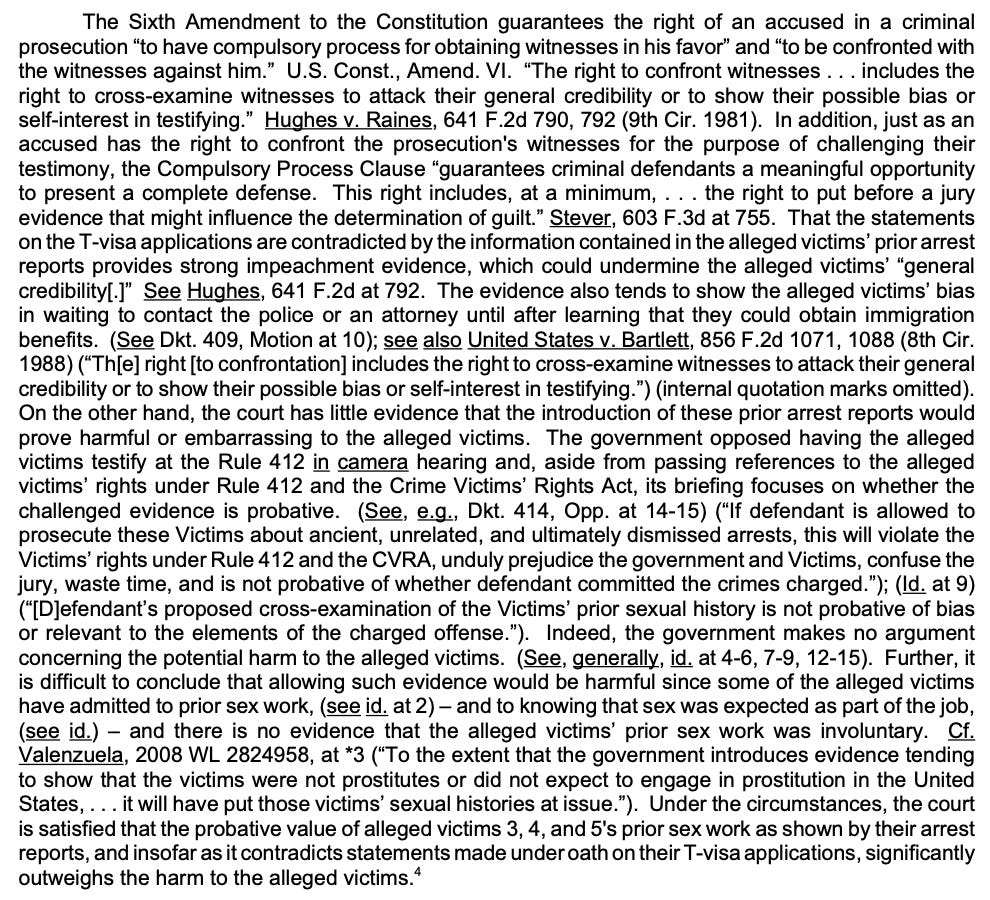
In a May 23 order, Olguin permitted Steele and her co-counsel, Neha Christerna, to question victims about their “prior sex work” through their arrest reports, saying prosecutors made “no argument concerning the potential harm to the alleged victims.”
“Further, it is difficult to conclude that allowing such evidence would be harmful since some of the alleged victims have admitted to prior sex work — and to knowing that sex was expected as part of the job — and there is no evidence that the alleged victims’ prior sex work was involuntary,” according to Olguin’s order. Olguin was a U.S. magistrate judge for 11 years before President Barack Obama appointed him to a lifetime judgeship in 2012.
Prior to ruling, Olguin wanted the alleged victims to testify in an “in camera” hearing, which would be sealed from the public. But prosecutors opposed and the judge said it was “unclear” if he could force the testimony.
“Thus, the court is faced with the task of ruling on defendant’s Motion without the benefit of the alleged victims’ testimony, even though such questioning may be essential to protecting defendant’s rights under the Confrontation Clause and right to present a defense under the Compulsory Process Clause,” Olguin wrote in his May 23 order.
With trial scheduled to begin that day, lawyers for the alleged victims took the rare step of asking the 9th Circuit for an emergency intervention.
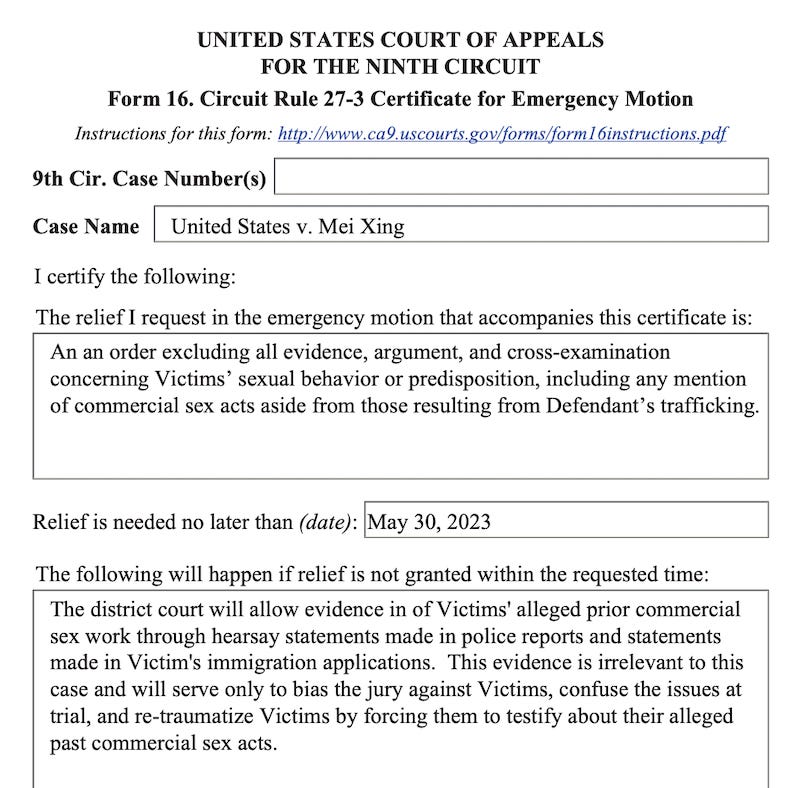
“The district court will allow evidence in of Victims’ alleged prior commercial sex work through hearsay statements made in police reports and statements made in Victim’s immigration applications. This evidence is irrelevant to this case and will serve only to bias the jury against Victims, confuse the issues at trial, and re-traumatize Victims by forcing them to testify about their alleged past commercial sex acts,” according to a May 25 emergency motion from Cassidy T. Young, an associate at K&L Gates LLP who’s working with associate Kevin G. Sullivan and Stephanie Richard of Loyola Law School
Judge asks for deadline extension, then vacates order
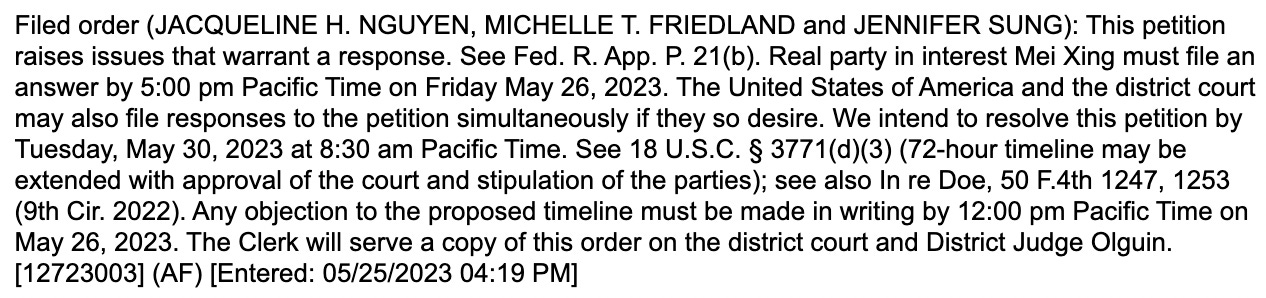
Less than three hours after Young filed the motion, the 9th Circuit declared: “This petition raises issues that warrant a response.”
Judges Jacqueline H. Nguyen, Michelle T. Friedland and Jennifer Sung ordered the defendant, Mei Xing, to respond by 5 p.m. on May 26. They said prosecutors and Judge Olguin “may also file responses to the petition simultaneously if they so desire a three-judge panel issued an order.”
“We intend to resolve this petition by Tuesday, May 30, 2023 at 8:30 am Pacific Time,” the judges said.
They didn’t do so.
Instead, Olguin vacated his order. But first, he asked for more time to decide what to do.
“The Petition was not served on the court and the undersigned only received a copy of the Petition and the Excerpts of Record this morning at approximately 9:30 a.m.,” the judge wrote to the 9th Circuit on Friday. “Given the press of business and the undersigned’s schedule, the undersigned cannot determine whether a response to the Petition is warranted by the deadline set by the Court.”
The appellate court agreed to give Olguin until Monday at noon to respond.
Olguin filed his response Monday at 11:26 a.m. It’s sealed, but the docket entry for the filing in the U.S. District Court file says it includes an “order vacating court’s order re: amended Rule 412 motion.”
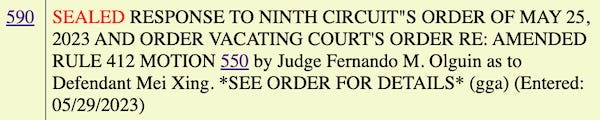
That’s the order that allowed the defense to question the alleged victims about their sexual histories.
UPDATE: Despite Olguin vacating his order, the 9th Circuit still issued a ruling Tuesday at 5:33 p.m., but it’s sealed.

Rule 412 of the Federal Rules of Evidence prohibits “evidence offered to prove that a victim engaged in other sexual behavior” and “evidence offered to prove a victim’s sexual predisposition.” But it also allows for exceptions, including if the evidence is offered to prove consent or prove someone other than the defendant is responsible for a sex crime.
Steele and Christerna said police reports about the alleged victims’ arrests for prostitution include statements that contradict statements made under oath in immigration documents. Part of their defense for Xing is that the women are lying to incriminate Xing in exchange for immigration visas from the government.
Olguin’s May 23 order stood by his previous rulings that prohibit “introducing evidence of any alleged victim’s post-arrest sexual behavior or any alleged victim’s sexual behavior before encountering defendant.” But he allowed Steele and Christerna to “attempt to introduce the arrest reports” regarding the prosecution arrests “in order to contradict statements made under oath on their T-visa applications and to show the alleged victims’ bias.”
The emergency motion filed with the 9th sought, “An order excluding all evidence, argument, and cross-examination concerning Victims’ sexual behavior or predisposition, including any mention of commercial sex acts aside from those resulting from Defendant’s trafficking.”
All other filings are sealed, including Olguin’s decision to vacate his order.
Alleged victim testifies through Mandarin translator
The trial reconvened Tuesday morning with continued testimony from an alleged victim. Two Mandarin Chinese language interpreters rotated as translators, and the testimony was very slow and often interrupted by translation questions or clarifications. The alleged victim who was on the stand testified in direct-examination that she was raped while working in what Assistant U.S. Attorney Scott Lara called “commercial sex work.”
“Did Mei Xing pay you?” asked Lara, who is prosecuting the case with Assistant U.S. Attorney Damaris Diaz.
“Yes,” the woman said through a translator.
“How much?” Lara asked.
“$80,” the woman answered through the translator.
“Was the $80 worth it?” Lara asked
“Not worth it,” she said through a translator. She said she feared Xing because she knew where her family lived and knew people involved in organized crime and law enforcement or “black and white.”
Lara asked if she felt safe because Xing had surveillance cameras at the parlors. She answered no “because we lived out our lives under surveillance. We did not have any privacy.” She said Xing forced her to service abusive customers and would get angry with her if they complained about her.
In cross-examination, the woman, who is 46, confirmed she previously worked as a masseuse and that her husband is U.S. citizen whom she met in China in 2003.
Christerna asked if he was married at the time, but Olguin sustained Lara’s objection for relevance and cumulative under Rule 403 of the Federal Rules of Evidence. Olguin, however, overruled Lara’s objection when Christerna asked if her husband is 26 years older than her.
“25, to be exact,” she answered.
Alias Anna or Boss, 62-year-old Xing has been in custody since her arrest nearly three years ago. She’s charged with five counts of sex trafficking by force, fraud or coercion involving five women who are Chinese nationals.
Xing is a U.S. citizen who was born in China. Prosecutors say she owned and operated several massage parlors; the woman who testified said she worked in parlors at 2821 Peck Road in El Monte and 9661 Garvey Avenue in South El Monte. A complaint filed in 2020 said Xing identified one of the regular patrons as a police officer and told the women he warned her of possible law enforcement investigations.
‘I lost the ability to trust the honesty of defense counsel’
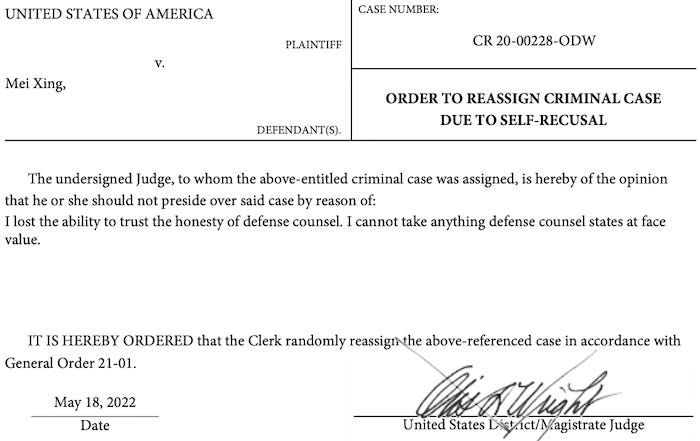
The trial began May 24, about one year after Wright’s mistrial and recusal drew broad attention.
Wright’s self-recusal was documented in a standard trial minute form as well as a separate May 18 docket order that said, “I lost the ability to trust the honesty of defense counsel. I cannot take anything defense counsel states at face value.”
The case was assigned to Olguin in the same order, but the next day, after his order received widespread attention, Wright went back into the case he was no longer assigned and issued a one-sentence direction: “The Court orders the clerk’s office to seal the image on docket no. 200 immediately,” with 200 being his self-recusal order.
The two-sentence recusal explanation was then wiped from the case file, but it still appears in the Free Law Project’s Courtlistener file.
Wright’s comments were based on Steele’s assertion that jurors could see Xing’s leg shackles under the defense table. She asked for a mistrial over it, but Wright said he doubted the truthfulness of her claims. He granted the mistrial then recused himself in what was essentially a judicial tantrum.
Prior to the shackles dustup, Wright sparred with Steele over her request to question the victims about their previous prostitution work means “anyone else can basically force them into commercial sex and take all of their money.”
When Steele answered, “No, Your Honor,” Wright replied, “So don’t — then don’t you come in and go, but she’s been a prostitute all her life. So what? So what if I take all of her money? So what if I make her have unprotected sex?”
Steele said her point was that the women shouldn’t be allowed to testify that they had no idea they’d be subjected to prostitution when they went into a massage parlor associated with Xing, and that Xing should be able to ask them about this under her 6th Amendment right to confront her accusers.
Wright replied, “Wait a minute. I want to make sure I understand your argument. You’re saying that I need to leave the room and basically let you have carte blanche in terms of your cross examination.”
The judge later said, “It looks like everyone involved on both sides has been in the prostitution game…Are we the only ones who have never prostituted ourselves?”
Wright eventually ordered Steele to sit down and told her “I already have marshals. Push me.”
“I’m not trying to push you, Your Honor, I’m just trying to —” Steele replied, according to the transcript.
“Sit down. Sit down,” Wright interjected.
Steele left the Central District federal defender’s office two months later, after 30 years, to become trial chief of the Santa Barbara County Public Defender’s Office. She stayed on as Xing’s lawyer through the Criminal Justice Act alternate defender panel.
Thank you for supporting my independent legal affairs journalism. Your paid subscriptions enable me to go in-depth and unfiltered on major issues. If you’re not already a paid subscriber, please consider purchasing a subscription for yourself or a gift subscription for someone else. Your support is absolutely essential to my work and will help build www.legalaffairsandtrials.com into a hub for quality journalism about our judiciary.