

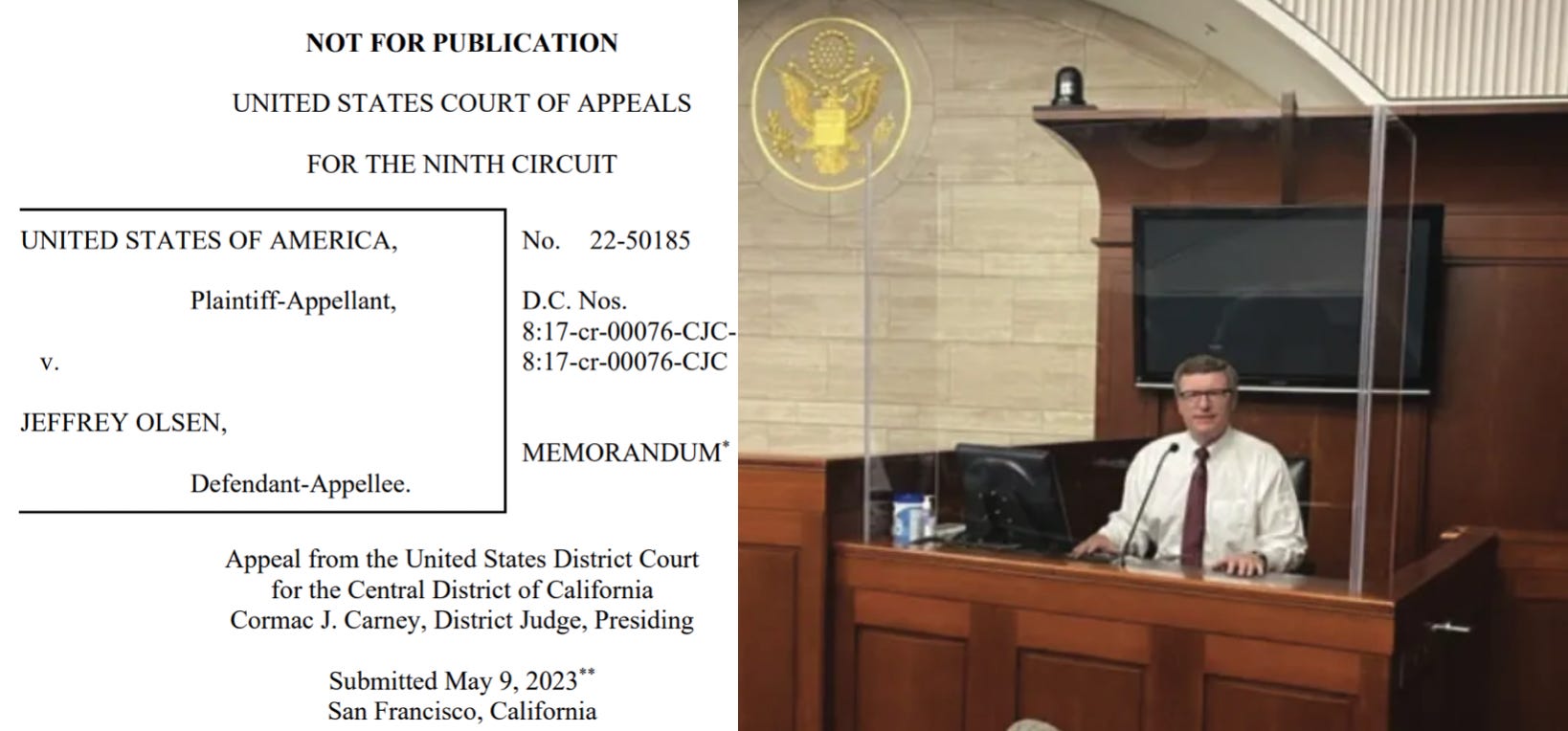
An appellate panel has ordered a California federal judge removed from a seven-year-old criminal case that he twice dismissed while upset with his colleagues for not allowing jury trials during the COVID-19 pandemic.
U.S. District Judge Cormac J. Carney “improperly defied” an appellate order when he dismissed drug charges against a doctor for a second time and criticized the appellate court for “unfairly” characterizing his opinion, the 9th Circuit U.S. Court of Appeals said.
“The district judge’s rhetoric suggests that he would have difficulty in putting aside previously expressed views, and that reassignment would best serve the appearance of justice,” according to a seven-page memorandum.
The May 9 ruling reverses Carney’s June 2022 dismissal of a 34-count indictment against Jeffrey Olsen, a Newport Beach doctor who was released on bond shortly after his July 2017 arrest. Federal prosecutors say Olsen acted as a “drug dealer” who prescribed opioids to addicted patients, four of whom died, but nearly seven years after his indictment, he still holds a medical license and the allegations against him have not been adjudicated.
Judge Carney first dismissed Olsen’s indictment in August 2020 amid his disagreement with other Central District of California judges about their decision to indefinitely halt jury trials. The ban lasted 14 months.
The three-judge 9th Circuit panel that reversed Carney’s first dismissal called his motives “misguided” and ordered him to reinstate the indictment and set the case for trial.
Instead of doing so, the judge dismissed the indictment again in a 62-page order and called the 9th’s analysis “insulting” and “a little hostile.” The order detailed why Carney believes jury trials could have been safely conducted, and it included photos and measurements of rooms in the courthouse as well as a photo of himself sitting on the witness stand in his courtroom.
Prosecutors appealed, and their February 2023 opening brief took the rare step of asking the 9th Circuit to order the Central District’s chief judge to assign a different judge to the case.
“The judge’s decision to ignore this Court’s mandate shows that he cannot put these views out of mind,” the brief said. Prosecutors also implied Carney won’t change his ways if the 9th Circuit allows him to continue with the case: “Reassignment may prevent further waste by ensuring that the district court complies with this Court’s mandate—rather than forcing a third appeal.”
Trial judge reassignments by the appellate courts are exceedingly rare. The late U.S. District Judge Manuel Real in Los Angeles was widely known for how often he’d been ordered off cases, but it rarely happens with other judges.
Olsen’s public defenders said Carney was correct to dismiss the indictment a second time and the case didn’t need to be reassigned.
“Because the government didn’t dispute that the judge could have held a safe jury trial for Olsen in October 2020, the judge had legitimate reasons to question the jury-trial ban,” according to an answering brief from Deputy Federal Public Defender James H. Locklin. “Furthermore, the government unfairly characterizes comments made by the judge, who was respectful of, and faithfully applied, this Court’s opinion.”
In reply, prosecutors said “there is no dispute that the judge referred to this Court’s opinion as both ‘insulting’ and ‘hostile.’”
“Indeed, the judge suggested that this Court had called into question the ‘oath’ that he took ‘to support and defend the Constitution,’” according to the brief from Assistant U.S. Attorney David R. Friedman. “These are not the usual comments of a judge who has been reversed.”
A court clerk filed notice on July 21, 2023, that the same panel that reversed Carney’s first dismissal would consider the appeal: Judges Mary H. Marguia and Morgan B. Christen and U.S. District Judge Barbara M.G. Lynn, sitting by designation from the Northern District of Texas. The notice said oral argument “if any, will be set in due course,” then nothing happened until the panel filed its order last week.
It’s unpublished — which means it does not set precedent — and its reasoning is simple.
In reversing the district court’s 2020 dismissal order, we issued the following mandate: “REVERSED and REMANDED with instructions to reinstate Olsen’s indictment, grant an appropriate ends of justice continuance, and set this case for a trial.” The mandate plainly instructed the district court to “reinstate” the indictment, “grant” a continuance, and “set this case for a trial.” The district court did not comply with any of those directives.
According to a footnote, “Others have plainly understood the implications” of the first order, including another 9th Circuit panel that quoted it when ruling that pandemic-related trial delays do not violate the Speedy Trial Act.
Regarding Carney’s ability to continue with the case, the judges said they’re “mindful that reassignment to another district judge on remand is appropriate ‘only in unusual circumstances or when required to preserve the interests of justice,’” quoting a 2012 9th Circuit opinion.
They considered three factors:
whether the judge “would reasonably be expected upon remand to have substantial difficulty in putting out of his . . . mind previously expressed views or findings determined to be erroneous or based on evidence that must be rejected”
“whether reassignment is advisable to preserve the appearance of justice”
“whether reassignment would entail waste and duplication out of proportion to any gain in preserving appearance of fairness”
“All three factors are met in this case,” according to the order. “The district court’s repeated dismissals of the indictment support reassignment.”
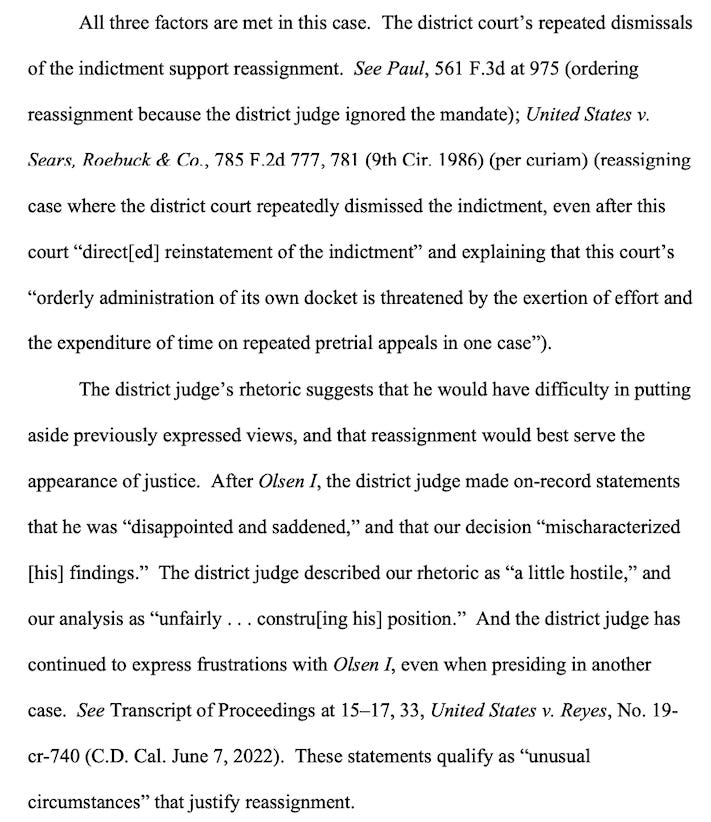
The panel cited Carney’s comments in a drug and immigration case he dismissed because of the COVID-19 trial ban and said his statements “qualify as ‘unusual circumstances’ that justify reassignment.”
The order doesn’t quote him, but the transcript lines cited include Carney saying, “I have no problem being accused of being stubborn, accused of being rigid, or being called wrong. But I don’t -- I want to be called wrong for the right reasons on the right record.”
Carney, a 2003 George W. Bush appointee, is fully retiring from the bench at the end of May. The U.S. Attorney’s Office currently is appealing another controversial decision of his: the dismissal of criminal charges against neo-Nazi leader Robert Paul Rundo because prosecutors targeted him instead of left-wing activists.
Previous coverage:
9th Circuit stays Judge Carney's bail order for Robert Rundo four hours after request

An appellate court on Friday stayed a federal judge’s bail order for neo-Nazi Robert Paul Rundo. A 9th Circuit U.S. Court of Appeals panel issued the order at 2:01 p.m., four hours after prosecutors filed an emergency motion that said Rundo “is …
DOJ asks 9th Circuit to remove judge from doctor’s criminal case, citing broken mandate

A federal judge upset over his colleagues’ decision to prohibit jury trials during the COVID-19 pandemic has twice dismissed a criminal drug distribut…
Thank you for supporting my independent legal affairs journalism. Your paid subscriptions make my work possible. If you’re not already a paid subscriber, please consider purchasing a subscription through Substack. You also can support me through my merchandise store. Thank you!
Now do Aileen Cannon. I practiced in the Central District when Manny Real, may he RIP, was on the bench. What a nightmare. We avoided him at all costs.